
Hemp Cream for Face: How It Works, for Which Skin Type, and Can It Replace Pharmacy Cream
Hemp cream for the face: what has really been demonstrated in studies, how hemp seed oil differs from CBD, for which skin type it makes sense, and when it cannot replace a dermatologist.
Hemp cream has transitioned from a niche product in health food stores to a shelf in every drugstore. Along with it, a handful of numbers that sound like research results but are not have spread through product descriptions. A comedogenic rating of 0 for hemp seed oil, a twenty-week clinical study on atopic dermatitis, CB2 receptors regulating sebum. We checked each of them at the source, reading the works they refer to. The result is mixed. One number turned out to come from a study with a completely different purpose, another has no publication at all, and the mechanism that manufacturers have described for years was measured on a different cellular channel than the labels claim. At the same time, several things have indeed been demonstrated, and it would be a shame to lose them along with the rest. Below you will find what has been measured, what has never been measured, and practical conclusions for your own care.
KEY INFORMATION
• CBD inhibited sebum production in human sebocyte cultures through the TRPV4 ion channel, not through CB2 receptors (Oláh et al., Journal of Clinical Investigation, 2014).
• The twenty-week study cited by the market involved consuming hemp oil, not applying it to the face (Callaway et al., 2005).
• The comedogenic rating of 0-1 for hemp oil has no source in the literature.
• No study has been found involving humans that would test hemp cream on the face.
How Does Hemp Cream Work on the Face?
It depends on what is inside. Under the name hemp cream, there are two different substances: hemp seed oil, which acts as a carrier of fatty acids, and an extract with cannabidiol, which affects the skin’s endocannabinoid system. The former rebuilds the lipid layer. The latter has a documented effect on sebaceous glands, but only in studies conducted outside the body.
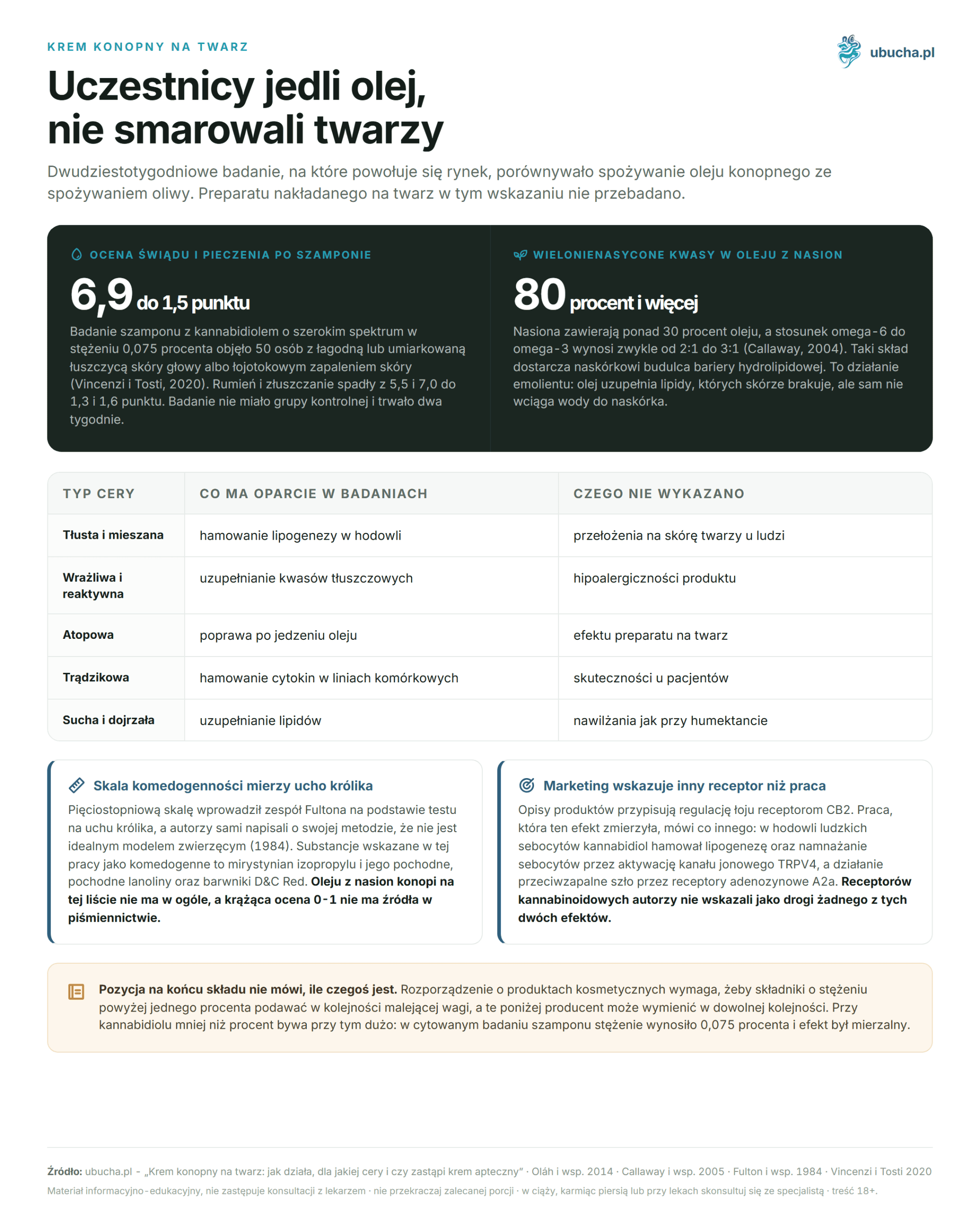
Hemp seed oil is primarily a fat with an unusual profile. The seeds contain over 30 percent oil, and in the oil itself, over 80 percent consists of polyunsaturated fatty acids, with a typical omega-6 to omega-3 ratio of 2:1 to 3:1 (Callaway, Euphytica, 2004). This composition provides the epidermis with building blocks for the hydrolipid barrier. This is the action of an emollient and nothing more: the oil replenishes the lipids that the skin lacks, but it does not draw water into the epidermis.
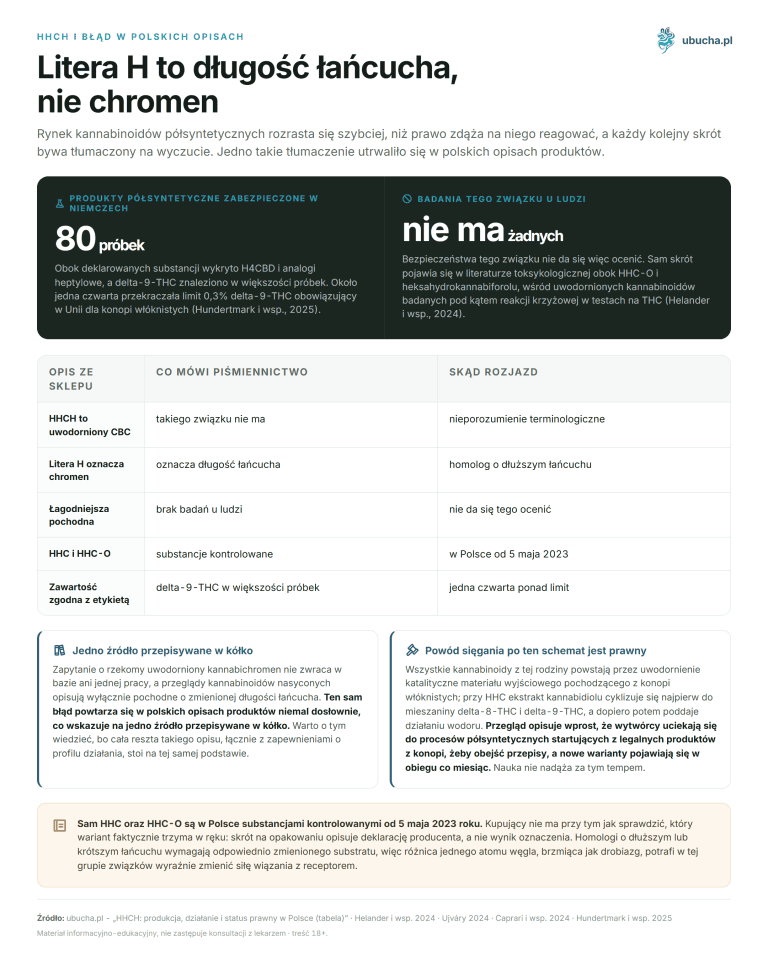
CBD is a different story. A review by Tóth confirms that the skin has its own endocannabinoid system: CB1 and CB2 receptors, ligands, and the enzymatic apparatus are present in the epidermis, and disturbances in this signaling are associated with atopic dermatitis, psoriasis, and acne (Tóth et al., Molecules, 2019). However, this is a review of the state of knowledge, not proof that a specific cream changes anything.
The most frequently repeated description of the mechanism is, however, reversed. Marketing attributes sebum regulation to CB2 receptors. The work that measured this effect says otherwise: in human sebocyte cultures and in organotypic skin cultures, CBD inhibited lipogenesis and sebocyte proliferation by activating the ion channel TRPV4, and the anti-inflammatory action went through adenosine A2a receptors and inhibition of the NF-kB pathway (Oláh et al., Journal of Clinical Investigation, 2014). The authors did not indicate cannabinoid receptors as the pathway for either of these two effects. And a more important point than the name of the channel: these were cells in a dish and a skin sample, not people applying cream to their faces.
What Is the Difference Between Hemp Cream and CBD Cream?
It differs in the active ingredient, price, and what can be said about it. Hemp cream is usually based on oil pressed from seeds, which contains virtually no cannabinoids. CBD cream contains an extract from flowers or leaves. Both terms are sometimes used interchangeably in the market, although they describe different products.
The INCI composition decides, not the trade name. Seed oil is listed as Cannabis sativa seed oil. The extract is recorded as cannabidiol or Cannabis sativa flower extract, leaf extract, or stem extract. If you see only the first item on the list, you are paying for vegetable oil, not for cannabidiol.
It is also worth knowing how to read the order. Regulation (EC) No 1223/2009 on cosmetic products requires that ingredients with a concentration above one percent be listed in descending order of weight; those below one percent can be listed in any order. The practical conclusion is different from what is often repeated in guides: a position at the end of the list does not tell you exactly how much of something there is, it only indicates that there is less than one percent. With CBD, this can be a lot, as in the cited shampoo study, the concentration was 0.075 percent and the effect was measurable.
For Which Skin Type Is Hemp Cream Suitable?
It makes the most sense for oily and combination skin, the least for very dry skin. The reason is simple: hemp oil replenishes lipids but does not retain water, so dehydrated skin needs a humectant alongside it. The table below compares what is supported by research for each skin type and what is merely a promise on the label.
| Skin Type | What Is Supported by Research | What Has Not Been Demonstrated |
|---|---|---|
| Oily and Combination | CBD inhibited sebocyte lipogenesis in cell culture (Oláh 2014) | Translating this effect to facial skin in humans |
| Sensitive and Reactive | Emollient action: replenishing fatty acids in the epidermal barrier | Hypoallergenicity; reactions are usually caused by fragrances and preservatives |
| Atopic | Improvement in dryness and itching after 20 weeks of consuming hemp oil (Callaway 2005) | Any effect of the product applied to the face |
| Acne-Prone | Inhibition of lipid and inflammatory cytokine synthesis in cell lines (Lee 2024) | Effectiveness in acne in patients |
| Dry and Mature | Replenishing lipids that decrease with age | Moisturizing comparable to a humectant or ceramides |
We have noticed in practice that hemp cream disappoints those with dry skin the most, who expect from it what a pharmacy cream with urea provides. The oil works through occlusion and barrier rebuilding, not through binding water. If you are looking for intense hydration, you need a product where hyaluronic acid or glycerin stands alongside the oil.
Does Hemp Oil Clog Pores?
Probably not, but the number that the entire market repeats has no source. The comedogenic rating of 0-1 for hemp seed oil circulates in product descriptions without citing a publication. The scale it refers to does exist, but it measures something different and in a different species than the label suggests.
The five-point scale was introduced by Fulton’s team based on a rabbit ear test. The authors themselves wrote about their method that it is not an ideal animal model, but the best they have (Fulton et al., Journal of the American Academy of Dermatology, 1984). The substances that this work indicated as comedogenic are isopropyl myristate and its derivatives, lanolin derivatives, and D&C Red dyes. Hemp seed oil is not on this list at all.
Later works have challenged the model itself. The Baek team points out that the rabbit ear test reacts too strongly to comedogenic materials and recommends testing products on the skin of the back and face of volunteers (Baek et al., Skin Research and Technology, 2016). In other words: even if someone tested hemp oil this way, the result would need to be confirmed on humans.
What does this mean for you? That whether or not pores are clogged is determined by your own skin, not a number from a table. Do a test on a small area, observe the area around your nose and cheeks for several weeks, and check the rest of the composition, as emulsifiers and waxes added alongside the oil can also clog pores. If you are looking for home remedies for pores, also read why apple cider vinegar does not clean pores as the internet promises.
Can Hemp Cream Replace Pharmacy Cream?
In the daily care of healthy skin, yes, in treatment, no. Evidence for the action of hemp products applied to the skin is scarce and comes from studies with different purposes than face cream. It is worth knowing them precisely, as they return in product descriptions in a stronger version than the authors allow.
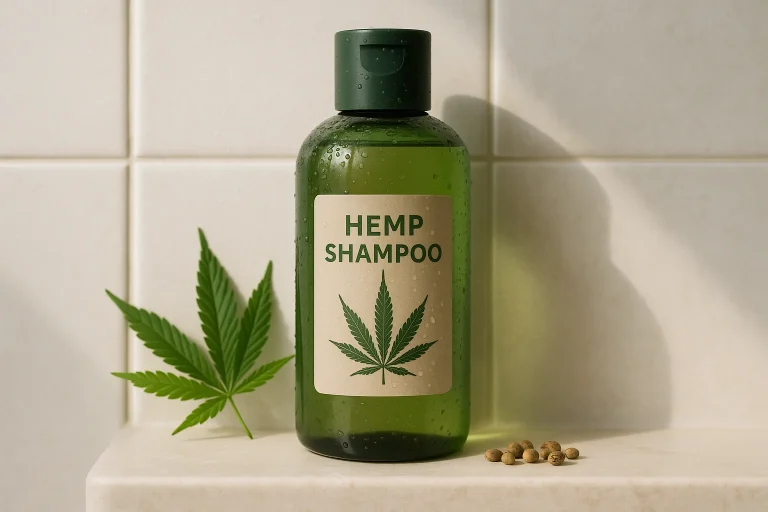
The closest topic is a study of a shampoo with cannabidiol at a wide spectrum at a concentration of 0.075 percent. It involved 50 people with mild or moderate scalp psoriasis or seborrheic dermatitis. After 14 days, the scores for itching and burning dropped from 6.9 to 1.5 points, and erythema and scaling from 5.5 and 7.0 to 1.3 and 1.6 points, all with a p below 0.0001 (Vincenzi and Tosti, Skin Appendage Disorders, 2020). However, there are serious reservations: the study had no control group, lasted two weeks, and concerned the scalp and other diseases than those mentioned in the cream’s advertisement. More about what hemp can do for hair is described in the text about hemp shampoo.
The second work, repeated as evidence for atopic dermatitis, concerns diet. In a twenty-week randomized crossover study, the consumption of hemp oil was compared with the consumption of olive oil. After consuming hemp oil, the scores for dryness and itching improved (p = 0.027), the use of topical medications decreased (p = 0.024), and the change in transepidermal water loss did not reach significance (p = 0.074) (Callaway et al., Journal of Dermatological Treatment, 2005). Participants consumed the oil. They did not apply it to their faces.
Go to the dermatologist without hemp cream in hand during flare-ups of atopic dermatitis, hormonal or pustular acne, rosacea, and psoriasis. The cosmetic can support the skin barrier between flare-ups, but it is not a medicine and does not treat the cause.
How to Use Hemp Cream on the Face?
A simple routine is enough: cleansing, a water layer, cream, and in the morning, a sunscreen on top. The order matters because the humectant draws water into the epidermis, and the oil from the cream retains it. Reversing this order traps dry skin under a layer of fat.
Start with a patch test. Apply a small amount to your forearm or behind your ear and wait a day before applying the product to your entire face. This is standard caution with any new cosmetic, and with hemp creams, it makes additional sense because the reactions are most often caused by accompanying substances, not the oil itself.
The amount should be small. Hemp oil is thick, and excess remains on the surface, giving the impression of oily skin instead of better hydration. Spread it gently from the center of the face outward, without pulling the skin.
In the evening, you can apply a bit more, especially to dry areas. In the morning, remember one caveat that usually gets left out in guides: there are no studies checking whether a layer of oil under sunscreen changes its effectiveness. It is safer to wait for the cream to absorb and then apply the sunscreen.
Evaluate the effect after several weeks, not after a few days. With acne-prone skin, the first few days can be worse, which usually subsides. If the worsening persists for more than a month or if itching and redness occur, discontinue the product and show your skin to a dermatologist.
Frequently Asked Questions
Does hemp cream contain CBD?
Usually not. If the INCI composition lists only Cannabis sativa seed oil, the product contains oil pressed from seeds, which has virtually no cannabinoids. Cannabidiol must be listed separately as cannabidiol or as an extract from the flowers, leaves, or stems of hemp.
Does CBD really reduce sebum production?
In human sebocyte cultures, yes, and through the TRPV4 ion channel, not through cannabinoid receptors (Oláh et al., 2014). The effect was measured on cells in a dish and in organotypic skin cultures. There is no study involving humans that would check if the cream has the same effect on the face.
Does hemp seed oil clog pores?
The popular rating of 0-1 has no source in the literature. The comedogenic scale was based on a rabbit ear test, and its authors themselves called this model far from ideal (Fulton et al., 1984). Later works criticize it for excessive reactivity. The observation of your own skin over several weeks is decisive.
Does hemp cream help with atopic dermatitis?
The study cited by the market involved consuming hemp oil for 20 weeks, not applying it to the skin (Callaway et al., 2005). Improvements were noted in dryness and itching scores and the use of topical medications. The product applied to the face for this indication has not been tested.
Can hemp cream replace pharmacy cream?
In the care of healthy skin and for mild irritations, it may be sufficient. In cases of active atopic dermatitis, acne requiring treatment, rosacea, and psoriasis, it remains an addition to therapy conducted by a dermatologist, not a substitute for it.
How long does it take for hemp cream to work?
The skin needs several weeks to adjust to new care, so evaluate the effect after a month of regular use. In oily and acne-prone skin, initial worsening usually subsides. If it persists longer or if itching and redness occur, discontinue the product.
Facial cream with hemp oil can be found in the creams category, and a broader overview of the entire line in the text about Palacio hemp cosmetics.
This article is for informational and educational purposes. It contains internal links to product categories available in the u Bucha store. Prices and specifications may change: check the current data on the product page before purchasing.
Author: Michał Waluk · Published: 2026-06-22 · Updated: 2026-08-15