
Poorly Labeled CBD Products: Where the 69 Percent Figure Comes From and What It Measures
Where the 69 percent figure comes from, what sample it was measured on, and what newer studies from 2022 and 2024 showed. Percentages provided along with the denominator.
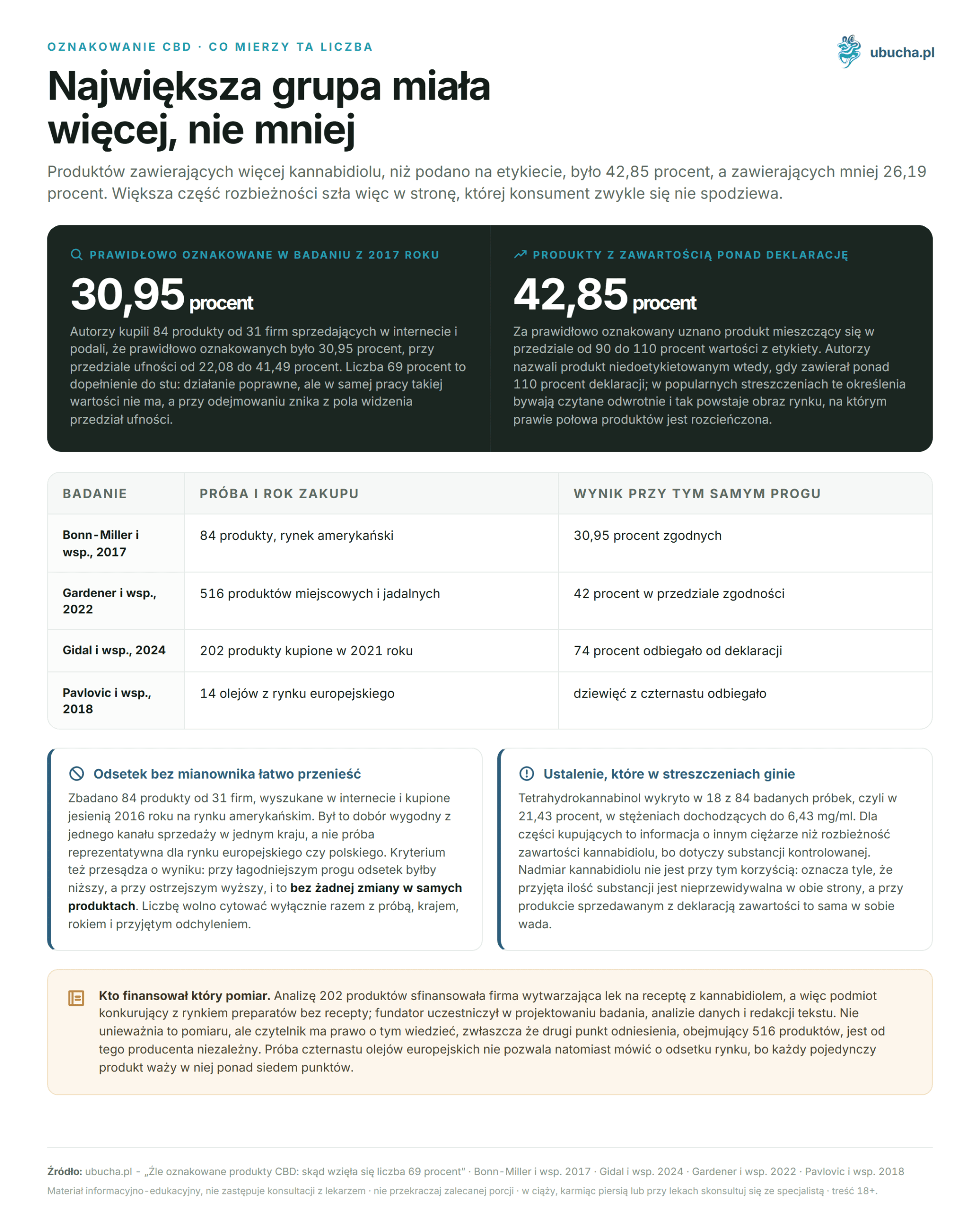
The figure of 69 percent has been circulating in the industry for nine years and is almost never accompanied by a denominator. It comes from a single study: Bonn-Miller and colleagues purchased 84 cannabidiol products from 31 companies selling online and checked how many matched the label (Bonn-Miller et al., JAMA, 2017). The study itself does not provide the figure of 69; it states that 30.95 percent were correctly labeled. The percentage without a denominator can easily be transferred to a market it does not pertain to, and that is exactly what happened with this value. This text shows where the rest comes from, what sample it was measured on, and what criteria were used, in which direction the discrepancies went, and what is known about labeling from newer, much larger studies.
KEY INFORMATION
• In the 2017 study, 30.95 percent of 84 products were correctly labeled; 69 percent is the complement to that value, not a number printed in the study.
• The criterion was strict: an allowable deviation of plus or minus 10 percent from the declaration.
• The largest group, 42.85 percent, contained more cannabidiol than declared, not less.
• THC was detected in 18 of 84 samples, or 21.43 percent, at concentrations up to 6.43 mg/ml.
• Newer studies do not show improvement: in a sample of 202 products from 2021, 74 percent deviated from the declaration by the same criterion.
Where did the 69 percent figure come from?
From subtraction. The authors stated that 30.95 percent of products were correctly labeled, with a confidence interval of 22.08 to 41.49 percent. The value of 69 percent is the complement to one hundred and is a correct operation, but it should be noted that such a number does not exist in the study itself, and the confidence interval disappears from view when subtracting.
The denominator is equally important and rarely provided. 84 products from 31 companies were examined, sourced online and purchased between September 12 and October 15, 2016, in the American market. This was a convenient selection from one sales channel in one country, sold ten years ago, and not a representative sample for the European or Polish market. The criterion also needs to be known, as it determines the outcome: a product was considered correctly labeled if it fell within the range of 90 to 110 percent of the value on the label. With a milder threshold, the percentage would be lower, and with a stricter one, it would be higher, and this is without any change in the products themselves.
The conclusion for the reader is that 69 percent is not a property of the CBD market, but the result of one measurement with the stated boundaries. It can be cited, but only together with the sample, country, year, and accepted deviation.
Does poorly labeled mean that CBD is too low?
Most often, no, and this is the most misleading aspect in the common interpretation of this number. Products containing more cannabidiol than stated on the label accounted for 42.85 percent, while those containing less accounted for 26.19 percent. The majority of discrepancies thus leaned in a direction that consumers typically do not expect.
The source of confusion can be the terminology used in the study. The authors labeled a product as under-labeled when it contained more than 110 percent of the declaration, meaning the label underestimated the actual content, and as re-labeled when it contained less than 90 percent. In popular summaries, these two terms are often read in reverse, creating an image of a market where almost half of the products are diluted.
This does not mean that excess is beneficial. It means that the amount of the substance is unpredictable in either direction, and with a product sold with a declared content, this is a flaw in itself. It is also worth noting a finding that gets lost in the summaries of this study: tetrahydrocannabinol was detected in 18 of the 84 tested samples, or 21.43 percent, at concentrations reaching 6.43 mg/ml. For some buyers, this is information about a different weight than the discrepancy in cannabidiol content, as it pertains to a controlled substance, which we discuss more broadly in relation to the legality of CBD purchases in Poland.
Has anything changed since 2017?
Available measurements do not show improvement, and one shows deterioration. In an analysis of 202 cannabidiol products purchased in American online sales between October and December 2021, 74 percent deviated from the declared content by at least 10 percent, and 26 percent did not meet the definition type stated on the packaging (Gidal et al., Frontiers in Pharmacology, 2024). This is the same deviation threshold as in 2017, so the numbers are comparable.
Who funded this work is stated directly by the authors: Jazz Pharmaceuticals, a manufacturer of a prescription drug containing cannabidiol, thus a competitor in the market of over-the-counter products. The funder participated in the design of the study, data analysis, and text editing. This does not invalidate the measurement, but the reader has the right to know.
The second point of reference is independent of this manufacturer. Among 516 tested topical and edible products, less than 90 percent of the declared content had 40 percent, more than 110 percent had 18 percent, and within the plus or minus 10 percent range were 42 percent (Gardener et al., Science of the Total Environment, 2022). Thus, three measurements from 2016, 2021, and 2022 give non-compliance rates ranging from 58 to 74 percent, and none confirm the thesis of an improving market.
What did European studies show?
They exist, but they are much smaller and should be described cautiously. The most frequently cited European study examined 14 cannabidiol oils available in trade in European countries, with full profiling of cannabinoids, terpenes, and oxidation products. Nine of the 14 samples had concentrations that clearly deviated from the declared values, while five retained cannabidiol within recognized limits (Pavlovic et al., Molecules, 2018).
A sample of fourteen products does not allow for statements about the percentage of the market, and no percentage values should be drawn from it, as each individual product weighs over seven points in it. The finding is therefore more modest: discrepancies between the label and content were also found in Europe, but no one has measured the scale of the phenomenon on a sample comparable to the American ones. The authors also point out the lack of uniform quality requirements, which enables this situation.
This same study also checked two things omitted in other labeling studies: the terpene fingerprint of the samples and the oxidation products of the oil used as a carrier. The authors propose treating both as additional quality indicators, the first for the raw material variety, the second for the durability of the preparation itself. For the reader, this means that mere compliance of cannabidiol content with the declaration does not exhaust the question of product quality.
Why does the content diverge from the label?
One reason is physical and well measured. In a stability study of cannabidiol dissolved in sunflower oil, samples stored in open vials at 40 degrees and at 75 percent relative humidity lost 20.2 percent of the substance after just 90 days, and after a year, only 1.03 percent of the initial amount remained. In closed vials, the loss after 180 days was 16.5 percent, and after a year, 24.09 percent remained. Under milder conditions, i.e., at 25 degrees and 60 percent humidity, the oil was stable for at least 180 days, and after a year contained 58.03 percent of the initial value (Kosović et al., Pharmaceutics, 2021). Cannabidiol in powdered form proved to be significantly more durable, with a loss of about 10 percent over the course of a year.
The study was conducted in stability chambers, on samples of 5 mg, in darkness and according to ICH guidelines, and not on products from store shelves. Therefore, it is not a measurement of what happens to a bottle at home, but an indication of how strongly storage conditions affect the measurement result after a few months. It was funded by the Czech Ministry of the Interior, and the authors reported no conflict of interest. The second reason is simpler: mixing the extract with a carrier requires homogeneity, and without it, the concentration varies within a single batch. The third is regulatory, as there is no obligation to test each batch of the finished product.
What does a certificate of analysis determine, and what does it not?
It determines one thing: what was measured in a specific batch on the day of testing. It does not determine what is in the bottle after six months of transport and storage, nor whether the document even pertains to the purchased item if the batch number on the certificate does not match the number on the packaging. The evidential value increases when the laboratory has accreditation according to ISO 17025 standards.
Regarding the THC position, it is important to know the difference that certificates do not explain. The Polish Act on Counteracting Drug Addiction in Article 4 point 5 defines industrial hemp by the sum of delta-9-THC and tetrahydrocannabinolic acid in the flowering or fruiting tops of the plant, from which the resin has not been removed, not exceeding 0.3 percent of dry mass, rounded to one decimal place. The threshold pertains to the plant, not the finished product, and sums both substances without a coefficient, while the certified position Total THC calculates the acid with a coefficient of 0.877. For the same sample, the statutory number comes out higher. It is also worth remembering that cannabidiol remains unauthorized as a novel food in the EU, and sanitary notification is not permission. As narrow as the margin can be at the threshold itself, we describe in relation to the problem of hot crops.
Frequently Asked Questions
Where does the 69 percent figure of poorly labeled CBD products come from?
It comes from subtracting 30.95 percent, the percentage of products deemed correctly labeled in a study of 84 products purchased online in the United States in the fall of 2016. The study itself does not provide the figure of 69, and the confidence interval of 22.08 to 41.49 percent disappears when subtracting.
Does the 69 percent refer to the Polish market?
No. The sample consisted of 84 products from 31 companies selling online in the American market, purchased between September 12 and October 15, 2016. This was a convenient selection from one sales channel, so it cannot be extrapolated to Poland or the EU.
Does a poorly labeled product contain less CBD than declared?
More often, it contains more. In a 2017 study, 42.85 percent of products contained more cannabidiol than stated on the label, while 26.19 percent contained less. A deviation was considered to be a difference greater than 10 percent in either direction, so both groups ended up in the same aggregate number.
Has the situation improved since 2017?
Available measurements do not show improvement. In a sample of 202 products purchased in 2021, 74 percent deviated from the declaration by the same criterion of 10 percent, and in a sample of 516 products from 2022, 42 percent fell within that range. None of these results are better than the 2016 result.
Why does CBD content decrease between production and purchase?
Cannabidiol dissolved in oil is sensitive to temperature, humidity, and air exposure. In a stability study, samples in open vials at 40 degrees lost 20.2 percent after 90 days, and after a year, only 1.03 percent remained. At 25 degrees, the oil was stable for at least 180 days. The powdered form proved to be significantly more durable.
Does a certificate of analysis guarantee compliance with the label?
It guarantees only the measurement result for a given batch on the day of testing. It does not account for what happens to the product later, and it loses value if the batch number on the document does not match the number on the packaging. Laboratory accreditation according to ISO 17025 standards increases the credibility of the result.
Before purchasing, it is advisable to ask the seller for a certificate for a specific batch and compare the measured content with the declaration on the packaging. You can find the current offer in the oils category.
This article is for informational and educational purposes only and does not constitute medical advice. Before starting to use cannabis or CBD for therapeutic purposes, consult a doctor, especially if you are taking other medications, are pregnant, or breastfeeding.
Author: Michał Waluk · Published: 2026-08-09 · Updated: 2026-08-16