
How to Find a Good CBD Store? Buyer’s Checklist 2026
Eight criteria for evaluating a CBD store: certificate of analysis, registration data, price per milligram, and legal compliance. Check the seller in fifteen minutes before purchase.
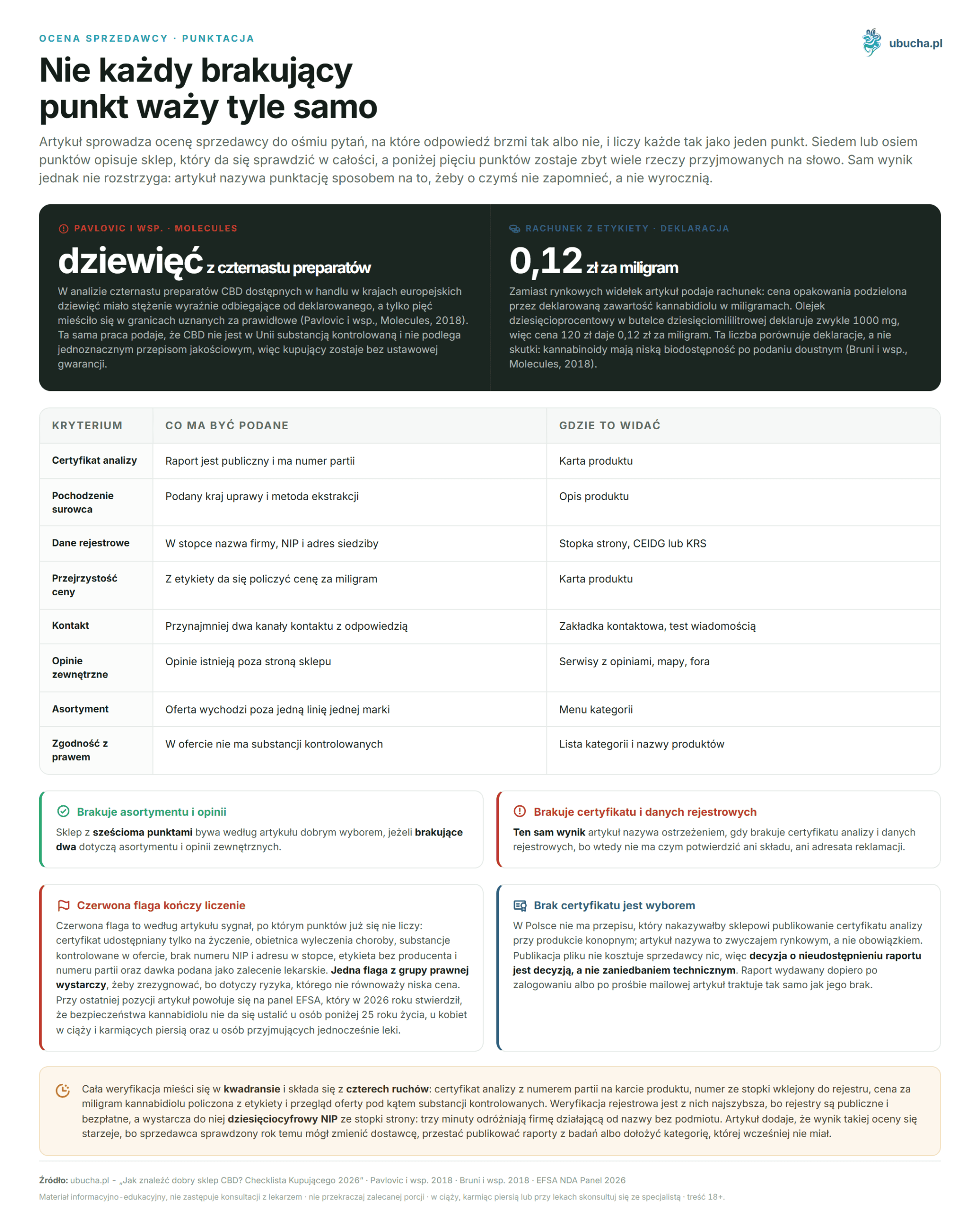
Not every oil contains as many cannabinoids as the label promises. In an analysis of fourteen CBD preparations available in European markets, nine had concentrations clearly different from declared, and only five were within accepted limits (Pavlovic et al., Molecules, 2018). The authors state plainly that CBD is not a controlled substance in the EU and is not subject to clear quality regulations, so the buyer is left without statutory guarantees. This gap remains. It is filled only by what the store publishes itself and what can be verified in registers. Below is a checklist that turns such verification into a quarter-hour task before purchase.
KEY INFORMATION
- Nine out of fourteen CBD oils from the European market had concentrations differing from declarations (Pavlovic et al., Molecules, 2018).
- A publicly available certificate of analysis on the product page is the first thing to check, although no Polish regulation requires it.
- The 0.3% threshold applies to the plant and is calculated as the sum of delta-9-THC and THCA (art. 4 point 5 of the Act on Counteracting Drug Addiction).
- EFSA recognized in 2026 that CBD safety cannot be established for people under 25 years old, pregnant and breastfeeding women, and those taking medications.
- Compare price in PLN per milligram of cannabidiol and calculate it yourself from the label.
Why does the choice of store determine what’s in the bottle?
Because no one outside the store checks that content. In the study of fourteen European CBD preparations, nine had concentrations clearly different from those declared on the packaging (Pavlovic et al., Molecules, 2018). The buyer cannot detect this without a lab, so the only available tool is the seller’s documentation.
The same study explains the reason. CBD is not a controlled substance in the EU, so producers can manufacture and sell preparations from hemp varieties with low THC content without clear quality requirements. The authors conclude for regulators that strict and unified regulations are needed. Until then, the difference between a reliable and a random product is visible only in documents.
The topic has separate literature also on online sales. Label accuracy of CBD extracts sold online was studied and described in JAMA in 2017 (Bonn-Miller et al., JAMA, 2017). The mere fact that a peer-reviewed medical journal publishes a study on label compliance speaks more about the scale of the phenomenon than any store ranking.
There is also regulatory uncertainty. A review published in Food and Chemical Toxicology states that publicly available data confirming declared CBD benefits in consumer products are limited, and regulations remain uncertain; in the US, which the analysis concerns, state levels can even conflict with federal (Li et al., Food and Chemical Toxicology, 2021). A seller who hides this uncertainty is a worse partner than one who names it.
What is a certificate of analysis and what does it really prove?
A certificate of analysis, called COA in the industry, is a report from testing a specific batch of product by a laboratory. It proves one thing: what was found in the sample marked with a given batch number on the test date. It does not prove the quality of the entire brand or that the next batch will be the same.
This distinction has practical consequences. A certificate without a batch number is decoration because it cannot be linked to the bottle in your hand. A certificate from three years ago describes goods no longer on sale. A certificate without the lab name does not allow checking who performed the test or whether the lab is accredited for those methods.
It is worth dispelling a common myth: in Poland, there is no regulation requiring a store to publish a certificate of analysis with a hemp product. It is a market custom, not an obligation. That is why its absence says so much. Publishing a PDF file costs the seller nothing, so the decision not to share it is a choice, not a technical oversight.
A reliable report usually includes cannabinoid profile, pesticide residue testing, and heavy metals determination. Oil preparations also include residual solvents from extraction and microbiological testing. If the report is one page with one number, it describes a fragment, not the product.
How to read a certificate of analysis step by step?
Reading takes about five minutes and boils down to comparing four things with the label: batch number, test date, declared cannabidiol content, and THC content. The rest of the report is important, but these four items decide whether the document even concerns your package.
| What you check | What you look for in the report | When it’s a problem |
|---|---|---|
| Batch number | Same string as on the package label | No number or does not match the bottle |
| Test date | Report issue date and sample collection date | Report older than product shelf life |
| Laboratory | Lab name, test method, accreditation scope | Report signed only by producer |
| CBD content | Result in mg per package or percent by mass | Result differs from label declaration |
| THC content | Delta-9-THC and THCA given separately or as sum | Report gives only delta-9-THC, no acid form |
| Contaminants | Pesticides, heavy metals, solvents | Panel limited to cannabinoids only |
The last row often surprises buyers. Hemp absorbs metals from soil very readily, so testing only the cannabinoid profile says nothing about raw material safety. If the store provides the report only after login or email request, treat it the same as no report.
What does the declared extraction method tell about the product?
It tells what was allowed to get into the bottle. The method of extracting compounds from plant material determines the extract composition as much as the raw material itself, and differences between methods are measurable and well described. A store that does not provide this information leaves you with just a trade name.
A direct comparison of methods was done. A research team compared four extraction techniques from three medical cannabis varieties: Soxhlet extraction, ultrasound-assisted supercritical extraction, and microwave extraction, describing the chemical composition of the extracts (Lewis-Bakker et al., Cannabis and Cannabinoid Research, 2019). Result: microwave method gave fully decarboxylated extracts, with temperature and exposure time playing a key role.
For the buyer, two things follow. First, the extract is not a faithful reflection of the plant but a product of a designed process. Second, the same procedure applied to another variety may yield a different result, as the authors note separately. Hence their conclusion that repeatability of composition requires higher scientific rigor than the industry currently applies.
In practice, this means the product description should state the extraction method alongside the country of cultivation. Not because one method is always better, but because a seller who knows the answer also knows their supplier. A seller who does not know bought from an intermediary and passes on exactly what they got.
What should be on a hemp product label?
The label is the only document that comes with the bottle. The certificate of analysis stays on the store’s server and may disappear, but the label goes to your cabinet and stays there until the package is finished. That’s why you check things on it that no one can later reproduce.
Four pieces of information decide whether the product can be linked to any test at all. Batch number, because without it the certificate describes another product. Name and address of the responsible entity, because that’s who you direct complaints to. Expiry date, because cannabinoids are not stable compounds. Composition, because it shows whether the content is extract or just seed oil.
This last distinction confuses buyers most often. Hemp seed oil and flower extract are two different products from the same plant. Seeds contain no significant cannabinoids, so a product listing only seed oil is not a cannabidiol preparation, even if the front of the package shows a hemp leaf.
Also check consistency between front and back declarations. The front text is often marketing, while the binding information is the composition and declared content on the back label. Discrepancy between them is a signal that no good certificate of analysis can offset.
What eight criteria make up the CBD store checklist?
The assessment boils down to eight yes-or-no questions. Each yes is one point. Seven or eight points means a seller who can be fully verified. Below five points leaves too many things you must take on trust.
| Criterion | Control question | Where to check |
|---|---|---|
| Certificate of analysis | Is the report public and has a batch number? | Product page |
| Raw material origin | Is the country of cultivation and extraction method given? | Product description |
| Registration data | Is the company name, VAT ID, and address in the footer? | Site footer, CEIDG or KRS |
| Price transparency | Can you calculate price per milligram from the label? | Product page |
| Contact | Are there at least two contact channels with response? | Contact tab, test message |
| External reviews | Do reviews exist outside the store’s site? | Review sites, maps, forums |
| Assortment | Does the offer go beyond one line of one brand? | Category menu |
| Legal compliance | Are there no controlled substances in the offer? | Category list and product names |
The score is not a verdict but a way to avoid forgetting something under the influence of a nice site or good price. A store with six points can be a good choice if the missing two concern assortment and reviews. The same score is a warning if the certificate of analysis and registration data are missing.
Order matters. The first four criteria concern the product and you check them on the product page. The last four concern the company and you check them outside the store, in registers and sources beyond the seller’s influence. If short on time, start with the fourth and eighth, as they quickly filter out random offers.
How to check a company in CEIDG and KRS in three minutes?
Registry verification is the fastest part of the checklist. Registers are public, free, and available 24/7, and you only need the VAT ID from the site footer. Three minutes suffice to distinguish an active company from a name without an entity.
Start from the footer or contact tab. They should contain: full company name with legal form, ten-digit VAT ID, and registered address with postal code. If any of these are missing, you can end verification here because further steps have no basis.
With the VAT ID, enter it in the CEIDG search if the seller is a sole proprietor, or in the KRS search if the footer shows a company. The register shows entry status, start date, full name, and business scope. Check three things: if the entry is active, if the name matches the brand on the site, and if the business scope includes retail trade.
Finally, enter the registered address in maps. Check if there is a building at that address and if it is not just a virtual office. A virtual office alone does not decide anything, but combined with no phone and no external reviews, it creates an image of a seller hard to reach for complaints.
How to assess the price of a CBD product without trusting others’ benchmarks?
Calculate it yourself. Price per milligram of cannabidiol is the package price divided by declared CBD content in milligrams. A 10% oil in a 10 ml bottle usually declares 1000 mg, so a 120 PLN price gives 0.12 PLN per milligram. This one calculation compares products whose packages cannot be compared.
Don’t buy market thresholds given without sources. Price ranges circulating in industry texts rarely have any measurement behind them, and articles stating them as fact usually copy from other articles. It’s more honest to compare several offers you open in a given week, as catalogs change faster than texts about them.
For scale: in the hemp oils category at u Bucha, prices of six available items range from 65 to 240 PLN, differing in concentration, volume, and cannabinoid type (catalog status as of August 10, 2026). Such information can be checked in a minute but may be outdated after a month. That’s why the calculation method matters, not the remembered number.
Extremely low price can be a signal but proves nothing alone. The decisive factor is the price combined with the certificate of analysis: if a product confirmed by report gets cheaper, it’s a promotion; if a cheap product is untested, you don’t know what you pay for. More on the promotion mechanism is in the post about cheap and good CBD.
Why price per milligram doesn’t tell the whole story?
Because the milligram on the label and the milligram that works are not the same number. Cannabinoids are strongly lipophilic compounds with low oral bioavailability, often overlooked when comparing offers (Bruni et al., Molecules, 2018). A cheaper product with the same declaration may thus have a different effect than a more expensive one.
A review on cannabidiol carriers lists four reasons at once: poor solubility, low bioavailability, variable pharmacokinetic profile, and significant first-pass metabolism, i.e., losses before entering bloodstream (Grifoni et al., Molecules, 2022). That’s why the administration form can be more important than concentration.
The practical conclusion is simple. Price per milligram compares declarations, not effects, so use it to filter out extreme offers, not to choose between two similar products. For such choice, the form, carrier, and whether the producer describes product behavior tell more.
The same review notes cannabidiol’s poor stability. A product bought cheaper but stored longer or in transparent packaging may have less substance on opening day than on test day. That’s why expiry date and packaging type are part of price evaluation, not a separate topic.
What red flags should end the store assessment?
A red flag is a signal after which you don’t count points but close the tab. The first group concerns the product, the second legal compliance, the third company transparency. One legal flag is enough to quit, as it involves risk that cannot be offset by low price.
| Signal | Why it ends the assessment |
|---|---|
| Certificate only on request | Providing the file costs nothing, so refusal is a choice |
| Promise to cure disease | Violates EU health claims regulations |
| Controlled substances in offer | Legal risk passes to buyer |
| No VAT ID and address in footer | No addressee for complaints without registration data |
| Label without producer and batch | Cannot link product to any test |
| Dose given as medical advice | Store is not authorized to give such advice |
The last row is often overlooked but worth attention. A seller who states a specific milligram dose per day for a health problem on the product page steps into a doctor’s competence. A set of warning signals from the supplement perspective is described separately in the post about what to watch for before purchase.
What does Polish law say about hemp products in stores?
The law describes the plant, not the finished product. Fiber hemp are plants of the Cannabis sativa species, in which the sum of delta-9-THC and tetrahydrocannabinolic acid in flower or fruiting tops does not exceed 0.3% on a dry weight basis, rounded to one decimal place.
The basis is art. 4 point 5 of the Act of July 29, 2005 on Counteracting Drug Addiction, consolidated text Dz.U. 2023 item 1939, as amended by the Act of March 24, 2022 (Dz.U. 2022 item 763). Two details of this definition affect lab test results. The threshold is the sum of two compounds, not just delta-9-THC, and applies to the plant, not the bottle content you buy.
The national threshold corresponds to the EU threshold from Regulation 2021/2115 but does not derive from it. These are two separate regulations with the same numeric value. A store that explains the Polish threshold by the EU regulation or cites the repealed Regulation 1307/2013 with a 0.2% threshold copied it without checking.
Cannabidiol itself is not listed in any controlled substances lists. It is different with HHC, hexahydrocannabinol: a controlled substance whose position in the list is set by the Minister of Health’s regulation of July 7, 2026, effective July 28, 2026 (Dz.U. 2026 item 934). Presence of such items in a CBD store’s offer signals the seller does not follow the list.
How to check if a store does not trade controlled substances?
Browse the category list before opening any product page. It takes a minute and is the only checklist point where risk passes to you as buyer, not the seller. Trade names can be misleading, but abbreviations in category names are usually clear.
The reference is the list of psychotropic substances, narcotics, and new psychoactive substances announced in the Minister of Health’s regulation (consolidated text Dz.U. 2024 item 1139, amended by Dz.U. 2026 item 934). Cannabidiol is not on this list. Hexahydrocannabinol, HHC, is listed and remains a controlled substance.
The list does not stop at the general name. The tetrahydrocannabinols entry lists isomers by name with stereochemical variants, including delta-8-THC and delta-10-THC. Variants marked with a number suffix are thus not a legal novelty escaping regulations, though sometimes presented so in offers.
Note another signal: descriptions emphasizing the intoxicating power of the product. A legal hemp offer has no reason to promise such effect, as the raw material by definition is below 0.3% threshold. Language promising intoxication in a CBD store contradicts what the store can legally sell.
What can a store not promise you?
Cure, disease reversal, or therapy replacement. Health claims for food are regulated in the EU by Regulation 1924/2006 and only those passing scientific evaluation are allowed. Claims about curing cancer or depression have no such evaluation and are not a marketing style issue but a legal violation.
The second restriction concerns ingredient status. Cannabidiol in food is subject to novel food procedure, and submitting a sanitary notification is not authorization and does not change product status. A store citing notification as approval confuses two different things.
The third restriction comes from the latest safety assessment. The EFSA panel derived in 2026 a provisional safe dose of 0.0275 mg per kg body weight per day, about 2 mg daily for a 70 kg person, applying an uncertainty factor of 400 (EFSA NDA Panel, EFSA Journal, 2026). This applies only to supplements with at least 98% cannabidiol purity, without nanoparticles.
The same document contains a sentence that should be in every text about dosing: CBD safety cannot be established for people under 25 years old, pregnant and breastfeeding women, and those taking medications. A seller who nevertheless gives a daily milligram number for such a person is years ahead of science.
What is known today about cannabidiol safety?
Less than most product descriptions suggest. The EFSA panel reviewed studies published from the previous opinion to June 2024 and found that data gaps from 2022 remain because many new studies have methodological limitations: protocols without standardization, short observation times, and concurrent treatment with other preparations.
The assessment lists specific uncertainty areas. Animal studies showed consistent liver toxicity, with liver mass and histopathological changes as sensitive endpoints. In humans, hepatotoxic potential was described, especially with concurrent use of other drugs. Data on neurological and psychiatric safety were deemed insufficient.
Two further findings concern special groups. Cannabidiol crosses the placenta and accumulates systemically, with prenatal exposure linked to long-term and sex-dependent neurodevelopmental effects. Hormonal disorders, including altered thyroid hormone levels, were described separately. None of the analyzed studies addressed immunotoxicity.
Why does the buyer need this? To recognize a store promising certainty where the risk assessor has none. A product description consistent with current knowledge is cautious, indicates limitations, and refers to a doctor. A description sounding more confident than EFSA’s opinion was made in marketing, not based on data.
Stationary or online store - which to choose?
The sales channel does not determine quality. The same eight criteria apply to a street store and an online store, only checked differently. In a store, you ask the seller and look at the label; online, you open the product page and company register.
A stationary store offers two things hard to replace online. You can see the package with full composition and expiry date before paying, and ask a question and get an immediate answer. Staff competence at the first purchase is a real value, allowing you to filter out products unsuitable for your use.
An online store wins in document availability and comparability. You open the certificate of analysis on the product page in a second, and comparing price per milligram among several offers takes a quarter-hour you cannot spend at the shelf. A wider assortment also helps find a form other than oil.
In practice, these channels do not compete. Many buyers start by comparing online and finish in a store, or vice versa. Purchase channels and their strengths are described separately in the post about where to buy CBD oil. Choose the seller, not the channel.
How to read store reviews to get something out of them?
Reviews collected and moderated by the store have limited evidential value, as the owner decides which stay. That’s why you look for sources beyond the seller’s influence: review sites, maps, forums, and thematic groups. You care not about average rating but distribution and content.
A healthy review profile has mostly high ratings but also some low ones. A set of all maximum ratings without a single critical one is less credible than a profile with some complaints the seller answered reasonably. How criticism is handled tells more about service than any company description.
Pay attention to review distribution over time. Several dozen entries added in one week after months of silence signal someone worked on the profile. Content matters more than number: a review describing a specific product, delivery time, and complaint process carries information; a one-sentence praise carries none.
Don’t overvalue any platform. Review sites remove entries deemed manipulative, but their own reports on the scale are hard to verify externally, and some block automatic checking. Treat reviews as one of eight checklist points, not a verdict.
Most informative are reviews describing difficult situations. Returns, damaged shipments, product not as described: these moments show how the seller behaves when not obliged to be nice. Praise for fast delivery says nothing the same shelf’s other stores don’t say.
What to order on the first purchase?
The least amount sufficient to assess the seller. The first order has two goals: check the product and check the store. One or two items in the smallest available package suffice for both, and failure costs as much as one small package.
You check things visible without a lab. Did the shipment arrive on time, was the package secured, does the batch number on the label match the certificate published on the site, and did the staff answer your question reasonably? This is a test of the seller, not the product.
We deliberately do not give a milligram per day number here. The EFSA panel stated in 2026 that CBD safety cannot be established for people under 25, pregnant and breastfeeding women, and those taking medications, and a pharmacokinetic review reminds that both main cannabinoids are metabolized in the liver, opening the way to drug interactions (Lucas et al., British Journal of Clinical Pharmacology, 2018). Discuss dosage with a doctor or pharmacist, not the seller.
If the first order passes this test, you can order next ones more calmly. If not, you lost the cost of one small package but gained information no checklist read on screen could give.
Frequently Asked Questions
How to check if a CBD store is reliable?
Check four things: a public certificate of analysis with batch number on the product page, company registration data in the footer and confirmation in CEIDG or KRS, reviews from sources outside the store’s site, and absence of controlled substances in the offer. The entire verification takes about fifteen minutes.
Does a CBD store have to publish a certificate of analysis?
No, no Polish regulation requires it. Publishing a batch test report is a market custom, not a legal obligation. That’s why its absence conveys information: providing the file costs the seller nothing, so refusal is a decision, not a technical problem.
Does the declared concentration on the label usually match?
Not always. In an analysis of fourteen CBD preparations available in European markets, nine had concentrations clearly different from declared, and five were within acceptable limits (Pavlovic et al., Molecules, 2018). Without a certificate of analysis, the buyer has no way to verify this.
How to calculate if a CBD oil is overpriced?
Divide the package price by the declared cannabidiol content in milligrams. A 120 PLN bottle with a 1000 mg declaration gives 0.12 PLN per milligram. Apply the same calculation to several offers opened the same day, as catalogs change faster than price articles.
What THC threshold applies in Poland and how is it calculated?
The threshold is 0.3% on a dry weight basis and is calculated as the sum of delta-9-THC and tetrahydrocannabinolic acid, rounded to one decimal place. It applies to the plant, not the finished product. The basis is art. 4 point 5 of the Act on Counteracting Drug Addiction (Dz.U. 2023 item 1939).
Can a store promise that a product will cure a disease?
No. Health claims regarding food are regulated in the EU by Regulation 1924/2006 and only those that have passed scientific evaluation are allowed. Claims about curing cancer, depression, or epilepsy have no such evaluation, so their presence disqualifies the seller.
Is a stationary store safer than an online one?
Not by itself. The same eight criteria apply to both channels; only the verification method differs. In a store, you look at the label and ask the staff; online, you open the certificate of analysis and company register. The seller decides, not the sales channel.
How much CBD per day is safe?
In 2026, the EFSA panel derived a provisional dose of 0.0275 mg per kilogram of body weight per day, about 2 mg for a 70 kg person, and only for supplements with at least 98% purity. Safety cannot be established for people under 25 years old, pregnant or breastfeeding women, and those taking medications.
Summary: a quarter-hour worth spending
The entire verification fits in fifteen minutes and consists of four steps. Open the product page and look for a certificate of analysis with batch number. Scroll to the footer for VAT ID and paste it into the register. Calculate price per milligram of cannabidiol. Review the offer for controlled substances.
None of these steps requires chemical or legal knowledge. They only require not taking on trust things that can be checked in a register or calculated on a calculator. A seller passing all four likely passes the other four criteria in the table as well.
One note on proportions. The most common mistake is not choosing a bad store but skipping verification and basing the decision on price. Fifteen minutes before the first order pays off at the first situation when you need to complain or find out what exactly was in the bottle.
Also keep in mind that this assessment ages. A seller checked a year ago may have changed supplier, stopped publishing test reports, or added a category previously missing. For a larger order, repeat the first two steps, as they take five minutes total and catch most such changes.
If you want to see how such data look for real products, visit the hemp oils category and check the points described above on any product page.
This article is informational and educational. It contains internal links to product categories available at u Bucha. Prices and specifications may change: check current data on the product page before purchase.
Author: Michał Waluk · Published: 2026-05-04 · Updated: 2026-08-10