
CBD for Stress - How Much to Take, When and How Long? Practical Guide 2026
CBD and stress without promises: what was measured in studies on anxiety, what dose EFSA considered safe, and why numbers from experiments are not recommendations.
The question of cannabidiol and stress comes up in every conversation about natural support, and the answers circulating online are surprisingly confident: a specific number of milligrams, a ready weekly plan, a table according to body weight. The scientific literature does not contain such things. However, it does contain several well-described experiments in which people were given specific amounts of the substance under specific conditions, as well as a fresh safety assessment that states outright for whom a safe amount cannot be determined today. This text shows both, without translating laboratory results into recommendations for the reader. You will see who was studied, how many participants there were, how long the observation lasted, and what exactly was measured, as well as what is not present in these works, although it is often attributed to them.
KEY INFORMATION
- The milligram numbers given below describe specific studies: who participated, how many there were, and how much they were given. They are not a guideline for how much the reader should take.
- In 2026, EFSA derived a provisional safe dose of 0.0275 mg per kilogram of body weight per day, which is about 2 mg daily for a person weighing 70 kg (EFSA 2026).
- The safety of CBD cannot be determined today for people under 25 years of age, for pregnant and breastfeeding women, and for people taking medications.
- In a study with a simulated public speaking event, anxiety was reduced only by the 300 mg dose; 150 mg and 600 mg did not differ from placebo (Linares 2019).
- In cases of severe anxiety, panic attacks, or low mood, the first step is to talk to a doctor, not to purchase a supplement.
What is stress and what does the endocannabinoid system have to do with it?
Stress is the body’s reaction to a stimulus requiring adaptation, primarily driven by the hypothalamic-pituitary-adrenal axis and the sympathetic nervous system. Its hormonal marker is cortisol, which has a clear daily rhythm: it rises in the morning and falls throughout the day. This rhythm will be important in one of the studies described below.
The endocannabinoid system is a network of receptors and compounds produced by the body, present among other things in brain structures responsible for emotions and memory. It participates in extinguishing the stress response, that is, bringing the body back to its baseline state after the stimulus has ceased. This is why it has become a subject of interest for researchers studying anxiety.
cannabidiol does not strongly bind to the main receptors of this system and does not act like a psychoactive substance. The described mechanisms of its action are indirect and still a subject of dispute; the literature points to an influence on serotonin transmission and prolonging the action of the body’s own compounds. This is at the level of mechanistic hypotheses, not established facts, and should be read as such.
Caution here has a practical basis. Tension, sleep problems, and irritability usually have more than one cause, and some of them have nothing to do with the endocannabinoid system: lack of sleep, untreated thyroid disease, chronic pain, low mood. Before concluding that you are lacking a supplement, it is worth ruling out what can be tested. One of the less obvious clues is the gut, which we discuss in the text about how gut bacteria affect mood and stress.
What does CBD do in the brain under stress?
The most concrete answers come from two small imaging and hormonal studies from years ago. Both are cited in guides more often than read, and both say something different than what is attributed to them. It is worth knowing them in their original form, as they well illustrate the scale of the knowledge available today.
In the imaging study, ten previously untreated patients with generalized social anxiety participated. Cerebral blood flow was measured at rest using SPECT, twice, after a single oral dose of 400 mg of cannabidiol or placebo. After the active substance, significantly lower subjective anxiety and lower uptake of the marker in the left parahippocampal gyrus, hippocampus, and inferior temporal gyrus were noted, and higher in the right cingulate gyrus (Crippa et al. 2011).
Two things in this description are important. It was single-photon emission computed tomography, not functional magnetic resonance imaging, and it concerned perihippocampal structures, not the amygdala, which appears most often in popular summaries. The summary of this work also does not provide any percentage decrease in activity, so circulating numbers of this kind have no basis in it.
The second study concerned hormones. Eleven healthy volunteers received placebo or cannabidiol in amounts of 300 mg (seven people) or 600 mg (four people) in the morning. Cortisol levels in sessions with placebo significantly dropped, according to the normal daily rhythm, and after cannabidiol, this drop was significantly weakened. The substance also had a calming effect in self-assessment scales (Zuardi et al. 1993). The authors conclude that cannabidiol interferes with cortisol secretion, not that it lowers it.
What doses were given in studies on anxiety?
From 150 to 600 mg at once in experiments on anxiety induced by situations and about 25 mg daily in the only larger observational series from a psychiatric clinic. These two worlds are divided by everything: the number of participants, duration, measurement method, and whether the subjects were simultaneously taking other medications.
The following summary organizes five studies most frequently cited on this topic. Read them as a description of what was done in the laboratory, not as a list of doses to try. None of these studies were designed to determine a safe amount for a person buying a product in a store.
| Study | Who and how many participants | How administered | What was shown |
|---|---|---|---|
| Linares 2019 | 57 healthy men | Single oral dose of 150 mg, 300 mg, 600 mg, or placebo, before a simulated public speaking event | Anxiety was reduced only by the 300 mg dose |
| Bergamaschi 2011 | 24 untreated patients with social phobia plus 12 healthy individuals | Single dose of 600 mg or placebo, one and a half hours before the test | Less anxiety and discomfort during the performance, results similar to healthy individuals |
| Crippa 2011 | 10 untreated patients with social anxiety | Single dose of 400 mg or placebo, SPECT imaging at rest | Lower subjective anxiety and changes in blood flow in limbic system structures |
| Zuardi 1993 | 11 healthy volunteers | In the morning 300 mg (7 people) or 600 mg (4 people) | Weakening of the normal morning drop in cortisol and calming effect |
| Shannon 2019 | 72 adult patients from a psychiatric clinic | Almost all 25 mg daily in capsules, alongside previous treatment | Decrease in anxiety scores in the first month in 57 individuals |
The second row is often summarized most freely. Twenty-four previously untreated patients with social phobia were randomly assigned to cannabidiol at a dose of 600 mg or to placebo, with twelve people in each group, and an additional twelve healthy individuals underwent the same test without any preparation. After the active substance, anxiety, discomfort, and cognitive disturbances during the speech were lower, and the results approached those of the healthy group (Bergamaschi et al. 2011). The authors themselves call their study preliminary.
Note the last row. Shannon’s series is a retrospective review of medical documentation, not a controlled study, and patients mostly continued their previous psychiatric medications. Attributing improvement solely to cannabidiol is not possible in this setup, and the authors themselves state that controlled studies are needed.
Why can’t these results be transferred to everyday life?
Because each of these studies answers a narrower question than the one posed by someone seeking help for chronic tension. The difference is not that the studies are weak, but that they measured something different. Three limitations regularly recur in them.
The first is participant selection. In the comparison of three amounts, only healthy men participated, and in the other two experiments, individuals with diagnosed social anxiety, previously untreated. These groups were selected for measurement purity, not for reflecting the population in which the product is used. There were no women in the first of these studies at all.
The second is the number of subjects and time. The groups ranged from four to fifteen people, and the observation covered one afternoon in the laboratory. With such a small number, the result of a single study is a signal to check, not a resolution, and that is why there is talk of the need for replication.
The third is the stimulus itself. A simulated public speaking event is a short, predictable, and deliberately induced stressor that subsides with the end of the procedure. Chronic tension related to work, caring for a loved one, or a difficult financial situation acts differently and lasts for months. Transferring results from one to the other is an assumption of the researcher reading the work, not a conclusion from that work.
Why does a higher dose not mean a stronger effect?
Because in the only study that deliberately compared several amounts in humans, the middle dose worked, not the highest. Fifty-seven healthy men were randomly assigned to four groups: 150 mg, 300 mg, 600 mg of cannabidiol, or placebo, in a double-blind procedure, before a simulated public speaking test.
Compared to placebo, anxiety during the speech was significantly reduced only by the 300 mg dose. The groups receiving 150 mg and 600 mg did not differ from placebo in self-assessment mood scales. The authors described this as a U-shaped dose-response curve and considered it confirmation of earlier observations from animal studies (Linares et al. 2019).
The conclusion the authors draw from this is cautious and worth quoting in full: optimal therapeutic amounts still need to be rigorously determined for research results to be translatable to clinical practice. This sentence is from the abstract, not an interpretation. In other words, the researchers state that there is no translation yet.
For the reader, this means two things. First, increasing the amount on your own is not a strategy supported by results, because in the only such comparison, the largest dose performed worse than the average. Second, the result obtained in healthy men before one speech says nothing about daily use over weeks, which this study did not cover at all.
What is known today about the safe amount of CBD?
The latest answer comes from the EFSA update on the safety of cannabidiol as a novel food. The panel derived a provisional safe dose of 0.0275 mg per kilogram of body weight per day using the benchmark dose method, with an uncertainty factor of 400, which is about 2 mg daily for a person weighing 70 kg (EFSA 2026).
This value has a narrowly defined range. It applies only to supplements with a purity of cannabidiol of at least 98 percent, without nanoparticles, produced safely, and with excluded genotoxicity. It does not apply to other forms or products with unknown composition.
The most important sentence of this assessment does not contain a number. The panel states that based on all available safety data, the safety of cannabidiol cannot be determined for people under 25 years of age, for pregnant and breastfeeding women, and for people simultaneously taking medications. A reader seeking support for chronic tension often belongs to the third of these groups.
The scale of discrepancy between these two milligrams and hundreds of milligrams from experiments can be misleading, so it is worth naming it directly. An experiment checks what a substance does in one situation in a narrowly selected group under supervision. A safety assessment asks what amount can be considered safe for daily consumption by any person from the population, and therefore uses a large uncertainty factor. These are two different questions, not two contradictory answers.
How long did the observations last in the studies?
From one session to three months. Experiments on situational anxiety measured the effect of a single dose over one afternoon. The only larger observational series followed patients through monthly visits, but without a control group and without random assignment.
In this series, the documentation of 103 patients was analyzed, of which 72 adults were included in the study: 47 reported primarily anxiety, and 25 primarily poor sleep. Anxiety scores were measured using the Hamilton scale, and sleep quality using the PSQI questionnaire, at each monthly visit (Shannon et al. 2019).
The results are mixed and have been described as such. In the first month, anxiety scores decreased in 57 individuals, or 79.2 percent of those studied, and remained lower in subsequent months. Sleep scores improved in 48 individuals, or 66.7 percent, but changed over time, and in some patients, symptoms worsened. In the anxiety group, the average Hamilton scale score was 23.87 at the start and 16.36 after three months.
The authors emphasize the limitations of their own work: it is a review of documentation, not a controlled study, patients remained under psychiatric care, and most continued their psychiatric medications. The conclusion they formulate is that cannabidiol may be beneficial in anxiety-related disorders and that controlled clinical studies are needed. This is the full strength of the evidence available today.
What do the scales used in these studies actually measure?
The percentages cited in guides come from specific measurement tools, not from a general impression of improvement. It is worth knowing what these tools count, as it changes the way results are read. Without this, a statement about improvement in seven out of ten people sounds stronger than it deserves.
The Hamilton anxiety scale has fourteen questions and a scoring range from 0 to 56. A score below 17 points corresponds to mild anxiety, and above 25 points to severe anxiety. In the series from the psychiatric clinic, the average in the anxiety group was 23.87 points at the start, so it fell between these thresholds, and after three months, it was 16.36 points.
Sleep quality was measured using the PSQI questionnaire, consisting of nineteen items rated from 0 to 3, with a total range from 0 to 21 points. A higher number indicates more problems, and a score of 5 points or higher classifies the subject as a poor sleeper. Both scales are self-reporting and clinical tools, not physiological measurements.
In experiments on public speaking, other tools were used: a visual analog mood scale and a negative self-thought questionnaire, supplemented by measurements of blood pressure, heart rate, and skin conductance. These are also subjective assessments, supplemented by a few physiological parameters. None of these studies measured anything that could be called an objective level of stress.
Is there tolerance to CBD and do breaks need to be taken?
It is unknown, and that is an honest answer. There is no study that has checked whether repeated administration of cannabidiol weakens its effects over time in humans, nor one that has compared continuous use with intermittent use. Claims about percentages of people losing response after a certain number of weeks have no source in the literature.
The same applies to the fashionable explanation of increasing the number of receptors in response to the presence of the substance. This is a hypothesis described for other compounds acting on this system, transferred to cannabidiol by analogy, not based on measurement. A mechanistic explanation without experimental results is a story, not evidence.
What can be said sensibly? That the subjective impression of the action of any substance with a mild profile changes with circumstances: with the season, workload, amount of sleep, and what we expect. Distinguishing a change in the body’s response from a change in life situation requires recording, not memory, because memory in such matters is fallible.
If you are looking for signals by which the practicality of a break is assessed, we described them separately in the text about when it’s time for a tolerance break. In any health-related doubts, make the decision to continue or discontinue anything with your doctor.
What won’t CBD do?
It will not replace the treatment of anxiety disorders or depression, it does not act like a tranquilizer given on demand, and it does not remove the causes of tension that lie outside the body. Cannabidiol is not registered in Poland as a drug for use in stress, and products available for sale are not medicinal products.
It is also worth distinguishing between two different states that we commonly call the same thing. Tension accompanying a difficult period is an adaptive response. An anxiety disorder is a medical diagnosis, with specific criteria and effective treatment methods, primarily psychotherapy and pharmacotherapy. Replacing the latter with a supplement means postponing help that works.
Separately, there are situations requiring urgent response: panic attacks, suicidal thoughts, insomnia lasting for weeks, unexplained somatic symptoms. These are not situations in which purchasing anything is a reasonable first step. These are situations in which one should call a doctor.
Finally, caution regarding one’s own expectations. The studies described above measured changes in self-assessment scales and clinical scores, usually moderate, in small groups of people. No one in these works described the disappearance of anxiety or a lasting change in reactivity to stress. Promises of this kind come from marketing materials, not from the literature.
It will also not do one thing that is rarely mentioned: it will not become safer just because it is plant-based. The EFSA assessment from 2026 indicates consistent liver toxicity in animal studies and a potential hepatotoxicity in humans when used simultaneously with medications. Natural origin is not a toxicological category, and in this case, that difference can be the most misleading for the reader.
What to start with before reaching for a supplement?
With two things that cannot be bought: a conversation with a doctor if you are taking any medications, and naming what exactly you want to change. The EFSA assessment states outright that for people taking medications, the safety of cannabidiol cannot be determined, so this conversation is not a formality.
The second thing is a reference point. Without a recorded baseline, after a few weeks, you will not distinguish improvement from a good week, or deterioration from a worse mood on a Monday. A short daily note is enough: how you slept, how you assess your tension, what was happening at work and at home during that time. We described a template for such a record in the text about how to keep a cannabinoid journal.
The third thing concerns the product itself, if after those two you still want to try it. Only the certificate of analysis for a specific batch, with a number matching the packaging, the date of testing, and the indicated cannabinoid content is verifiable. Everything else in the offer is a seller’s declaration.
The fourth thing is the basics that are easy to forget when looking for a preparation: regular sleep, exercise, and limiting stimulants. They do not sound attractive, and that is why they are often overlooked. A supplement added to a disrupted daily rhythm usually has nothing to support.
The fifth thing is a predetermined end to the trial. Decide before you start what will indicate that it is not worth continuing, and when you will make that assessment. Without such a determination, the trial has no end, and its extension is decided by habit and money already spent, not by observation. In the only longer series described above, the assessment took place during monthly medical visits, and that is a reasonable reference point even when no one is guiding you by the hand.
What are the risks and interactions with medications?
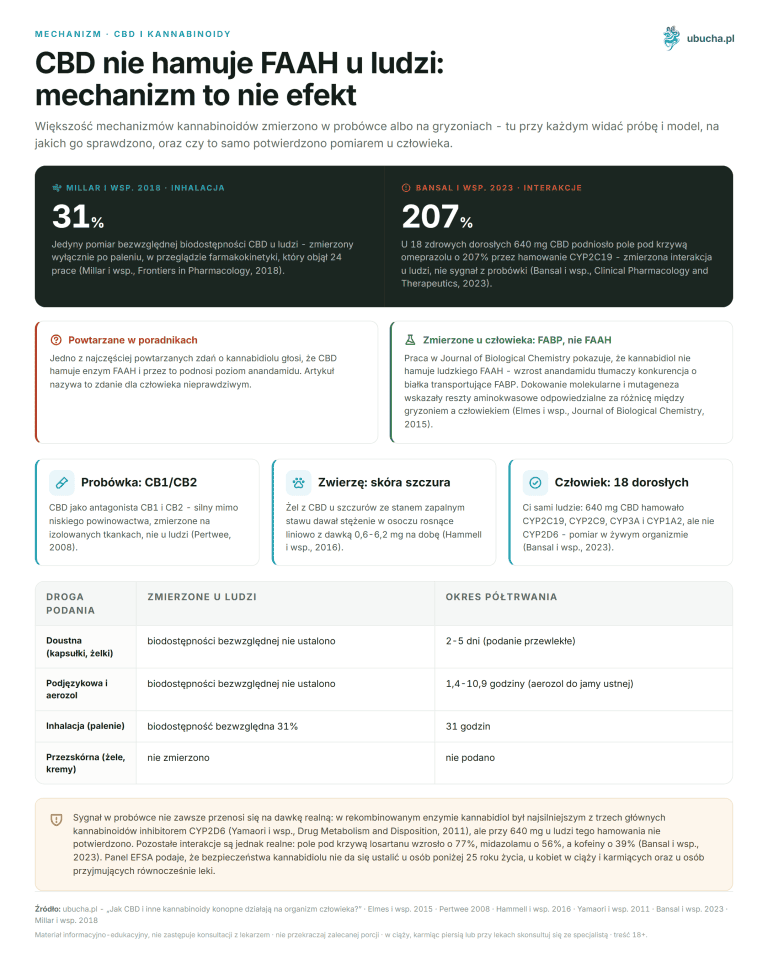
The most serious risk is the impact on the metabolism of other medications. In a study on the inhibition of liver cytochrome P450 enzymes by cannabinoids and their metabolites, it was shown that cannabidiol competitively inhibits CYP3A4, CYP2B6, CYP2C9, CYP2D6, and CYP2E1, and acts on CYP1A2 in a mixed manner (Nasrin et al. 2021).
These enzymes are responsible for the metabolism of many medications used chronically, including those for which a small change in blood concentration has clinical significance. Therefore, in any prescription treatment, the decision is made by a doctor or pharmacist, not by a seller or author of a guide. The time interval between the medication and the supplement does not eliminate this problem, as enzyme inhibition lasts longer than the presence of the substance in the digestive tract.
The second group of risks concerns the liver. In the EFSA assessment, animal studies showed consistent liver toxicity, with liver mass and histopathological changes as sensitive endpoints, and human studies indicated a potential hepatotoxicity, especially when used simultaneously with medications. Higher amounts have also been reported to cause gastrointestinal discomfort.
The panel also noted the penetration of cannabidiol through the placenta and accumulation in the body, long-term neurodevelopmental effects from prenatal exposure dependent on sex, and hormonal disturbances, including altered thyroid hormone levels. Immunotoxicity has not been studied at all, which the panel explicitly states. The lack of a study is not a reassuring result.
Is CBD legal in Poland?
Pure cannabidiol is not listed in controlled substances, and products from industrial hemp remain in legal circulation. The legality is determined by the raw material and the content of tetrahydrocannabinol in the plant material from which the product was made, not by the trade name or declared purpose.
The law defines industrial hemp as plants in which the sum of delta-9-THC and tetrahydrocannabinolic acid in flowering or fruiting tops, from which resin has not been removed, does not exceed 0.3 percent of dry weight, rounded to one decimal place. The basis is Article 4 point 5 of the Act of July 29, 2005 on Counteracting Drug Addiction (Journal of Laws 2023, item 1939), as amended by the Act of March 24, 2022 (Journal of Laws 2022, item 763).
It is worth distinguishing between two regulations with the same numerical value. The national threshold corresponds to the EU threshold, but it does not follow from it: the EU’s 0.3 percent for varieties eligible for support under the Common Agricultural Policy was introduced by Regulation 2021/2115, effective from January 1, 2023. The previous EU threshold was 0.2 percent.
A separate issue is the food status. Cannabidiol remains a subject of the novel food procedure in the European Union, and a health notification is not an authorization, while the EFSA position from 2026 is a safety assessment with conditions, not a clearance for food circulation. This also implies a ban on attributing therapeutic effects to such products and using unauthorized health claims.
This last principle explains the apparent inconsistency seen in every store. A product description cannot promise calming or improved sleep, as such claims for cannabidiol have not been authorized, while articles online speak of this directly. Therefore, if the product card promises an effect on stress, it is information from the seller, not about the product. A reliable offer instead of a promise shows the composition and the result of the batch test.
Frequently Asked Questions
How much CBD should I take for stress?
This article does not resolve and cannot resolve this. The numbers from studies describe specific experiments, not recommendations for the reader, and EFSA has stated that for people taking medications, pregnant, breastfeeding, and under 25 years of age, a safe amount cannot be determined today. Decide on the amount with your doctor.
What amount of CBD has been considered safe?
In 2026, EFSA derived a provisional safe dose of 0.0275 mg per kilogram of body weight per day, which is about 2 mg daily for a person weighing 70 kg. This value applies only to supplements with a purity of at least 98 percent, without nanoparticles. No safe amount has been established for other forms.
Does a higher dose work stronger for anxiety?
In the only study that compared several amounts in humans, no. Fifty-seven healthy men were given 150 mg, 300 mg, 600 mg, or placebo before a simulated public speaking event. Only the 300 mg dose reduced anxiety, while the other two did not differ from placebo.
Does CBD lower cortisol?
Not in the way it is usually summarized. In a 1993 study of eleven healthy volunteers, morning cortisol levels dropped according to the daily rhythm in sessions with placebo, and after cannabidiol, this drop was significantly weakened. The authors speak of interference with cortisol secretion, not its reduction.
How long did the studies on CBD and anxiety last?
From one laboratory session to three months. The longest observation is a retrospective review of the documentation of 72 patients from a psychiatric clinic, without a control group, in which most continued their previous medications. The authors themselves state that controlled studies are needed.
Is there tolerance to CBD?
It is unknown. There is no study that has checked whether the effects of cannabidiol weaken over time in humans or compared continuous use with intermittent use. Circulating percentages of people losing response after a certain number of weeks have no source in the literature, and receptor explanations are transferred by analogy.
Can CBD be combined with anti-anxiety medications?
Not without consultation. In a study on inhibiting liver enzymes, cannabidiol competitively inhibited CYP3A4, CYP2B6, CYP2C9, CYP2D6, and CYP2E1, which are enzymes responsible for the metabolism of many drugs. EFSA stated that for people taking medications, the safety of cannabidiol cannot be determined.
Is CBD legal in Poland?
Yes, as long as the product comes from industrial hemp. The law defines them by the sum of delta-9-THC and tetrahydrocannabinolic acid not exceeding 0.3 percent of dry weight, rounded to one decimal place. Cannabidiol is not listed in controlled substances, but it is also not authorized as a novel food.
What does this mean for the reader?
The evidence available today is much more modest than guides suggest. A few small experiments showed a reduction in anxiety after a single large dose in a public speaking situation, one observational series without a control group described improvement in patients simultaneously taking medications, and the safety assessment from 2026 indicated an amount lower than those by two orders of magnitude.
From such a set, it is not possible to honestly derive a plan for the reader, and no one who does so is basing it on the literature. However, three practical conclusions can be drawn: increasing the amount on your own has no support in results, the decision regarding any medications belongs to the doctor, and in cases of heightened anxiety, the first step is diagnosis, not purchase.
If you still want to try, treat it as an experiment on one person, conducted with recording and a reasonable time horizon. Then you will at least learn something about yourself, not about the effectiveness of advertising.
This article is for informational and educational purposes and does not constitute medical advice. Before starting to use cannabis or CBD for therapeutic purposes, consult your doctor, especially if you are taking other medications, are pregnant, or breastfeeding.
Author: Michał Waluk · Published: 2026-05-11 · Updated: 2026-08-10