
Lion’s mane gummies: an effective form of lion’s mane and who they are best for
Three lion's mane gummies in the offer, prices, and the cost of a daily serving. We check what the declaration of 4000 mg really means and who this form is worth it for.
Lion’s mane (Hericium erinaceus) reached gummies faster than studies on this form of administration were conducted. Manufacturers print numbers in the range of several thousand milligrams on the packaging, while clinical studies worked with three grams of dried powder daily for sixteen weeks. These two numbers look similar but describe completely different things, and this misunderstanding underpins most of the marketing of functional mushrooms. In the store u Bucha, there are three gummy products with lion’s mane and three other forms of the same mushroom. Below, we break them down: what the label declaration really means, how much a daily serving costs in each form, and who the gummy is actually worth it for.
KEY INFORMATION
• Cognitive improvement was shown with 3 g of powder daily for 16 weeks (Mori et al., Phytotherapy Research, 2009).
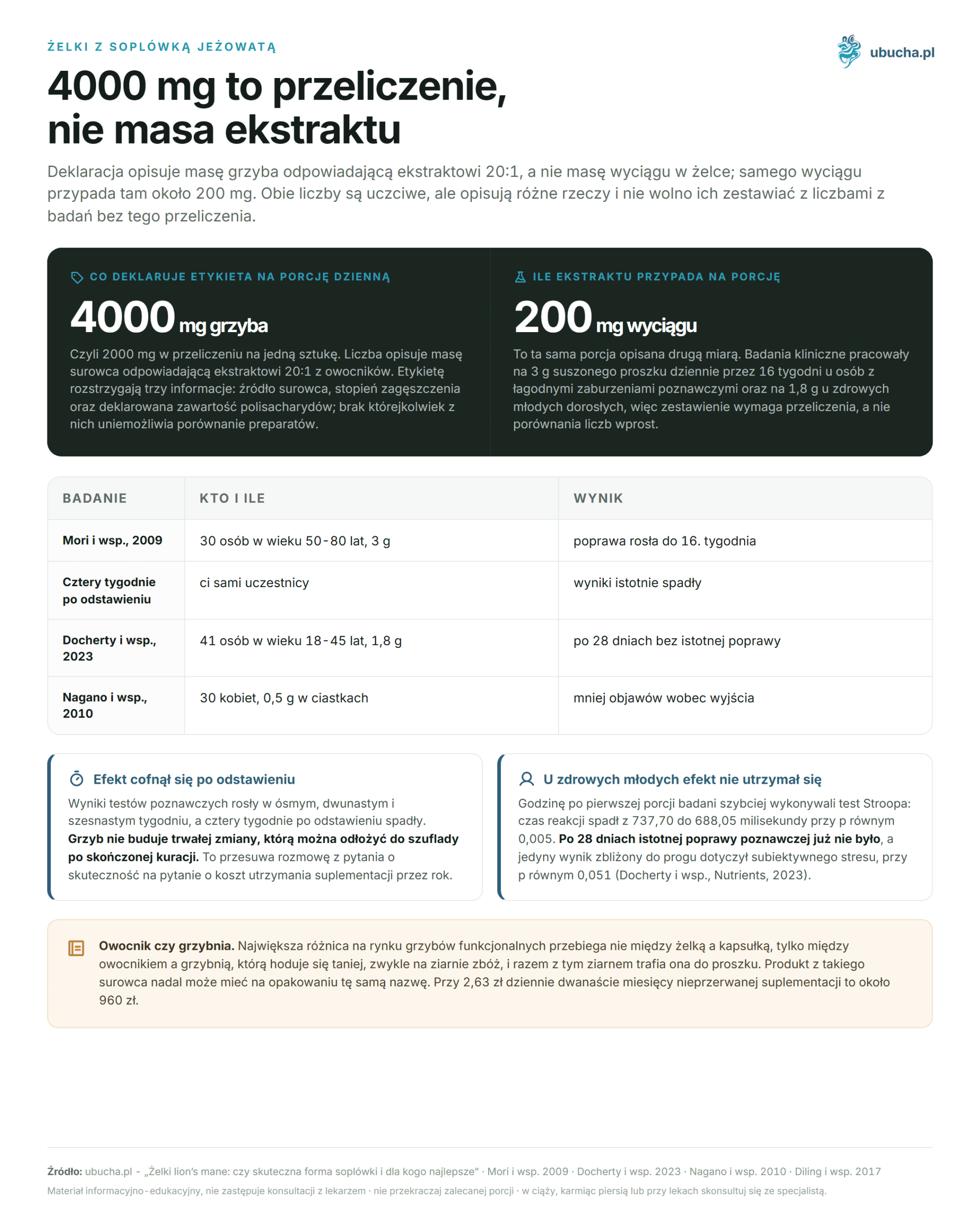
• The declaration of 4000 mg of lion’s mane refers to the mass of the mushroom calculated from a 20:1 extract, which is about 200 mg of extract.
• Three gummy products with lion’s mane, starting at 78.97 PLN for 30 servings (as of August 8, 2026).
• The effect diminishes after discontinuation, so the cost of a year matters, not the packaging.
How does lion’s mane affect the brain?
Lion’s mane stimulates the synthesis of NGF, or nerve growth factor, through two groups of compounds: hericenones from fruiting bodies and erinacines from mycelium. NGF keeps cholinergic neurons alive, and those same cells degenerate in Alzheimer’s disease. This is the basis of the entire hypothesis regarding the cognitive action of this mushroom.
The first clinical study was conducted by Mori et al. (Phytotherapy Research, 2009). Thirty people aged 50-80 with mild cognitive impairment received four 250 mg tablets of 96% dried mushroom powder three times a day for 16 weeks, totaling 3 g per day. Cognitive test results increased in the eighth, twelfth, and sixteenth weeks, and the difference from placebo grew over time. Four weeks after discontinuation, results dropped.
This last observation says more about lion’s mane than the effect itself. The mushroom does not create a lasting change that can be put away in a drawer after the treatment is finished. It works as long as you take it, and this shifts the entire conversation from a question of effectiveness to a question of the cost of maintaining supplementation for a year. We will return to this when discussing prices.
The influence of lion’s mane on the remyelination of peripheral nerves and its anti-inflammatory effects have also been described. These pathways have been mainly studied in animals, so treat them as hypotheses rather than descriptions of what happens after eating two gummies. We have compiled the remaining clinical trials on lion’s mane, along with the populations and dosages used, in a guide to lion’s mane extract.
Do lion’s mane gummies work the same as powder?
The form of administration does not determine anything by itself. What matters is how much and what kind of raw material the manufacturer has put into the gummy. A well-described gummy with fruiting body extract provides the same compounds as a capsule, while a poorly described one mainly provides sugar and a growth medium.
The biggest difference in the functional mushroom market is not between gummies and capsules, but between fruiting bodies and mycelium. The fruiting body is the part of the mushroom that you recognize as a mushroom. Mycelium is grown cheaper, usually on grain, and along with that grain, it ends up in the powder. A product from such raw material can still have the label lion’s mane on the packaging.
The label determines this with three pieces of information. The first is the source of the raw material, stated directly as fruiting body extract. The second is the degree of concentration, for example, 20:1 or 25:1. The third is the declared content of polysaccharides or beta-glucans in percentages. The absence of any of these means that comparison with another preparation is impossible because it is unclear what you are comparing.
We noticed while reviewing labels in our offer that the most misleading term is not mycelium, but the abbreviation mg. The declaration of 4000 mg of lion’s mane in a daily serving describes the mass of the mushroom calculated from a 20:1 extract, not the mass of the extract in the gummy. The extract itself is about 200 mg. Both numbers are honest, but they describe different things, and they should not be compared with numbers from clinical studies without this conversion.
Which lion’s mane gummies can you find in the store u Bucha?
There are three gummy products with lion’s mane in the offer, all from the SOOL line and all based on a 20:1 extract from fruiting bodies. Each package contains 60 pieces divided into 30 servings of two gummies. They differ in sweetening base, flavor, and how much lion’s mane is in the daily serving.
| Place | Product | What distinguishes it | Price | Cost per 1000 mg of lion’s mane |
|---|---|---|---|---|
| 1 | Lion’s Mane Mushroom Vegan Gummies 60 pcs | 4000 mg of lion’s mane per serving, natural mushroom flavor, base of sugar and glucose syrup | 78.97 PLN | 0.66 PLN |
| 2 | Lion’s Mane Mushroom Berry Gummies 60 pcs | same dose without added sugar, base of maltitol and sorbitol, forest fruit flavor | 83.89 PLN | 0.70 PLN |
| 3 | 4 Mushroom Complex Vegan Gummies 60 pcs | four species of mushrooms at 1000 mg per serving, lion’s mane is one fourth of the dose | 89.96 PLN | 3.00 PLN |
Prices are from the store u Bucha, as of August 8, 2026.
The last column shows why the four mushroom complex ranks third despite the highest packaging price. The manufacturer divided the dose evenly among four species, 1000 mg each. Therefore, you pay over four times more for lion’s mane than in the single-species product, and in return, you get species that this article does not cover. This is a sensible choice for someone looking for a blend, and a poor choice for someone who came for lion’s mane.
The choice between the first two products comes down to the base. The vegan variant is based on sugar and glucose syrup, while the Berry variant is based on maltitol and sorbitol, i.e., polyols. Polyols are not sugar in the sense of the label, but they are still carbohydrates and can cause issues in larger amounts.
How much does a daily serving of lion’s mane cost in each form?
A daily serving of lion’s mane costs in our offer from 2.63 PLN to 4.97 PLN, depending on the form. Gummies, contrary to intuition, are not the most expensive here. The most expensive is functional cocoa, as you also pay for the other four species of mushrooms and for the cocoa itself. What these other species contribute and how much their daily serving costs is detailed in the text about adaptogenic mushrooms.
The gap is smaller than the difference in packaging prices would suggest. Divine Lion’s Mane drops cost 95.00 PLN, which is more than any of the gummy packages, but the manufacturer divides the 50 ml bottle into servings of 1.5 ml, which gives 33 servings instead of 30. The daily cost comes out to 2.85 PLN, which is exactly between the two gummy variants.
The fourth form, Aura Care oil macerate for 129.00 PLN, was excluded from this comparison due to arithmetic, not price. The manufacturer defines the daily serving as 32 drops, but does not specify how many servings are in the 50 ml bottle, and the number of drops per milliliter depends on the oil’s density and the dropper. Calculating the daily cost would require guessing, so we do not calculate it.
The annual calculation looks different from the daily calculation. At 2.63 PLN per day, twelve months of uninterrupted supplementation is about 960 PLN. Since the effect in the Mori study receded four weeks after discontinuation, this number, rather than the price of a single package, describes the real cost of starting with lion’s mane.
How many milligrams of lion’s mane do you need daily?
Clinical studies worked with two levels: 3 g of dried powder daily in people with mild cognitive impairment and 1.8 g in healthy young adults. A serving of two gummies declares 4000 mg of mushroom calculated from the extract, so it falls within the same order of magnitude.
The second of these studies needs to be known in full, as it is sometimes cited selectively. Docherty et al. (Nutrients, 2023) administered 1.8 g of lion’s mane daily to 41 healthy individuals aged 18-45 for 28 days. An hour after the first dose, participants performed the Stroop test faster: reaction time decreased from 737.70 to 688.05 milliseconds (p = 0.005). After 28 days, there was no significant cognitive improvement, and the only result close to the threshold concerned subjective stress (p = 0.051).
This is a warning against excessive expectations. In healthy young people, lion’s mane did not achieve in four weeks what it did in people over fifty with cognitive impairment in sixteen weeks. If you are 28 years old and have full cognitive function, the reference point is rather Docherty than Mori.
Practically, this means one thing: one serving of two gummies daily corresponds to what the manufacturer declares, and there is no reason to increase it. Doubling the serving doubles the cost and the sweetening base, and there is no study showing an advantage of doses higher than 3 g per day.
Who are lion’s mane gummies the best choice for?
The gummy wins where the outcome depends on regularity rather than dose height. Lion’s mane in powder has an earthy, distinctly mushroom taste, and a supplement that one does not like the taste of is often discontinued after two weeks. The candy format removes this problem, and that is its true advantage.
- Travelers or those working away from home: you can take a gummy without water, measuring, or mixing powder in a cup.
- People with difficulty swallowing capsules, for whom a tablet is a real barrier.
- Those starting with adaptogens who want to first check if they can maintain a daily serving for eight weeks.
- People over fifty, as this age group showed the clearest cognitive effects in studies.
The gummy loses in three situations. If you are limiting simple sugars, the variant with sugar and glucose syrup adds them to your day, and the variant with polyols adds substances that can harm some people’s intestines. If you want a higher dose than declared, gummies become expensive faster than powder. Finally, if you care about standardization expressed in percentages of active compounds, you are more likely to find it on the labels of powdered extracts.
Lion’s mane gummies are also not a product for children. The manufacturer of the SOOL line states this directly, and there are simply no studies on lion’s mane in children. If you are looking for gummies with another active ingredient, we compared forms separately in vitamin gummies.
What does lion’s mane do to the gut microbiome?
The best-documented effect of lion’s mane on the gut was described by Diling et al. (Frontiers in Immunology, 2017), and it concerns protein, not polysaccharides. The protein HEP3 isolated from the mushroom restored the diversity of the microbiota destroyed by cyclophosphamide in mice.
In the same study, HEP3 increased the numbers of Bifidobacterium and Lactobacillus bacteria while decreasing Bacteroides and Desulfovibrio. The authors describe this effect as prebiotic. It should be noted that there are two limitations: it is an animal model, and the starting point was an intestine damaged by chemotherapy, not a healthy intestine.
The version of this work repeated on the internet speaks of beta-glucans feeding gut bacteria. Beta-glucans are indeed present in lion’s mane and are indeed prebiotics, but this study specifically concerned the protein fraction. This distinction matters because products standardized on polysaccharides are not standardized on HEP3, and no one declares its content on the label.
The gut-brain axis offers an enticing explanation for why some people report an improvement in mood after lion’s mane faster than an improvement in memory. Enticing does not mean proven. As of now, it is a bridging hypothesis between two sets of studies, neither of which measured both things simultaneously in humans. If you are reaching for lion’s mane mainly with gut health in mind, the gummy form has no advantage over any other: the raw material matters, not the packaging.
Does lion’s mane improve mood?
One clinical study measured this directly. Nagano et al. (Biomedical Research, 2010) administered cookies with 0.5 g of fruiting body powder to thirty women with an average age of 41.3 years for four weeks. After this time, the severity of depressive symptoms and the number of unspecified ailments decreased compared to baseline values.
The scale of this study warrants caution. Thirty people, four weeks, and a dose of 0.5 g daily, which is six times lower than in Mori. Improvement was observed in subscales concerning concentration, irritability, and anxiety, but not in clinically diagnosed depression, as there were no such patients in the study.
On the other hand, the result from Docherty et al. in 2023 indicates that after 28 days in healthy young adults, the reduction in subjective stress did not reach significance (p = 0.051). Two studies, two different populations, and two results close to the threshold. This is the honest state of knowledge as of today.
Moreover, Nagano et al. used fruiting body powder baked in cookies, not a 20:1 extract in a gummy. Transferring this result to any product labeled lion’s mane is a shortcut that the data do not allow. The practical conclusion remains clear: lion’s mane is not an antidepressant and does not replace a psychiatrist or psychotherapist. If low mood persists for weeks, start with a specialist.
Is long-term use of lion’s mane safe?
Data from clinical studies extend to 16 weeks, and within this window, no significant adverse effects or deviations in laboratory results were reported. Beyond this period, there is no data. Lion’s mane is also an edible mushroom, present in Asian cuisine for centuries, which in itself speaks for good tolerance.
Three situations require a conversation with a doctor before starting. The first is an allergy to mushrooms, as cross-reactions are possible. The second is an autoimmune disease or immunosuppressive treatment, as the described immunomodulatory effect may interfere here. The third is pregnancy and breastfeeding, where safety data simply do not exist, and the manufacturer of the SOOL line explicitly excludes these groups.
Our observations from conversations with customers indicate that the question of breaks in supplementation arises more often than the question of dosage. The answer does not stem from studies, as none have tested it. A break once a quarter makes practical sense, not pharmacological: it allows you to check whether the effect attributed to lion’s mane actually disappears without it.
A separate issue is the gummy base. With daily use for a year, we are talking about two gummies times 365, so the composition of the base stops being a detail and starts being a position in the diet. You can find the full offer of supplements, including in other forms of administration, in the supplements category.
Frequently asked questions
Do lion’s mane gummies work?
They work to the extent that the raw material contained in them works. Cognitive improvement was shown with 3 g of dried powder daily for 16 weeks in people with mild cognitive impairment (Mori et al., Phytotherapy Research, 2009). A serving of two gummies with a 20:1 extract falls within the same order of magnitude.
How much lion’s mane is in one serving of gummies?
The manufacturer of the SOOL line declares 4000 mg of lion’s mane in a daily serving, which is two gummies, and 2000 mg when calculated per piece. This number describes the mass of the mushroom corresponding to a 20:1 extract from fruiting bodies, not the mass of the extract itself, which is about 200 mg per serving.
How do gummies differ from capsules and powder?
In terms of active ingredients, nothing, if the extract is the same. They differ in base, price per milligram, and convenience. A gummy adds sugar or polyols and cannot be split in half, but it does not require water or measuring. Powder and capsules allow for higher doses at a lower cost.
How long does it take to see the effects of lion’s mane?
In the study by Mori et al. from 2009, the difference from placebo appeared in the eighth week and increased until the sixteenth. In healthy young adults, 28 days was not enough for a significant cognitive improvement (Docherty et al., Nutrients, 2023). Plan for at least eight weeks before assessing anything.
Who are lion’s mane gummies best for?
For those who dislike the earthy taste of powder, for travelers, and for those who have difficulty swallowing capsules. The greatest cognitive effects were shown in studies involving people aged 50-80 with mild cognitive impairment. Gummies are not intended for children or pregnant women.
Does lion’s mane have side effects?
In studies lasting up to 16 weeks, no significant adverse effects or laboratory deviations were reported. Rare reactions described include allergies in individuals sensitive to mushrooms and gastrointestinal discomfort at higher doses. Consult a doctor before use if you have autoimmune diseases, are on immunosuppressive medications, or are pregnant.
Three products with lion’s mane, a complete price list, and other formats can be found in the gummies category.
This article is for informational and educational purposes. It contains internal links to product categories available in the store u Bucha. Prices and specifications may change: check the current data on the product page before purchasing.
Author: Michał Waluk · Published: 2026-05-20 · Updated: 2026-08-08