
Potassium: deficiency, symptoms and how to safely supplement (FAQ)
What are the symptoms of potassium deficiency, where does it come from, and why can supplementation without a blood test be risky. EFSA norms and data from clinical studies.
Potassium is an ion, most of the body’s pool of which is located inside cells, with only a small part circulating in the blood. It is this small fraction that determines the excitability of nerve and muscle cells, which is why deviations in either direction cause cardiac symptoms, not just discomfort. EFSA has established the adequate intake of potassium for adults at 3500 mg per day, basing this value on the relationship between potassium intake and blood pressure and the risk of stroke (EFSA, Dietary reference values for potassium, 2016). Below, we answer the most common questions: where does potassium deficiency come from, how to recognize it, how much of this element is actually needed, and in what situations supplementation makes sense, and in which it can be a source of risk.
KEY INFORMATION
• The adequate intake of potassium for adults according to EFSA is 3500 mg per day; intake below this value is associated with a higher risk of stroke (EFSA, 2016).
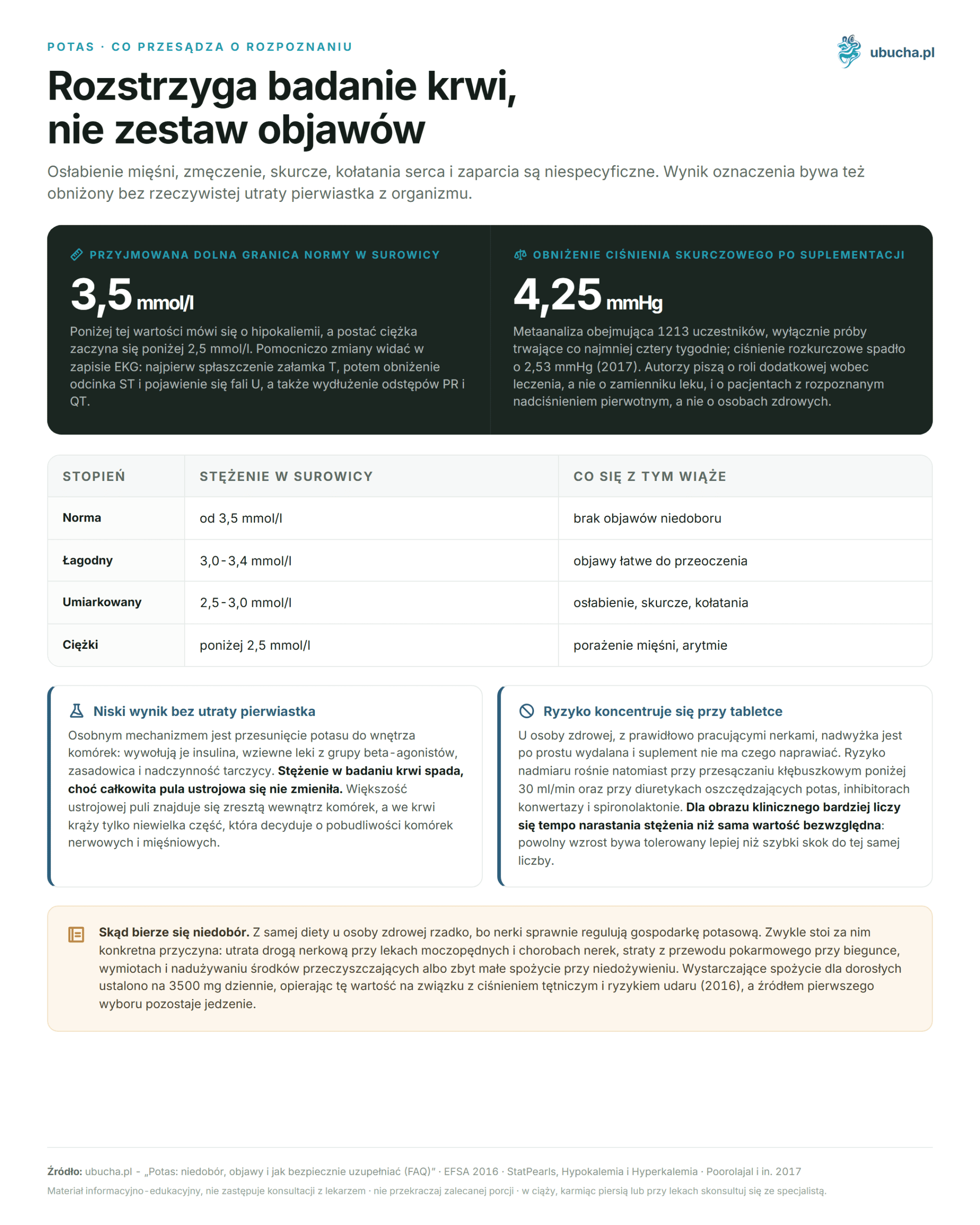
• Hypokalemia is a serum potassium concentration below 3.5 mmol/l; the severe form starts below 2.5 mmol/l (StatPearls, Hypokalemia).
• Typical symptoms include muscle weakness, fatigue, cramps, palpitations, and constipation.
• The most common causes are diuretics, diarrhea, vomiting, and excessive use of laxatives.
• In a meta-analysis of 23 randomized studies, potassium supplementation lowered systolic blood pressure by 4.25 mmHg in individuals with primary hypertension (Poorolajal et al., PLoS One, 2017).
• Excess potassium is as dangerous as deficiency, and the risk increases with kidney disease and potassium-retaining medications.
Where does potassium deficiency come from and who is most at risk?
Deficiency rarely results from diet alone in a healthy person. The kidneys efficiently regulate potassium balance, so hypokalemia usually has a specific cause: either potassium is lost through the kidneys or the gastrointestinal tract, or it shifts from plasma into cells.
Renal loss is the most common scenario in cardiology patients. It is caused by diuretics, kidney diseases, and metabolic alkalosis. The second major group consists of losses from the gastrointestinal tract: diarrhea, vomiting, and excessive use of laxatives, which can be an overlooked cause of deficiency in individuals with eating disorders (StatPearls, Hypokalemia).
A separate mechanism is the shift of potassium into cells, without actual loss from the body. This is triggered by insulin and inhaled medications from the beta-agonist group, as well as metabolic alkalosis and hyperthyroidism. The concentration in blood tests decreases, although the total body pool has not changed. Additionally, there is simply too low intake, which is directly mentioned in cases of malnutrition and eating disorders. If you are interested in a broader context of water-electrolyte balance, check out the post about when and how much electrolytes are really needed.
How to recognize potassium deficiency?
It cannot be reliably recognized by symptoms alone, as they are nonspecific, but their combination can be characteristic. Muscle weakness, fatigue, cramps, palpitations, and constipation are mentioned. In severe cases, muscle paralysis, respiratory failure, and heart rhythm disturbances occur, which, if untreated, can lead to death.
The severity of symptoms correlates with serum concentration. The accepted lower limit of the norm is 3.5 mmol/l. The mild form is described by the range of 3.0-3.4 mmol/l, moderate 2.5-3.0 mmol/l, and severe values below 2.5 mmol/l (StatPearls, Hypokalemia).
| Degree | Serum potassium concentration | Associated symptoms |
|---|---|---|
| Normal | from 3.5 mmol/l | no deficiency symptoms |
| Mild | 3.0-3.4 mmol/l | subtle symptoms, easy to overlook |
| Moderate | 2.5-3.0 mmol/l | weakness, cramps, palpitations |
| Severe | below 2.5 mmol/l | muscle paralysis, heart rhythm disturbances |
A blood test determines the diagnosis, not an interview. Changes can also be seen in the EKG: first, flattening of the T wave, then lowering of the ST segment and appearance of the U wave, as well as prolongation of the PR and QT intervals. In severe cases, dangerous arrhythmias are described, including torsades de pointes and ventricular tachycardia.
How much potassium do you need and where is the best source?
The reference point for adults is an adequate intake level of 3500 mg per day. EFSA based this value on two types of evidence: randomized studies and an observational cohort study in the European population, showing the beneficial impact of such intake on blood pressure, and on consistent cohort data linking intake below 3500 mg per day with a higher risk of stroke (EFSA, 2016).
The first choice source is food, not a pill. Potassium is abundant in vegetables and fruits, with bananas, oranges, and spinach being specifically mentioned; it promotes sodium excretion, which is one of the pillars of the DASH diet (StatPearls, The DASH Diet).
In the same diet, sodium is also limited, to 2300 mg per day in the basic variant and to 1500 mg in the low-sodium variant recommended for hypertension. Reported reductions in systolic blood pressure range from 1 to 13 mmHg, and diastolic from 1 to 10 mmHg; simply reducing sodium from 2300 to 1500 mg additionally gives about 2-7 mmHg of systolic pressure. It is worth noting that the benefit is attributed to the entire dietary pattern, not a single component.
Does potassium supplementation lower blood pressure?
In individuals with primary hypertension, yes, although the effect is moderate. In a meta-analysis of 23 randomized studies, involving a total of 1213 participants, oral potassium supplementation lowered systolic blood pressure by an average of 4.25 mmHg compared to placebo, and diastolic by 2.53 mmHg. Only trials lasting at least four weeks were included in the analysis (Poorolajal et al., PLoS One, 2017).
The authors of this study describe potassium supplementation as safe, with no significant adverse effects, and indicate that it may be considered as an adjunctive treatment for hypertension in patients with primary hypertension. It is important to note the wording: it refers to an additional role alongside treatment, not as a substitute for medication, and to a population of patients with diagnosed hypertension, not healthy individuals.
The practical difference between these two situations is fundamental. In a healthy person, with properly functioning kidneys, excess potassium is simply excreted, and the supplement has nothing to correct. In a treated person with hypertension, the decision lies with the doctor, as it depends on the medications used and the results of electrolyte measurements. A similar principle applies to other minerals, which we discuss in the context of choosing the form of magnesium.
When is there too much potassium and who is at risk?
Hyperkalemia is a concentration exceeding the upper limit of the norm, usually given as 5.0-5.5 mEq/l. The most serious complication is life-threatening heart rhythm disturbances. Changes in the EKG increase with concentration, from peaked T waves at lower values to arrhythmias and cardiac arrest above 8-10 mEq/l (StatPearls, Hyperkalemia).
It is important to note that for the clinical picture, the rate of increase in concentration matters more than the absolute value itself. A slow increase may be tolerated better than a rapid spike to the same number.
The risk concentrates in several groups. The first is impaired renal excretion, in acute and chronic kidney disease, with the risk clearly increasing when glomerular filtration drops below 30 ml/min. The second is medications that disrupt potassium balance: potassium-sparing diuretics, renin-angiotensin-aldosterone system inhibitors along with ACE inhibitors, and spironolactone. The third is excessive potassium intake and its shift from cells during rhabdomyolysis, metabolic acidosis, and tumor lysis syndrome. This is why self-supplementation can be risky, especially for those who most often reach for it. More about what is safe and what to avoid in older age can be found in the post about supplements for seniors.
Frequently Asked Questions
What are the first symptoms of potassium deficiency?
The most commonly mentioned are muscle weakness, fatigue, cramps, palpitations, and constipation. They are nonspecific, so they do not definitively indicate a diagnosis. In severe cases, muscle paralysis, respiratory failure, and heart rhythm disturbances requiring urgent medical assistance occur.
At what concentration do we talk about hypokalemia?
The accepted lower limit of the norm is 3.5 mmol/l. The mild form includes the range of 3.0-3.4 mmol/l, moderate 2.5-3.0 mmol/l, and severe values below 2.5 mmol/l. Diagnosis is made based on the measurement of electrolytes in serum, not based on symptoms alone.
Can I supplement potassium without a blood test?
It is not advisable. Both deficiency and excess of potassium lead to heart rhythm disturbances, and without measuring electrolytes, it is unknown which side of the norm you are on. The risk is highest in people with kidney disease and those taking potassium-retaining medications.
Why do diuretics cause potassium deficiency?
Because they increase potassium loss through the kidneys, which is directly mentioned among the causes of hypokalemia alongside kidney diseases and metabolic alkalosis. For this reason, diuretic treatment requires periodic monitoring of electrolytes, and the decision to possibly supplement potassium is made by the attending physician.
Does potassium supplementation lower blood pressure?
In a meta-analysis of 23 randomized studies, involving 1213 participants, it lowered systolic blood pressure by an average of 4.25 mmHg compared to placebo, and diastolic by 2.53 mmHg. This applied to individuals with primary hypertension, and the authors describe this role as supportive of treatment, not a replacement for it.
Does a ketogenic diet increase the risk of potassium deficiency?
It may increase the risk because it limits fruits, legumes, and potatoes, and too low intake is mentioned as a cause of hypokalemia. The solution is to choose potassium-rich vegetables with low carbohydrate content. If cramps and palpitations persist, it is advisable to measure electrolytes.
When does potassium become dangerous in the other direction?
When it exceeds the upper limit of the norm, usually given as 5.0-5.5 mEq/l. This poses a risk of arrhythmias, and above 8-10 mEq/l, cardiac arrest. The risk increases with kidney disease, especially when glomerular filtration drops below 30 ml/min, and with potassium-retaining medications.
Mineral and vitamin preparations can be found in the category of supplements.
This article is for informational and educational purposes and does not constitute medical advice. Before starting supplementation, consult your doctor, especially if you are taking medications regularly, are pregnant or breastfeeding, or have a chronic illness.
Author: Michał Waluk · Published: 2026-08-09 · Updated: 2026-08-11