
Hempcrete (hemp concrete): a hemp alternative in construction
Hempcrete, or hemp concrete: measured lambda and specific heat values, the real CO2 balance of the wall, and the legal basis for cultivation and construction in Poland.
A wall made of hemp and lime, which remains positive in the carbon dioxide balance over a hundred years of building use, sounds like a marketing slogan. Meanwhile, it is a calculated value from a peer-reviewed life cycle analysis and is less impressive than what is repeated in Polish internet. A layer of numbers without sources has grown around hempcrete: sometimes thermal conductivity is better than mineral wool, sometimes absorption is given per cubic meter instead of per square meter of wall. The difference is not trivial for purists, as a cubic meter of material is over three square meters of wall, so the same number can inflate the calculation threefold. Below, I leave only values that someone has measured and published, I add the legal basis for cultivation and construction in Poland, and next to each number, I write what it specifically refers to and where it comes from.
KEY INFORMATION
• One square meter of a hemp-lime wall 300 mm thick binds 82.7 kg of CO2, and the net balance over a hundred-year life cycle is a reduction of 36.08 kg of CO2 equivalent (Ip et al., Resources, Conservation and Recycling 2012).
• The measured thermal conductivity of hemp-lime mixtures ranges from 0.087 to 0.161 W/(m·K), depending on the recipe and work.
• Hempcrete is not a load-bearing material: compressive strength is 0.09-0.57 MPa.
• The production of building materials is a legally permitted purpose of hemp cultivation (Article 45, paragraph 3, point 5 of the Act on Counteracting Drug Addiction).
What is hempcrete and what is it made of?
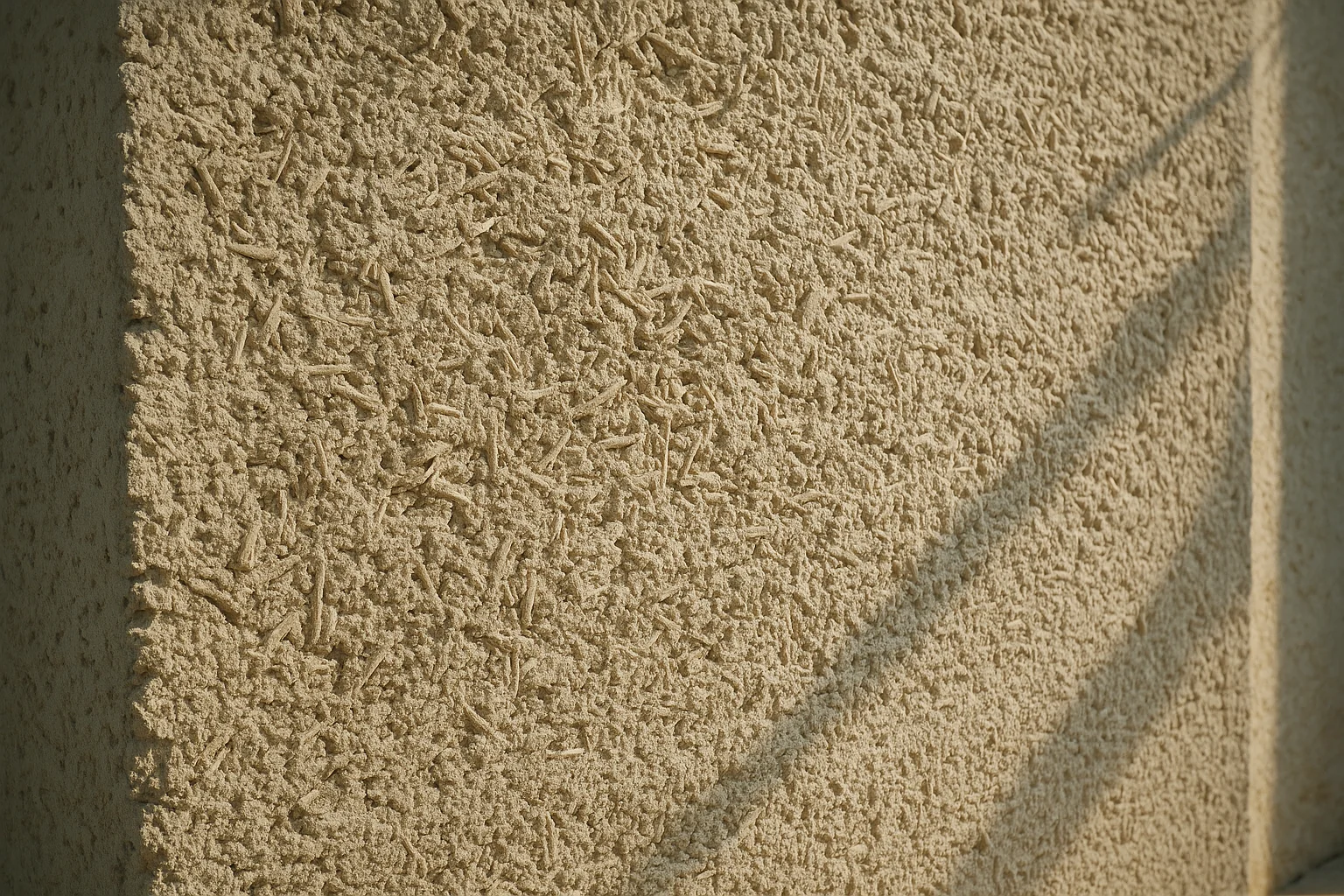
Hempcrete, in Polish hemp concrete or hemp beton, is a composite made of three ingredients: hemp shives, lime as a binder, and water. Shives are the woody core of the stem, left after separating the bast fiber. For decades, they were treated as waste from fiber processing; today, they are a raw material in their own right.
The mixture is poured into formwork or manually tamped around a load-bearing frame, either wooden or steel. Lime binds the shive particles into a cohesive mass and over time carbonizes, meaning it rebuilds calcium carbonate from carbon dioxide taken from the air. This second process is slow and continues long after construction is completed, which is significant for the emission balance described later.
The most important limitation comes directly from measurement. Abdellatef and colleagues studied mixtures with a binder to hemp ratio of 1:1 and a density of 300-400 kg/m3, considering them suitable for insulating wall infills. The compressive strength in their samples ranged from 0.09 to 0.57 MPa (Abdellatef et al., Materials 2020). For scale comparison: this is an order of magnitude below the values required for load-bearing elements. Hemp concrete fills and insulates, it does not carry, and every project must assume this from the first line.
What properties of hempcrete have been truly measured?
Four parameters have published numerical values: thermal conductivity, specific heat, compressive strength, and moisture buffering capacity. The variation between studies is significant because hempcrete is not a single material but a family of recipes with different binder content and densities.
| Parameter | Measured Value | Study |
|---|---|---|
| Density of insulating mixture | 300-400 kg/m3 | Abdellatef 2020 |
| Thermal conductivity lambda | 0.087-0.10 W/(m·K) | Abdellatef 2020 |
| Thermal conductivity lambda | 0.117-0.161 W/(m·K) | Benfratello 2013 |
| Compressive strength | 0.09-0.57 MPa | Abdellatef 2020 |
| Specific heat | 1250-1557 J/(kg·K) | Abdellatef 2020 |
| Moisture buffering (MBV) | 2.78 g/(m2·%RH) | Abdellatef 2020 |
The variation in thermal conductivity is instructive. Benfratello and colleagues measured values from 0.117 to 0.161 W/(m·K) in their mixtures (Benfratello et al., Construction and Building Materials 2013), which is clearly above the values provided by Abdellatef’s team. Both studies are peer-reviewed and both measured real samples, just with different compositions. Therefore, any number given for hempcrete without specifying density and recipe is incomplete.
Specific heat is more interesting, ranging from 1250 to 1557 J/(kg·K). High heat capacity means that the wall heats up slowly and releases heat slowly, thus smoothing daily temperature fluctuations. Additionally, there is moisture buffering: the average value of 2.78 g/(m2·%RH) was described in this study as excellent buffering capability. The wall absorbs moisture from the indoor air and releases it when the air dries out, without mechanical involvement.
Does hempcrete really absorb more CO2 than it emits?
Yes, but the magnitude of the effect is less impressive than in popular descriptions and refers to a different unit. Ip and colleagues calculated the full life cycle of a hemp-lime wall under British conditions. The unit was 1 m2 of wall 300 mm thick with a wooden frame, and the horizon was 100 years.
This unit binds 82.7 kg of carbon dioxide. After subtracting emissions occurring throughout the life cycle of this wall, the net balance results in a reduction of 36.08 kg of CO2 equivalent. A number smaller than the absorbed mass is not a mistake, but the whole point of life cycle analysis: it shows how much of the absorbed carbon remains after paying the production bill.
We have noticed that in Polish texts, the same study is sometimes cited as 35-110 kg of CO2 per cubic meter of hempcrete and attributed to the Journal of Biobased Materials and Bioenergy. Both statements are false: the study was published in Resources, Conservation and Recycling, and its unit is a square meter of wall, not a cubic meter of material. Substituting the unit changes the result incomparably, as a cubic meter is over three square meters of a 300 mm thick wall.
The source of carbon in the wall is shown by the field calculation. The European Industrial Hemp Association assumes that one ton of harvested hemp straw corresponds to 1.6 tons of absorbed CO2, which, with a yield of 5.5-8 tons per hectare, gives 9-13 tons of CO2 per hectare of harvest (EIHA, Hemp a Real Green Deal). The same mechanism supports the argument for including hemp in crop rotation in organic farming.
Is it allowed to build with hemp in Poland?
Yes, and this is without resorting to interpretations. The Act on Counteracting Drug Addiction mentions in Article 45, paragraph 3, point 5 the production of composite and building materials among the permitted purposes of hemp cultivation. Therefore, cultivation for hemp concrete is directly included in the statutory catalog, not by analogy.
The raw material is exclusively industrial hemp, meaning plants in which the total delta-9-THC and tetrahydrocannabinolic acid content does not exceed 0.3% dry weight (Article 4, point 5, consolidated text Journal of Laws 2023 item 1939). The value of 0.2%, which still circulates in descriptions of hempcrete, ceased to be valid on May 7, 2022. The grower also needs to be registered in the register of industrial hemp producers, which is done by the director of the KOWR regional office within 14 days of a correct application (Article 47a, paragraph 2, Article 47b, paragraph 1, and Article 47c, paragraph 1).
The second layer of regulations concerns construction. Article 10 of the Construction Law (consolidated text Journal of Laws 2026 item 524) states that products manufactured for permanent use in a building can only be used in works if they have been placed on the market or made available in accordance with separate regulations, and building products additionally in accordance with their intended use. Therefore, the obstacle for hemp concrete is not drug law, but the ordinary path of introducing a building product to the market.
Where will hempcrete not work?
Everywhere the material is supposed to carry loads. A compressive strength of 0.09-0.57 MPa excludes foundations, columns, and load-bearing walls, so every building made of hemp concrete needs a separate wooden or steel frame. This raises costs and complicates the project compared to masonry solutions, where one element does both things at once.
The second barrier is chemical. Lime carbonizes slowly and absorbs carbon dioxide from the air, so the infill achieves its target parameters long after installation, not on the day of acceptance. Additionally, the moisture buffering capability is an advantage only when the partition allows this moisture to be released. Therefore, a wall made of hemp concrete requires a solution consistent with this mechanism, not one directly transferred from masonry technology.
The third issue is the variation of parameters. Two peer-reviewed studies provide ranges for thermal conductivity that do not overlap because they measured different recipes and densities. Therefore, a designer cannot take a value from a popular article and insert it into thermal calculations. They need data for a specific mixture from a specific supplier, and the rarer the material, the harder it is to obtain such data. The same difficulty arises during the acceptance of works, as verifying parameters then requires testing on samples from a specific batch, not referring to a catalog card.
Frequently Asked Questions
What is hempcrete made of?
It consists of three ingredients: hemp shives, lime as a binder, and water. Shives are the woody core of the stem left after separating the bast fiber. A mixture with a density of 300-400 kg/m3 is suitable for insulating wall infill, but not for load-bearing structural elements.
What is the thermal conductivity of hemp concrete?
It depends on the recipe and density. Abdellatef and colleagues measured values from 0.087 to 0.10 W/(m·K) in 2020, while Benfratello and colleagues measured from 0.117 to 0.161 W/(m·K) in 2013. Providing a single number for hempcrete without indicating density and mixture composition is imprecise.
How much CO2 does a hempcrete wall absorb?
One square meter of a 300 mm thick wall with a wooden frame binds 82.7 kg of carbon dioxide, and the net balance over a hundred-year life cycle is a reduction of 36.08 kg of CO2 equivalent in emissions. This value refers to one square meter of wall, not one cubic meter of material, and these two units are often confused.
Is hempcrete legal in Poland?
Yes. The production of building and composite materials is mentioned in Article 45, paragraph 3, point 5 of the Act on Counteracting Drug Addiction among the permitted purposes of hemp cultivation. The raw material must come from plants with a total delta-9-THC and THCA content not exceeding 0.3% dry weight, and the grower needs to be registered with KOWR.
Can a load-bearing wall be made of hempcrete?
No. The measured compressive strength ranges from 0.09 to 0.57 MPa, which is an order of magnitude below the values required for structural elements. Hemp concrete is used as insulating infill between wooden or steel frame elements that bear the loads.
Does a wall made of hemp and lime regulate humidity?
Yes, and this is a measured property, not a manufacturer’s claim. The average moisture buffering value for the tested samples was 2.78 g per square meter per percent relative humidity, which the authors described as excellent buffering capability. The wall absorbs excess water vapor and releases it when the air dries out.
This article is for informational and educational purposes and does not constitute legal advice. The legal status described in the article is valid as of the publication date: regulations regarding hemp may change. Before making decisions, consult a lawyer or current legal acts.
Author: Michał Waluk · Published: 2026-08-09 · Updated: 2026-08-11