
ADHD naturally: supplements and herbs that may support concentration alongside treatment
Omega-3, iron, zinc, magnesium, bacopa, and ginkgo biloba in ADHD: what studies show in people, what are the effect sizes, and where the role of the supplement ends.
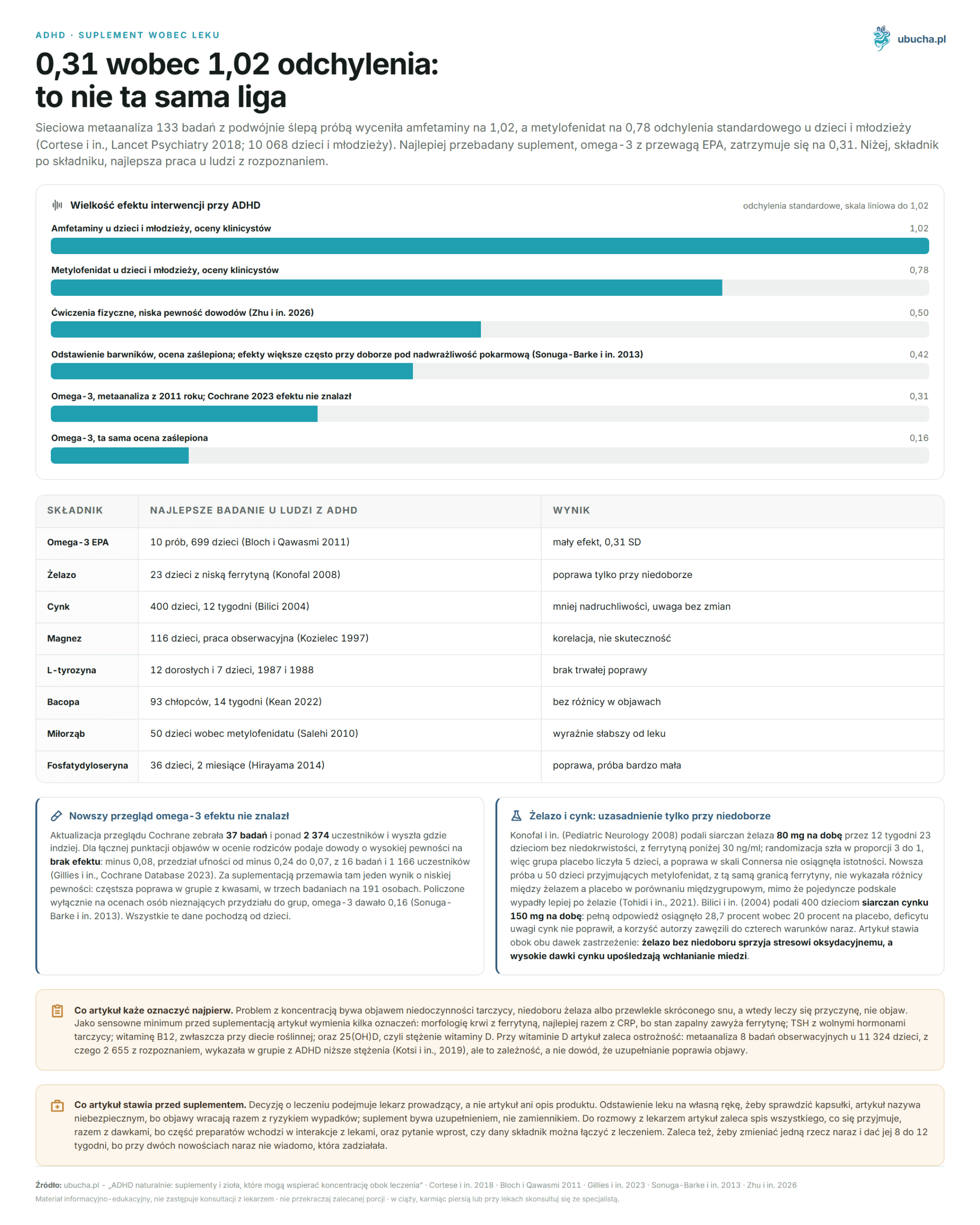
Type the phrase about ADHD without medication into a search engine, and you will get a list of capsules promising focus. Research says otherwise. A network meta-analysis of 133 trials rated ADHD medications at 0.78 to 1.02 standard deviations, while the best-studied supplement stops at 0.31. This is not the same league, and this text does not encourage swapping one for the other. We checked what has been realistically studied in people diagnosed with ADHD: how many people were involved, how long the study lasted, and whether attention was measured. Several popular ingredients have no such studies at all, and with omega-3, two meta-analyses contradict each other. At the end, you will find a list of tests worth doing beforehand.
KEY INFORMATION
• Omega-3 with a predominance of EPA gives an effect of 0.31 standard deviations in a meta-analysis of 10 studies involving 699 children (Bloch and Qawasmi, JAACAP 2011), but the Cochrane review from 2023, covering 37 studies, found no effect on symptoms rated by parents.
• Iron and zinc are justified only with confirmed deficiency from blood tests.
• Two trials of L-tyrosine in people with ADHD were negative.
• Physical exercise has stronger data today than any supplement on this list.
Can supplements replace medications for ADHD?
No, they cannot. ADHD is a clinical diagnosis, and pharmacotherapy has the best-documented effectiveness of everything studied so far. In a network meta-analysis of 133 double-blind studies, amphetamines achieved an effect of 1.02 standard deviations, and methylphenidate 0.78 in children and adolescents (Cortese et al., Lancet Psychiatry 2018).
In adults, the same work reports 0.79 for amphetamines and 0.49 for methylphenidate. The analysis included 10,068 children and adolescents and 8,131 adults. No supplement described below comes close to these values, and most have data from trials involving dozens of participants.
All these figures come from clinician assessments. In teacher assessments against placebo, only methylphenidate and modafinil remained significant, while amphetamines did not. Who assesses the child decides the outcome, and this returns throughout the text.
Thus, two things need to be said at the beginning, not hidden in a note at the end. The decision about treatment is made by the attending physician, not an article or product description. Discontinuing medication on your own to test capsules is dangerous, as symptoms return along with the risk of accidents. A supplement may be a complement, not a substitute.
The diagnosis is not rare. The pooled prevalence of ADHD in children and adolescents is 3.4% (Polanczyk et al., JCPP 2015). In adults, a separate meta-analysis reports 2.58% for the persistent form from childhood (Song et al., Journal of Global Health 2021).
Which ingredients have studies in people with ADHD, and which do not?
Most do, but the quality of these works varies drastically. Some are meta-analyses of hundreds of participants, while others are single trials with a few dozen people from forty years ago. This difference determines how much can be said about an ingredient, which is why we compiled the best available work for each.
| Ingredient | Best study in people with ADHD | Result |
|---|---|---|
| Omega-3 EPA | meta-analysis of 10 trials, 699 children (Bloch and Qawasmi 2011) | small effect, 0.31 SD |
| Iron | 23 children with low ferritin (Konofal et al. 2008) | improvement only with deficiency |
| Zinc | 400 children, 12 weeks (Bilici et al. 2004) | less hyperactivity, attention unchanged |
| Magnesium | 116 children, observational study (Kozielec et al. 1997) | correlation, not efficacy |
| L-tyrosine | 12 adults and 7 children, years 1987 and 1988 | no lasting improvement |
| Bacopa | 93 boys, 14 weeks (Kean et al. 2022) | no difference in symptoms |
| Ginkgo biloba | 50 children against methylphenidate (Salehi et al. 2010) | clearly weaker than the drug |
| Phosphatidylserine | 36 children, 2 months (Hirayama et al. 2014) | improvement, trial very small |
When reading similar compilations elsewhere, pay attention to one thing. Almost all these works were conducted in children, and conclusions are often transferred to adults without basis. It also works the other way: results from healthy volunteers are sometimes presented as evidence of efficacy in ADHD.
How strong is the evidence for omega-3 really?
Weaker than the most frequently repeated number suggests. The meta-analysis by Bloch and Qawasmi (JAACAP 2011) included 10 randomized placebo trials and 699 children, and the improvement in ADHD symptoms was 0.31 standard deviations, which the authors themselves called a modest effect compared to pharmacotherapy. This work is now fourteen years old.
An update of the Cochrane review gathered 37 studies and over 2,374 participants, which is several times more material, and came out differently. For the total symptom score in parent assessments, the authors provide high-certainty evidence of no effect: minus 0.08 with a confidence interval from minus 0.24 to 0.07, from 16 studies and 1,166 participants. The same result was found for inattention and hyperactivity with impulsivity (Gillies et al., Cochrane Database 2023). One result of low certainty supports supplementation: more frequent improvement in the group with acids, in three studies on 191 people.
From the meta-analysis by Bloch comes another observation: the higher the dose of EPA in the preparation, the stronger the effect. When Sonuga-Barke et al. (American Journal of Psychiatry 2013) calculated the same exclusively on assessments from people unaware of group assignments, the effect dropped to 0.16 and remained significant, making it one of the two dietary interventions that survived blinding.
The cited work by Richardson and Puri from 2002 concerned 41 children with learning difficulties, mainly dyslexia, thus not a group with diagnosed ADHD; differences in score changes reached significance on 3 out of 14 scales (Richardson and Puri, 2002). Comparing these works side by side, we noticed that the discrepancy does not arise from an error in either, but from who assesses the child and how many studies entered the pool. All this data comes from children. More about the acids can be found in the post about the properties and dosing of omega-3.
When do iron and zinc make sense, and when do they harm?
Only with deficiency confirmed by blood tests. Konofal et al. (Pediatric Neurology 2008) administered iron sulfate 80 mg per day for 12 weeks to 23 children aged 5-8 years, without anemia, with ferritin below 30 ng/ml. Symptoms on the ADHD RS scale improved.
This work is sometimes cited as strong evidence, but it is not. Randomization was in a 3 to 1 ratio, so the placebo group had 5 children, and the improvement in parent and teacher assessments using the Conners scale did not reach statistical significance. A newer trial involving 50 children taking methylphenidate, also with ferritin below 30 ng/ml, showed no difference between iron and placebo in the intergroup comparison, although some subscales performed better after iron (Tohidi et al., 2021).
With zinc, it is similar. Bilici et al. (Progress in Neuro-Psychopharmacology 2004) administered zinc sulfate to 400 children at a dose of 150 mg per day or placebo for 12 weeks. Zinc performed better than placebo in hyperactivity and impulsivity, but did not improve attention deficit, which is precisely what people seek it for. The full therapeutic response was achieved by 28.7 percent of the zinc group compared to 20 percent on placebo. The benefit is sometimes summarized as “in children with zinc deficiency,” and the authors narrowed it down to four conditions at once: older age, higher BMI, and low levels of zinc and free fatty acids. In an American trial involving 52 children, clinical outcomes were ambiguous (Arnold et al., 2011).
Excess of both elements is harmful. Iron without deficiency promotes oxidative stress, and high doses of zinc impair copper absorption.
What is known about magnesium and L-tyrosine in ADHD?
Less than package descriptions suggest. For magnesium, there is correlation, not proof of efficacy. For L-tyrosine, there are two trials in people with ADHD, and both were negative. The mechanism sounds convincing, but studies do not confirm it.
The most frequently cited work on magnesium is Kozielec and Starobrat-Hermelin, Magnesium Research 1997: 116 children with ADHD aged 9-12 years, magnesium deficiency in 95% of the subjects. The number is impressive until you check where it was measured: in hair in 77.6% of children, in red blood cells in 58.6%, and in serum only in 33.6%. The summary of this work does not describe its own control group, although the conclusion compares the subjects with healthy children. We also did not find a blinded trial showing symptom improvement after magnesium supplementation.
L-tyrosine looks worse. Reimherr et al. (American Journal of Psychiatry 1987) conducted an open trial in 12 adults: eight improved after 2 weeks, but tolerance developed after 6, and the conclusion was that tyrosine is not useful here. Eisenberg et al. conducted a single-blind trial in seven children and found no improvement in any of them (Eisenberg et al., 1988). Studies showing benefit concerned healthy individuals under stress, not patients with a diagnosis. Additionally, in 83 children with ADHD, tyrosine levels in blood and urine were normal, and researchers found no correlation between them and symptom severity (Bergwerff et al., 2016), so the mechanism loses its basis. More about this amino acid can be found in the post about tyrosine and concentration.
Do bacopa, ginkgo biloba, and phosphatidylserine improve attention?
Partially, and not where it is usually promised. A meta-analysis by Kongkeaw et al. (Journal of Ethnopharmacology 2014) included 9 trials and 518 participants, of which 437 were included in the calculations, healthy or with memory impairment. Reaction time with choice and time in the Trail B test decreased, but not ADHD symptoms.
The study that actually concerned this group did not change symptoms. Kean et al. (Phytotherapy Research 2022) conducted a 14-week placebo trial with boys aged 6-14 with inattention and hyperactivity. Of the 112 recruited individuals, 93 data sets were analyzed, and no behavioral differences were found. Cognitive results diverged from behavioral ones: after bacopa, there were fewer errors, better cognitive flexibility, and sleep rhythm, and reaction speed improved in the placebo group.
Ginkgo has two Iranian trials with opposing results. In a study involving 50 children, ginkgo at a dose of 80 to 120 mg per day was compared directly with methylphenidate for 6 weeks and performed clearly worse (Salehi et al., 2010). When added to methylphenidate, it improved attention scores compared to placebo, in assessments by parents and teachers (Shakibaei et al., 2015). The popular 240 mg in Polish texts does not come from any of these works.
Phosphatidylserine has one blinded study in 36 children aged 4-14, in which 200 mg per day for 2 months improved symptoms and short-term auditory memory (Hirayama et al., 2014). The trial is very small. In an open trial from 2026, in which 56 children were assigned to phosphatidylserine or atomoxetine for three months, the core symptoms were improved by the drug, not the supplement. Phosphatidylserine, however, reduced internalizing and externalizing behaviors, including aggression (Shen et al., 2026).
What do reviews say about dyes and elimination diets?
The effect is small and heavily depends on who assesses the child. In a meta-analysis by Nigga et al. (JAACAP 2012), which included 24 publications on synthetic dyes, their elimination gave 0.18 in parent assessments and 0.12 after correction for publication bias. In teacher assessments and independent observers, the result dropped to 0.07 and ceased to be statistically significant. However, the authors add a caveat in the other direction: in a narrow pool of high-quality studies, teacher assessments gave 0.22, and this result survived correction. They estimate that symptoms related to dyes affect about 8 percent of children with ADHD.
Elimination diets scored 0.29 in the same work. The elimination of synthetic dyes is, however, one of the two non-pharmacological interventions that survived blinding assessment in the review by Sonuga-Barke et al. from 2013, with a result of 0.42. The authors of that review add a caveat to this number that disappears in reprints: larger effects often came from studies conducted on individuals selected for food sensitivity.
The most well-known study of an elimination diet, INCA, was published in The Lancet in 2011. It involved a non-selected group of children aged 4-8 years with ADHD, not, as is often stated, children with food allergies. The five-week diet required strict supervision by a dietitian, and only children who previously responded with improvement proceeded to the provocation phase. No one can predict in advance who will react, and this is the biggest limitation of this approach. This same work also resolves the issue of IgG antibody tests: the recurrence of symptoms after provocation occurred in 19 out of 30 children regardless of antibody levels, and the authors advise against designing diets based on such results (Pelsser et al., Lancet 2011).
What besides pharmacotherapy has the best evidence?
Movement, sleep, and daily structure. An umbrella review covering 45 meta-analyses attributed a 0.50 standard deviation effect on core ADHD symptoms to physical exercise and 0.77 on executive functions, with low certainty of evidence (Zhu et al., Psychiatry Research 2026). This is more than any supplement in this text, although the authors state that exercise should complement treatment, not replace it.
Sleep is the second pillar and usually neglected. In a meta-analysis of 13 studies, teenagers with ADHD reported shorter sleep and greater daytime sleepiness, but in three studies with objective measurement, no differences were found (Marten et al., JCPP Advances 2023). In a Swedish registry involving 145,490 individuals with ADHD, 7.5% had a diagnosed sleep disorder, and 47.5% had ever received a prescription for a sleeping pill (Ahlberg et al., BMJ Mental Health 2023).
With behavioral therapy, one must be honest. In the review by Sonuga-Barke et al., psychological interventions achieved effects ranging from 0.40 to 0.64, but when assessed by people unaware of group assignments, the result ceased to be significant. We noticed, reading these works side by side, that the effect disappears where a parent involved in the intervention assesses it. Therapy is not therefore useless: it improves family functioning and daily organization, just does not change core symptoms as medications do.
Individual raw materials, along with a table of studies and a clear indication of which of them actually concerned ADHD, are compiled in a second text about supplements and herbs for ADHD.
What tests to do and how to talk about it with a doctor?
Instead of guessing, test. Concentration problems can be a symptom of hypothyroidism, iron deficiency, or chronically shortened sleep. In none of these cases does a capsule with bacopa resolve anything, as the cause, not the symptom, is treated.
A sensible minimum before supplementation includes several tests:
- blood count with ferritin, preferably together with CRP, as inflammation inflates ferritin
- TSH with free thyroid hormones
- vitamin B12, especially with a plant-based diet
- 25(OH)D, i.e., vitamin D levels
Be cautious in interpreting vitamin D. A meta-analysis of 8 observational studies, involving a total of 11,324 children, of which 2,655 were diagnosed, showed lower levels of 25(OH)D in the ADHD group (Kotsi et al., 2019). This is a correlation, not proof that supplementation improves symptoms.
Talking to a doctor is easier if you come with specifics. Bring a list of everything you take, along with doses, as some preparations interact with medications. Ask directly if a given ingredient can be combined with your treatment. Do not discontinue medication to test a supplement. Change one thing at a time and give it 8 to 12 weeks, as with two new things at once, you will not know which one worked.
Frequently asked questions
Can supplements replace stimulant medications for ADHD?
No. In a network meta-analysis of 133 studies, amphetamines achieved an effect of 1.02 standard deviations, and methylphenidate 0.78 in children and adolescents (Cortese et al., Lancet Psychiatry 2018). The best-studied supplement stops at 0.31, and the latest Cochrane review found no effect for it. Discontinuing medication without consulting a doctor is dangerous.
Which supplement has the strongest evidence for ADHD?
Omega-3 has the most data, but that does not mean it works. A meta-analysis from 2011 on 699 children gave 0.31 standard deviations, while the blinded assessment was 0.16, and the Cochrane review from 2023, covering 37 studies, provides high-certainty evidence of no effect on symptoms rated by parents. Data in adults is lacking.
Does magnesium help with ADHD?
Data show correlation, not efficacy. Kozielec and Starobrat-Hermelin (Magnesium Research 1997) studied 116 children with ADHD and found magnesium deficiency in 95%, but in serum only in 33.6%. There is no blinded study confirming symptom improvement after supplementation.
Does L-tyrosine improve concentration in people with ADHD?
Both trials in people with ADHD were negative. Reimherr et al. (1987) administered L-tyrosine to 12 adults: eight improved after 2 weeks, but tolerance developed after 6. Eisenberg et al. (1988) found no improvement in 7 children. Positive studies concerned healthy volunteers.
Does bacopa work for attention in children with ADHD?
It did not affect symptoms. Kean et al. (Phytotherapy Research 2022) conducted a 14-week placebo trial with boys aged 6-14 with inattention and hyperactivity. In 93 data sets, there were no behavioral differences, although some cognitive results and sleep were better after bacopa. A meta-analysis from 2014 concerned individuals without ADHD.
When does iron make sense for ADHD?
Only with deficiency confirmed by ferritin measurement. Konofal et al. (Pediatric Neurology 2008) administered iron sulfate to 23 children with ferritin below 30 ng/ml for 12 weeks, with a placebo group of 5. Without confirmed deficiency, iron supplementation is unjustified and can be harmful.
If after talking to your doctor you decide to add something, you will find the ingredients discussed in this text in the supplements category.
This article is for informational and educational purposes and does not constitute medical advice. Before starting supplementation, consult your doctor, especially if you are taking medications regularly, are pregnant or breastfeeding, or have a chronic illness.
Author: Michał Waluk · Published: 2026-06-22 · Updated: 2026-08-24