
HHC: what is it, how does it work and is it legal in Poland 2026
HHC has been a controlled substance in Poland since May 5, 2023. Check what hexahydrocannabinol is, how it is produced, and what studies say about it.
The abbreviation HHC appeared on the European hemp market in 2021 and was initially sold as a “legal substitute for THC.” In Poland, this promise ceased to be valid on May 5, 2023, when hexahydrocannabinol was added to the list of controlled substances. The compound itself is not new: it was first described in 1940, and only a cheap method of production from hemp cannabidiol pushed it into stores eighty years later. This difference in dates explains a lot, as a molecule with a long laboratory history does not necessarily have a long history of human studies. In the case of HHC, there are no such studies at all, although product descriptions suggest something completely different. This article explains what HHC is chemically, how it is produced, what is really known about its effects from the literature, and what its current legal status is in Poland.
KEY INFORMATION
• HHC (hexahydrocannabinol) has been a controlled substance in Poland since May 5, 2023, based on Dz.U. 2023 poz. 744.
• It is a semi-synthetic compound: it is produced from hemp cannabidiol through hydrogenation, in the form of a mixture of two epimers (Ujváry, Drug Testing and Analysis, 2024).
• The 9R epimer stimulates the CB1 receptor as a partial agonist, while the 9S epimer is significantly weaker.
• The effects of HHC in humans have not been studied, so its biological profile remains undetermined.
What is HHC and how is it produced?
HHC is hexahydrocannabinol, a hydrogenated derivative of tetrahydrocannabinol. It was first described in 1940, and it only entered the recreational market in the United States and parts of Europe at the end of 2021 (Docampo-Palacios et al., Molecules, 2023). The eighty-year gap between discovery and market is not a coincidence: during that time, no one had a reason to produce it on an industrial scale.
This changed with the cheap cannabidiol from hemp. Today’s production of HHC starts with a CBD extract, which is first cyclized into a mixture of delta-8-THC and delta-9-THC, and then subjected to catalytic hydrogenation. A mixture of two epimers is produced, designated as (9R)-HHC and (9S)-HHC (Ujváry, Drug Testing and Analysis, 2024). Hydrogenation removes the double bond, making the molecule more resistant to oxidation than THC.
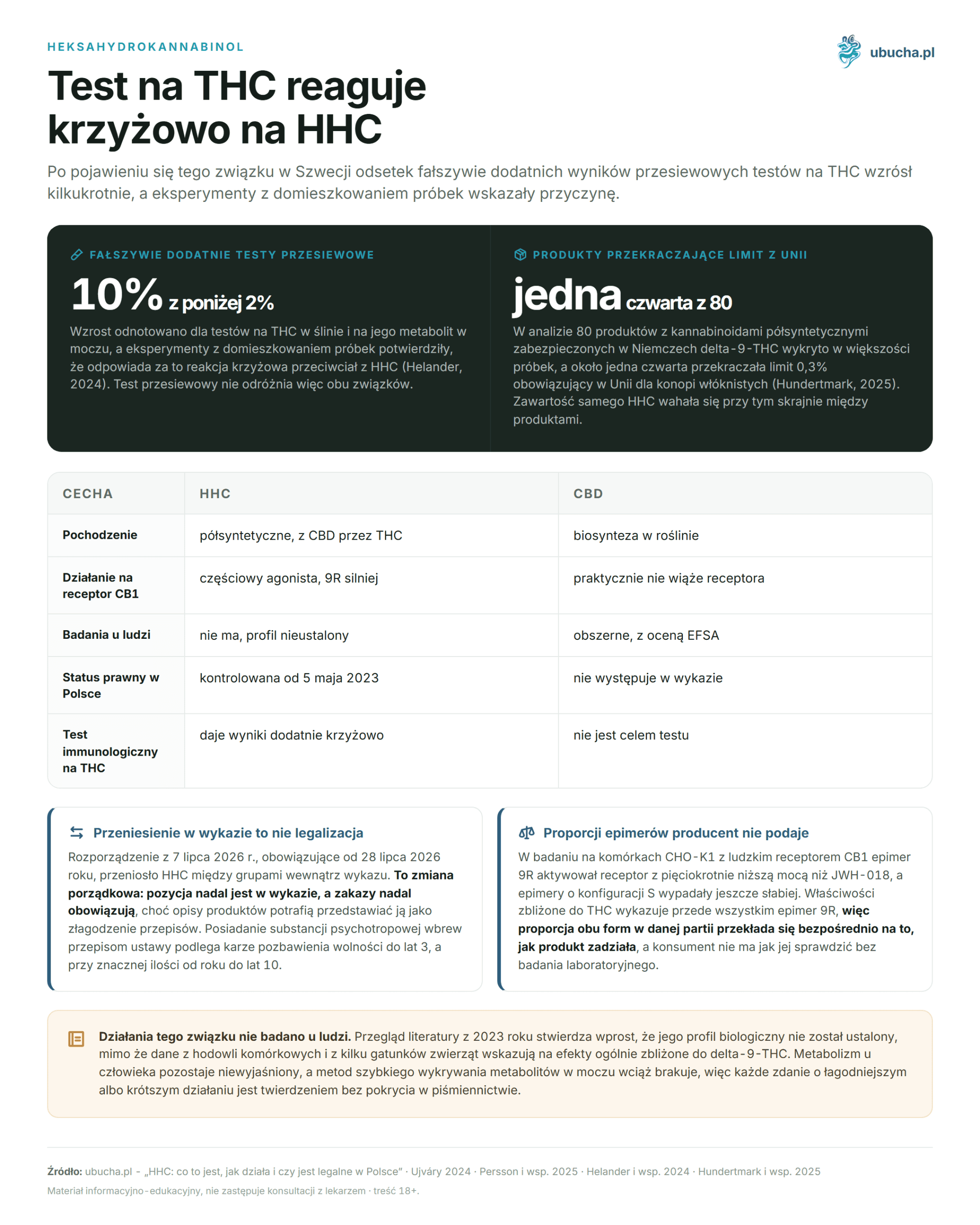
This synthesis route has one practical consequence that sellers do not mention. Since the intermediate stage is THC, residues of it remain in the final product. In an analysis of 80 products with semi-synthetic cannabinoids seized in Germany, delta-9-THC was detected in most samples, and about one quarter exceeded the limit of 0.3% delta-9-THC applicable in the EU for hemp. The content of HHC itself varied extremely among products (Hundertmark et al., Drug Testing and Analysis, 2025).
How does HHC differ from THC and CBD?
HHC shares a chemical skeleton and mode of action on the CB1 receptor with THC, and only the raw material with CBD. The difference that has practical significance is legal: THC and HHC are on the list of controlled substances, while cannabidiol is not. The following table organizes these three compounds.
| Feature | HHC | THC | CBD |
|---|---|---|---|
| Origin | Semi-synthetic, from hemp CBD through THC | Natural, from decarboxylation of THCA | Natural, biosynthesis in the plant |
| Action on CB1 | Partial agonist, 9R epimer stronger than 9S | CB1 agonist, main psychoactive component of cannabis | Practically does not bind to CB1 |
| Human studies | None, biological profile undetermined | Extensive, including clinical studies | Extensive, with safety assessment by EFSA |
| Legal status in Poland | Controlled substance since May 5, 2023 | Controlled substance | Not on the list |
| Immunological test for THC | Gives positive results due to cross-reaction | Detected directly | Not a target of the test |
The last row can be surprising for readers. After HHC appeared in Sweden, the percentage of false positive results in screening tests for THC in saliva and its metabolite in urine increased from below 2% to over 10%, and experiments with sample adulteration confirmed that this was due to the cross-reaction of antibodies with HHC (Helander et al., Scandinavian Journal of Clinical and Laboratory Investigation, 2024). If you are interested in how the receptors used by these compounds work, we have described it separately in the text about CB1 and CB2 receptors.
How does HHC act on cannabinoid receptors?
HHC stimulates the CB1 receptor as a partial agonist, but the strength of this stimulation depends on which epimer ended up in the product. In a study on CHO-K1 cells with the human CB1 receptor, the (9R)-HHC epimer activated the receptor with five times lower potency than the synthetic cannabinoid JWH-018, and the S-configured epimers performed even worse (Persson et al., Drug Testing and Analysis, 2025).
Preclinical studies add one observation to this. The 9R epimer exhibits pharmacological properties similar to THC (Ujváry, 2024), which means that the ratio of both forms in a given batch directly translates into how the product will act. The manufacturer usually does not provide this ratio, and the consumer has no way to check it without laboratory testing.
This is where what is known ends. A literature review from 2023 states directly that the effects of HHC have not been studied in humans and the biological profile of this compound has not been established, although data from cell cultures and several animal species indicate effects generally similar to delta-9-THC. The metabolism of HHC in humans remains unexplained, and there is still no method for rapid detection of its metabolites in urine. Any statement about “milder” or “shorter” effects of HHC in humans that you find in a product description is therefore a claim without support in the literature.
Is HHC legal in Poland in 2026?
No. HHC has been a controlled substance in Poland continuously since May 5, 2023. On that day, the regulation of the Minister of Health of April 17, 2023 (Dz.U. 2023 poz. 744) came into force, which added two items to the list of psychotropic substances: HHC and HHC-O, which is the acetate of O-acetylhexahydrocannabinol. Since then, the trade in HHC and its possession outside the provisions of the law has been prohibited.
The list was changed once again. The regulation of July 7, 2026 (Dz.U. 2026 poz. 934), effective from July 28, 2026, moved HHC between groups within the list. This is an organizational change, not a legalization: the item is still on the list, and the prohibitions still apply. It is worth emphasizing this, as product descriptions can present such a change as a softening of regulations.
Possession of a psychotropic substance contrary to the provisions of the law is punishable by imprisonment of up to 3 years, and in the case of a significant amount, from 1 to 10 years (art. 62 sec. 1 and 2 of the Act on Counteracting Drug Addiction, t.j. Dz.U. 2023 poz. 1939). In the case of lesser weight, the law provides for a fine, restriction of liberty, or imprisonment for up to one year. The argument “it’s not on the list, so it’s allowed” does not apply here, as HHC is on the list by name. We write more broadly about this in the guide to HHC products and the associated risks.
What is the status of HHC in other European countries?
Poland did not act alone or first in this matter. The first national bans on HHC appeared in some EU countries as early as the beginning of 2023 (Hundertmark et al., 2025), and by the beginning of 2024, 24 European countries had recorded the presence of HHC in their markets. During this time, the market has expanded to include other derivatives, including HHC acetate and hexahydrocannabiforol (Persson et al., Drug Testing and Analysis, 2025).
Sweden shows what happens after a ban is introduced. HHC and hexahydrocannabiforol were classified there as narcotic substances on July 11, 2023, after which both compounds disappeared from online and stationary stores, replaced by variants not yet under control (Helander et al., 2024). The same mechanism has repeated in other countries: the ban on one molecule pushes another, differing by one substituent, onto the market.
For the reader in Poland, the conclusion is simple. The fact that some abbreviation does not yet appear on the list speaks only to the pace of legislative work, not to the safety of the compound or what will be in the package. The composition of such products is often completely different from what the label declares, as seen in the aforementioned analysis of German seizures.
Frequently Asked Questions
What is HHC?
HHC is hexahydrocannabinol, a hydrogenated derivative of THC. It was described in 1940 and entered the market at the end of 2021. It is produced from cannabidiol from hemp: the extract is cyclized into a mixture of delta-8-THC and delta-9-THC, and then catalytically hydrogenated into a mixture of 9R and 9S epimers.
Is HHC legal in Poland?
No. HHC has been a controlled substance since May 5, 2023, when the regulation Dz.U. 2023 poz. 744 came into force, adding it to the list along with HHC-O. The regulation Dz.U. 2026 poz. 934 moved HHC between groups in the list from July 28, 2026, but did not abolish the control.
How does HHC act on the CB1 receptor?
HHC stimulates the CB1 receptor as a partial agonist. In a study on cells with the human CB1 receptor, the 9R epimer activated it with a potency five times lower than JWH-018, and the S-configured epimers even weaker. Therefore, the ratio of both epimers in the product determines its strength, and manufacturers do not provide it.
Is HHC safe?
This is unknown. A review from 2023 states that the effects of HHC have not been studied in humans and its biological profile has not been established. Available data comes from cell cultures and animal studies. The metabolism of HHC in humans remains unexplained, so there is no basis for risk assessment.
Will HHC show up in a THC test?
Yes, screening immunological tests cross-react with HHC. After HHC appeared in Sweden, the percentage of false positive results for THC in saliva and its metabolite in urine increased from below 2% to over 10%, which was confirmed by experiments with sample adulteration.
How does HHC differ from CBD?
CBD serves as a raw material for the production of HHC, but apart from that, the two compounds differ in almost everything. Cannabidiol practically does not bind to the CB1 receptor and is not on the list of controlled substances. HHC stimulates CB1 as a partial agonist and has been a controlled substance in Poland since May 2023.
If you are looking for hemp products that are not on the list of controlled substances, a starting point is hemp oils available in the store at u Bucha.
This article is for informational and educational purposes only and does not constitute legal advice. The legal status described in the article is valid as of the date of publication: regulations regarding cannabis may change. Before making a decision, consult a lawyer or current legal acts.
Author: Michał Waluk · Published: 2026-08-09 · Updated: 2026-08-11