
Taurine for endurance, blood pressure, and energy: what the studies say
What did the meta-analyses of taurine show on aerobic endurance and blood pressure, what were the effect sizes, and why does taurine not work like caffeine.
Taurine has been a component of energy drinks since the 1990s and has carried two misunderstandings along with it. The first concerns its origin and boils down to a joke about bull bile. The second is more serious, as it concerns its action: taurine ended up in drinks marketed as stimulating, so it is sometimes taken for a stimulant. It is not. Separately, there are two meta-analyses that measured isolated taurine on two different endpoints, and both showed a moderate effect. This text separates these threads and provides effect sizes as reported by the authors, not converted into percentages, which do not appear in the publications. For blood pressure, we provide both numbers from each pair, that is, the result of the active arm and the result of the placebo, because only the difference between them describes the action of the preparation.
KEY INFORMATION
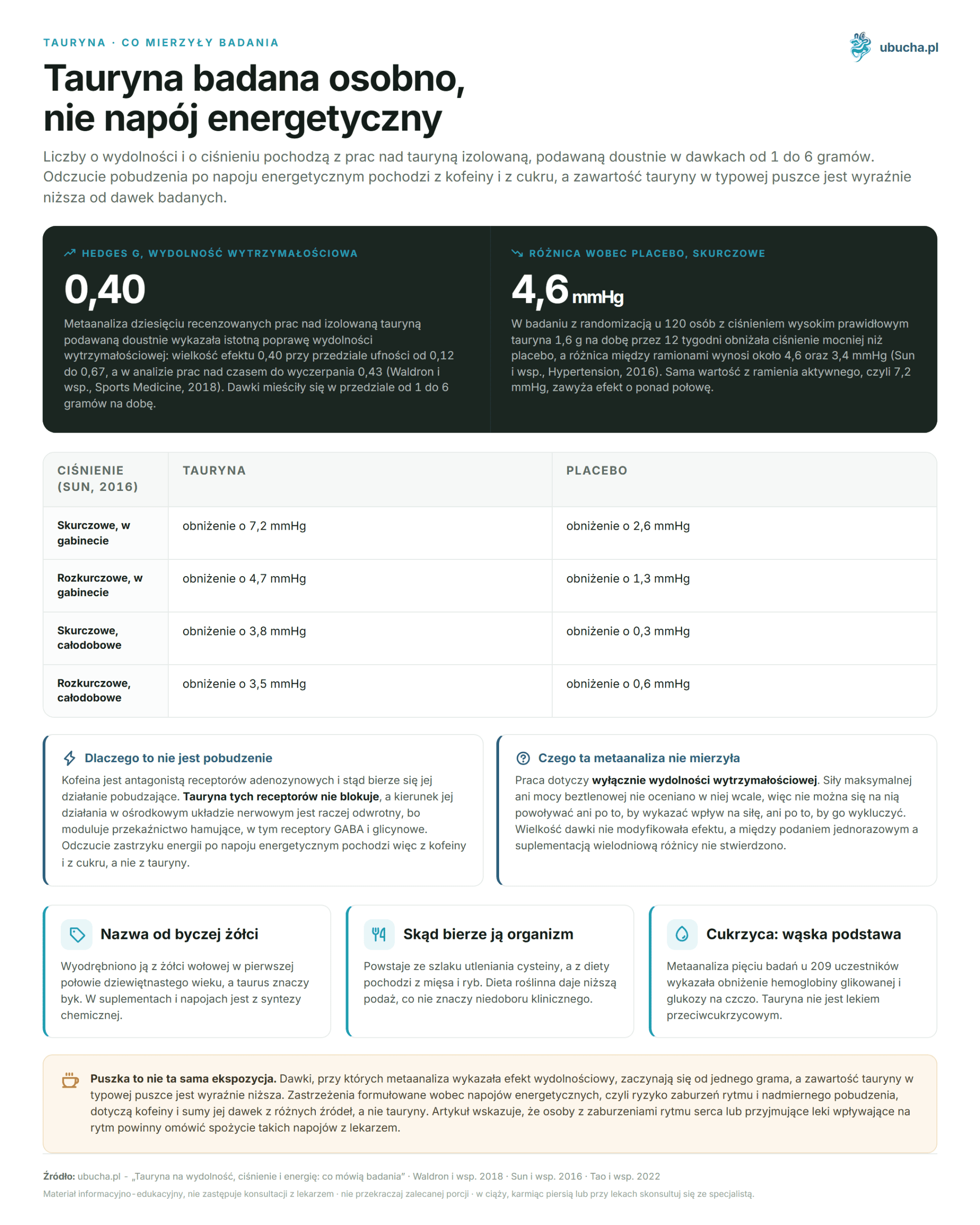
• A meta-analysis of ten studies showed an improvement in endurance after oral taurine in doses from 1 to 6 grams; the Hedges g effect size was 0.40 (Waldron et al., Sports Medicine, 2018).
• The same meta-analysis found no dose-response relationship or difference between single and multi-day administration.
• In a study of 120 individuals with high normal blood pressure, taurine 1.6 g per day for 12 weeks lowered systolic blood pressure by 7.2 mmHg compared to 2.6 mmHg in the placebo group (Sun et al., Hypertension, 2016).
• Taurine is not a stimulant and does not block adenosine receptors.
• A meta-analysis of five studies in individuals with diabetes showed a reduction in HbA1c and fasting glucose, with small sample sizes.
What is taurine and where does the body get it?
Taurine is 2-aminoethanesulfonic acid, a compound classified as an amino acid that is not incorporated into proteins. It has no codon and is not built into the peptide chain. However, it performs osmotic functions, participates in the formation of bile acids, and modulates inhibitory signaling in the nervous system.
It is produced in the body as a product of the oxidation pathway of cysteine. A paper dedicated to sulfur metabolism describes that cysteine is broken down by two pathways, and the oxidative pathway leads to the formation of taurine and sulfate in a ratio of about two to one; the contribution of this pathway depends on the activity of cysteine dioxygenase, which is low on a low-protein diet and high with an excess of sulfur-containing amino acids in the diet (Stipanuk and Ueki, Journal of Inherited Metabolic Disease, 2011). Besides endogenous synthesis, taurine is supplied by the diet, mainly meat, fish, and seafood, so individuals on a plant-based diet have a lower intake.
Where does the myth about bull bile come from? The name comes from the material from which the compound was first isolated in the first half of the nineteenth century, namely from bovine bile, and the Latin word taurus means bull. Taurine used in supplements and drinks is a product of chemical synthesis, not an extract from an animal.
Does taurine improve endurance?
Yes, to a moderate degree and only in endurance efforts. The meta-analysis included ten peer-reviewed studies on isolated taurine administered orally, including a partial analysis of seven studies measuring time to exhaustion. Doses ranged from 1 to 6 grams per day, administered either as a single dose or over a period of up to two weeks. Endurance improved significantly, and the effect size expressed as Hedges g was 0.40 with a confidence interval from 0.12 to 0.67; for the studies on time to exhaustion, it was 0.43 (Waldron et al., Sports Medicine, 2018).
Two findings from this work are worth highlighting, as they contradict how taurine is usually described. First, the dose did not modify the effect size, so the claim that more means better has no support here. Second, no difference was found between single administration and multi-day supplementation, which undermines the sense of talking about a treatment and a saturation period.
Equally important is what this meta-analysis did not measure. It concerns only endurance. Maximum strength or anaerobic power were not assessed at all, so statements about the lack of effect of taurine on these parameters cannot reference it. If someone attributes a result for sprinting or jumping to this work, they are attributing a measurement that was not performed.
How much did taurine lower blood pressure in clinical studies?
The strongest single study is a randomized double-blind trial in which 120 individuals with high normal blood pressure were assigned to taurine at a dose of 1.6 grams per day or to placebo for 12 weeks. The average reduction in systolic blood pressure measured in the office was 7.2 mmHg with taurine and 2.6 mmHg with placebo, and diastolic was 4.7 and 1.3 mmHg, respectively. In 24-hour measurements, the differences were smaller: 3.8 versus 0.3 mmHg for systolic and 3.5 versus 0.6 mmHg for diastolic. Endothelial-dependent and independent vasodilation also improved (Sun et al., Hypertension, 2016).
Providing both numbers from each pair is important here, as the difference between the arms is what describes the action of the preparation. It is about 4.6 mmHg for systolic blood pressure measured in the office and about 3.4 mmHg for diastolic. The version that only provides the value from the active arm, that is, 7.2 mmHg, overestimates the effect by more than half.
A separate meta-analysis gathered seven studies on isolated taurine and resting blood pressure, involving a total of 103 participants of varying ages and health statuses. The reduction in systolic and diastolic blood pressure was significant, averaging about 3 mmHg for both values, with ranges from 0 to 15 mmHg for systolic and from 0 to 7 mmHg for diastolic; no adverse events were reported (Waldron et al., Current Hypertension Reports, 2018). The authors call these findings preliminary and indicate the need for further research on doses and duration of administration.
Why doesn’t taurine work like caffeine?
Because it belongs to a completely different pharmacological class. Caffeine is an antagonist of adenosine receptors, and that is where its stimulating effect comes from. Taurine does not block these receptors. Its action in the central nervous system is rather opposite, as it modulates inhibitory signaling, including GABA and glycine receptors.
The feeling of a boost of energy from an energy drink comes from caffeine and sugar, not from taurine. It is also worth noting the proportions. The doses at which the meta-analysis showed an endurance effect start from one gram, while the taurine content in a typical can is clearly lower. Even if taurine were credited with all the merit, the amount in the drink does not correspond to the amount studied.
This leads to a practical distinction regarding safety. Concerns raised about energy drinks, namely the risk of rhythm disturbances and excessive stimulation, relate to caffeine and the sum of its doses from various sources, not taurine. Individuals with heart rhythm disorders or taking medications affecting rhythm should discuss the consumption of such drinks with their doctor, regardless of the taurine content.
What is known about taurine in carbohydrate metabolism disorders?
Little is known and from small trials. A meta-analysis of randomized studies in individuals with diabetes included five studies and a total of 209 participants. Taurine supplementation reduced glycated hemoglobin, fasting glucose, and the HOMA-IR insulin resistance index; the differences were statistically significant but expressed as standardized mean differences, not as clinical units. No effect on serum lipids, blood pressure, or body composition in this population was observed (Tao et al., Food Chemistry: Molecular Sciences, 2022).
The authors conclude with a cautious statement: taurine emerges as a possible supportive option, and further research is needed. Five studies and a couple of hundred participants provide too narrow a basis to speak of established action and definitely too narrow to treat taurine as a component of diabetes treatment.
Older literature on blood pressure and taurine is sometimes cited as a meta-analysis, although it is not. The work describing the treatment of hypertension with oral taurine is a review of experimental and clinical studies (Militante and Lombardini, Amino Acids, 2002). This distinction is important because a narrative review and a meta-analysis are two different levels of evidence.
Frequently Asked Questions
How much does taurine improve endurance?
A meta-analysis of ten studies showed a significant improvement with a Hedges g effect size of 0.40, with a confidence interval from 0.12 to 0.67. For studies measuring time to exhaustion, the value was 0.43. Doses ranged from 1 to 6 grams, and the dose size did not modify the effect.
Does taurine improve strength or anaerobic power?
The cited meta-analysis did not assess these parameters, as it only concerned endurance. Therefore, it cannot be referenced to demonstrate an effect on strength or to exclude it. This question remains unanswered based on this source.
How much did taurine lower blood pressure in clinical studies?
In 120 individuals with high normal blood pressure, after 12 weeks of taking 1.6 grams per day, systolic blood pressure measured in the office decreased by 7.2 mmHg compared to 2.6 mmHg with placebo, and diastolic by 4.7 compared to 1.3 mmHg. The difference between the arms is therefore about 4.6 and 3.4 mmHg.
Does taurine stimulate like caffeine?
No. Caffeine blocks adenosine receptors, while taurine does not. Taurine modulates inhibitory signaling, including GABA and glycine receptors, so its action in the central nervous system is rather opposite. The feeling of stimulation from energy drinks comes from caffeine and sugar.
Is taurine in energy drinks dangerous?
Concerns about energy drinks relate to caffeine and sugar, not taurine. The amount of taurine in a typical can is lower than the doses used in endurance studies. Individuals with heart rhythm disorders or taking medications affecting rhythm should discuss the consumption of such drinks with their doctor.
Does taurine help with diabetes?
A meta-analysis of five studies involving 209 individuals showed a reduction in glycated hemoglobin, fasting glucose, and the HOMA-IR index, with no effect on lipids, blood pressure, and body composition in this group. The basis is narrow, and taurine is not an antidiabetic drug and does not replace treatment.
Do vegans have a taurine deficiency?
Taurine comes from the diet mainly from meat, fish, and seafood, and the body also produces it from the oxidation pathway of cysteine. Individuals on a plant-based diet have a lower intake from food, which does not equate to a clinical deficiency described in the literature.
How long has taurine safety been studied?
The studies described above lasted from a single dose to 12 weeks, and in the meta-analysis on blood pressure, no adverse events were reported. There is little data on administration longer than several weeks at supplemental doses, and this is a gap in the current evidence base.
If you are looking for related topics, read the text about the differences between forms of magnesium, including magnesium taurinate, and a comparison of BCAA and EAA. Similarly structured data on aerobic endurance can be found in the review of studies on cordyceps and VO2max.
This article is for informational and educational purposes and does not constitute medical advice. Before starting supplementation, consult your doctor, especially if you are taking medications regularly, are pregnant or breastfeeding, or have a chronic illness.
Author: Michał Waluk · Published: 2026-08-09 · Updated: 2026-08-16