
CBD Oil for Atopic Dermatitis: What Dermatology Says
CBD oil and cream for atopic dermatitis. We check what two clinical studies have shown, where the evidence ends, and what CBD cannot replace.
Atopic dermatitis is one of the most common skin diseases and one of the most troublesome: chronic itching, dryness, cracks, and recurring flare-ups can disrupt sleep for weeks. It is no wonder that many people are looking for something alongside steroid ointment, and cannabis cosmetic manufacturers are eager to respond to this need. The question is how much of these promises are backed by research involving humans. We checked this at the source, and the answer is more restrained than the labels suggest: there are exactly two studies involving patients with atopic dermatitis, and the better-designed one turned out unfavorable for cannabidiol itself. This does not mean that the cannabis cosmetic is useless, only that the reason it may bring relief may be different than what the packaging claims. Below you will find what exactly was measured, on how many people, for how long, and where knowledge ends and marketing begins.
KEY INFORMATION
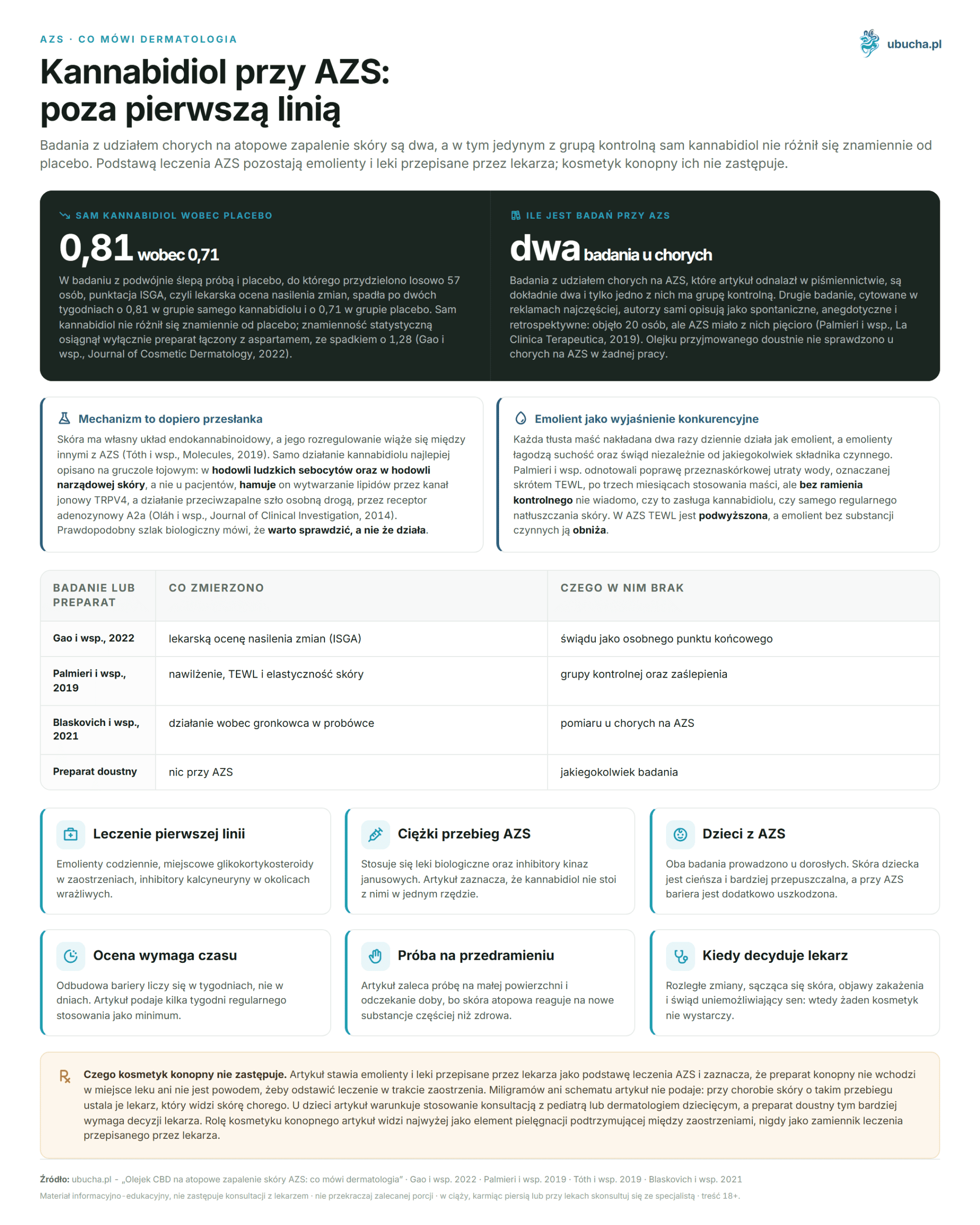
• In the only double-blind study on atopic dermatitis, cannabidiol did not outperform placebo; the advantage was given only to the mixture with aspartame (Gao et al., Journal of Cosmetic Dermatology 2022).
• The second study cited by the market was retrospective and involved five patients with atopic dermatitis (Palmieri et al., 2019).
• The skin has its own endocannabinoid system, and its dysregulation is associated with atopic dermatitis (Tóth et al., Molecules 2019).
• The annual prevalence of diagnosed atopic dermatitis in adults ranges from 1.2% in Asia to 17.1% in Europe (Bylund et al., 2020).
• The basis of treatment for atopic dermatitis remains emollients and medications prescribed by a doctor; cannabis cosmetics do not replace them.
How common is atopic dermatitis and who does it really affect?
The numbers circulating on the internet are much less precise than they appear. A systematic review Bylund et al. (Acta Dermato-Venereologica, 2020) included 378 studies of moderate or good quality and showed how wide the range is: the annual prevalence of doctor-diagnosed atopic dermatitis in adults ranges from 1.2% in Asia to 17.1% in Europe, and in children in Asia from 0.96% to 22.6%.
This range has practical significance. A single number like “atopic dermatitis affects 20% of children” is not a universal value, but a result from one country and one definition of the disease. The authors of the review point out that the data mainly come from Europe and the United States, and there is a lack of studies on incidence in adults themselves.
For the reader, this means one thing: atopic dermatitis is common enough for the cosmetics market to notice it, but not homogeneous enough for one solution to fit all. The form in infants, teenagers, and adults differs in the distribution of lesions and course, and thus in what makes sense in care. This is the background against which to read the promises of manufacturers.
Why are cannabinoids considered for atopic dermatitis?
Because the skin has its own endocannabinoid system, and it is dysregulated in atopic dermatitis. This is not a marketing hypothesis, but a finding from dermatological literature, and it justifies asking the question about cannabidiol at all.
A review Tóth et al. (Molecules, 2019) collects two decades of work on cannabinoids in the skin. Endocannabinoids, their receptors, and enzymes responsible for their metabolism are present in the skin, and this signaling is involved in maintaining epidermal balance, building the barrier, and its reconstruction. The authors mention atopic dermatitis among the diseases in which dysregulation of this system plays a role, alongside psoriasis, scleroderma, acne, hair growth disorders, and pruritus.
How cannabidiol itself works is best described on the sebaceous gland. Oláh et al. (Journal of Clinical Investigation, 2014) demonstrated in cultures of human sebocytes and in organ culture of skin that CBD inhibits lipid production, and this occurs through the TRPV4 ion channel. The anti-inflammatory action took a separate route: through the A2a adenosine receptor and inhibition of the NF-κB pathway. It is worth remembering this, as product descriptions almost always attribute this effect to CB2 receptors, whose work in this role is not confirmed.
However, the mechanism is only a premise. The probable biological pathway suggests that it is worth checking, not that it works. Definitive answers come from studies on humans with diagnosed disease, and these are the subject of the next section.
What have clinical studies shown about CBD for atopic dermatitis?
Not much, and what they have shown is less optimistic than the market repeats. The studies involving patients with atopic dermatitis that we managed to find in the literature are two, and only one of them has a control group. In the one with a control group, cannabidiol alone did not prove better than placebo.
Gao et al. (Journal of Cosmetic Dermatology, 2022) conducted a double-blind placebo-controlled study in which 57 people were randomly assigned to three groups: a preparation combining CBD with aspartame, pure CBD, or placebo. After two weeks, the ISGA score, which is a physician’s assessment of the severity of lesions, decreased by 1.28 in the combined preparation group, by 0.81 in the pure CBD group, and by 0.71 in the placebo group. Statistical significance was achieved only by the combined preparation. A clear or nearly clear skin was achieved by 50% of people in the combined group compared to 20% in the pure CBD group and 15% in the placebo group.
The second study is the work of Palmieri et al. (La Clinica Terapeutica, 2019), most often cited in advertisements. The authors themselves describe it as spontaneous, anecdotal, and retrospective. It involved 20 people, but only five had atopic dermatitis: the others had psoriasis or post-inflammatory scars. The CBD ointment was applied twice daily for three months, and improvement concerned hydration, transepidermal water loss, and skin elasticity. There was no control group or blinding, and the authors do not provide the concentration of cannabidiol in the summary.
Comparing these two works gives an honest and unimpressive picture. There is a signal, it is weak, and in the only study capable of distinguishing the drug’s effect from the placebo effect, it was the combined preparation, not cannabidiol itself, that prevailed. Any statement saying that “studies confirm the effectiveness of CBD in atopic dermatitis” goes further than the data allow.
Does CBD relieve itching in atopic dermatitis?
None of the two studies described above measured itching as a separate endpoint with a control group. Itching is the most troublesome symptom in atopic dermatitis, as it drives the vicious cycle of scratching and exacerbation, so the question is valid. However, the answer is that there is simply no definitive measurement in these works.
The Gao et al. study measured the physician’s assessment of the severity of lesions, not the severity of itching reported by the patient. The Palmieri study noted improvements in hydration and barrier parameters, but without a control group, it is impossible to read how much of the perceived relief is due to cannabidiol itself, how much to the ointment base, and how much to the passage of time. In a disease with a wave-like course, the latter possibility is not theoretical.
The base is, in fact, a clue that should not be overlooked. Any oily ointment applied twice daily acts as an emollient, and emollients are the basis of care in atopic dermatitis, alleviating dryness and itching regardless of any active ingredient. A CBD cosmetic may help precisely in this way, without the involvement of the ingredient for which you pay extra. This does not invalidate the relief you feel, but it changes what should determine your choice of product: the composition of the base and the absence of irritating substances weigh more than the declared content of cannabidiol. More about external use in eczema is described in the text about cannabis ointment for eczema and skin itching.
Does CBD rebuild the skin barrier?
One parameter was indeed measured, but in a study without a control group. This concerns transepidermal water loss, abbreviated as TEWL: the higher it is, the worse the skin retains water, and the easier allergens and microorganisms penetrate it. In atopic dermatitis, it is elevated, and its reduction is a reasonable goal of care.
Palmieri et al. noted an improvement in TEWL after three months of using CBD ointment twice daily. The limitations described above also apply to this result: without a control arm, it is unknown whether the improvement is due to cannabidiol or the regular moisturizing of the skin itself. An emollient without active substances reduces TEWL, and this is the basis of atopic dermatitis treatment recognized by dermatology, so a competitive explanation is strong here.
Regardless of who is right, the practical conclusion does not change. Rebuilding the barrier is a process measured in weeks, not days, and requires regular application. Evaluating any preparation after a few days makes no sense, whether with a cannabis cosmetic or a regular emollient. If after two months of daily use nothing changes, that is a result and it is worth taking seriously instead of increasing the frequency.
How to use CBD cosmetics for atopic dermatitis?
Externally, on affected areas, as an addition to the care you are already conducting. We do not provide milligrams or a dosing scheme here: for a skin disease with such a course, it is determined by the doctor who sees your skin, not an article on the internet.
Before you start, do a patch test on a small area. Apply a small amount to the inner side of your forearm and wait a day. Atopic skin reacts to new substances more often than healthy skin, and irritation can be caused by the ointment base, not the active ingredient. Choose preparations without fragrance compositions and without preservatives with known irritating potential.
Three things to remember when using:
- An emollient is the basis, not an addition. It is used regularly and regardless of whether you use anything with cannabidiol.
- A cannabis cosmetic does not replace a medication prescribed by a doctor and is not a reason to stop treatment during a flare-up.
- Evaluation takes time. A few weeks of regular use is the minimum to draw any conclusions.
Separately about oral preparations. There is no study that has examined CBD oil taken orally in patients with atopic dermatitis, so adding it to care is a decision without data support. If you still consider it, check with your doctor, especially if you are taking medications regularly.
Can CBD be used in children with atopic dermatitis?
Not without consulting a pediatrician or pediatric dermatologist. Atopic dermatitis most often begins in the first years of life, and it is parents who look for something gentler than steroid ointment, but there are no data in this group.
Both studies discussed above were conducted in adults. Children’s skin is thinner and more permeable, so the absorption of substances applied to a large body surface can be higher than in adults, and in atopic dermatitis, the barrier is additionally damaged. These are two reasons why conclusions from studies in adults cannot be directly transferred here, even if that conclusion were strong.
Oral preparations with cannabidiol in children are a separate matter and require a doctor’s decision even more. The only well-documented use of CBD in children concerns drug-resistant forms of epilepsy, where a registered drug is used under supervision, for a specific indication. This is not a basis for self-supplementation for skin disease.
Practically, this means a simple order. First, establish emollient care and treatment for flare-ups with a doctor, then possibly ask about cannabis cosmetics as an addition, not the other way around. A parent who postpones a visit because they are trying another over-the-counter preparation is wasting time in which the disease can worsen.
Does CBD limit staphylococcus colonization?
In vitro, yes, but this has not been tested in patients with atopic dermatitis. The thread is interesting because atopic skin is excessively colonized by Staphylococcus aureus, and its toxins exacerbate inflammation and itching, closing another vicious circle.
Blaskovich et al. (Communications Biology, 2021) examined the antimicrobial action of cannabidiol and confirmed activity against Gram-positive bacteria, including resistant strains of Staphylococcus aureus. They also noted effectiveness against biofilm, a slight tendency of bacteria to develop resistance, and local action in an animal model, with the main mechanism being damage to the bacterial membrane.
From this result to the statement “CBD cream will limit staphylococcus on your skin” is a long way. Concentrations that work in culture may not be achievable in a cosmetic applied to the skin, and no study has examined the effect of such a preparation on the skin microbiome of patients with atopic dermatitis. Treat this as a direction for research, not as a reason to purchase.
There is also a reverse trap worth knowing. Excessive colonization by staphylococcus arises in atopic dermatitis largely from a damaged barrier, so the thing that most effectively limits it is rebuilding that barrier and calming inflammation, not antibacterial action in itself. Oozing, crusted skin and increasing pain indicate superinfection, and then treatment prescribed by a doctor is needed, not another cosmetic.
What CBD cannot replace in atopic dermatitis treatment?
Nothing from the first line. Daily emollients, topical glucocorticoids during flare-ups, and calcineurin inhibitors in sensitive areas are therapies with incomparably stronger evidence than anything currently known about cannabidiol in this indication.
The interest in cannabis cosmetics arises from a real problem: long-term use of topical steroids has its consequences, and patients and parents are looking for something for the periods between flare-ups. This is a sensible question, and it is precisely here that a cannabis preparation may have some role, as a supportive care element, not as a drug.
The boundary, beyond which you need to go to a doctor, is clear. Extensive lesions, oozing skin, signs of infection, itching that prevents sleep: in such situations, no cosmetic is enough, and delaying consultation worsens the prognosis. In severe atopic dermatitis, biological drugs and Janus kinase inhibitors are now used, which have changed the course of the disease for people previously deprived of options. Cannabidiol does not stand in line with them and there is no reason to present it that way. We have written about other uses of cannabidiol on the skin in the text about cannabis cosmetics.
Frequently Asked Questions
Does CBD help with atopic dermatitis?
The evidence is weak. In the only double-blind placebo-controlled study involving 57 people, cannabidiol alone reduced the ISGA score by 0.81 compared to 0.71 for placebo, which is not significant; the advantage was only achieved by a preparation combining CBD with aspartame (Gao et al., 2022). The second cited study was retrospective and involved five patients with atopic dermatitis.
How to use CBD cosmetics for atopic dermatitis?
Externally, on affected areas, as a supplement to care, not as a substitute. Before the first use, do a patch test on your forearm and wait a day, as atopic skin reacts to new substances more often than healthy skin. We do not provide milligrams or a dosing scheme: for skin diseases, it is determined by the doctor who examines it.
Can CBD cosmetics replace steroid ointment?
No. Topical glucocorticoids and calcineurin inhibitors have incomparably stronger evidence, and in severe atopic dermatitis, biological drugs and Janus kinase inhibitors are used. The cannabis preparation can be considered as a supportive care element between flare-ups, never as a substitute for treatment prescribed by a doctor.
Can CBD be used in children with atopic dermatitis?
Not without consulting a pediatrician or pediatric dermatologist. Both clinical studies on atopic dermatitis were conducted in adults. Children’s skin is thinner and more permeable, and in atopic dermatitis, the barrier is additionally damaged, so absorption from a large body surface can be higher than in adults.
Does CBD fight staphylococcus on atopic skin?
This has not been studied in humans. Blaskovich et al. (Communications Biology, 2021) demonstrated the action of cannabidiol against Gram-positive bacteria, including resistant strains of Staphylococcus aureus, and against biofilm, mainly by damaging the bacterial membrane. However, no study has examined the effect of CBD cosmetics on the skin microbiome of patients with atopic dermatitis.
Cannabis body cosmetics, including creams and balms, can be found in the cosmetics category. Treat them as care, not as treatment: in atopic dermatitis, the basics of therapy are determined by a doctor.
This article is for informational and educational purposes and does not constitute medical advice. Before starting to use cannabis or CBD for therapeutic purposes, consult a doctor, especially if you are taking other medications, are pregnant, or breastfeeding.
Author: Michał Waluk · Published: 2026-06-02 · Updated: 2026-08-15