
Supplements with the Strongest Scientific Evidence (not just advertising)
Which supplements have real evidence from meta-analyses and randomized studies, and which only have an advertising budget. A review of sources, numbers, and their actual limits.
The supplement market is based on promises from in vitro studies, opinions of internet creators, and selectively cited works on small groups. A truly solid evidence base exists only for a few substances, and they are not always the ones with the largest advertising budget. This review does not assess popularity or price. It evaluates what can be verified in the abstract of the work: how many participants there were, how long the study lasted, and what the outcome was. For each item, we also provide the limit of evidence, which is what the studies did not show, because this is where marketing most often writes its own version. All numbers in the text come from the abstracts of the works indicated by the links and describe the course of the studies, not recommendations for the reader.
KEY INFORMATION
• Only a few substances have repeatable results from meta-analyses of randomized studies for a specific indication.
• Creatine and caffeine have the broadest research base in physical performance: the ISSN position from 2017 and a review of 21 meta-analyses in BJSM from 2020.
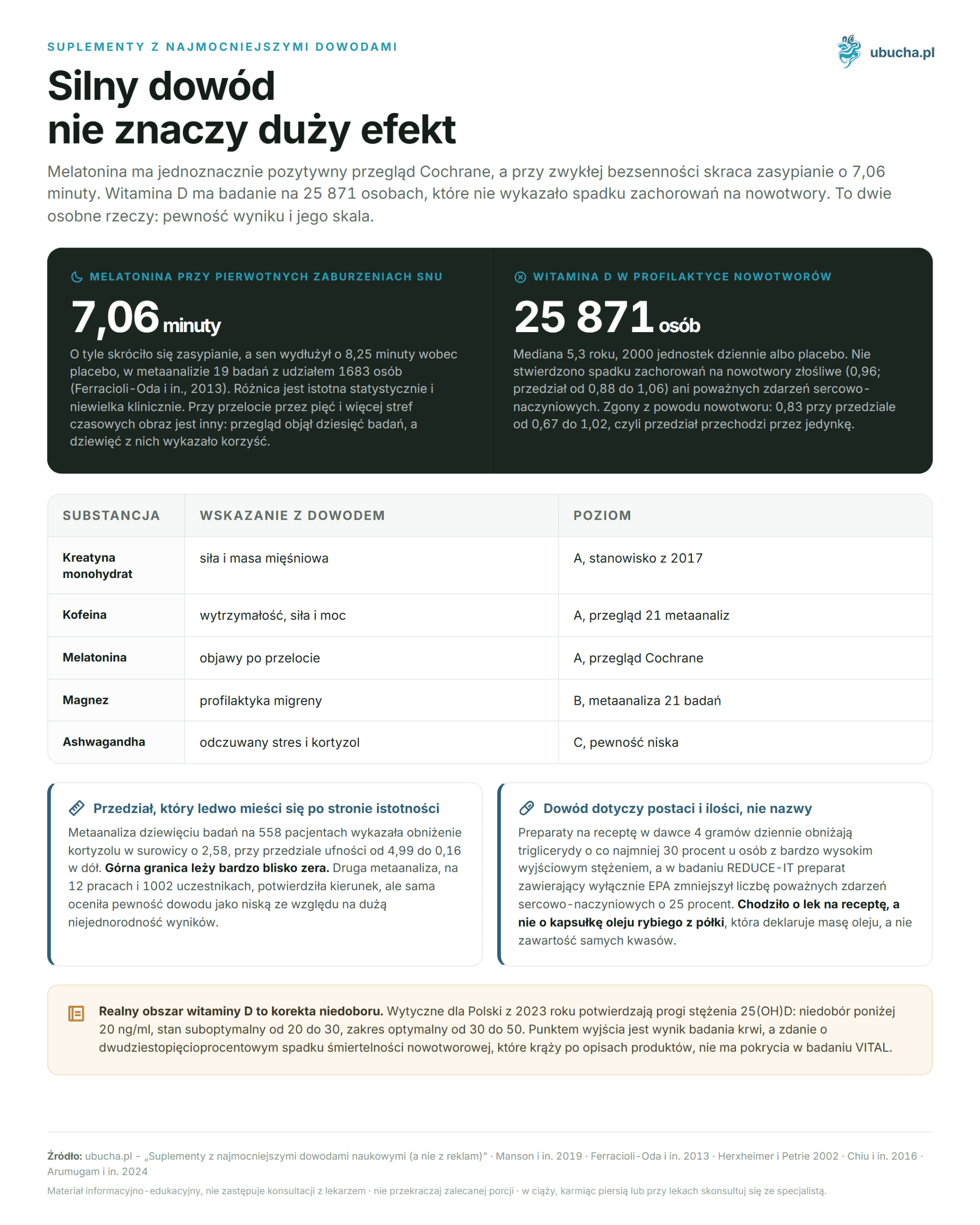
• The VITAL study on 25,871 people did not show a decrease in cancer incidence or cardiovascular events after vitamin D.
• Strong evidence does not mean a large effect: melatonin shortens sleep onset by an average of 7 minutes, and vitamin C reduces cold duration by 8 percent in adults.
• This text does not provide dosages to measure. The numbers describe the course of the studies, not recommendations for the reader.
How is the strength of evidence for a supplement measured?
The strength of evidence is determined by the type of study, the number of independent repetitions, and the consistency of results across populations. Meta-analyses of randomized controlled trials with placebo, where the same effect was replicated in different centers, rank the highest. Studies on cells and animals, as well as observational studies without a control group, rank the lowest.
In this review, we do not count as evidence works funded solely by the manufacturer without independent verification, animal studies, or observational data without comparison. The level is always assigned to the substance along with the indication, as the same substance may have strong evidence for one action and none for another. We have elaborated on how to read such assessments in the post how supplements are assessed on the strength of evidence scale.
| Level | What supports it | Example from this text |
|---|---|---|
| A | Meta-analyses of multiple randomized studies, consistent results across different populations | Creatine and caffeine in physical performance |
| B | Several correct randomized studies, consistent results, short observation | Melatonin for jet lag, magnesium for migraine prevention |
| C | Meta-analyses with low certainty of evidence or single studies | Ashwagandha for cortisol and perceived stress |
| D | Inconsistent results or trials too small to draw any conclusions | Multivitamins for chronic disease prevention |
Which supplements have the strongest evidence today?
The following list includes substances for which there is at least one meta-analysis or a position from a scientific society based on randomized studies. The column with the indication is more important than the substance name itself, as evidence never pertains to the supplement in general, but to a specific effect in a specific group.
| Substance | Indication with evidence | Level | Source |
|---|---|---|---|
| Creatine monohydrate | Strength and muscle mass, anaerobic effort | A | Kreider et al., JISSN, 2017 |
| Caffeine | Endurance, strength, and muscle power | A | Grgic et al., BJSM, 2020 |
| Omega-3 (EPA and DHA) | Reduction of triglyceride levels | A | Skulas-Ray et al., Circulation, 2019 |
| Melatonin | Symptoms after flying through five or more time zones | A | Herxheimer and Petrie, Cochrane, 2002 |
| Magnesium | Migraine prevention, subjective sleep quality | B | Chiu et al., Pain Physician, 2016 |
| Vitamin C | Shortening the duration of colds with regular use | B | Hemila and Chalker, Cochrane, 2013 |
| Vitamin D | Correction of deficiency, bone health, and muscle function | A in deficiency | Płudowski et al., Nutrients, 2023 |
| Ashwagandha | Perceived stress, cortisol levels | C | Arumugam et al., Explore, 2024 |
Why does creatine top this list?
Creatine monohydrate has the broadest and longest research base among all sports supplements. The position of the International Society of Sports Nutrition from 2017 summarizes it unequivocally: supplementation increases creatine levels in muscle, which corresponds to improved performance in high-intensity efforts and greater training effects (Kreider et al., Journal of the International Society of Sports Nutrition, 2017).
This same position resolves the safety issue, which is most often asked about. The authors state that short- and long-term use, in studies lasting up to five years, was well tolerated in healthy individuals and in many patient groups, from infants to the elderly. The mechanism is also better understood than for most supplements: creatine replenishes the pool of phosphocreatine, which is a quick energy reserve used in efforts lasting several seconds.
More interesting is the part outside of sports. In a double-blind, crossover study, 45 young vegetarians took creatine for six weeks; they performed significantly better in working memory tests and Raven’s matrices than after placebo (Rae et al., Proceedings. Biological Sciences, 2003). Vegetarians have lower baseline creatine stores, so the result does not automatically transfer to meat-eaters. We write more broadly about the substance itself in the post creatine: what it gives and for whom.
Does vitamin D reduce cancer risk?
No, and this is the most frequently misrepresented result in the entire category. The VITAL study involved 25,871 people who took vitamin D3 at a dose of 2000 units daily or placebo for a median of 5.3 years. No decrease in malignant cancer incidence was found (risk ratio 0.96; confidence interval 95 percent from 0.88 to 1.06) nor a decrease in serious cardiovascular events (Manson et al., New England Journal of Medicine, 2019).
Separately reported were cancer deaths: risk ratio 0.83 with a confidence interval from 0.67 to 1.02. The interval crosses one, so the result is not statistically significant, and it was a secondary endpoint. The statement about a twenty-five percent reduction in cancer mortality that circulates in product descriptions has no support in this work.
The real area of action for vitamin D is correcting deficiency. The guidelines for Poland from 2023, prepared by a consensus of eight scientific societies, confirm the thresholds for 25(OH)D levels: deficiency below 20 ng/ml, suboptimal state from 20 to 30 ng/ml, optimal range from 30 to 50 ng/ml (Płudowski et al., Nutrients, 2023). The starting point is therefore the result of a blood test, and the amount of supplementation is determined by a doctor, not an article.
How does the evidence for omega-3 differ from the promises on the label?
EPA and DHA acids have a strong, repeatable effect on one laboratory parameter: they lower triglyceride levels. The scientific position of the American Heart Association from 2019 states that prescription preparations at a dose of 4 grams daily lower triglycerides by at least 30 percent in individuals with very high baseline levels (Skulas-Ray et al., Circulation, 2019).
Hard endpoints are another story. The same position cites the REDUCE-IT study, in which a preparation containing only EPA reduced the number of serious cardiovascular events by 25 percent in high-risk patients treated with statins. However, this was about a prescription drug at a dose of four grams, not a fish oil capsule from the shelf.
Hence the practical conclusion for those reading labels: evidence pertains to a specific form and specific amounts of EPA and DHA, not the concept of “omega-3” in general. A typical supplement declares the mass of fish oil, not the content of the acids themselves, and these two numbers can differ by several times. If supplementation is to address elevated triglycerides, this is a situation for discussion with a doctor, not for self-selecting capsules.
What does melatonin really do for sleep?
Melatonin is one of the few supplements with a clearly positive conclusion from a Cochrane review. The review by Herxheimer and Petrie included ten randomized studies; nine of them showed that melatonin taken close to the target bedtime reduces symptoms after flying through five or more time zones. The number of people that need to be treated to achieve one additional good effect was two (Herxheimer and Petrie, Cochrane, 2002).
This same review contains two caveats that do not appear in advertisements. The benefit is smaller for westward flights, and melatonin taken at the wrong time of day delays the clock adjustment instead of speeding it up. Case reports also indicate possible harm in individuals with epilepsy and in patients taking warfarin.
For ordinary insomnia, the effect is much more modest. A meta-analysis of 19 studies involving 1683 individuals with primary sleep disorders showed a reduction in sleep onset time by 7.06 minutes and an increase in sleep duration by 8.25 minutes compared to placebo (Ferracioli-Oda et al., PLoS One, 2013). The difference is statistically significant and clinically small, which well illustrates that strong evidence and a large effect are two separate things.
What does magnesium work for, and what does it not?
Magnesium has modest marketing and surprisingly decent data for two indications. A meta-analysis covering 21 studies, including ten trials of oral supplementation involving 789 individuals, showed a significant reduction in the frequency and severity of migraines compared to the control group (Chiu et al., Pain Physician, 2016).
The second indication is sleep in older adults. In a randomized double-blind study, 46 older individuals with primary insomnia received magnesium or placebo for eight weeks. In the magnesium group, scores on the insomnia severity scale improved, sleep efficiency increased, and sleep onset time decreased, while serum cortisol levels dropped (Abbasi et al., Journal of Research in Medical Sciences, 2012).
What magnesium lacks is evidence of effectiveness in individuals without deficiency and without a specific ailment. The slogan of a supplement “for everything” has no support here: both of the above studies clearly pertain to distinctly defined groups and distinctly defined endpoints. We have described the forms and interactions with calcium separately in the post magnesium and calcium: the proper ratio.
Who really lacks vitamin B12?
Vitamin B12 is an example of a substance where the strength of evidence depends solely on who is taking it. In confirmed deficiency, correction is an intervention of undisputed effectiveness. With normal levels, there is no data indicating any benefit.
Real risk groups are well described. They include individuals on a plant-based diet without animal products, older adults with reduced secretion of stomach acid and intrinsic factor, and patients taking metformin for a long time, which impairs B12 absorption in the ileum. Diagnosis is made from a blood test, not from symptoms, as the picture is not very specific. More about the entire group can be found in the post B vitamins: what they do and who needs them.
Folic acid works similarly. Its strongest data pertains to one narrow application, namely the prevention of neural tube defects in women planning pregnancy and in early pregnancy. The dosage and timing of initiation are determined by the attending physician, as they depend on history and previous pregnancies. Outside of this indication, evidence for the benefit of folic acid supplementation in healthy individuals is weak.
Does ashwagandha have evidence for reducing stress?
It does, but the evidence is weaker than suggested by its presence in every adaptogen advertisement. A meta-analysis of nine randomized studies involving 558 patients showed a significant improvement in perceived stress scale (mean difference minus 4.72), Hamilton anxiety scale (minus 2.19), and a reduction in serum cortisol levels (mean difference minus 2.58; confidence interval from minus 4.99 to minus 0.16) compared to placebo (Arumugam et al., Explore, 2024).
The upper limit of the confidence interval for cortisol is very close to zero, meaning the result barely falls on the side of significance. A second meta-analysis, covering 12 studies and 1002 participants, confirmed the reduction of anxiety and stress but rated the certainty of this evidence as low due to high heterogeneity of results (Akhgarjand et al., Phytotherapy Research, 2022).
Hence the level C instead of A. Ashwagandha has the most studies collected in meta-analyses among popular adaptogens, yet the evidence base is short, heterogeneous, and mainly conducted on small groups. We have gathered herbal preparations from this category in the adaptogens category, and a compilation of substances with higher-order evidence can be found in the supplements category.
Frequently Asked Questions
Which supplement has the strongest scientific evidence?
In physical performance, creatine and caffeine. Creatine has the position of the International Society of Sports Nutrition from 2017, caffeine a review of 21 meta-analyses published in BJSM in 2020. Outside of sports, the strongest data is for correcting confirmed deficiencies of vitamin D or vitamin B12.
Does EFSA approval of a claim mean the supplement works?
It means that the scientific panel deemed the evidence sufficient for one strictly defined claim and at a specified amount of the ingredient. It says nothing about the size of the effect or other actions of the same substance. Always check what exactly the claim refers to.
Does vitamin D reduce cancer risk in people without deficiency?
The VITAL study on 25,871 people did not show a decrease in cancer incidence or cardiovascular events after five years. Documented benefits relate to correcting deficiency confirmed by testing 25(OH)D levels, not supplementation in individuals with normal results.
Which supplements are unnecessary with a good diet?
The American task force USPSTF deemed in 2022 the evidence for multivitamins in cancer and heart disease prevention insufficient, and against beta-carotene and vitamin E it expressed opposition. Iron and probiotics taken without a recognized indication can also be unnecessary.
Is creatine safe for long-term use?
The ISSN position from 2017 summarizes that short- and long-term use, in studies lasting up to five years, was well tolerated in healthy individuals and in many patient groups. In kidney disease, the decision to use it is made by a doctor, not the individual concerned.
Does ashwagandha actually lower cortisol?
A meta-analysis of nine studies involving 558 people showed a reduction in serum cortisol, but the confidence interval was nearly zero. A second meta-analysis, on 12 studies and 1002 participants, rated the certainty of this evidence as low. The effect is real and uncertain in size.
This article is for informational and educational purposes and does not replace consultation with a doctor. If you are pregnant, breastfeeding, taking medications, or have chronic conditions, consult the use of supplements or herbs with a specialist.
Author: Michał Waluk · Published: 2026-08-05 · Updated: 2026-08-11