
CBD for IBS and Irritable Bowel: What Studies Say About Cannabidiol and the Microbiome
One randomized study of CBD for IBS, 32 participants, no difference compared to placebo. We check the evidence, microbiome, and what really works for IBS.
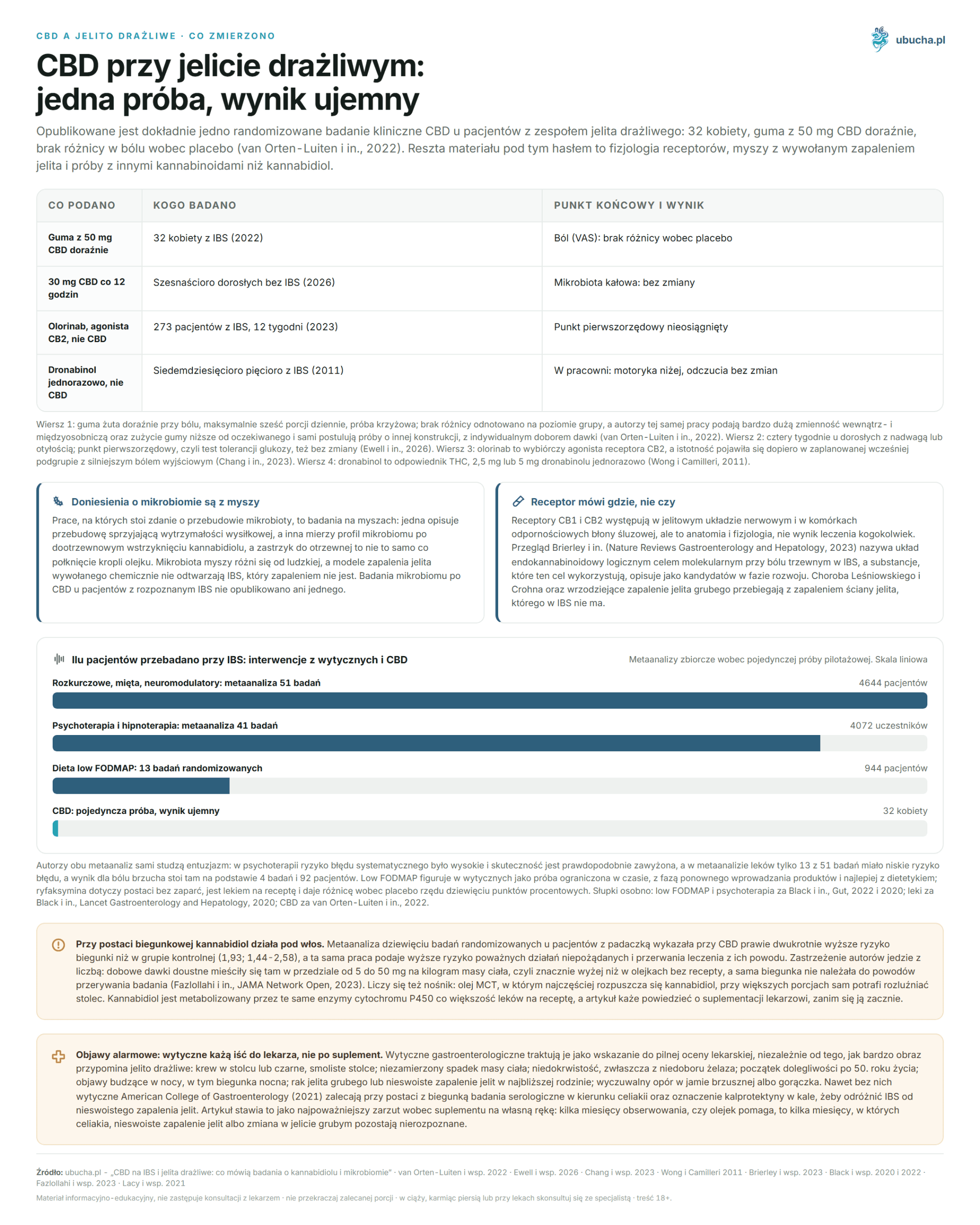
The question in the title has a short answer that most CBD-related sites will not like. There is exactly one randomized clinical study on CBD in patients with irritable bowel syndrome. It involved 32 women and showed no difference compared to placebo. We checked this through two avenues, in the literature database and in the clinical trial registry, because a denial based on a single query can be false. The rest of the material that usually accompanies this term consists of receptors described in physiology textbooks, mice with induced intestinal inflammation, and trials with cannabinoids other than cannabidiol. None of these things are evidence that CBD alleviates IBS. Below you will find what exactly was checked, what the result was, and what gastroenterology has to offer instead.
KEY INFORMATION
• The only randomized trial of CBD in IBS involved 32 women and showed no difference compared to placebo (van Orten-Luiten et al., Cannabis and Cannabinoid Research, 2022).
• The microbiome in humans after four weeks of CBD did not change in a measurable way (Ewell et al., 2026). Reports of microbiota remodeling come from mice.
• A drug acting on the CB2 cannabinoid receptor underwent a phase 2b trial in 273 patients and did not reach the primary endpoint.
• The low FODMAP diet, psychotherapy, and antispasmodic medications have thousands of patients behind them in randomized trials.
• Blood in the stool, weight loss, anemia, and the onset of symptoms after age 50 require diagnostics.
Is there a clinical trial of CBD for irritable bowel syndrome?
There is one. The van Orten-Luiten team published a randomized, double-blind, placebo-controlled trial in 2022 in Cannabis and Cannabinoid Research. Thirty-two women with IBS chewed gum with 50 mg of CBD as needed for pain, up to six doses per day. At the group level, there was no difference in pain intensity compared to placebo.
Denial of this weight requires checking from several sides, as the work may be indexed under a term that is not searched. In Europe PMC, a query for cannabidiol along with irritable bowel syndrome returns eight entries, and only this one is a clinical trial; narrowing it down to titles alone gives it as the only result, and narrowing it to the years 2024-2026 yields none. In the clinical trial registry, there is exactly one trial of CBD for this indication, NCT03003260, and it is indeed this chewing gum. A cross-sectional review of cannabinoids in gastroenterology from 2023 (Camilleri and Zheng, Clinical Gastroenterology and Hepatology) also does not mention any other.
This is a negative result, and it is worth seeing how it looks in detail. Participants rated their pain on a visual analog scale, and quality of life was assessed using the IBS-36 questionnaire. The authors noted very high variability within and between individuals, no signal that women reached for the gum according to the severity of symptoms, and consumption lower than expected. Their own interpretation of the latter is ruthless: the perceived benefit generally did not outweigh the inconvenience of chewing gum all day. They themselves propose trials of a different design, with individual dose selection.
Another trial from 2011, published in Gastroenterology by Wong and Camilleri’s team, is sometimes cited. Seventy-five patients with IBS received either placebo or 2.5 mg or 5 mg of dronabinol in a single dose, and researchers measured colonic compliance and motility in a laboratory setting. The result was positive, but it concerns something else: dronabinol reduced fasting motility of the left colon and increased its compliance, apparently in the diarrhea and mixed forms, while not changing sensation or tension in the intestine. Dronabinol is a synthetic equivalent of THC, not cannabidiol, the dose was a single one, and the endpoint was a laboratory measurement, not the patient’s well-being after several weeks.
Why are cannabinoid receptors in the intestines not evidence?
Because the presence of a receptor indicates where a molecule could act, not whether the patient will feel better. CB1 and CB2 receptors are indeed present in the enteric nervous system and in immune cells of the mucosa. This is anatomy and physiology, described decades ago, not the result of treating anyone.
A review by Brierley et al. (Nature Reviews Gastroenterology and Hepatology, 2023) formulates this cautiously: the endocannabinoid system is a logical molecular target for visceral pain in IBS, and substances that utilize this target are described by the authors as candidates in development. A candidate is not a drug with proven efficacy.
The path from receptor to outcome is best illustrated by olorinab, a selective CB2 receptor agonist acting peripherally. In the phase 2b CAPTIVATE trial (NCT04043455), 273 patients with IBS took one of three doses of olorinab or placebo for 12 weeks. Improvement was noted in all arms, but the difference compared to placebo was not significant for any dose. Significance only appeared in a pre-planned subgroup of individuals with stronger baseline pain.
Similarly, the argument from inflammatory bowel diseases does not hold. Crohn’s disease and ulcerative colitis involve inflammation of the intestinal wall, which is simply not present in IBS, as IBS is a disorder of gut-brain interaction. We write separately about how this axis works daily in a post about the gut-brain axis. Trials in inflammatory diseases most often concerned THC-containing preparations and showed improvement in well-being, not healing of the mucosa.
Does CBD change the human gut microbiome?
The only randomized study measuring this in humans showed no changes. Sixteen adults with overweight or obesity, leading a sedentary lifestyle and without diabetes, took 30 mg of CBD every 12 hours or placebo for four weeks in a double-blind design.
This is a pilot study by Ewell et al. (Cannabis and Cannabinoid Research, 2026). The composition of the stool microbiota after the intervention did not differ significantly between groups, nor did inflammatory markers, and the primary endpoint, which was an oral glucose tolerance test, also remained unchanged. On a small sample and in individuals without IBS, this does not resolve the matter in the other direction. However, it does resolve something else: there are currently no human data on which to base an opinion about CBD remodeling the microbiome.
So where do these statements come from on the internet? From rodents. The studies that usually underpin such claims are studies in mice: one describes microbiota remodeling conducive to exercise endurance, another measures the microbiome profile after intraperitoneal injection of cannabidiol. Note the route of administration in the latter case. An injection into the peritoneal cavity is not the same as swallowing a drop of oil.
Two additional caveats. The microbiota of mice differs from that of humans to such an extent that transferring results is never automatic, and chemically induced intestinal inflammation models in animals do not replicate IBS, which is not inflammatory. And the simplest thing: not a single study has yet been published on the microbiome after CBD in patients with diagnosed irritable bowel syndrome. If you are looking for what is known about the microbiome from studies in humans, we have gathered it in a post about psychobiotics.
What has proven effectiveness for IBS?
Several things, and all have a much stronger basis than cannabidiol. The guidelines of the British Society of Gastroenterology from 2021 and the guidelines of the American College of Gastroenterology from the same year rank them based on meta-analyses, not on mechanisms.
| Intervention | Evidence Base | Outcome |
|---|---|---|
| Low FODMAP diet | 13 randomized trials, 944 patients (Black et al., Gut, 2022) | Risk of no improvement 0.67 (0.48-0.91) compared to usual diet, first place in ranking |
| Cognitive-behavioral therapy | 41 studies, 4072 participants (Black et al., Gut, 2020) | Risk of no improvement 0.61 (0.45-0.83) and 0.62 (0.48-0.80), depending on the form of delivery |
| Gut-directed hypnotherapy | same meta-analysis | Risk of no improvement 0.67 (0.49-0.91) |
| Peppermint oil, antispasmodics, neuromodulators | 51 studies, 4644 patients (Black et al., Lancet Gastroenterology and Hepatology, 2020) | For overall symptoms, peppermint oil was first (0.63); for abdominal pain, tricyclic antidepressants, but based on 4 studies and 92 patients |
| Rifaximin for the non-constipated form | 2 phase 3 studies (Pimentel et al., New England Journal of Medicine, 2011) | Sufficient relief in 40.8% compared to 31.2% on placebo in the first study |
| CBD | 1 study, 32 participants (van Orten-Luiten et al., 2022) | No difference compared to placebo |
Three notes on this table. The low FODMAP diet is not a forever diet: it is listed in the guidelines as a time-limited trial with a phase of reintroducing products, best conducted with a dietitian. Rifaximin concerns the non-constipated form and is a prescription drug, and the difference compared to placebo, although real, is about nine percentage points. The authors of both meta-analyses themselves temper enthusiasm: in the psychotherapy paper, the risk of systematic error was high, and effectiveness is likely overestimated, while in the drug meta-analysis, only 13 out of 51 studies had a low risk of error.
Which intestinal symptoms require diagnostics, not supplements?
There are symptoms for which no supplementation is the proper first response, as they may indicate an organic disease. Gastroenterology guidelines refer to them as alarm symptoms and treat them as indications for urgent medical evaluation, regardless of how much the picture resembles irritable bowel syndrome.
- Blood in the stool or black, tarry stools.
- Unintentional weight loss.
- Anemia, especially from iron deficiency.
- Onset of symptoms after age 50.
- Symptoms waking you at night, including nocturnal diarrhea.
- Colon cancer or inflammatory bowel disease in close family.
- Palpable resistance in the abdominal cavity or fever.
Even without alarm symptoms, diagnostics make sense. The American College of Gastroenterology guidelines (2021) recommend diagnosing IBS using a positive strategy, based on symptom criteria, rather than just ruling everything else out. For the diarrhea subtype, they recommend serological tests for celiac disease and measuring calprotectin in the stool to differentiate IBS from inflammatory bowel disease.
This is the most serious charge against self-medicating with supplements. A few months of taking oil and observing whether it helps is a few months during which celiac disease, inflammatory bowel disease, or changes in the colon remain undiagnosed. Stool testing and blood sampling take less time than one such trial.
Can CBD harm in IBS?
cannabidiol is not a neutral substance and has a paradoxical profile of adverse effects in intestinal disorders. A meta-analysis of nine randomized trials in patients with epilepsy, Fazlollahi et al. (JAMA Network Open, 2023), showed that the risk of diarrhea with CBD was almost twice as high as in the control group (1.93; 1.44-2.58).
This same work reports a higher risk of serious adverse events and treatment discontinuation due to them. A caveat is important: the daily oral doses ranged from 5 to 50 mg per kilogram of body weight, which is significantly higher than in over-the-counter oils, and diarrhea was not among the reasons for discontinuing the study. However, the direction of the signal remains the same, and in the diarrhea form of IBS, this is an obvious problem.
Separately, the carrier needs to be mentioned. MCT oil, in which cannabidiol is most often dissolved, can itself loosen stools at larger doses, regardless of what is dissolved in it. With irritable bowel syndrome, it is easy to attribute the effect to the wrong substance.
There remains the interaction with medications. CBD is metabolized by the same cytochrome P450 enzymes as most prescription drugs. A systematic review by Nachnani et al. (Frontiers in Pharmacology, 2024) gathered 31 documented cases in which cannabinoids altered the pharmacokinetics of drugs or caused adverse events, involving sixteen substances with a narrow therapeutic index; warfarin, valproate, tacrolimus, and sirolimus were most frequently reported.
Regulatory positions go in the same direction. EFSA in an updated assessment from 2026 derived a temporary safe dose of cannabidiol at 0.0275 mg per kilogram of body weight per day, which is about 2 mg daily for a 70 kg person, and stated directly that the safety of cannabidiol cannot be established in individuals under 25 years of age, pregnant and breastfeeding women, and those taking medications. The same opinion notes gastrointestinal effects at higher doses. If you are taking anything regularly, tell your doctor about supplementation before starting it. More about the principles of taking can be found in the post Dosage of CBD.
Frequently Asked Questions
Does CBD help with irritable bowel syndrome?
As of today, there is no evidence for this. The only randomized clinical trial involved 32 women chewing gum with 50 mg of CBD as needed for pain and showed no difference compared to placebo at the group level (van Orten-Luiten et al., Cannabis and Cannabinoid Research, 2022). The authors themselves stated that studies of a different design are needed.
Does CBD change the human gut microbiome?
The only randomized study measuring the microbiome in humans showed no changes. Sixteen adults with overweight or obesity took 30 mg of CBD every 12 hours for four weeks, and the composition of the stool microbiota did not differ significantly from placebo (Ewell et al., 2026). Claims about microbiome remodeling come from studies in mice.
Do studies on cannabis in Crohn’s disease say anything about IBS?
No, because these are separate diseases. Crohn’s disease and ulcerative colitis involve inflammation of the intestinal wall, which is not present in IBS. Trials in these diseases most often concerned THC-containing preparations and measured well-being, not healing of the mucosa.
Has any drug acting on cannabinoid receptors worked in IBS?
The furthest progress has been made with olorinab, a CB2 receptor agonist. In a phase 2b trial involving 273 patients, the difference compared to placebo was not significant for any of the three doses, and significance only appeared in a pre-planned subgroup with stronger baseline pain (Chang et al., Neurogastroenterology and Motility, 2023).
Can CBD worsen diarrhea?
Yes. In a meta-analysis of nine trials in patients with epilepsy, the risk of diarrhea was almost twice as high with cannabidiol compared to the control group (Fazlollahi et al., JAMA Network Open, 2023). The doses there were significantly higher than in over-the-counter oils, and the MCT oil used as a carrier can itself loosen stools.
What to start with if IBS is suspected?
With a diagnosis made by a doctor. The American College of Gastroenterology guidelines recommend testing for celiac disease in the diarrhea subtype and measuring calprotectin in the stool to rule out inflammatory bowel disease (Lacy et al., 2021). Only then does the low FODMAP diet and other interventions with proven effectiveness come into play.
If you still want to try cannabidiol for other ailments, fully aware that there is a lack of evidence for its action in IBS, you can find the assortment in the oils section.
This article is for informational and educational purposes and does not constitute medical advice. Before starting to use cannabis or CBD for therapeutic purposes, consult your doctor, especially if you are taking other medications, are pregnant, or breastfeeding.
Author: Michał Waluk · Published: 2026-06-22 · Updated: 2026-08-15