
Supplements for Chronic Fatigue: When It’s Not Laziness and How to Rise from the Bottom
Chronic fatigue is not laziness. Check what tests to perform first and which fatigue supplements have research data and which do not.
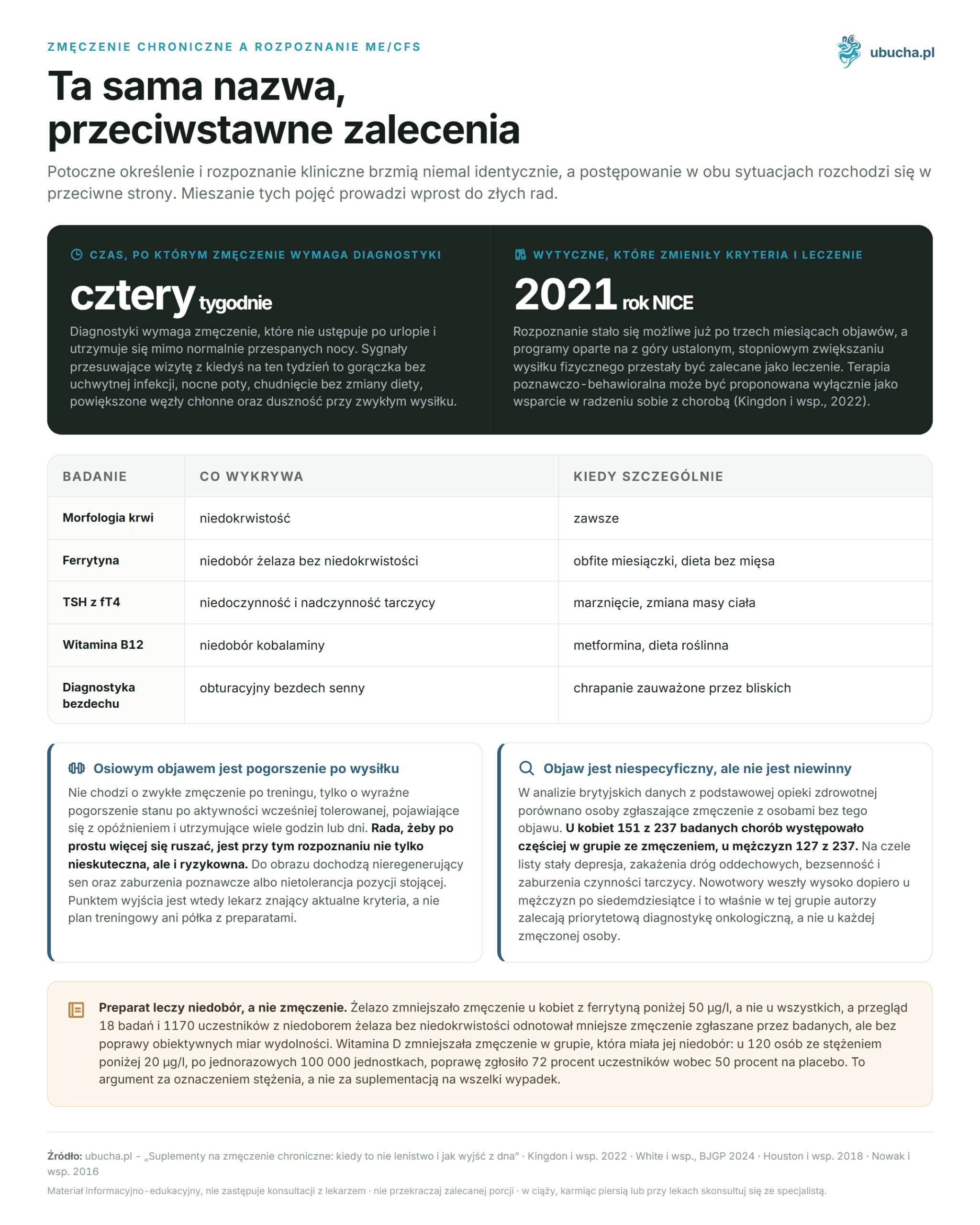
Fatigue is one of the most common reasons for visits to a family doctor and also one of the symptoms that is easiest to dismiss. An analysis of British primary care data compared 304,914 individuals reporting fatigue with 423,671 individuals without this symptom. In women, 151 of 237 studied diseases occurred more frequently in the fatigue group, with depression, respiratory infections, insomnia, and thyroid dysfunction at the top of the list (White et al., British Journal of General Practice, 2024). This is not a reason to panic, but to diagnose. Below you will find what to examine first, how common “chronic fatigue” differs from the diagnosis of ME/CFS, and which preparations have undergone randomized studies.
KEY INFORMATION
• Fatigue can be the first symptom of a disease: in a cohort of 304,914 individuals with fatigue, 151 of 237 diseases were more common in women than in the comparison group (White et al., BJGP, 2024).
• Before buying a supplement, do a complete blood count, ferritin, TSH with fT4, B12, glucose, and 25(OH)D.
• Iron reduced fatigue in women with ferritin below 50 µg/l, but not in everyone (Vaucher et al., CMAJ, 2012).
• ME/CFS is a distinct diagnosis. NICE has withdrawn recommendations for gradual increases in effort.
When does chronic fatigue stop being a lifestyle issue?
Fatigue that lasts longer than four weeks, does not improve after a vacation, and persists despite normally sleeping nights requires diagnostics. In the cited cohort, 127 of 237 diseases occurred more frequently in men reporting fatigue than in those who did not report it. The symptom is nonspecific, but it is not innocent.
The same analysis suggests what to look for first. Depression, respiratory infections, and insomnia were most strongly associated with fatigue, and in women, additionally thyroid dysfunction. Cancers only ranked high on the list in men over seventy, and it is in this group that the authors recommend priority oncological diagnostics, not in every fatigued person.
Signals that move a doctor’s visit from “sometime” to “this week”: fever without an identifiable infection, night sweats, weight loss without dietary changes, enlarged lymph nodes, shortness of breath with normal exertion. Treat separately the situation where fatigue clearly worsens after exertion and lasts for many hours or days. This phenomenon has a name and specific diagnostic consequences, described later in the text.
Before dealing with biochemistry, check the boring things: the number of hours slept, alcohol consumption, shift work, access to daylight. No supplement can make up for five hours of sleep a day, and there is no test that promises that.
What tests should be done before buying the first supplement?
The basic set for fatigue lasting more than a month includes a complete blood count, ferritin, TSH with fT4, vitamin B12, fasting glucose, and 25(OH)D. Additionally, two topics that supplement guides often overlook: questions about snoring and daytime sleepiness, and an honest conversation about mood and anxiety.
This list makes sense because each item describes a condition treated differently than an over-the-counter preparation. Hypothyroidism requires levothyroxine, obstructive sleep apnea requires treatment for breathing disorders during sleep, depression requires psychotherapy or pharmacotherapy. Buying an energy-boosting preparation with an undiagnosed thyroid disease is half a year of lost time.
| Test or Question | What It Detects | When Particularly |
|---|---|---|
| Complete Blood Count | Anemia and blood system disorders | Always |
| Ferritin | Iron deficiency without anemia | Heavy menstruation, meat-free diet |
| TSH with fT4 | Hypothyroidism and hyperthyroidism | Feeling cold, dry skin, weight change |
| Vitamin B12 | Cobalamin deficiency | Metformin, plant-based diet, age over 65 |
| Fasting Glucose | Carbohydrate metabolism disorders | Sleepiness after meals, excessive thirst |
| 25(OH)D | Vitamin D deficiency | Months from October to April |
| Sleep Apnea Diagnostics | Obstructive sleep apnea | Snoring, apneas noticed by relatives |
| Mood and Anxiety Assessment | Depression, anxiety disorders | Loss of interest, worrying |
A borderline result is not yet a diagnosis, and a normal result does not close the case. Interpretation belongs to the doctor, who sees symptoms, medications taken regularly, and medical history. Our experience with readers is that the most commonly overlooked item from this table is ferritin, followed closely by the question about snoring.
What is the difference between chronic fatigue and ME/CFS?
Common “chronic fatigue” simply means fatigue lasting for weeks. ME/CFS, or myalgic encephalomyelitis or chronic fatigue syndrome, is a distinct clinical diagnosis with its own criteria. Mixing the two concepts leads to bad advice, as recommendations for these two situations can be contradictory.
The core symptom of ME/CFS is malaise after exertion, described in the literature as post-exertional malaise. It is not about ordinary fatigue after training, but a clear deterioration in condition after previously tolerated activity, appearing with a delay and lasting for hours or days. The picture is complemented by non-restorative sleep and cognitive disturbances or intolerance to standing positions.
NICE guidelines published in October 2021 changed two things at once. Diagnosis became possible after three months of symptoms, and programs based on a predetermined, gradual increase in physical effort were no longer recommended as treatment for ME/CFS. Cognitive-behavioral therapy may be proposed only as support in coping with the disease (Kingdon et al., Healthcare, 2022). The advice “just move more” is therefore not only ineffective for this diagnosis but also risky.
The practical conclusion is simple. If you recognize a deterioration after exertion, do not start with a training plan or a shelf of supplements, but with a doctor who knows the current criteria.
Does iron help when the complete blood count is normal?
It helps when iron stores are low, even with normal hemoglobin. In a randomized study of 198 menstruating women aged 18-53, with unexplained fatigue, without anemia and with ferritin below 50 µg/l, they received iron sulfate or placebo for 12 weeks. Fatigue decreased by 47.7 percent compared to 28.8 percent in the placebo group (Vaucher et al., CMAJ, 2012).
Note what the study did not show. There was no difference in quality of life, severity of depressive or anxiety symptoms. The effect pertained to fatigue itself, and the authors propose assessing effectiveness after six weeks based on blood tests, not well-being. The threshold of 50 µg/l, at which they considered supplementation, is their own conclusion from this study, not a commonly accepted laboratory norm. This topic is further developed in our post about iron for fatigue in women without anemia.
A broader perspective is provided by a systematic review covering 18 studies and 1170 participants with iron deficiency without anemia. Supplementation was associated with a reduction in fatigue reported by participants, but did not improve objective measures of physical performance, including maximum oxygen uptake (Houston et al., BMJ Open, 2018).
Hence, the principle is the opposite of advertising: iron is not an energy supplement for everyone, but a treatment for a specific deficiency. With normal ferritin, excess iron burdens the body instead of helping, so supplementation without test results is not justified.
What have studies shown about vitamin D and vitamin B12?
Vitamin D reduced fatigue in the group that had a deficiency. In a randomized study of 120 individuals with an average age of 29, with 25(OH)D levels below 20 µg/l, they received a single dose of 100,000 units of vitamin D or placebo. After four weeks, 72 percent of participants in the vitamin D group reported improvement in fatigue compared to 50 percent in the placebo group (Nowak et al., Medicine, 2016).
This is not an argument for supplementation “just in case,” but for measuring levels; moreover, it was a single bolus dose in young adults with confirmed deficiency, not a scheme to copy. Polish guidelines from 2023 remind that vitamin D deficiency is common in our country’s population and provide dosing principles based on age and body weight (Płudowski et al., Nutrients, 2023). The dose is chosen by the doctor based on the result, not on advertising.
Vitamin B12 deficiency can be insidious, as symptoms are initially subtle, and neurological and hematological consequences are serious. In older individuals, deficiency affects over 20 percent, and the most common cause, accounting for over 60 percent of cases, is not a poor diet but a syndrome of malabsorption of cobalamin related to food: the body cannot release the vitamin from food (Andrès et al., CMAJ, 2004). This is why “I eat meat” does not rule out deficiency. If you are in the risk group from the table above, measuring B12 is more sensible than buying a supplement blindly. Further development of the topic can be found in our post about vitamin B12 deficiency and energy levels.
Do coenzyme Q10, NADH, and carnitine have data on fatigue?
They do, but they come from small studies in narrowly defined groups. In an eight-week randomized placebo-controlled study of 73 Spanish patients diagnosed with CFS, coenzyme Q10 at a dose of 200 mg per day together with NADH at a dose of 20 mg per day resulted in a reduction in fatigue severity (Castro-Marrero et al., Antioxidants and Redox Signaling, 2015).
Acetyl-L-carnitine was studied in 96 individuals over 70 years old meeting the criteria for chronic fatigue syndrome. After treatment, a reduction in physical and mental fatigue and improvement in functional capacity were noted compared to the control group (Malaguarnera et al., Archives of Gerontology and Geriatrics, 2008). In another study, in 36 individuals with multiple sclerosis, acetyl-L-carnitine at a dose of 1 g twice daily was compared alternately with amantadine for three months for each drug, and it performed better on the fatigue severity scale. It was also better tolerated: of the six individuals who discontinued participation due to adverse effects, five were taking amantadine at that time (Tomassini et al., Journal of the Neurological Sciences, 2004).
What does this not imply? That a healthy, overworked person will feel the same. Participants in these studies had a diagnosed disease or were over seventy, and the groups numbered several dozen individuals. Details regarding one of these compounds are described in our post about coenzyme Q10.
Which adaptogens have results, and which do not?
Rhodiola rosea performs best, and only in a narrow application: for fatigue caused by stress and night work. In a double-blind study of 56 young, healthy doctors on night shifts, a standardized extract SHR-5 improved fatigue scores measured by cognitive performance tests, with a significant difference appearing in the first two-week treatment period (Darbinyan et al., Phytomedicine, 2000).
The second study from the same year involved foreign students during exam periods and administered low, repeated doses of the same extract for 20 days. Improvement was noted in physical performance, mental fatigue, and neuromotor tests, but there was no difference in the text correction test and tapping, and the authors themselves state that the dose was probably too low (Spasov et al., Phytomedicine, 2000). Both studies are over two decades old and involve small groups, so treat them as suggestive, not as conclusive evidence.
Ginseng has a mixed picture. In a meta-analysis of 19 randomized studies, the overall result for fatigue severity did not reach significance compared to control groups. Analyses in subgroups yielded different results: preparations containing ginseng, chronic fatigue, and fatigue not related to a specific disease showed significant results, with the authors themselves describing the effect size as small and calling for more rigorous studies (Li et al., Journal of Integrative and Complementary Medicine, 2023). Ginseng did not increase the number of adverse effects either.
Ashwagandha has an ambiguous result. In a 12-week randomized study of 120 overweight individuals aged 40 to 75, taking root extract twice daily, the primary endpoint, perceived stress, did not differ from placebo. Improvement in fatigue on the Chalder scale appeared only among secondary outcomes (Smith et al., Journal of Psychopharmacology, 2023). The authors themselves state that further studies are needed.
Where to start to avoid losing half a year?
The order is more important than the choice of preparation. First diagnostics, then correction of documented deficiencies, and only then everything else. Reversing this order is the most common way to waste several months and a significant amount of money with an undiagnosed disease.
If tests show a deficiency, treat that deficiency, not fatigue in general. Low ferritin means iron, low 25(OH)D means vitamin D, low B12 means cobalamin, abnormal TSH means thyroid treatment. Doses and forms are chosen by the doctor or pharmacist based on the result, as the difference between deficiency and excess can be small.
If results are normal and fatigue persists, return to the doctor instead of expanding the supplement set. Undiagnosed sleep apnea, depression, or ME/CFS will not resolve with any preparation, and every week of delay works against you.
Honestly: none of the ingredients described here has data allowing for a promise to rise from the energy bottom. The strongest results pertain to replenishing deficiencies, not adding something above the norm. A seasonal variant of this problem is described in our post about spring equinox.
Frequently Asked Questions
What is the difference between chronic fatigue and ME/CFS?
Chronic fatigue is a symptom with dozens of possible causes. ME/CFS is a distinct clinical diagnosis, with the core symptom being malaise after exertion, lasting for hours or days. NICE guidelines from 2021 allow it to be diagnosed after three months of symptoms, after excluding other causes.
What tests should be done for chronic fatigue?
The basic set includes a complete blood count, ferritin, TSH with fT4, vitamin B12, fasting glucose, and 25(OH)D. In cases of snoring and daytime sleepiness, sleep apnea diagnostics are added. Depression and anxiety disorders also cause fatigue, so discussing mood is part of this list.
Do exercises help with ME/CFS?
NICE guidelines published in October 2021 state that programs based on a predetermined, gradual increase in activity should not be offered to people with ME/CFS. The reason is the risk of worsening after exertion. Cognitive-behavioral therapy may be proposed only as support, not as a causal treatment.
Will iron help if ferritin is normal?
Data pertains to individuals with deficiency. In the study by Vaucher et al. (CMAJ, 2012), among menstruating women without anemia and with ferritin below 50 µg/l, fatigue decreased by 47.7 percent compared to 28.8 percent in the placebo group. No such effect was observed with normal ferritin.
Do ashwagandha and ginseng reduce fatigue?
Moderately and not for everyone. In a meta-analysis of 19 studies, the overall result for ginseng was not significant, although effects appeared in subgroups, with low strength (Li et al., 2023). In a 12-week study of ashwagandha in 120 individuals, the primary endpoint did not differ from placebo, and improvement in fatigue was a secondary outcome.
When does fatigue require urgent consultation with a doctor?
With fever without infection, night sweats, weight loss without dietary changes, enlarged lymph nodes, shortness of breath with normal exertion, and fatigue worsening after exertion and lasting for many hours. Supplements will not replace diagnostics and may delay the diagnosis of a disease.
Preparations containing vitamin D, magnesium, iron, and B vitamins can be found in the supplements section of the U Bucha store.
This article is for informational and educational purposes only and does not constitute medical advice. Before starting supplementation, consult a doctor, especially if you are taking medications regularly, are pregnant or breastfeeding, or have a chronic illness.
Author: Michał Waluk · Published: 2026-05-29 · Updated: 2026-08-14