
Tyrosine properties: what studies show about concentration and motivation
Tyrosine improved cognitive performance in healthy volunteers under stress: cold, lack of sleep, noise. It failed in ADHD. Studies, protocols, and interactions.
L-tyrosine is sold as an amino acid for concentration and motivation because it is a precursor to dopamine. However, when you review studies on humans, it turns out that almost all were conducted on healthy volunteers under strong stress: in cold, noise, after a sleepless night, or during a military combat course. These are not conditions in which you sit down to work on a Monday morning. Where tyrosine was tested in individuals with a real attention problem, namely ADHD, the results were negative. The study groups were small, and the doses were many times higher than the content of a typical capsule. This text shows exactly what was measured, on how many people, and under what conditions, while also organizing interactions with medications, the situation with phenylketonuria, and the issue of N-acetyl-L-tyrosine.
KEY INFORMATION
• Cognitive effect was shown in healthy volunteers under stress: 4.5 hours of cold and hypoxia (Banderet and Lieberman, Brain Research Bulletin, 1989).
• In ADHD, tyrosine failed: 12 adults in an open trial (Reimherr et al., 1987) and seven children (Eisenberg et al., 1988).
• Tyrosine levels in children with ADHD were normal (Bergwerff et al., PLoS ONE, 2016), which undermines the idea of supplementing the precursor.
• MAO inhibitors, levodopa, and thyroid medications require a discussion with a doctor.
What is tyrosine and how are neurotransmitters formed from it?
Tyrosine is a conditionally essential amino acid that the body can produce from phenylalanine. It is a substrate for three pathways at once: catecholamines, melanin, and thyroid hormones. This multitasking explains both the promised cognitive effects and most of the warnings described later in the text.
The catecholamine pathway proceeds in four steps. Tyrosine hydroxylase converts tyrosine into L-DOPA, using tetrahydrobiopterin and iron. DOPA decarboxylase with vitamin B6 produces dopamine. Beta-hydroxylase of dopamine with vitamin C creates norepinephrine, and N-methyltransferase of phenylethanolamine closes the pathway with epinephrine. The first step is slower than the others, and it sets the pace for the entire synthesis.
This is where the theory behind supplementation comes from. Tyrosine hydroxylase does not work at full substrate saturation, so more tyrosine may mean faster synthesis, but only if neurons fire often and quickly deplete the transmitter reserves. At rest, the enzyme is not a bottleneck, as a regular diet provides tyrosine in surplus. This difference explains the results described below.
The other two pathways run separately. Tyrosinase converts tyrosine into melanin, and in the thyroid, tyrosine residues incorporated into thyroglobulin undergo iodination, resulting in thyroxine and triiodothyronine.
Under what conditions did tyrosine work in human studies?
In all positive studies, participants were healthy and stressed: cold with hypoxia, noise at 90 dB, a sleepless night, a combat course, or several tasks at once. Outside of stress, the signal disappears. This is the most serious objection to the statement that tyrosine is a supplement for concentration.
The starting point is the work of Banderet and Lieberman (Brain Research Bulletin, 1989). Volunteers received 100 mg of tyrosine per kilogram of body weight or a placebo in a crossover design with a double-blind trial, after which they spent 4.5 hours in cold and hypoxia. Symptoms, mood, and task performance improved, but only in individuals who reacted to these conditions moderately or strongly. In many descriptions of this work, hypoxia is sometimes replaced with noise.
Noise was tested separately. Deijen and Orlebeke (Brain Research Bulletin, 1994) administered 100 mg/kg to 16 healthy volunteers and seated them for tasks in 90 dB sound. Improvement was noted in two tasks most sensitive to stress. Diastolic pressure dropped fifteen minutes after ingestion, but an hour later it was no different from placebo, and mood, systolic pressure, and heart rate were not affected by tyrosine.
Deijen and colleagues (Brain Research Bulletin, 1999) observed 21 cadets on a demanding combat course. Ten consumed a drink with 2 g of tyrosine in five daily portions, while eleven had a carbohydrate drink of the same caloric content. The tyrosine group performed better in memory and tracking tasks, and their systolic pressure dropped. Mood did not change.
Neri and colleagues (Aviation, Space, and Environmental Medicine, 1995) studied continuous night work after a full day of wakefulness. Half of the participants received 150 mg/kg in a divided dose. Improvement was noted in psychomotor and vigilance tasks and lasted about three hours.
The closest to the desk were Thomas and colleagues (Pharmacology, Biochemistry and Behavior, 1999). Ten men and ten women received 150 mg/kg, and an hour later sat down to two batteries of tasks. Tyrosine improved working memory only when it was necessary to count and track visual and auditory signals simultaneously. In the simple battery, it changed nothing. This is the best available description of the boundary in question: it helps not with focus, but with maintaining memory under load.
What exact protocols were used in these studies?
Doses in studies are significantly higher than what is usually found in a capsule: 100 to 150 mg per kilogram of body weight, which is 7 to 10 g for a person weighing 70 kg. An exception is the work with cadets, where 2 g was administered daily for a week.
| Study | Participants | Protocol | Conditions | Outcome |
|---|---|---|---|---|
| Banderet and Lieberman, 1989 | healthy, crossover | 100 mg/kg once | cold and hypoxia, 4.5 h | less drop in performance |
| Deijen and Orlebeke, 1994 | 16 healthy | 100 mg/kg once | 90 dB noise | improvement in two stress-sensitive tasks |
| Neri et al., 1995 | healthy, night work | 150 mg/kg in divided dose | over a day of wakefulness | better vigilance for about 3 h |
| Thomas et al., 1999 | 10 men, 10 women | 150 mg/kg once | multitasking battery | working memory better only in multitasking |
| Deijen et al., 1999 | 21 cadets | 2 g daily, five portions | combat course, day 6 | better memory and tracking, mood unchanged |
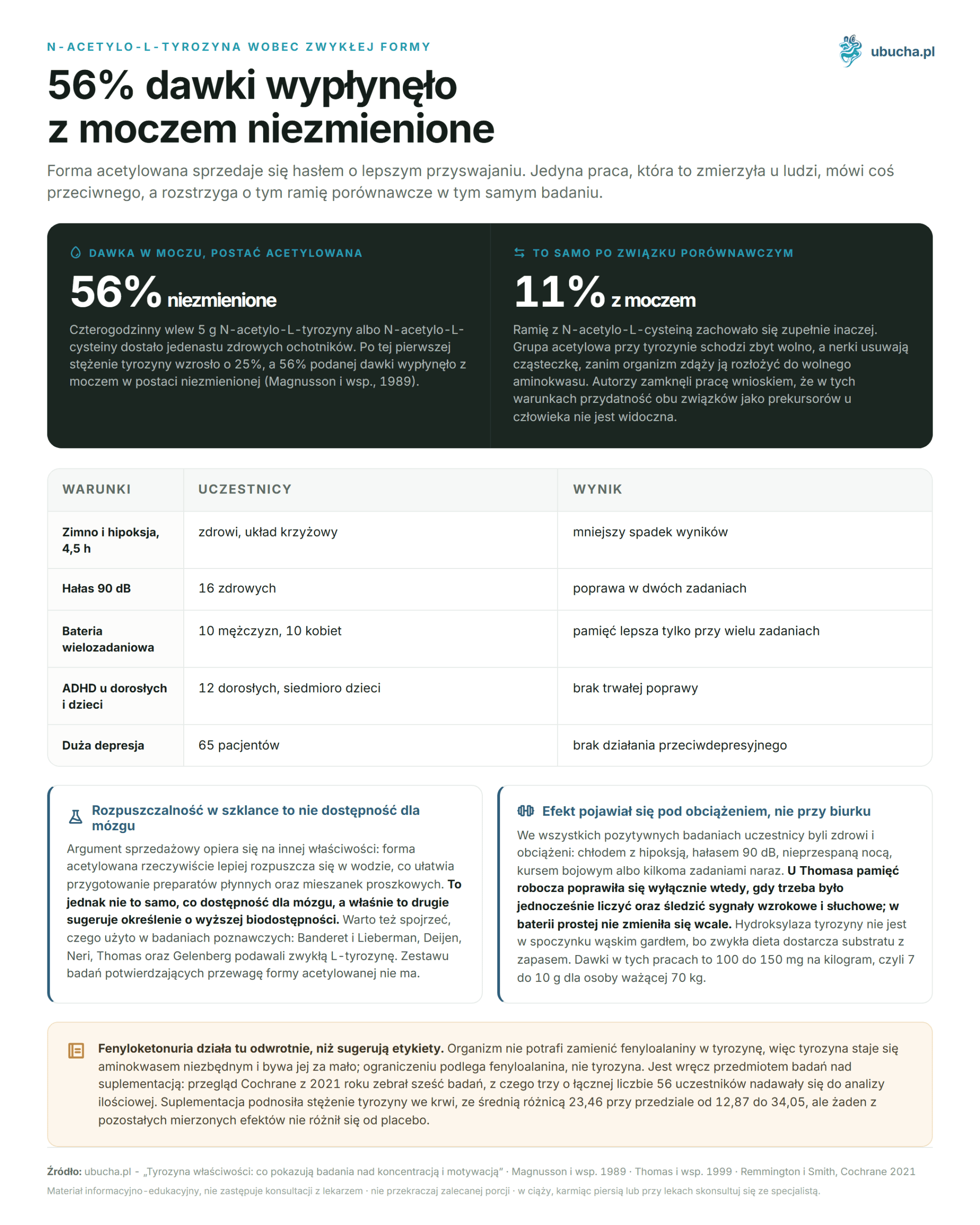
| Gelenberg et al., 1990 | 65 patients | 100 mg/kg daily, 4 weeks | major depression | no antidepressant effect |
| Reimherr et al., 1987 | 12 adults | open trial, 8 weeks | residual type ADHD | response faded in week 6 |
| Eisenberg et al., 1988 | seven children | single-blind trial | ADHD with hyperactivity | no improvement |
We noticed while organizing this table that the gap between the laboratory and the store shelf is larger here than with most supplements. The groups are small, and the largest consists of 65 people and concerns depression, not attention. None of these studies tested what the label promises, namely focus in a rested person at a desk. Therefore, you will not find recommended doses here, only protocols.
Does tyrosine help with ADHD and everyday concentration problems?
There is no data for this, and the existing ones have yielded negative results. Two clinical trials for ADHD ended in failure, and measuring amino acid levels showed that children with ADHD do not have a deficiency of tyrosine. This undermines the entire justification for supplementing the missing precursor.
Reimherr et al. (American Journal of Psychiatry, 1987) conducted an eight-week open trial of L-tyrosine in 12 adults with residual type ADHD. Eight responded within two weeks, but by the sixth week the response faded. The authors stated directly that tyrosine is not useful in this diagnosis.
A year later, Eisenberg et al. (Journal of Clinical Psychiatry, 1988) tested oral tyrosine in seven children with hyperactive ADHD in a single-blind trial. None of them achieved significant improvement.
A stronger blow came later. Bergwerff et al. (PLoS ONE, 2016) compared 83 children with ADHD and 72 typically developing children. The levels of tryptophan, tyrosine, and phenylalanine in the blood did not differ between the groups. Since the precursor is not lacking, adding it has nothing to supplement.
Improvement in attention was measured in healthy individuals whose performance was impaired by external conditions, not in individuals with everyday attention problems. The result of one situation does not transfer to another. More about this in the post on natural support for concentration in ADHD.
Does tyrosine improve mood or help with depression?
The largest study says no. Gelenberg et al. (Journal of Affective Disorders, 1990) compared L-tyrosine, imipramine, and placebo in 65 outpatients with major depression over four weeks. Tyrosine did not show antidepressant effects.
Interestingly, the way this study failed is notable. Tyrosine increased the excretion of MHPG, a metabolite of norepinephrine, while imipramine decreased it. Biochemistry behaved according to theory, yet the patients’ condition did not change. Neither plasma amino acid levels nor MHPG excretion predicted clinical improvement.
Compare this with the study on cadets. There, too, no effect on mood was noted, although memory and tracking improved measurably. The only study where mood actually improved was the one with cold and hypoxia, where the reference point was mood worsened by environmental conditions, not by illness.
So if you are looking for something for low drive, tyrosine does not have data to justify that. In case of suspected depression, the only sensible path is to talk to a doctor, as delaying diagnosis in favor of a supplement costs time. In persistent fatigue without diagnosis, it is worth first ruling out the causes we described in the post about chronic fatigue.
What medications can tyrosine interact with?
Three groups of medications require a discussion with a doctor: MAO inhibitors, levodopa, and thyroid preparations. The mechanisms are different, from competition for the same transporter to cardiovascular risk, and none of these situations can be considered purely theoretical.
MAO inhibitors are most often described and usually imprecisely. The documented mechanism concerns tyramine, not tyrosine. With monoamine oxidase blocked, tyramine from food accumulates and raises blood pressure in a dose-dependent manner, which is detailed in the review by Van den Eynde et al. (Psychopharmacology Bulletin, 2022). Tyrosine is a substrate for tyrosine decarboxylase, from which tyramine is formed, among other things, in gut bacteria. This is a reason for caution, but not the same as the measured risk of hypertensive crisis after supplementation.
Levodopa has a purely transport conflict with tyrosine. Both molecules belong to large neutral amino acids and use the same transporter in the intestine and the blood-brain barrier. Therefore, in Parkinson’s disease, protein intake is shifted to later times of the day, as discussed in the review by Rusch et al. (npj Parkinson’s Disease, 2023). A large dose of the amino acid acts like a protein meal and may weaken the effect of the drug.
Thyroid preparations require attention due to the structure of the hormone. Tyrosine is a building block of thyroxine and triiodothyronine. We found no studies showing that supplementation actually changes TSH results in humans, so warnings about hyperthyroidism remain a conclusion from biochemistry, not from measurement. If you are taking levothyroxine or a drug that inhibits thyroid function, leave the decision to an endocrinologist.
Does phenylketonuria exclude tyrosine?
No, and it is actually the opposite of what many supplement descriptions suggest. In phenylketonuria, the body cannot convert phenylalanine into tyrosine, so tyrosine becomes an essential amino acid and may be insufficient. The restriction applies to phenylalanine, not tyrosine.
Tyrosine is actually the subject of research on supplementation. The Cochrane review by Remmington and Smith (2021) gathered six studies, three of which with a total of 56 participants were suitable for quantitative analysis. Supplementation raised tyrosine levels in the blood, with an average difference of 23.46 with a 95% confidence interval from 12.87 to 34.05. None of the other measured effects differed from placebo. The authors concluded the review by stating that the available data do not allow for a recommendation for clinical practice.
The practical conclusion has two parts. Phenylketonuria is not a contraindication to tyrosine in the sense that it is often written on labels, as the warning on food products concerns phenylalanine and its sources, such as aspartame. At the same time, a person with phenylketonuria follows a diet under the supervision of a metabolic clinic, and it is the clinic that determines the intake of individual amino acids.
Does N-acetyl-L-tyrosine absorb better than L-tyrosine?
Data says no. In the study by Magnusson et al. (Metabolism, 1989), eleven healthy volunteers received a four-hour infusion of 5 g of N-acetyl-L-tyrosine or N-acetyl-L-cysteine. After the former, the tyrosine level increased by 25%, and 56% of the administered dose was excreted unchanged in urine.
This is a poor conversion result and is best seen in comparison. The arm with N-acetyl-L-cysteine behaved quite differently: only 11% of the dose escaped in urine. The acetylated group with tyrosine leaves too slowly, and the kidneys remove the molecule before the body can break it down into free amino acid. The authors concluded the work by stating that under these conditions, the usefulness of both compounds as precursors in humans is not evident.
The sales argument is based on another property. N-acetyl-L-tyrosine does indeed dissolve better in water, which facilitates the preparation of liquid preparations and powder mixtures. Solubility in a glass, however, is not the same as availability to the brain, and the latter suggests a definition of higher bioavailability.
It is also worth looking at what was used in the studies described above. Banderet and Lieberman, Deijen, Neri, Thomas, and Gelenberg administered regular L-tyrosine. There is no set of cognitive studies confirming the superiority of the acetylated form, so the promise of better absorption is not supported by published data.
Frequently asked questions
Below are answers to questions that most often arise regarding tyrosine.
What is L-tyrosine and where does the body get it from?
L-tyrosine is a conditionally essential amino acid. The body produces it from phenylalanine, and a mixed diet provides it in surplus. It is a substrate for catecholamines, for melanin, and for thyroid hormones, as tyrosine residues in thyroglobulin serve as binding sites for iodine.
Does tyrosine improve concentration on a regular workday?
There are no studies that have tested this. Positive results come from healthy volunteers subjected to strong stress: 4.5 hours of cold and hypoxia (Banderet and Lieberman, 1989), noise at 90 dB (Deijen and Orlebeke, 1994), or over a day of wakefulness (Neri et al., 1995).
Does tyrosine help with ADHD?
Two trials ended in failure. Reimherr et al. (1987) in an eight-week open trial with 12 adults found tyrosine to be ineffective. Eisenberg et al. (1988) noted no improvement in seven children. Bergwerff et al. (2016) showed that tyrosine levels in children with ADHD are normal.
At what time and in what doses was tyrosine administered in studies?
Once 100 to 150 mg per kilogram of body weight, usually an hour before tasks (Banderet and Lieberman, 1989; Thomas et al., 1999). Neri et al. (1995) administered 150 mg/kg in a divided dose six hours after the start of the night shift. Deijen et al. (1999) used 2 g daily in five portions for a week.
Is tyrosine safe for pregnant women and children?
There is no data to assess this. Cognitive studies were conducted on adult volunteers, and the only trial in children involved seven participants with ADHD and did not assess long-term safety. During pregnancy, breastfeeding, and in children, the decision about supplementation is made by a doctor.
Is N-acetyl-L-tyrosine better than regular tyrosine?
Data suggests otherwise. Magnusson et al. (Metabolism, 1989) administered a four-hour infusion of 5 g of N-acetyl-L-tyrosine or N-acetyl-L-cysteine to eleven healthy volunteers. After the former, the tyrosine level increased by 25%, and 56% of the dose was excreted unchanged in urine. Cognitive studies were conducted on regular L-tyrosine.
We do not have tyrosine in our offer, so we have nothing to suggest here. If you are looking for other preparations supporting your daily diet, check the supplements section.
This article is for informational and educational purposes and does not constitute medical advice. Before starting supplementation, consult a doctor, especially if you are taking medications regularly, are pregnant or breastfeeding, or have a chronic illness.
Author: Michał Waluk · Published: 2026-05-29 · Updated: 2026-08-15