
Supplements for Children: What is Safe, What is Worth Giving, and What to Absolutely Avoid
Vitamin D, omega-3, iron, probiotics, and melatonin in children: what doses result from guidelines for Poland, when to test a child, and what not to give.
In a survey among parents of 2826 children from educational institutions in Krakow, 72.2% of children took dietary supplements, with vitamin D being the most popular (Piórecka et al., Nutrients 2024). The scale is therefore large, while the number of ingredients with solid pediatric data remains small. Most products “for immunity” and “for concentration” lack studies on children, and doses are often calculated from adult studies. This is a misleading simplification: a child weighs less, has lower official intake limits, and different toxicity thresholds. In this text, you will find what can be supported by guidelines: vitamin D doses from recommendations for Poland, conditions for iron supplementation, probiotic strains with evidence, and a list of things we do not give to children. We analyze the products advertised for immunity in a separate post on supplements for children’s immunity.
KEY INFORMATION
• After winter, 64% of Polish children aged 9-13 had a vitamin D deficiency, and 20.2% had a severe deficiency (Chlebna-Sokół et al., European Journal of Nutrition 2019).
• Vitamin D doses for children are established in guidelines for Poland and depend on age, from 400 IU in newborns to 2000 IU in teenagers.
• Iron is given only after confirming a deficiency through testing; prophylactically only in preterm infants and children with low birth weight, at the doctor’s request.
• Melatonin is the most common cause of unintentional poisoning in children under 6 years in the United States.
Does every child need supplements?
No. A healthy child with a varied diet needs one supplement in Poland: vitamin D. Everything else requires indication, most often confirmed by a blood test. The order is the opposite of advertisements: first, ask what the child is lacking, then the preparation.
The reason for this caution is simple. Pediatric data for most ingredients simply do not exist, and the manufacturer is not obliged to present them, as a supplement is not a drug and does not undergo registration studies. Where authorities have set safety limits, they are clearly lower for children than for adults. The European Food Safety Authority has established the upper tolerable intake level for vitamin D at 50 µg daily (2000 IU) for children aged 1-10 years and 100 µg (4000 IU) for teenagers aged 11-17 years, justifying the lower value by lower body weight (EFSA Journal 2023). For infants, the limit is even lower: 25 µg up to 6 months and 35 µg from 6 to 12 months, with these two values coming from a separate opinion from 2018, which the 2023 document upholds.
A separate issue is fat-soluble vitamins: A, D, E, and K. They accumulate in the liver and fatty tissue, so their excess is not flushed out in urine like excess vitamin C. A clinical review from 2026 indicates infants and children with absorption disorders as the group most at risk for both deficiency and toxicity of these vitamins (Paparella et al., Current Medicinal Chemistry 2026). Therefore, when taking a multivitamin, the total doses from all preparations the child receives matter.
How much vitamin D should a child receive?
The dose depends on age and comes from the guidelines for the Polish population, not from parental discretion. An infant up to 6 months receives 400 IU of cholecalciferol daily from the first days of life, regardless of the feeding method. A child aged 1-3 years: 600 IU throughout the year. A teenager aged 11-18 years: 1000-2000 IU.
These numbers come from an update of the recommendations developed by a team led by Paweł Płudowski (Nutrients 2023), which replaced an earlier version endorsed by the Polish Society of Pediatric Endocrinology and Diabetes (Rusińska et al., Frontiers in Endocrinology 2018). An infant aged 6-12 months receives 400-600 IU, depending on how much vitamin D is in their meals. A child aged 4-10 years who does not spend 15-30 minutes a day in the sun with exposed forearms and legs from May to September needs 600-1000 IU throughout the year.
Why this emphasis? A study of 720 healthy children aged 9-13 from six regions of Poland showed that in March, 64% of them had 25(OH)D levels in the deficiency range, and 20.2% had a severe deficiency. In October, the percentage dropped to 25.9%, but summer alone did not solve the problem (Chlebna-Sokół et al., European Journal of Nutrition 2019). The target concentration in a child is 30-50 ng/ml, and values above 100 ng/ml indicate a risk of toxicity and a mandate to stop supplementation. This is important for high-dose preparations intended for adults.
Is it worth giving omega-3 to a child?
Fish yes, capsules not necessarily. Docosahexaenoic acid builds neuronal and retinal membranes, so the idea of adding it seems logical, but studies on the supplement in term infants have been disappointing. A Cochrane review included 15 studies involving 1889 infants and did not confirm a consistent benefit.
The authors checked visual acuity, neurological development, and growth after enriching the formula with long-chain polyunsaturated fatty acids. One meta-analysis of three studies showed improved visual acuity measured by evoked potentials at 12 months, while another, based on Teller cards, showed no difference. Observations at ages 3, 6, and 9 years showed no effect. The authors’ conclusion is clear: routine enrichment of formulas for term infants cannot currently be recommended (Jasani et al., Cochrane Database of Systematic Reviews 2017).
What does this mean in practice? Omega-3 from fish remains a part of a normal diet, and no one disputes that, while buying a bottle of drops will not compensate for a diet lacking fish. If a child does not eat fish at all, for example on a plant-based diet, it is worth discussing the supplement with a pediatrician, who will adjust the dose to age and body weight. Numbers from packages intended for adults do not translate to children. More about the fatty acids themselves can be found in the post on the properties and dosing of omega-3.
When does a child really need iron?
Only when a deficiency is confirmed by testing, or when prophylaxis is prescribed by a doctor for a preterm infant or a child with low birth weight. WHO defines iron deficiency as ferritin below 12 µg/l in children up to 5 years and below 15 µg/l in older children. Without this result, iron is not a supportive supplement, but a burden that the child does not need.
Recommendations developed by the Polish Pediatric Society together with societies of pediatric hematology, neonatology, and family medicine calculate the therapeutic dose per kilogram of the child’s body weight and emphasize that a lower dose works just as well as a higher one, and less frequently causes gastrointestinal discomfort (Chaber et al., Nutrients 2024). The same document lists the harms of overdose: delayed growth and development of the nervous system, disruption of trace element metabolism, increased susceptibility to infections, and disruption of gut microbiota development. The specific number of milligrams is prescribed by a doctor after seeing the result, which is why it is not provided here. The authors also emphasize that the frequency of iron deficiency in Polish children is not known; European estimates range from 4% to 18% in infants aged 6-12 months and from 4% to 41% in children aged 1-3 years.
There is also a purely accidental reason. Iron is among the most dangerous household poisons for small children, and a typical source is the mother’s prenatal tablets. In a series of five cases from a pediatric intensive care unit, the average age of patients was 25.8 months, all had swallowed the mother’s preparation, and two children died from acute liver failure (Chandran et al., Journal of Family Medicine and Primary Care 2023). Keep iron preparations where the child cannot reach them.
Which probiotics have evidence in children?
Two strains clearly stand out from the rest: Saccharomyces boulardii and Lactobacillus rhamnosus GG. The effect is attributed to a specific strain, not to bacteria in general, so a product described simply as “probiotic” has no documented effect, even if it costs more.
In a meta-analysis of 21 studies involving 4780 individuals, S. boulardii reduced the risk of antibiotic-associated diarrhea from 18.7% to 8.5%, and in the subgroup of children from 20.9% to 8.8% (Szajewska and Kołodziej, Alimentary Pharmacology and Therapeutics 2015). For LGG, the same authors collected 12 studies involving 1499 individuals: the risk of post-antibiotic diarrhea decreased from 22.4% to 12.3%, the difference was significant only in children, and the authors rated the quality of evidence as moderate to low (Szajewska and Kołodziej, Alimentary Pharmacology and Therapeutics 2015). In acute gastroenteritis, a review of 18 studies involving 4208 children showed a shortening of diarrhea by an average of 0.85 days, with this value coming from 15 studies and 3820 children, and the authors caution about significant heterogeneity of trials (Szajewska et al., Alimentary Pharmacology and Therapeutics 2019).
Practical conclusions are three. Look for the full strain designation on the label, not just the genus name. In studies on preventing post-antibiotic diarrhea, the preparation was given together with the antibiotic, not after the treatment ended, so only such a scheme has been tested. In a child with a severe underlying illness, with a central catheter, or with immune disorders, the decision is made by the doctor: nearly a hundred cases of blood infections from yeast originating from the preparation have been described, although not in individuals with normal immunity (Kelesidis and Pothoulakis, Therapeutic Advances in Gastroenterology 2012). We discuss this more broadly in the post on choosing a probiotic strain.
Is melatonin safe for a child?
Data is limited and mainly concerns children with neurodevelopmental disorders. A systematic review published in 2026 states directly that melatonin is the most common cause of unintentional drug poisoning in children aged 0-6 years, and there is a lack of data on effectiveness in typically developing children.
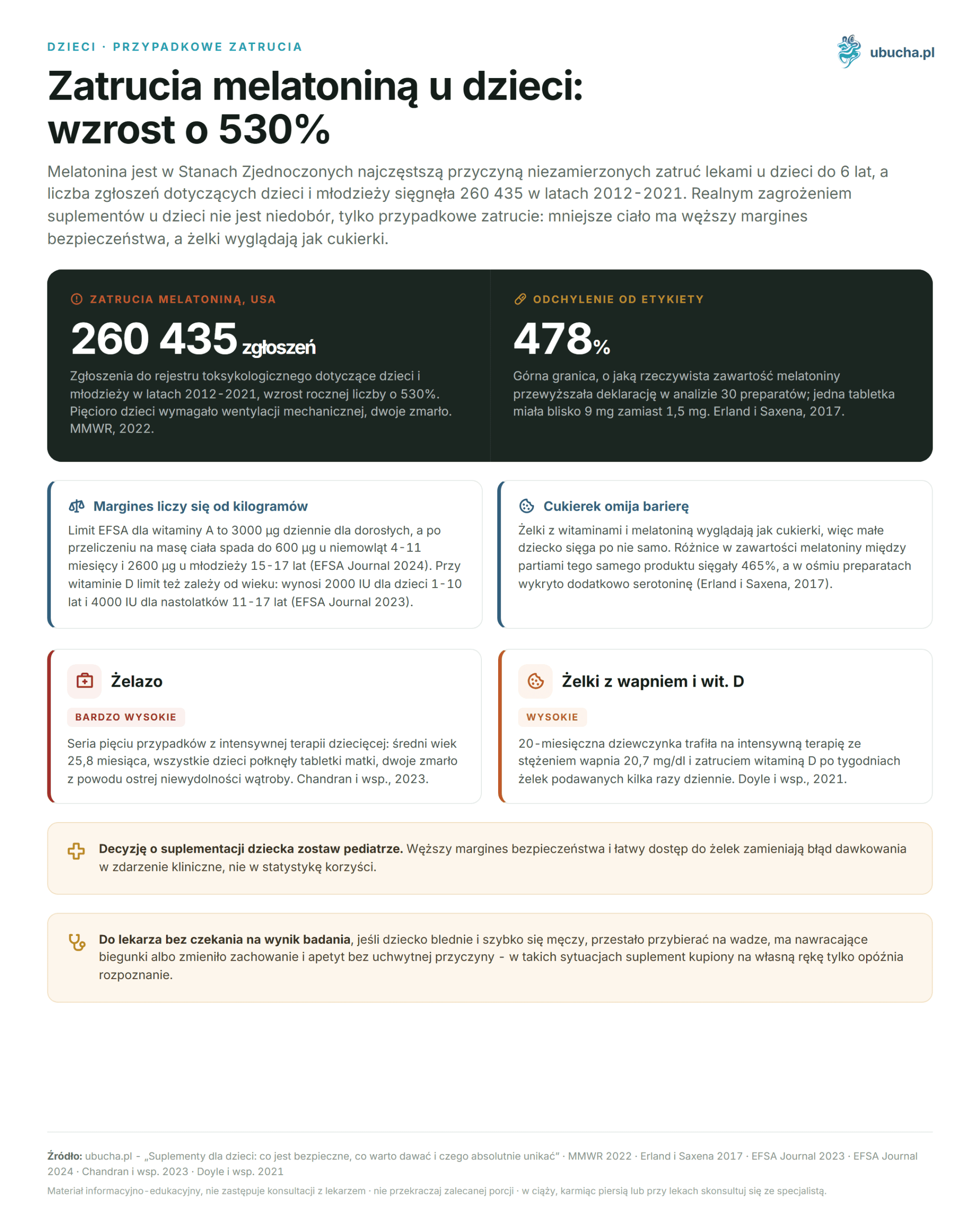
The authors analyzed 19 publications. Interventional studies included a total of 167 small children with neurological disorders, mainly from the autism spectrum, and showed a reduction in sleep onset time with a small number of adverse events. Outside this group, there is no evidence, and observational data show an increasing number of prescriptions, prolonged use, and cases of overdose (Kracht et al., JAMA Network Open 2026). The American poison control registry recorded a total of 260,435 reports concerning children and adolescents from 2012 to 2021, with an annual increase of 530%. Five children required mechanical ventilation, and two died (MMWR 2022).
Concerns about the impact on sexual maturation remain hypothetical. In a Dutch observation of 51 children treated with an average of 2.7 mg of melatonin for 3.1 years, the advancement of maturation on the Tanner scale did not differ from values published for peers (van Geijlswijk et al., Psychopharmacology 2011). This is a study without a control group, so it resolves little. The problem is therefore not a confirmed hormonal disorder, but the lack of basis for giving melatonin to a child who sleeps poorly for behavioral reasons. Start with regular sleep hours, evening winding down, and removing screens, and if that does not help, go to a pediatrician instead of a pharmacy.
What should not be given to children and why?
The following list includes only items with documented harm or well-described lack of pediatric data. What could not be supported by a source is not included here.
| What to avoid | Reason |
|---|---|
| Adaptogens, including ashwagandha | A review from 2026 describes liver damage, immunological hypersensitivity, and hormonal disorders with prolonged or excessive use and calls for long-term safety assessments (Kumar et al., Phytotherapy Research 2026) |
| Melatonin in a child without diagnosis | The most common cause of unintentional poisoning in children under 6 years, lack of data on effectiveness in healthy children (JAMA Network Open 2026) |
| Iron without confirmed deficiency | Disrupts trace element metabolism and microbiota development, delays growth (Chaber et al., Nutrients 2024) |
| Retinol above the age limit | The EFSA limit increases from 600 µg retinol equivalent in infants 4-11 months to 2600 µg in youth 15-17 years; excess accumulates in the liver |
| Caffeine and guarana preparations | Intended for adults, the dose is not calculated for the child’s body weight |
The most misunderstandings arise with vitamin A. Retinol from supplements is dangerous, not beta-carotene from carrots or spinach, as the body regulates its conversion. The EFSA maintained the limit of 3000 µg retinol equivalent daily for adults and scaled it for children according to body weight, resulting in values from 600 µg in infants to 2600 µg in teenagers (EFSA Journal 2024). Check how much retinol is in your child’s multivitamin before adding cod liver oil to it.
How to read a supplement label for a child?
Start with the daily serving and convert it to what the child is already getting from other preparations. Then check the form of the ingredient, and for probiotics, the full strain designation. Finally, look at the form: gummies look like candy, so the child reaches for them on their own.
Declared content can be the weakest link. In an analysis of 30 melatonin preparations, the actual content ranged from 83% below to 478% above the declaration, with the most deviation being a chewable tablet with nearly 9 mg of melatonin instead of the declared 1.5 mg; differences between batches of the same product reached 465%. Eight preparations additionally contained serotonin (Erland and Saxena, Journal of Clinical Sleep Medicine 2017). Therefore, when choosing supplements for children, select manufacturers that publish batch test results, not the prettiest packaging.
Gummies also have two other disadvantages that advertising rarely mentions: they add sugar to the child’s daily intake and remove the natural barrier against overdose. This is shown in a case report from Pediatric Emergency Care: a 20-month-old girl was admitted to the intensive care unit with a calcium level of 20.7 mg/dl and vitamin D poisoning after weeks during which her mother gave her calcium-vitamin gummies several times a day. The authors describe this as a case of neglect due to the mother’s mental illness, and the hospitalization was long and complicated (Doyle et al., 2021). Treat gummies like medicine: a measured portion, locked cabinet, out of reach of the child.
When to test a child, and when to go to the pediatrician?
Testing instead of guessing makes sense when the result will change the decision. Three tests are enough to start: morphology with ferritin when iron deficiency is suspected, 25(OH)D with long supplementation or its absence, and vitamin B12 in a child on a plant-based diet. The pediatrician issues the referral and interprets the result.
Go to the doctor without waiting for tests if the child is pale and quickly fatigues, has stopped gaining weight, has recurrent diarrhea, or has changed behavior and appetite without an obvious cause. These are situations where a supplement bought on your own delays diagnosis. Also schedule an appointment if the child is on permanent medication, as some ingredients change their absorption.
A vegan diet requires a separate plan. The position of the ESPGHAN Nutrition Committee from 2025 recommends that infants, children, and adolescents on such a diet be under the constant care of a dietitian and pediatrician and receive supplementation of indicated micronutrients, with vitamin B12 at the forefront, as it does not occur in plant products (Verduci et al., Journal of Pediatric Gastroenterology and Nutrition 2025). Undiagnosed B12 deficiency develops over months without clear symptoms, and its neurological effects can be irreversible, so this is not an area for self-experimentation.
Frequently Asked Questions
How much vitamin D should a child receive?
According to guidelines for Poland, an infant up to 6 months receives 400 IU daily, from 6 to 12 months 400-600 IU, a child 1-3 years 600 IU throughout the year, a child 4-10 years 600-1000 IU, and a teenager 11-18 years 1000-2000 IU. The target concentration of 25(OH)D is 30-50 ng/ml (Płudowski et al., Nutrients 2023).
Can children take omega-3?
Fish in the diet yes, capsules not necessarily. A Cochrane review from 2017, covering 15 studies and 1889 term infants, found no consistent developmental benefit from adding DHA to formulas. If a child does not eat fish, adjust the supplement dose with a pediatrician, not from an adult package.
Is melatonin safe for children?
Data mainly concern children with neurodevelopmental disorders. A systematic review from 2026 found no data on effectiveness in typically developing children and reminds that melatonin is the most common cause of unintentional poisoning in children under 6 years. For sleep problems, start with sleep hygiene and consultation with a pediatrician.
When does a child need iron from a supplement?
Only after confirming a deficiency through testing, and prophylactically only in preterm infants and children with low birth weight. WHO considers ferritin below 12 µg/l in children up to 5 years and below 15 µg/l in older children. The therapeutic dose is calculated per kilogram of body weight and prescribed by a doctor. Iron without deficiency disrupts trace element metabolism and the development of gut microbiota.
Are vitamin gummies safe for children?
The problem is not the composition itself, but the ease of overdose and additional sugar. In a case report from Pediatric Emergency Care, a 20-month-old girl was admitted to intensive care with a calcium level of 20.7 mg/dl after weeks of receiving vitamin D and calcium gummies several times a day. Count the pieces, keep the package out of reach of the child, and sum doses from all preparations.
Which probiotics have evidence in children?
Saccharomyces boulardii reduced the risk of antibiotic-associated diarrhea in children from 20.9% to 8.8%, and Lactobacillus rhamnosus GG shortened infectious diarrhea by an average of 0.85 days in a review of 18 studies involving 4208 children, with this result coming from 15 of them (Szajewska et al., 2015 and 2019). A product without a specified strain designation has no documented clinical effect.
If you are looking for products for yourself, you can browse the assortment in the supplements category. Leave the decision about your child’s supplementation to the pediatrician.
This article is for informational and educational purposes and does not constitute medical advice. Before starting supplementation, consult a doctor, especially if you are on permanent medication, pregnant, breastfeeding, or have a chronic illness.
Author: Michał Waluk · Published: 2026-06-02 · Updated: 2026-08-11