


Rhodiola rosea (roseroot): properties for stress and fatigue 2026
Rhodiola rosea (roseroot) – properties for stress and fatigue, SHR-5 extract, dosing 200–400 mg/day, salidroside and rosavins 2026.
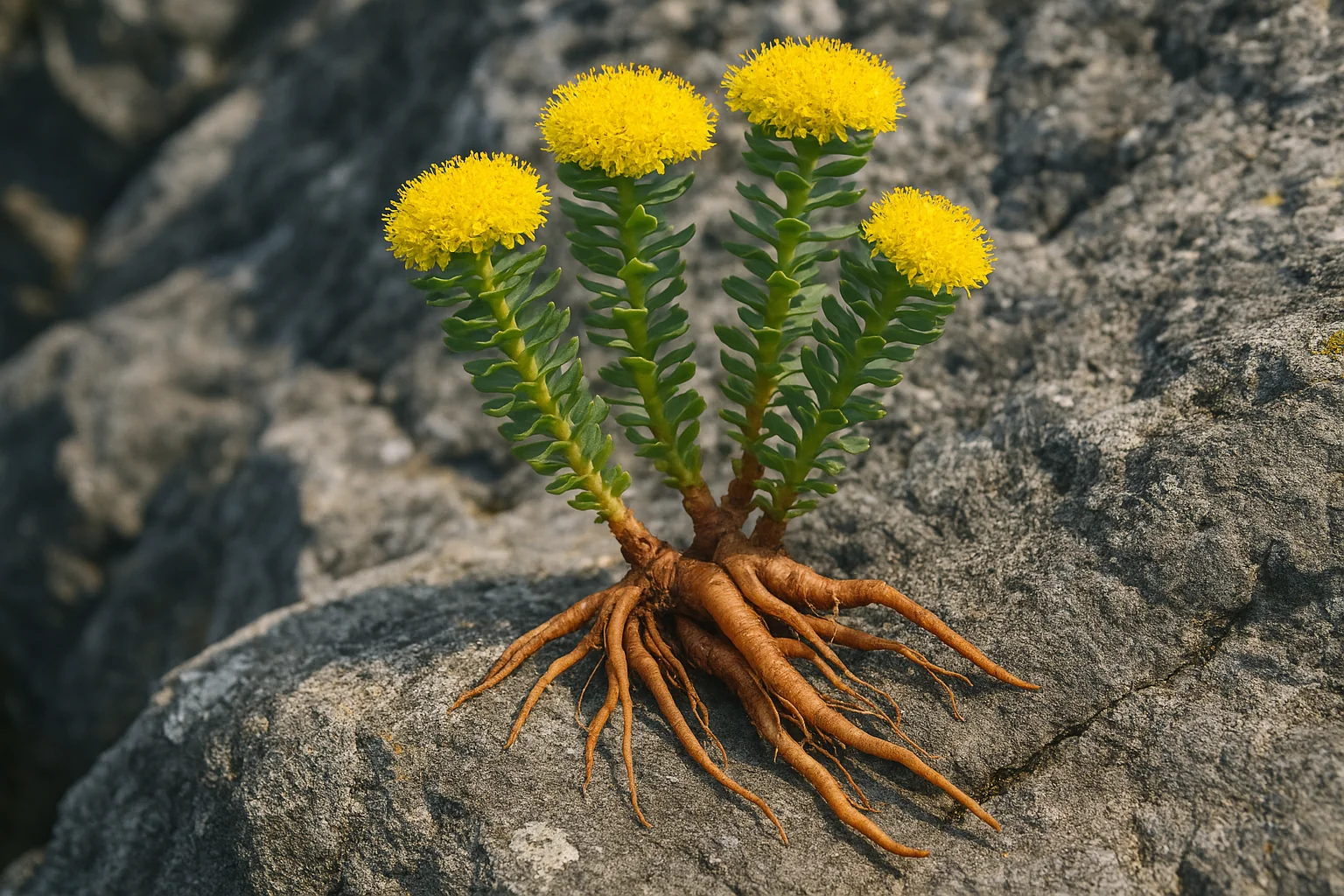
Golden root is a plant that grows where few other things survive: in rock crevices above 2000 m above sea level, in the arctic cold of Siberia and Scandinavia. Its active ingredients - salidroside and rosavins - exhibit the same resilience to extreme conditions, helping the human body cope with physical and mental stress. The study by Olsson et al. (Planta Medica, 2009) with 60 patients suffering from chronic fatigue showed significant improvement in fatigue, attention, and quality of life after 28 days of using the SHR-5 extract. The meta-analysis by Hung et al. (Phytomedicine, 2011) confirmed the effectiveness of rhodiola for stress-induced fatigue at doses of 150-600 mg/d. This article explains the mechanisms, standardization of SHR-5, and practical dosing - without marketing exaggeration.
KEY INFORMATION
• The study by Olsson et al. (Planta Medica, 2009) showed significant improvement in MFI (Multidimensional Fatigue Inventory) and stress indicators after 28 days of using SHR-5 576 mg/day in 60 patients with chronic fatigue.
• Meta-analysis by Hung et al. (Phytomedicine, 2011) - 11 clinical studies confirmed the effectiveness of rhodiola for fatigue and stress at doses of 150-600 mg/d.
• Standardization of SHR-5: 3% rosavins and 1% salidroside - this is the benchmark for clinical studies.
• Rhodiola acts faster than ashwagandha - effects after 1-2 weeks; good for combining: rhodiola in the morning, ashwagandha in the evening.
What is rhodiola rosea and what distinguishes it among adaptogens?
Rhodiola rosea (golden root, also known as zlatnik in some folk traditions) is a perennial plant from the Crassulaceae family growing in the arctic and mountainous regions of Europe, Asia, and North America. In Europe, it mainly grows wild in Scandinavia and the Carpathians; in Poland, it can be found in the Tatra Mountains and the Sudetes. The medicinal raw material is the thick, fleshy root - harvested after 3-5 years of growth, when the content of salidroside and rosavins is highest.
History of use: traditionally used by Vikings as a strengthening agent before battles and long voyages, by Siberian shamans as a vitality and fertility tonic, and by Soviet scientists in the 20th century as an adaptogen for cosmonauts, soldiers, and professional athletes. The Soviet army funded extensive research on rhodiola in the 60s-80s as a means to increase endurance and resistance to operational stress. These studies, long unknown in the West, became the basis for later Western RCTs.
What distinguishes rhodiola among adaptogens? Three features set it apart from ashwagandha and reishi: (1) faster onset of effects - fatigue and stress respond after 1-2 weeks vs 4-8 weeks for ashwagandha; (2) a more energizing profile than calming - it acts through monoamines, not through GABA; (3) particular effectiveness in acute stress and burnout - the mechanism of immediate stress response.
Salidroside and rosavins - active ingredients of rhodiola
Two main groups of active compounds determine the action of rhodiola: salidroside (p-tyrosol glycoside) and rosavins (rosavin, rosin, rosarin).
Salidrozyd (tyrozol): Considered the key compound responsible for the adaptogenic action of rhodiola. In vitro and in vivo studies show that salidroside: protects neurons from oxidative stress, inhibits monoamine oxidase A and B (MAO-A/B) - enzymes that break down serotonin, dopamine, and norepinephrine, increasing their availability; acts neuroprotectively by activating AMPK and PI3K/Akt pathways; normalizes the cortisol response in adrenal cells exposed to stress. Standardization to a minimum of 1% salidroside is crucial for the extraction of clinically active preparations.
Rozawiny (rozawina, rozyna, rozaryna): Phenylethanoids unique to Rhodiola rosea (other Rhodiola species do not contain them - this is a biochemical marker of authenticity). Rosavins exhibit adaptogenic, immunomodulatory, and antioxidant effects. Standardization of SHR-5 (3% rosavins, 1% salidroside) is a benchmark used in key clinical studies Olsson 2009, Hung 2011, and Darbinyan 2000. Products without declared content of rosin and salidroside cannot be evaluated as tested preparations.
What do clinical studies say about rhodiola?
The clinical evidence base for rhodiola is solid for a plant adaptogen - several double-blind RCTs involving dozens of patients.
Olsson et al. (Planta Medica, 2009) - the most important study on chronic fatigue: 60 patients with "chronic fatigue syndrome". Double-blind trial, SHR-5 576 mg/d for 28 days. Results: significant improvement in MFI (Multidimensional Fatigue Inventory) by 18%, improvement in focus and concentration, improvement in morning cortisol levels. No significant adverse effects.
Hung et al. (Phytomedicine, 2011) - meta-analysis of 11 RCTs on rhodiola and fatigue: all 11 studies showed a positive effect on fatigue and stress at doses of 150-600 mg/d. The authors rated the quality of evidence as moderate and stated that rhodiola is a "promising, safe" adaptogen for stress-induced fatigue.
Darbinyan et al. (Phytomedicine, 2000) - the first clinical RCT with rhodiola: 56 on-call doctors in Armenia. The 6-week study showed improvement in perception, memory capacity, and psychophysical endurance in the group taking 170 mg/d SHR-5 vs placebo. This historic study brought rhodiola into Western scientific literature.
Antidepressant action: Darbinyan et al. (Nordic Journal of Psychiatry, 2007) in a study with 89 patients with mild to moderate depression, it was shown that SHR-5 340 or 680 mg/d for 6 weeks significantly reduced the severity of depression on the HAM-D and SAS-M scales. The effects were comparable at the 680 mg dose, suggesting a plateau effect above this dose.
Dawkowanie rhodioli - SHR-5 i inne ekstrakty
Dosage of rhodiola in clinical literature ranges from 150 mg/d to 680 mg/d depending on the purpose of use and standardization of the extract. Several principles organize this data.
SHR-5 extract (3% rosavins, 1% salidroside): Clinical benchmark. Effective doses: 200-400 mg/d for general adaptogenic support and fatigue reduction; 400-680 mg/d for more severe symptoms (chronic fatigue, mild depression). The Olsson 2009 study used 576 mg/d in 2 capsules (288 mg × 2).
Inne ekstrakty standaryzowane: Look for products with declared content: at least 3% rosavins and at least 1% salidroside. Products without this standardization may be inactive Rhodiola species or insufficiently concentrated powders. Check the species name: "Rhodiola rosea" - not "Rhodiola sp." or "golden root."
Timing: In the morning or before a stressful situation. Rhodiola has stimulating properties on monoamines - in the evening it may hinder sleep in sensitive individuals. When taken twice daily: in the morning and at noon (not in the evening).
Cykl: 6-12 weeks of regular use, followed by a 4-week break. There is no evidence of tachyphylaxis (diminishing effects with prolonged use), but a break allows for assessing effects and maintains receptor sensitivity.
Product form: Dry capsules with standardized extract are the most convenient and accurately dosed form. Tinctures of rhodiola contain salidroside and rosavins in alcohol - they are absorbed faster through the oral mucosa, which is useful for immediate use before stress. Raw root powder (unextracted) requires significantly higher doses (3-5 g/d) and has less predictable standardization.
Combining with food: Rhodiola is traditionally taken on an empty stomach or 30 minutes before a meal. The absorption of salidroside is somewhat better without a simultaneous meal rich in fiber. If you have a sensitive stomach, take it with a light meal, but avoid combining it with large amounts of fiber (psyllium, oats) directly at the time of dosing.
Rhodiola and burnout - a special value of adaptogens
Burnout is one of the most widely discussed health issues in Poland in 2026. WHO data indicates that burnout affects between 23% and 67% of employees, depending on the industry and measurement methodology. It is characterized by three dimensions: emotional exhaustion, depersonalization, and reduced sense of efficacy. Rhodiola particularly addresses the first dimension - exhaustion.
Salvia i Palomino (Phytotherapy Research, 2013) A study on rhodiola was conducted with 118 patients suffering from "stress-related burnout" in an open-label trial over 12 weeks. The use of SHR-5 at 576 mg/day throughout the period showed significant improvement in all dimensions of burnout measured by the MBI (Maslach Burnout Inventory): emotional exhaustion -21%, depersonalization -17%, sense of efficacy +24%. This is the first study on rhodiola specifically in patients with occupational burnout.
Mechanism of action in burnout: salidroside normalizes HPA axis reactivity, which is characteristically disrupted in burnout (too low morning cortisol, flat diurnal curve). This differentiates burnout from acute stress (too high cortisol) and requires a different supplementation approach. Rhodiola with too low cortisol may help by normalizing HPA reactivity upwards, while ashwagandha lowers it with too high cortisol. This is an important clinical difference when choosing an adaptogen.
Practical conclusion: for occupational burnout with dominant apathy, helplessness, and low morning cortisol - rhodiola is a better choice than ashwagandha. For burnout with a stress component, insomnia, and elevated cortisol - ashwagandha or a combination of both.
How does Rhodiola rosea differ from other species of rhodiola?
In the supplement market, various species of the Rhodiola genus can be found: R. crenulata, R. imbricata, R. kirilowii, R. sachalinensis. An important question: are all biologically equivalent?
Answer: no. Rhodiola rosea is the only species containing rosavins (rosavin, rosin, rosarin). Other Rhodiola species do not produce rosavins or produce them in trace amounts. Salidroside is present in many Rhodiola species and other plants, but rosavins are a unique marker of the authenticity of Rhodiola rosea.
From a clinical perspective: all clinical studies confirming the effects of rhodiola (Olsson 2009, Hung 2011, Darbinyan 2000, 2007) used an extract from Rhodiola rosea standardized for rosavins. There is no basis for extrapolating their results to other species. When purchasing a supplement, check: "Rhodiola rosea" (not "Rhodiola sp."), declared content of rosavins ≥3% and salidroside ≥1%.
Rhodiola vs ashwagandha vs inne adaptogeny
Comparing adaptogens helps choose the right one for a specific symptom profile.
Rhodiola vs ashwagandha: Rhodiola = energizing adaptogen, works through monoamines (serotonin, dopamine, NA), good for acute stress, fatigue, and low mood, faster effect (1-2 weeks). Ashwagandha = calming adaptogen, works through the HPA axis (cortisol, GABA), good for chronic stress, insomnia, hypercortisolism, slower effect (4-8 weeks). Ideal stack: rhodiola in the morning + ashwagandha in the evening.
Rhodiola vs reishi: Reishi is more immunological and hepatoprotective; rhodiola is more neuropsychiatric and energizing. With dominant mental symptoms (mental fatigue, depression, stress) - rhodiola. With dominant somatic symptoms (immunity, sleep, oxidative stress) - reishi.
Learn more about adaptogens for women
Safety and interactions of rhodiola
Rhodiola has a good safety profile at recommended doses, but several interactions and situations require caution.
Leki antydepresyjne (SSRI, SNRI): Rhodiola exhibits its own serotoninergic activity by inhibiting MAO. When used concurrently with SSRIs (sertraline, fluoxetine, escitalopram) or SNRIs (venlafaxine, duloxetine), there is a theoretical risk of serotonin syndrome. The risk is low at standard doses of rhodiola, but a psychiatric consultation is absolutely necessary before combining rhodiola with antidepressant medications.
Stimulant medications (amphetamines, methylphenidate): Potential excessive stimulation of the monoaminergic system. Do not combine without medical supervision.
Antihypertensive medications: Rhodiola may slightly raise blood pressure in some individuals by stimulating the sympathetic nervous system. For pharmacologically treated hypertension - medical consultation and blood pressure monitoring.
Pregnancy and breastfeeding: Insufficient safety data. Caution is recommended; medical consultation is mandatory.
Side effects: Rare at therapeutic doses and generally mild. Possible nervousness, increased excitability, or insomnia when taken late or exceeding the recommended dose of 600 mg/day. For gastric sensitivity - take with a light meal.
Our observations: Rhodiola is an adaptogen with one unique feature that manufacturers rarely describe: it works acutely. A single dose of 200-300 mg SHR-5 taken 30 minutes before a stressful situation (exam, presentation, difficult conversation) can alleviate the stress response - feelings of rapid heartbeat, nervousness, trembling hands. This is not a placebo - salidroside has an acute action mechanism on the HPA axis independent of long-term adaptogenic effects. This duality (acute and long-term) makes rhodiola an exceptionally useful adaptogen in practical application.
Frequently Asked Questions
What is rhodiola rosea and how does it work?
Rhodiola rosea (golden root) is an adaptogenic plant from the mountainous regions of Europe and Asia. Salidroside and rosavins modulate the HPA axis, increase the availability of serotonin and dopamine by inhibiting MAO, and protect cells from oxidative stress. It works particularly effectively in cases of acute stress, physical and mental fatigue.
Jakie dawkowanie rhodioli jest skuteczne?
Standardized extract SHR-5 (3% rosavins, 1% salidroside): 200-400 mg/day for general support; 400-680 mg/day for increased fatigue. The study by Olsson et al. (2009) used 576 mg/day. The meta-analysis by Hung et al. (2011) confirmed efficacy at doses of 150-600 mg/day in 11 clinical trials.
When is the best time to take rhodiola - in the morning or evening?
Rhodiola works best in the morning or before a stressful situation. Its energizing profile (stimulation of serotonin and dopamine) may hinder sleep when taken in the evening by sensitive individuals. Optimal: in the morning on an empty stomach or 30 minutes before a meal.
Czy rhodiola ma interakcje z lekami antydepresyjnymi?
Rhodiola exhibits serotoninergic activity through MAO inhibition. With SSRIs or SNRIs, there is a theoretical risk of excessive serotonin stimulation. The risk is low at standard doses, but it requires absolute psychiatric consultation before combining.
What is the difference between rhodiola and ashwagandha?
Ashwagandha is "calming" (HPA axis, cortisol, GABA) - good for chronic stress and insomnia. Rhodiola is "energizing" (monoamines) - good for acute stress, fatigue, and low mood. These are complementary adaptogens: rhodiola in the morning, ashwagandha in the evening.
How long does it take for rhodiola to work?
Rhodiola acts faster than ashwagandha. Effects on fatigue appear after 1-2 weeks; antidepressant effects after 4-6 weeks. Rhodiola also has an acute effect - a single dose before a stressful situation can alleviate the acute stress response within 30-60 minutes.
This article is for informational and educational purposes and does not replace consultation with a doctor. If you are pregnant, breastfeeding, taking medications, or have chronic conditions, consult the use of supplements or herbs with a specialist.
Author: Michał Waluk · Published: 2026-05-04 · Updated: 2026-05-04