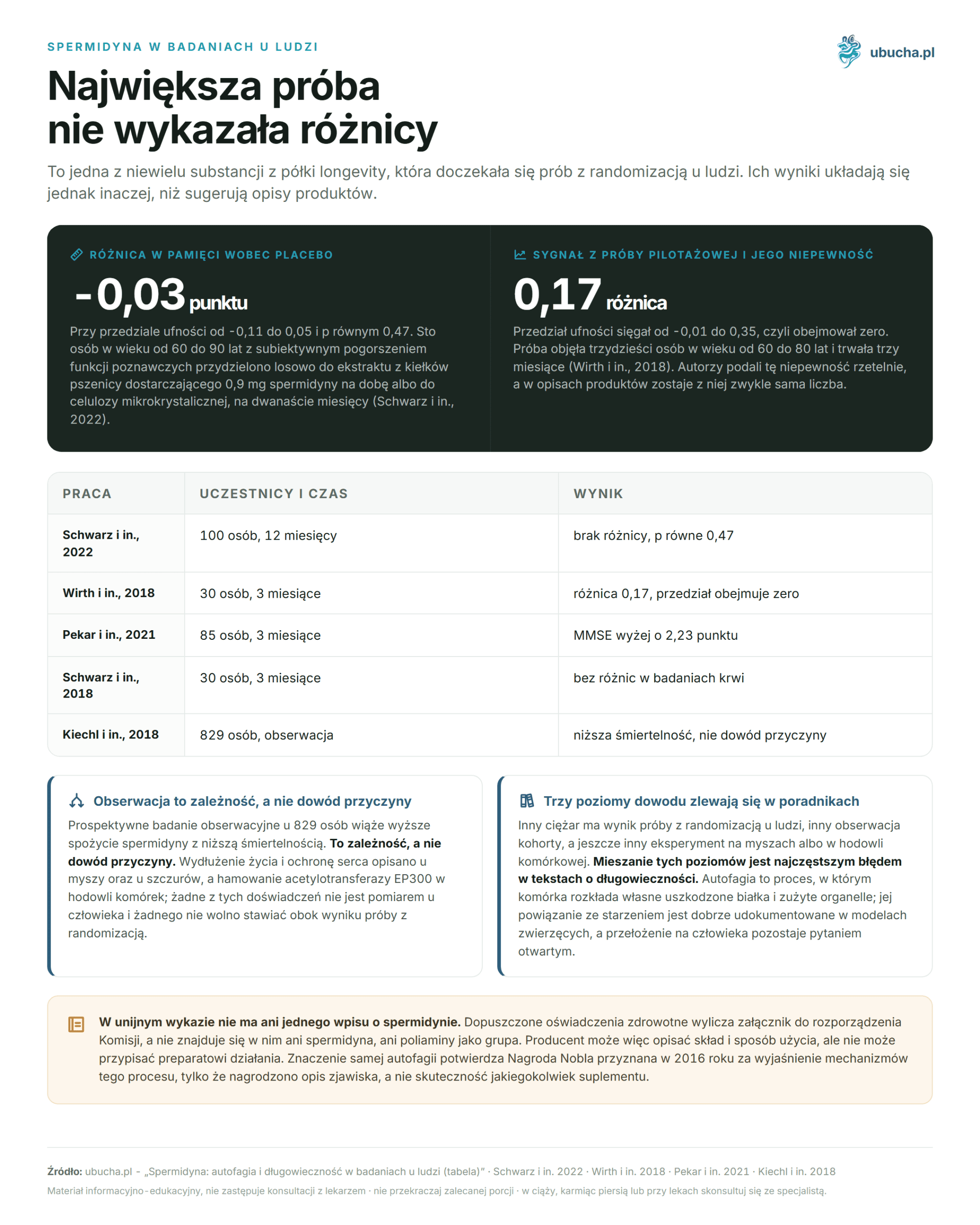

Spermidine: autophagy and longevity in human studies (table)
Spermidine extends life in mice and induces autophagy in cell culture. In humans, the largest randomized trial did not show memory improvement after 12 months.
Spermidine is one of the few substances from the longevity shelf that has undergone randomized trials in humans, not just reports from cell cultures and rodents. This is good news, but the results of these trials are different from what product descriptions suggest. The largest and longest study, a twelve-month phase 2b trial involving one hundred people, did not show improvement in memory compared to placebo. Shorter trials provided beneficial signals, although with confidence intervals touching zero. Below, we separate three layers of evidence that are usually conflated in guides: measurement in a randomized trial in humans, population observation, and experiments on animals or in cell culture. For each number, we provide how many participants there were, how long the observation lasted, and how wide the confidence interval around the result is.
KEY INFORMATION
• A twelve-month randomized trial involving 100 people with subjective cognitive decline showed no difference in memory compared to placebo: -0.03 with a confidence interval from -0.11 to 0.05 and p equal to 0.47 (Schwarz et al., JAMA Network Open, 2022).
• A three-month pilot trial involving 30 people showed a moderate effect, but the confidence interval for the difference ranged from -0.01 to 0.35, which includes zero (Wirth et al., Cortex, 2018).
• A prospective observational study involving 829 people links higher spermidine intake with lower mortality; this is a correlation, not proof of causation (Kiechl et al., AJCN, 2018).
• Lifespan extension and heart protection have been described in mice and rats, and inhibition of acetyltransferase EP300 in cell culture; none of these experiments are measurements in humans.
• Spermidine supplements have no approved health claims in the EU.
What is spermidine and where does it come from?
Spermidine is a polyamine, an organic cation present in mammalian cells and also obtained from food. It belongs to the same family as putrescine and spermine. In the cell, it stabilizes nucleic acids and participates in the regulation of protein synthesis, and in the context of aging, researchers are primarily interested in it as a factor stimulating autophagy. It is worth noting right away: in the EU’s list of approved health claims, that is, in the annex to Commission Regulation (EU) No 432/2012, there is not a single entry about spermidine or polyamines.
Autophagy is a process in which a cell breaks down its own damaged proteins and used organelles, recovering material for new synthesis. Its significance is confirmed by the Nobel Prize in Physiology or Medicine awarded in 2016 to Yoshinori Ohsumi for explaining the mechanisms of this process. The connection between autophagy and aging is well documented in animal models, while translating it to humans remains an open question.
This is why with every statement about spermidine, it is worth asking what it was measured against. A randomized trial in humans carries a different weight than a cohort observation, and even more so than an experiment on mice or in cell culture. We discuss these three levels separately below, as mixing them is the most common mistake in texts about longevity. We similarly organize the evidence in the review of longevity supplements.
What did randomized trials in humans show?
The strongest methodology is the SmartAge trial. One hundred people aged 60 to 90 with subjective cognitive decline were randomly assigned to wheat germ extract providing 0.9 mg of spermidine per day or to microcrystalline cellulose as placebo, for twelve months. The primary endpoint, the ability to distinguish similar memories, did not change: the difference between groups was -0.03 with a confidence interval from -0.11 to 0.05 and p equal to 0.47 (Schwarz et al., JAMA Network Open, 2022).
| Study | Participants and duration | Dose in protocol | Result |
|---|---|---|---|
| Schwarz et al., 2022 | 100 people, 60-90 years, 12 months | 0.9 mg per day from wheat germ extract | no difference: -0.03 (95% CI from -0.11 to 0.05); p = 0.47 |
| Wirth et al., 2018 | 30 people, 60-80 years, 3 months | plant extract rich in spermidine | difference 0.17 (95% CI from -0.01 to 0.35); interval includes zero |
| Pekar et al., 2021 | 85 people, 60-96 years, 3 months | higher and lower supply group | in mild dementia, MMSE score higher by 2.23 points (p = 0.026) |
| Schwarz et al., 2018 | 30 people, 60-80 years, 3 months | 1.2 mg per day | safety study: no differences in blood tests and self-reported health |
The phase IIa pilot trial involved thirty people and lasted three months. The authors described a moderate improvement in memory, while honestly providing the uncertainty: the difference was 0.17 with a confidence interval from -0.01 to 0.35, and the effect size was 0.77 with a range from 0 to 1.53 (Wirth et al., Cortex, 2018). Both intervals touch zero, so this is a signal to check in a larger study, not a determination. The phase IIb trial announced in this work was indeed conducted, and it was this one that turned out negative.
The third trial, conducted in six nursing homes in Styria, involved 85 people aged 60 to 96 years. The greatest improvement was noted in the subgroup with mild dementia: MMSE score higher by 2.23 points with p equal to 0.026. The second result, phonemic fluency, gave p equal to 0.47, which did not reach significance (Pekar et al., Wiener Klinische Wochenschrift, 2021). The authors called this study preliminary.
Does spermidine definitely trigger autophagy in humans?
The mechanism cited in product descriptions is the inhibition of acetyltransferase EP300. It comes from a study that examined cultured human cells and purified EP300 protein in vitro. Spermidine, along with anacardic acid, curcumin, and garcinol, lowered acetylation levels and induced signs of enhanced autophagy, and a screening of forty-three acetyltransferases indicated EP300 and NAA20 as those whose silencing produces the same effect (Pietrocola et al., Cell Death and Differentiation, 2015).
This is solid work, but it describes measurement in culture, not in humans. The statement “spermidine induces autophagy” is true at the cellular level and unresolved at the organism level. None of the clinical trials discussed above measured autophagy as an endpoint, so a product description attributing this mechanism to a study in seniors transfers the result between levels of evidence.
It is also worth separating two different theses. The first states that spermidine stimulates autophagy in the cell; this is supported. The second states that an oral capsule translates into a measurable change in autophagy in human tissues; this has not yet been demonstrated in a randomized trial.
What do epidemiological data say about longevity?
The most frequently cited source is a prospective population cohort. It involved 829 people aged 45 to 84 years, with intake assessed through repeated dietary questionnaires in 1995, 2000, 2005, and 2010, and observation continued until 2015, recording 341 deaths. Overall mortality decreased with tertiles of intake: 40.5 deaths per 1000 person-years in the lowest, 23.7 in the middle, and 15.1 in the highest (Kiechl et al., AJCN, 2018).
After adjusting for lifestyle and other dietary characteristics, the risk of death for each standard deviation increase in intake was 0.76 with a confidence interval from 0.67 to 0.86. This result was independently confirmed in a second cohort, where the risk was 0.71 with a range from 0.53 to 0.95. The study was registered under number NCT03378843.
There is one number here that guides notoriously misinterpret. The authors wrote that the difference in mortality risk between the highest and lowest tertile corresponds to a difference in age of 5.7 years, with a range from 3.6 to 8.1 years. This does not mean that anyone lived 5.7 years longer or that it pertains to quartiles. This is a risk conversion to age scale in an observational study, and such a study shows correlation, not causation.
Where do the data on heart and immunity come from?
The work on which the entire cardiological narrative stands primarily describes animals. Oral spermidine extended the lifespan of mice, reduced heart hypertrophy, and preserved diastolic function in old individuals, and in Dahl rats on a high-sodium diet, it lowered blood pressure and delayed the development of heart failure. In mice lacking Atg5 protein in cardiomyocytes, the protection disappeared, indicating the involvement of autophagy. The human part is solely a correlation of intake from questionnaires with blood pressure and incidence of heart disease (Eisenberg et al., Nature Medicine, 2016).
The immune thread looks similar. Researchers have shown that autophagy is activated in specific T lymphocytes after vaccination in healthy volunteers, and spermidine levels in human lymphocytes decrease with age. However, the key experiment was conducted on cells taken from older donors: adding spermidine to these cells outside the body restored autophagy and functionality comparable to cells from young individuals (Alsaleh et al., eLife, 2020).
This is not the same as a trial in which seniors take a capsule and their response to vaccination is measured. We did not find such a trial in the available literature, and title queries about spermidine together with vaccination return in Europe PMC only a study on mice. If a product description promises a better vaccine response, it is ahead of the evidence.
How much spermidine is in food?
Polyamines are a common dietary component, and their content has been compiled in a database based on literature reviews and on our own measurements of Swedish dairy products using HPLC. The highest levels of putrescine are found in fruits and cheeses, while spermidine dominates in vegetables, and spermine in meat products (Atiya Ali et al., Food and Nutrition Research, 2011).
The authors point out something that undermines the precise tables circulating on the internet: the content of polyamines in cheese varied significantly between studies. In their own measurements, aged cheese had 52.3 mg of putrescine, 1.2 mg of spermidine, and 2.6 mg of spermine per kilogram, while low-fat milk had 1.0 mg of spermidine per kilogram. Numbers given in other sources can be many times higher, so any calculation of daily intake from the diet is subject to a large error.
It is worth noting, however, what the clinical trials were based on. All three interventional studies discussed above used wheat germ extract, not pure spermidine, and administered fractions of milligrams per day. Comparing these amounts with food content is therefore a comparison of two different things: a standardized preparation and a variable food matrix.
Frequently asked questions
Does spermidine improve memory in humans?
The largest and longest randomized trial did not confirm this. In a hundred people taking 0.9 mg per day for twelve months, the difference compared to placebo was -0.03 with a confidence interval from -0.11 to 0.05 and p equal to 0.47 (Schwarz et al., 2022). Earlier, shorter trials showed beneficial signals, but with intervals including zero.
Does supplementation trigger autophagy in humans?
Inhibition of acetyltransferase EP300 has been shown in cultured human cells and on purified protein in vitro (Pietrocola et al., 2015). None of the discussed clinical trials measured autophagy as an endpoint, so transferring this mechanism to the human body remains an assumption, not a measurement.
Does spermidine extend life?
In mice, yes, and this has been described along with heart protection (Eisenberg et al., 2016). In humans, we only have an observational study linking higher intake with lower mortality, which shows a correlation, not causation. No randomized trial has studied lifespan in humans as an endpoint.
Where does the number 5.7 years come from?
From an observational cohort where the difference in mortality risk between the highest and lowest tertile of intake corresponded to a difference in age of 5.7 years, with a range from 3.6 to 8.1 (Kiechl et al., 2018). This is a risk conversion to age scale, not a measured difference in lifespan and does not pertain to quartiles.
Are spermidine supplements safe?
In a three-month trial involving thirty people taking 1.2 mg per day, no differences in blood parameters or self-reported health were found compared to placebo (Schwarz et al., Aging, 2018), and in a twelve-month trial, adverse events were evenly distributed between groups. Data on longer use and higher doses is lacking.
Does spermidine have better evidence than resveratrol or NMN?
None of these substances have evidence for extending human life, and for spermidine, the longest randomized trial was negative. Comparing their strength of evidence is therefore misleading. More about this group of preparations is discussed in texts about NAD+ and NMN and about ergothioneine.
The supplements available in our store are gathered in the supplements category.
This article is for informational and educational purposes only and does not constitute medical advice. Before starting supplementation, consult your doctor, especially if you are taking medications regularly, are pregnant or breastfeeding, or have a chronic illness.
Author: Michał Waluk · Published: 2026-07-31 · Updated: 2026-08-16