
White Mulberry for Sugar and Weight Loss: Dosage (Table)
White mulberry and DNJ: what has really been measured in studies on postprandial glycemia, body weight, and HbA1c, what doses were given, and when hypoglycemia is a risk.
The leaf of the white mulberry contains 1-deoxynojirimycin (DNJ), a molecule that inhibits intestinal alpha-glucosidases. This is the same target as acarbose, a prescription drug used in type 2 diabetes. The mechanism is therefore specific and well described, yet a lot of promises have accumulated around mulberry that research does not confirm. Below you will find a summary of what has really been measured: how much DNJ was given to volunteers, how much postprandial sugar decreased, what happened after twelve weeks, and why the result for body weight looks much weaker than for glycemia. The table shows doses from studies, not a plan for you. How much you should take is determined by a doctor, especially if you are taking blood sugar-lowering medications.
KEY INFORMATION
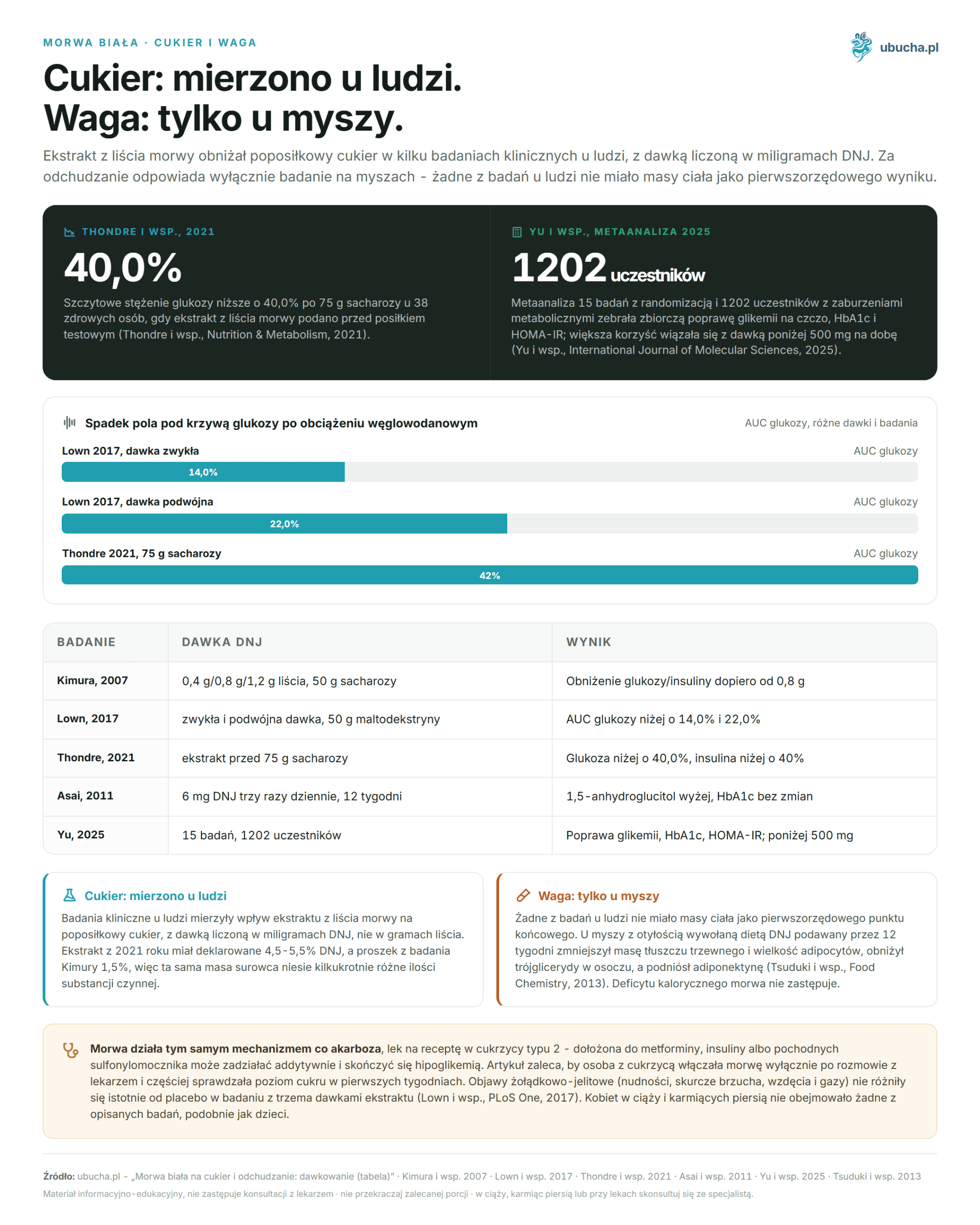
• Mulberry leaf extract reduced the peak glucose level after 75 g of sucrose by 40.0%, and the area under the insulin curve by 40% in 38 healthy individuals (Thondre et al., Nutrition & Metabolism 2021).
• The dose in studies is given in milligrams of DNJ, not grams of leaf.
• After 12 weeks, postprandial control improved, but fasting glucose and HbA1c remained unchanged (Asai et al., 2011).
• Data on weight loss come from studies on mice.
• With blood sugar-lowering medications, mulberry poses a risk of hypoglycemia.
How does white mulberry affect blood sugar levels?
It inhibits the digestion of carbohydrates in the intestine. DNJ is a glucose analog and blocks alpha-glucosidases, which are enzymes that break down disaccharides and oligosaccharides into simple sugars. Less glucose is produced in the intestine over time, so the postprandial glycemic spike is lower and more spread out over time. The effect is mechanical and occurs with the first dose.
The strongest measurement in humans comes from a double-blind study with a crossover design. Thirty-eight healthy volunteers received 75 g of sucrose with mulberry leaf extract or just sucrose. With the extract, the peak glucose concentration was 40.0% lower, the area under the glucose curve was 42% lower, and the area under the insulin curve was 40% lower; all differences were statistically significant (Thondre et al., Nutrition & Metabolism 2021).
This work, however, has a background that the reader should be aware of. It was funded by Phynova, the manufacturer of the extract used, and was involved in the study design and preparation of the publication, although not in data collection and analysis. This does not invalidate the result, but it should be treated as a single measurement of one preparation, not as a property of the species.
The condition for action follows directly from the mechanism: DNJ must be in the intestine before carbohydrates arrive there. Administered after a meal, it encounters sugars that are already partially absorbed and loses most of its meaning.
How much white mulberry was given in studies?
The dose is given in milligrams of DNJ, not grams of dried leaf. In the study on a single dose, a significant effect appeared only at amounts corresponding to 12 and 18 mg of DNJ (Kimura et al., Journal of Agricultural and Food Chemistry 2007), and in the twelve-week study, 6 mg of DNJ was administered three times a day. The table below summarizes what was actually given and what the results were.
| Study | Who and how many | What was given | Result |
|---|---|---|---|
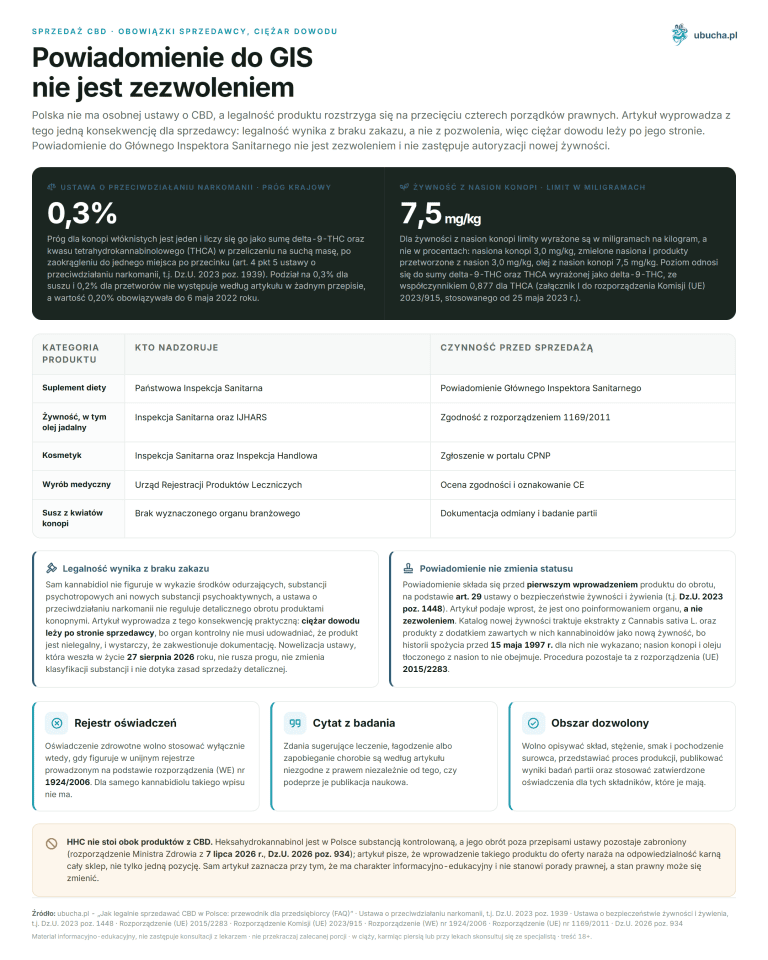
| Kimura et al., 2007 | healthy volunteers | 0.4 g, 0.8 g or 1.2 g of leaf powder (6, 12 or 18 mg of DNJ) before 50 g of sucrose | significant reduction in glucose and insulin after a meal only at 0.8 and 1.2 g |
| Lown et al., 2017 | 37 adults with normal glycemia | three doses of extract before 50 g of maltodextrin | area under the glucose curve lower by 14.0% at the regular dose and by 22.0% at the double dose |
| Thondre et al., 2021 | 38 healthy individuals | leaf extract before 75 g of sucrose | peak glucose lower by 40.0%, area under the insulin curve by 40% |
| Asai et al., 2011 (study 2) | 76 individuals with fasting glucose 110-140 mg/dl | 6 mg of DNJ three times a day for 12 weeks | better 1,5-anhydroglucitol, no changes in fasting glucose and HbA1c |
| Yu et al., 2025 (meta-analysis) | 15 studies, 1202 participants | various mulberry preparations | collectively better glycemia, HbA1c and HOMA-IR; greater benefit below 500 mg per day |
This highlights the importance of standardization. The extract used in the 2021 study had a declared 4.5-5.5% DNJ, while the powder from Kimura’s study had 1.5%, so the same mass of raw material carries several times different amounts of the active substance. A label stating only “500 mg mulberry leaf extract” does not allow relating the product to any of these studies.
Does white mulberry help with weight loss?
This has not been demonstrated in humans. None of the described studies had body weight as a primary endpoint, and the meta-analysis from 2025 collected metabolic markers, not kilograms. Data on anti-obesity effects come from animal models, which is a significant difference, not a formality.
In a study on mice with diet-induced obesity, DNJ was administered for 12 weeks. Visceral fat mass decreased, adipocyte size decreased, plasma triglycerides fell, and adiponectin levels increased, which the authors associate with the stimulation of beta-oxidation in the liver (Tsuduki et al., Food Chemistry 2013). This is a result in rodents, with doses calculated based on the body weight of the mice.
The indirect reasoning sounds reasonable: a lower insulin spike after a meal means weaker inhibition of lipolysis, so the body reaches for fat longer. However, a sensible mechanism is not proof of effectiveness, and white mulberry does not replace a caloric deficit. If you are looking for ingredients with better-documented effects on appetite, you can find a comparison in the text about chromium for appetite and blood sugar.
Does white mulberry lower HbA1c and insulin resistance?
The evidence here is conflicting, and it is worth stating this clearly. A single twelve-week study did not show a change in HbA1c, while a meta-analysis of fifteen studies collectively shows such a change. There is no resolution, but there is a clear difference between postprandial control and long-term indicators.
In a randomized placebo-controlled study, 76 individuals with fasting glucose levels between 110-140 mg/dl took an extract providing 6 mg of DNJ three times a day for 12 weeks. The concentration of 1,5-anhydroglucitol, a sensitive indicator of postprandial control, increased, while fasting glucose, glycated hemoglobin, and glycated albumin did not differ from placebo (Asai et al., Journal of Diabetes Investigation 2011).
The meta-analysis from 2025 included 15 randomized studies with 1202 participants with metabolic disorders. Collectively, there was an improvement in fasting glucose, HbA1c, HOMA-IR, as well as lipid profile and inflammatory markers. The subgroup analysis yielded an unclear result: greater benefits were associated with shorter duration of use and doses below 500 mg per day, and preparations from different parts of the plant acted differently (Yu et al., International Journal of Molecular Sciences 2025).
Another study adds caution. A three-month placebo trial in individuals with prediabetes resulted in a 7.8% decrease in fasting glucose and a 7.9% decrease in HOMA-IR, but the preparation contained mulberry along with Paraguayan holly and chromium picolinate, so the contribution of mulberry alone cannot be calculated (Derosa et al., Phytotherapy Research 2020). A broader overview of ingredients is described in the text about supplements for insulin resistance.
How does mulberry compare to berberine and cinnamon?
It is difficult to compare them directly, as different endpoints were measured. In studies on mulberry, the endpoint was most often the glycemic response to a single meal, while in studies on berberine and cinnamon, fasting glucose and glycated hemoglobin were measured. The quality of evidence also differs, and more so than the strength of the effect itself.
Berberine has the most clinical studies. A meta-analysis of fourteen randomized trials with 1068 participants showed that berberine added to lifestyle changes improves glycemia and lipid profile, and compared to oral antidiabetic medications, it does not provide better glycemic control, although it shows a mild lipid effect. The authors explicitly state that the methodological quality of the included studies was generally low (Dong et al., eCAM 2012). More about the ingredient itself can be found in the text about properties and dosing of berberine.
Cinnamon performs worse than its popularity suggests. A review of eleven randomized studies in 694 adults with type 2 diabetes, at doses ranging from 120 to 6000 mg per day, showed only a moderate effect on fasting glucose and HbA1c, and the target values recommended by the American Diabetes Association were achieved only in four trials. The diversity of studies was so great that the authors did not conduct a meta-analysis (Costello et al., Journal of the Academy of Nutrition and Dietetics 2016).
Gymnema sylvestre, known as gurmar, suppresses the perception of sweet taste through gymnemic acids and gurmarin peptide, so its target is appetite, not digestion (Tiwari et al., BioMed Research International 2014).
When can white mulberry be harmful?
The most serious risk is hypoglycemia in pharmacologically treated individuals. White mulberry lowers glycemia by the same mechanism as acarbose, so when added to metformin, insulin, or sulfonylurea derivatives, it may act additively. A person with diabetes should only incorporate it after consulting a doctor and should check blood sugar levels more frequently.
Gastrointestinal symptoms are reported, but measured data are milder than common opinion suggests. In a study with three doses of extract and placebo, no statistically significant differences were found in the likelihood of gastrointestinal symptoms, such as nausea, abdominal cramps, bloating, or gas, between any of the four groups (Lown et al., PLoS One 2017). In the 2021 study, the extract was described as well tolerated, and no adverse events were reported.
The 2017 study is also worth weighing against its background: it was funded by a grant from Innovate UK, and among the authors is the operational director of the company producing the studied extract. A conflict of interest declaration was published along with the work, so it does not need to be extracted from anyone.
Two groups remain outside the reach of evidence. Pregnant and breastfeeding women were not included in any of the described studies, so there is no basis to consider the use of mulberry during this period as verified. Similarly, for children. The lack of data does not mean that something is safe, only that no one has checked it.
Frequently Asked Questions
How much white mulberry was given in studies on postprandial sugar?
The dose was calculated in milligrams of DNJ. Single doses corresponding to 12 and 18 mg of DNJ significantly reduced glucose and insulin after 50 g of sucrose, while 6 mg was insufficient (Kimura et al., 2007). In a twelve-week study, 6 mg of DNJ was administered three times a day.
When to take white mulberry, before or after a meal?
Before a meal. DNJ blocks the enzymes that break down carbohydrates in the intestine, so it must be there before the sugars from food arrive. In all cited studies, the extract was administered together with the carbohydrate load or just before it, never after.
Does white mulberry help with weight loss?
This has not been demonstrated in humans, as none of the studies had body weight as a primary endpoint. A reduction in visceral fat and an increase in adiponectin were noted in mice fed a high-fat diet for 12 weeks (Tsuduki et al., 2013). White mulberry does not replace a caloric deficit.
Is white mulberry safe with diabetes medications?
Requires consultation with a doctor. White mulberry lowers glycemia by the same mechanism as acarbose, so together with metformin, insulin, or sulfonylurea derivatives, it may cause hypoglycemia. When starting the supplement, it is advisable to measure blood sugar levels more frequently during the first weeks.
Does white mulberry lower HbA1c?
The evidence is conflicting. A twelve-week placebo-controlled study in 76 people did not show a change in HbA1c or fasting glucose, despite better postprandial control (Asai et al., 2011). A meta-analysis of 15 studies with 1202 participants showed a collective improvement in HbA1c and HOMA-IR (Yu et al., 2025).
Herbal extracts, including white mulberry leaf extract, can be found in the plant extracts category in the u Bucha store.
This article is for informational and educational purposes only and does not constitute medical advice. Before starting supplementation, consult your doctor, especially if you are taking medications regularly, are pregnant or breastfeeding, or have a chronic illness.
Author: Michał Waluk · Published: 2026-07-06 · Updated: 2026-08-15