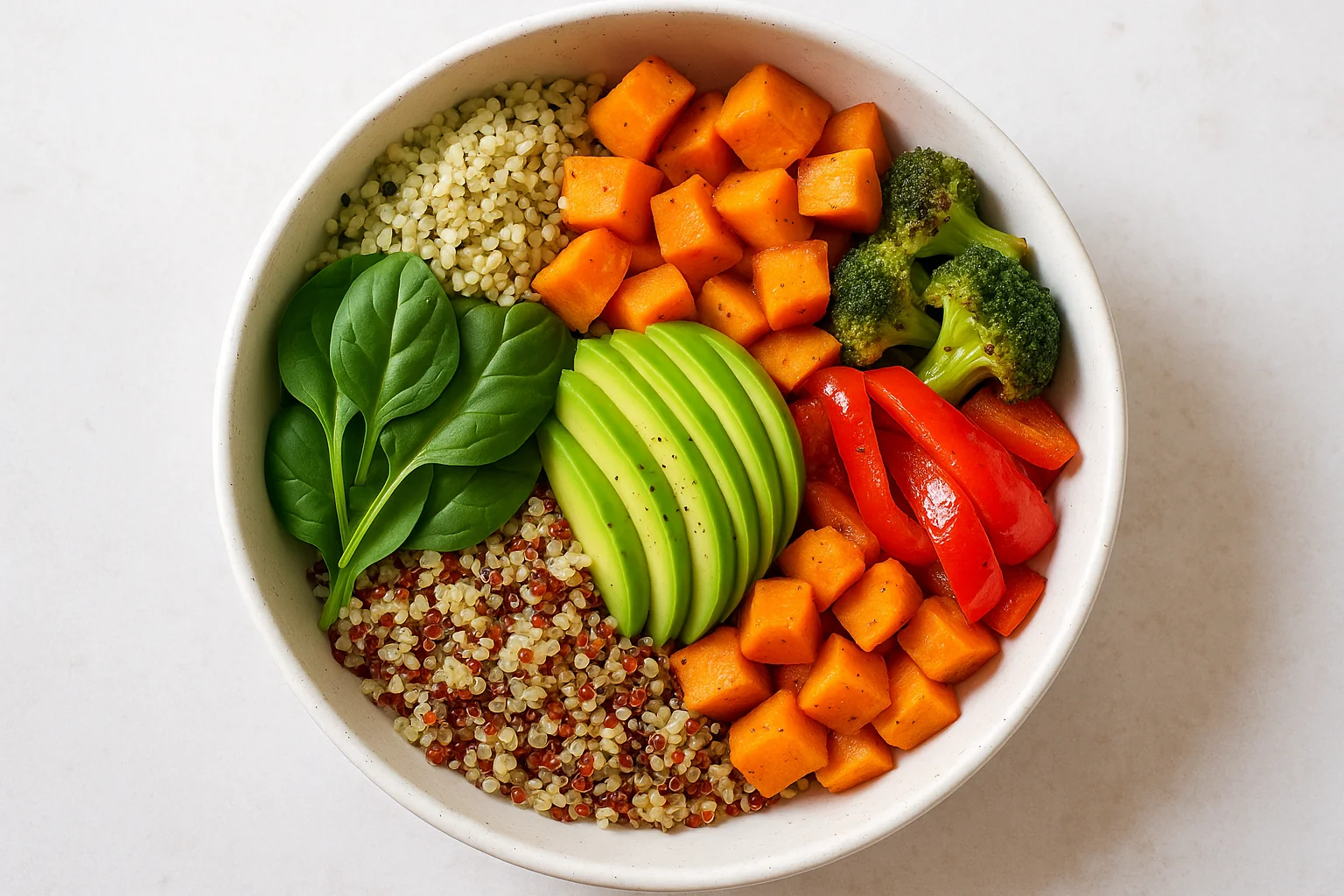

Quinoa bowl with hemp seeds and vegetables
Quinoa bowl with roasted vegetables and hemp seeds. How much protein does the bowl provide, which amino acid limits quinoa, and which limits hemp, and how to assemble it in 30 minutes.
Quinoa and hemp seeds end up in the same bowl for the same reason that zucchini and bell pepper are roasted side by side in the oven: they complement each other where each is weaker alone. Quinoa lacks fat, while hemp lacks lysine. Together they provide a filling lunch that tastes just as good warm or cold, and takes thirty minutes to prepare with just one baking sheet. It is also one of the few meals that can be cooked once and assembled over four days without losing flavor. Below you will find a step-by-step recipe, a table of the composition of both ingredients, a dressing that brings out the nuttiness of the seeds, and an explanation of why the term complete protein requires more caution than suggested by package descriptions.
KEY INFORMATION
• Two tablespoons of hulled hemp seeds is 20 g: 111 kcal, 6.3 g protein, and 9.8 g fat, including 7.6 g polyunsaturated (USDA FoodData Central, record 170148).
• Lysine limits hemp protein (House et al., 2010), while leucine limits quinoa protein (Craine and Murphy, 2020).
• In terms of 100 g of protein, quinoa has more lysine than hemp seeds, so it complements them, not the other way around.
• Add the seeds at the end: hot quinoa softens them in a few minutes.
What do hemp seeds bring to the quinoa bowl?
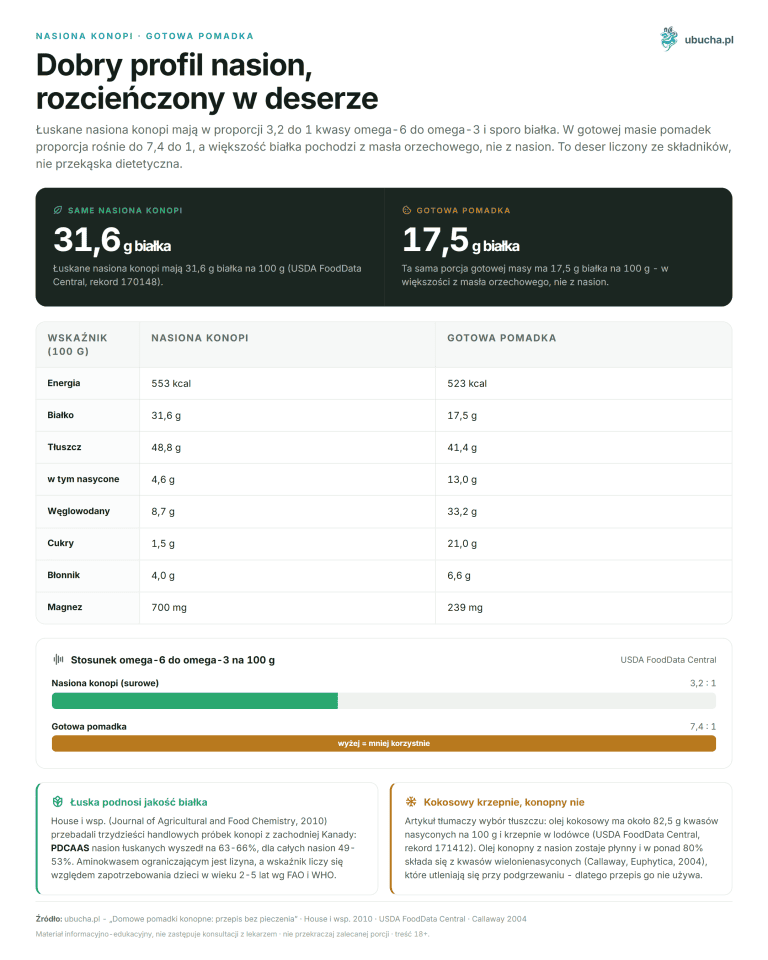
Fat, which quinoa almost lacks, and additional protein. The USDA FoodData Central database under record 170148 states that hulled hemp seeds contain 553 kcal, 31.6 g protein, and 48.8 g fat per 100 grams. Therefore, two tablespoons, or 20 grams, add 111 kcal, 6.3 grams of protein, and 9.8 grams of fat to the bowl.
The quality of this fat is more important here than its quantity. Of the 48.8 grams of fat, the record shows 38.1 grams are polyunsaturated, of which 27.4 grams is linoleic acid and 8.68 grams is alpha-linolenic acid. Callaway states that for hemp seed oil, the omega-6 to omega-3 ratio is usually between 2:1 and 3:1, and he calls this range optimal for humans (Callaway, Euphytica, 2004). This is his own assessment, not a recommendation from WHO or FAO, as neither of these institutions recommends a specific omega ratio.
Additionally, there are minerals. The same database states that hemp seeds contain 700 mg of magnesium per 100 grams compared to 197 mg in dry quinoa, so two tablespoons sprinkled on top provide 140 mg of magnesium from one addition.
The rest is texture. The crunchiness of the seeds contrasts with the soft roasted vegetables and creamy avocado, and the nutty flavor pairs well with the mild quinoa. We noticed in tests that on cooled quinoa, the seeds remain crunchy much longer than on hot: steam from the grains softens them in a few minutes.
Do quinoa and hemp seeds together provide complete protein?
Together they perform better than separately, but the slogan of complete protein simplifies the matter in both directions. Both ingredients contain all essential amino acids and both have their limiting factor, just in different places. That is why they work together.
| Per 100 g of product | Dry quinoa | Hulled hemp seeds |
|---|---|---|
| Protein | 14.1 g | 31.6 g |
| Fat | 6.1 g | 48.8 g |
| Fiber | 7.0 g | 4.0 g |
| Magnesium | 197 mg | 700 mg |
| Lysine | 0.77 g | 1.28 g |
The numbers in the last row need to be converted to protein to mean anything. Quinoa has 5.4 grams of lysine per 100 grams of protein, while hemp seeds have 4.1 grams. In other words, quinoa compensates for the lysine in hemp, not the other way around, although the reversed version is usually repeated.
How do we know where these limiting factors lie? House and colleagues examined thirty samples of hemp products and identified lysine as the first limiting amino acid in all of them (House et al., 2010). Craine and Murphy examined one hundred samples of quinoa grown in Washington state and were the first to describe leucine as the limiting amino acid in quinoa; the average contents met the WHO requirements for all age groups except for leucine in infants (Craine and Murphy, Frontiers in Nutrition, 2020). The lysine requirement for all age groups was met by only 52 out of 100 samples, so variety and growing location matter here.
What do you need for two servings?
One baking sheet, one pot, and thirty minutes, of which twenty is idle waiting. The vegetables and quinoa cook simultaneously, so start both processes at the same time.
- 150 g of quinoa, white or tricolor
- 1 zucchini, about 200 g
- 1 red bell pepper, about 180 g
- a handful of fresh spinach or arugula
- 1 avocado
- 4 tablespoons of hulled hemp seeds, or 2 tablespoons per bowl
- 1 tablespoon of oil for roasting vegetables
- salt, pepper, and oregano for the vegetables
- 2 tablespoons of extra virgin olive oil and 1 tablespoon of lemon juice for the dressing
- 1 teaspoon of honey or maple syrup
- optionally 1 teaspoon of Dijon mustard
Rinsing quinoa is not a whim: saponins from the surface of the grain give a bitter taste that remains in the finished dish. A minute under cold water, rubbing the grains with your fingers, is sufficient. Store hemp seeds in the fridge, as polyunsaturated fat goes rancid quickly.
You can substitute the vegetables for any others that roast in a similar time: eggplant, mushrooms, onion, or leek. Just keep the proportion of roughly equal volumes of quinoa and vegetables, otherwise the bowl becomes either too dry or too watery. Buy an avocado that is firm a day or two before cooking and leave it at room temperature, as ripe ones in the store are usually already a step too far.
How to prepare the quinoa bowl step by step?
In six steps, the first two of which you do simultaneously. Quinoa cooks for fifteen minutes, while the vegetables roast for twenty, so starting them together saves a quarter of an hour. Hemp seeds always go in at the very end.
- Rinse 150 g of quinoa under cold water for a minute, rubbing the grains with your fingers. Pour in 300 ml of salted water, bring to a boil, then cook covered on low heat for 15 minutes and let it sit for 5 minutes with the lid on.
- Preheat the oven to 200 degrees. Cut the zucchini and bell pepper into 2 cm cubes, place on a baking sheet lined with paper, drizzle with oil, and season. Roast for 18-20 minutes, turning once halfway through.
- Mix extra virgin olive oil with lemon juice, honey, and optionally mustard. Season with salt and pepper.
- Cut the avocado just before serving, as it darkens quickly, and drizzle with lemon. Rinse the spinach and dry it thoroughly so the dressing does not dilute.
- Divide the quinoa into two bowls, arrange the roasted vegetables, a handful of spinach, and avocado slices next to each other. Drizzle the dressing evenly.
- Sprinkle 2 tablespoons of hulled hemp seeds on each bowl and serve. If you prefer a cold version, chill the quinoa before assembling.
The lemon dressing works better here than balsamic, as the acidity of the citrus cuts through the fattiness of the seeds instead of adding sweetness to it. We described a dressing based on hemp oil separately with colorful salad with hemp dressing.
What variations work best?
Three, plus one tip for preparing in advance. Each leaves the base untouched, so you can mix them without recalculating proportions.
The version with hemp oil instead of olive oil in the dressing completes the hemp profile of the entire bowl and enhances the nuttiness of the seeds. Do not use it for roasting vegetables, only cold. The protein version is 100 g of roasted salmon, grilled chicken, or cooked chickpeas; the quickest is canned chickpeas, just rinse them.
The winter version swaps zucchini and bell pepper for butternut squash and carrot. Both roast longer, about 25-30 minutes, and handle a pinch of cinnamon added before roasting well. A warmer variant of the same idea is vegetable casserole with hemp topping.
To prepare in advance, cook a double portion of quinoa and roast the vegetables in advance. Store them separately in the fridge for up to four days, and add the dressing, avocado, and seeds only when assembling the bowl. The same applies to buckwheat salad with hemp seeds, just with a different grain.
Frequently asked questions
How many hemp seeds to add to the quinoa bowl?
Two tablespoons, or about 20 grams per bowl. This provides 111 kcal, 6.3 grams of protein, and 9.8 grams of fat (USDA FoodData Central, record 170148). You can add more, but above three tablespoons, the seeds start to dominate the flavor and the bowl becomes noticeably fatty.
Do quinoa and hemp seeds together create complete protein?
They complement each other because they have different limiting amino acids: lysine in hemp (House et al., 2010) and leucine in quinoa (Craine and Murphy, 2020). In terms of protein, quinoa has more lysine, so it compensates for the deficiencies of hemp. The combination is good, but it is not equivalent to an egg.
How many calories does a quinoa bowl with hemp seeds have?
It depends on the additions, so we provide two certain values. A serving of 75 grams of dry quinoa is 276 kcal, and two tablespoons of hemp seeds are 111 kcal (USDA FoodData Central). The rest comes from avocado and oil in the dressing, which are ingredients that can be easily dosed according to preference.
How long can you store a quinoa bowl?
Store cooked quinoa and roasted vegetables separately in the fridge for up to four days. Add the dressing, avocado, and hemp seeds only when assembling the bowl. An assembled bowl with dressing loses freshness after a few hours because the leaves wilt and the avocado darkens.
Why do you need to rinse quinoa before cooking?
The surface of the grain contains saponins with a bitter taste, which transfer to the water and remain in the cooked quinoa. A minute under cold water while rubbing the grains with your fingers is sufficient. Some quinoa in stores is already rinsed, but it is rarely indicated on the packaging, so it is safer to rinse again.
Ready-to-eat hemp products can be found in the hemp food category in the Bucha store.
This article is for informational and educational purposes and does not replace consultation with a doctor. If you are pregnant, breastfeeding, taking medications, or have chronic conditions, consult the use of supplements or herbs with a specialist.
Author: Michał Waluk · Published: 2026-06-15 · Updated: 2026-08-16