
Glycemic index of sweeteners: xylitol, erythritol, stevia (table)
The glycemic and insulin index of sweeteners in one table: erythritol, xylitol, stevia, maltitol. What do studies say about glycemia, the heart, and children's safety.
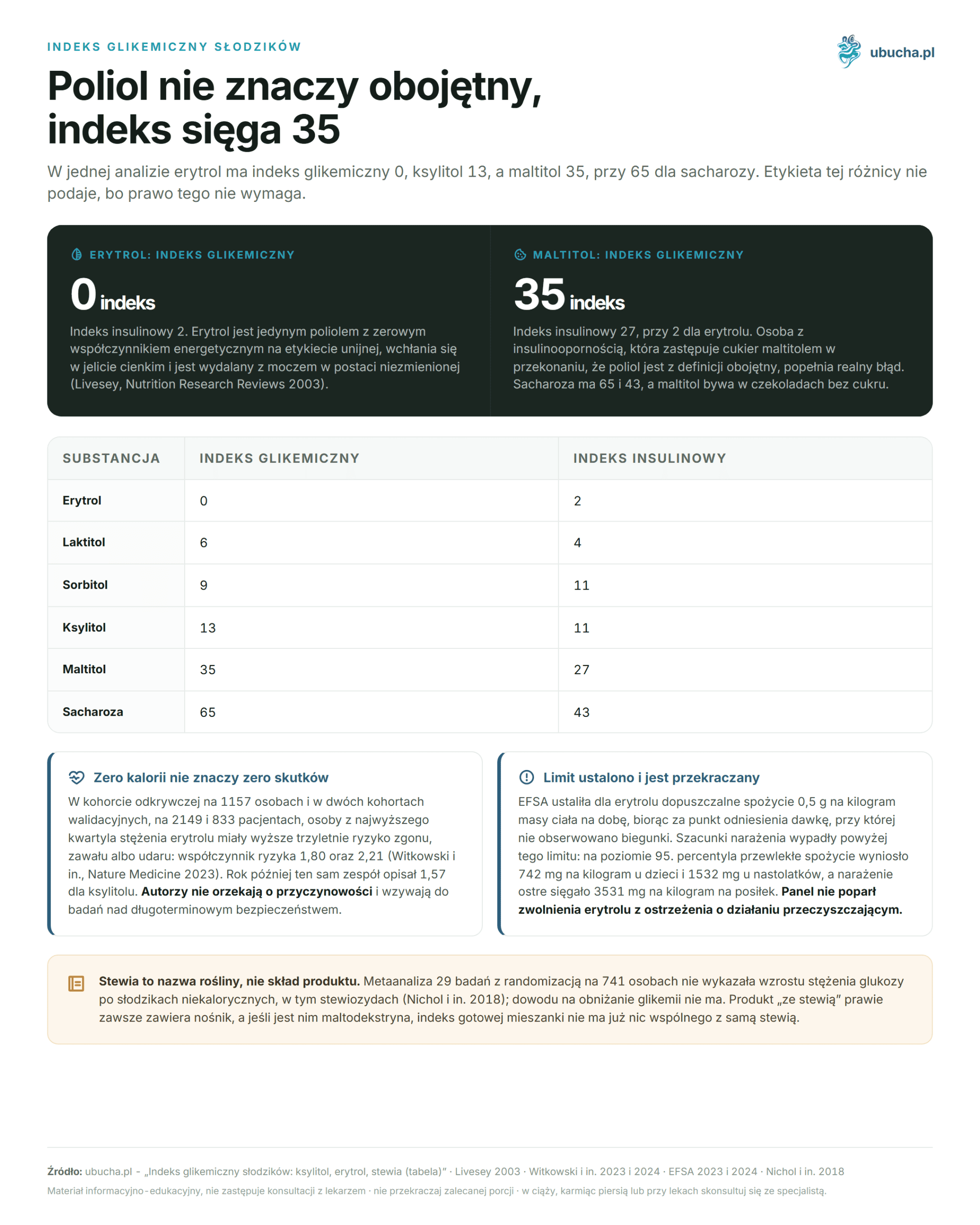
Sugar substitutes are usually lumped together under the label “healthy,” but the differences between them are enormous. An analysis of data on glycemia and insulinemia after consuming polyols assigns erythritol a glycemic index of 0, xylitol 13, and maltitol 35, with 65 for sucrose (Livesey, Nutrition Research Reviews 2003). This range is significant for anyone monitoring their sugar intake, and the label does not provide this information because the law does not require it. Below you will find a complete table with glycemic and insulin indices, energy values from the label in accordance with EU law, as well as what sweetener advertisements remain silent about: the cardiovascular signal associated with erythritol and xylitol and the consumption limits set by EFSA for children.
KEY INFORMATION
• Erythritol has a glycemic index of 0, xylitol 13, maltitol 35, and sucrose 65 (Livesey, 2003).
• Erythritol and xylitol are associated in cohort studies with a higher risk of cardiovascular events.
• EFSA has established an acceptable intake for erythritol of 0.5 g per kilogram of body weight per day.
• Children exceed this limit with high consumption.
What is the glycemic index and why does it matter for sweeteners?
The glycemic index describes how quickly and how high a given carbohydrate raises blood glucose levels within two hours after consumption, on a scale where pure glucose is 100. For sucrose, international tables provide a value of 65 with a deviation of 4 (Atkinson et al., Diabetes Care 2008).
For sweeteners, this indicator becomes more important than for regular products because the label rarely mentions it. Brand names emphasize naturalness or lack of sugar, not what the substance does to glycemia. Polyols, or sugar alcohols, are absorbed to varying degrees, and some of them do enter circulation as a source of glucose.
Alongside the glycemic index, it is worth looking at the insulin index, which is the pancreatic secretion response. Livesey provides both in parallel, and the differences can be telling: for erythritol, the insulin response is 2, while for maltitol it is 27. A person with insulin resistance who replaces sugar with maltitol under the impression that the polyol is neutral is making a real mistake. We discuss insulin resistance more broadly in our post about apple cider vinegar and insulin resistance.
What glycemic index do individual sweeteners have?
The table below compares polyols according to one analysis, so the values are comparable to each other. The calorie column does not provide the measurement result in a specific product but rather the conversion factor that the manufacturer must use on the label in the European Union.
| Substance | Glycemic index | Insulin index | kcal/g on EU label | Notes |
|---|---|---|---|---|
| Erythritol | 0 | 2 | 0 | The only polyol with a zero energy coefficient in EU law |
| Lactitol | 6 | 4 | 2.4 | Bloating with larger portions |
| Sorbitol | 9 | 11 | 2.4 | Osmotic effect, common in chewing gums |
| Isomalt | 9 | 6 | 2.4 | Used in candies and confectionery decorations |
| Xylitol | 13 | 11 | 2.4 | Toxic to dogs; cardiovascular signal described below |
| Maltitol | 35 | 27 | 2.4 | The highest among polyols, common in sugar-free chocolates |
| Sucrose | 65 | 43 | 4 | Reference point for the entire table |
| Glucose | 100 | 100 | 4 | Scale pattern |
The index values come from Livesey’s analysis from 2003, and the energy coefficients from Annex XIV to Regulation (EU) No 1169/2011, where polyols have 2.4 kcal/g, erythritol 0 kcal/g, and other carbohydrates 4 kcal/g. Steviol glycosides are not included in the table because they are not polyols and do not have an assigned index in this analysis. A meta-analysis of 29 randomized studies involving 741 people, including steviosides, found no increase in blood glucose levels after consuming non-caloric sweeteners (Nichol et al., European Journal of Clinical Nutrition 2018).
Erythritol or xylitol: which to choose and for what?
In terms of glycemia, erythritol wins because it has an index of 0 compared to 13 for xylitol, and a zero energy coefficient on the label. Erythritol is obtained through fermentation involving the fungi Moniliella pollinis or Moniliella megachiliensis, is absorbed in the small intestine, and is excreted in urine unchanged, only slightly converted to erythronate (EFSA, 2023).
Xylitol makes up for it in the kitchen because it sweetens similarly to sugar and dissolves well in hot beverages. However, its reputation was built on its anti-cavity action, and this is a place where it is worth tempering enthusiasm. A Cochrane review included 10 studies involving 5903 people and found only one effect worth noting: toothpaste with fluoride and a 10 percent addition of xylitol reduced cavities by 13 percent compared to toothpaste with just fluoride, with low-quality evidence. For gums, tablets, and tissues, the evidence was deemed insufficient (Riley et al., Cochrane Database of Systematic Reviews 2015).
A separate issue concerns dogs, and this is not an overblown warning. In a series of eight cases after consuming xylitol, dogs were taken to the clinic with vomiting and bleeding, and were diagnosed with acute liver failure and coagulation disorders. Three animals were euthanized, and two died (Dunayer and Gwaltney-Brant, JAVMA 2006). If you have a dog at home, keep products containing xylitol out of its reach.
Does zero calories mean zero effects on the body?
No. This is the most important change in knowledge about sweeteners in recent years and also the one that is the slowest to reach labels. Two large studies from the same team link both of the most popular polyols to the risk of cardiovascular events, and a third shows the impact of non-caloric sweeteners on the microbiome and glucose tolerance.
In a study published in Nature Medicine, erythritol levels in the blood were measured in a discovery cohort of 1157 people and in two independent validation cohorts, one American with 2149 and one European with 833 patients referred for planned cardiological diagnostics. Individuals in the highest quartile had a higher three-year risk of death, heart attack, or stroke: adjusted risk ratio of 1.80 and 2.21 compared to the lowest quartile. Erythritol also increased platelet reactivity and thrombus formation (Witkowski et al., Nature Medicine 2023).
A year later, the same team reported in the European Heart Journal a similar finding for xylitol: adjusted risk ratio of 1.57 for the highest tercile, increased platelet reactivity, and thrombosis in an animal model. In an interventional study, a xylitol-sweetened drink raised plasma levels and intensified the platelet response in all ten participants (Witkowski et al., European Heart Journal 2024). The authors of both studies state the same: research on long-term safety is needed.
The third thread concerns the microbiome. In a randomized study, 120 healthy adults took saccharin, sucralose, aspartame, or stevia in doses below the acceptable intake for two weeks. Each of the sweeteners changed the composition of the gut and oral microbiome, and saccharin and sucralose significantly worsened the glycemic response. The reaction was strongly dependent on the individual (Suez et al., Cell 2022).
Does stevia lower blood sugar levels?
There is no evidence that it lowers them. There is evidence that it does not raise them. Nichol’s meta-analysis included 29 randomized studies involving 741 people and examined aspartame, saccharin, steviosides, and sucralose. The authors’ conclusion is cautious: the consumption of these substances did not raise glucose levels, and the size of the effect varied somewhat depending on age, body weight, and the presence of diabetes.
Stevia is the common name for the plant Stevia rebaudiana. The sweetening agents in it are steviol glycosides, marked in the European Union with symbols E 960a to E 960d. They are many times sweeter than sugar, so they are used in very small amounts, and a product “with stevia” almost always contains a carrier. If that carrier is maltodextrin, the glycemic index of the finished mixture has nothing to do with stevia itself.
The acceptable daily intake of steviol glycosides is 4 mg per kilogram of body weight, converted to steviol equivalents. In 2024, EFSA considered a request to raise it to 6 or 16 mg and refused, deeming the justification insufficient; with the proposed expansion of uses, the limit would be exceeded in small children at the 95th percentile (EFSA, 2024). The notion of stevia as a substance that cannot be overdosed has no basis.
How to use erythritol and xylitol in cooking?
Replacing sugar with a sweetener is not a one-to-one substitution, and this is not only due to sweetness. Sugar in baking is responsible for moisture, browning of the crust, and the structure of the crumb, while polyols only replicate some of these functions.
We noticed in cooking trials three differences that most often ruin the first bake. Erythritol crystallizes upon cooling, causing creams and fillings to become grainy, and it gives a distinct cooling effect in the mouth. Cakes made with erythritol come out lighter than those made with sugar because browning is weaker. Xylitol behaves more like sugar and works better in hot drinks, where erythritol dissolves more slowly.
The practical conclusions are simple. For creams and ice creams, mix erythritol with another ingredient to limit crystallization. For tea and coffee, xylitol is more convenient. Dose steviol glycosides in pinches, as higher concentrations lead to bitterness, which manufacturers mask with the addition of erythritol.
There is also the issue of intestinal tolerance. Polyols are not completely absorbed, and in larger portions, they act osmotically, leading to bloating or diarrhea. EFSA deemed this effect significant enough to base its limit for erythritol on it. Other ingredients affecting glycemia are covered in separate posts, for example about berberine and chromium for appetite and blood sugar.
Are sweeteners safe for children?
The answer has changed after the re-evaluation of erythritol in 2023 and came out differently than suggested by most packaging. EFSA established an acceptable daily intake for erythritol at 0.5 g per kilogram of body weight, taking as a reference point the lower limit of the dose at which no diarrhea was observed.
Exposure estimates came out above this limit. At the 95th percentile, chronic intake was 742 mg per kilogram of body weight in children and 1532 mg in adolescents, while acute exposure reached 3531 mg per kilogram per meal in children at the 99th percentile. The panel stated that individuals with high intake may experience adverse effects and did not support the request to exempt erythritol from the requirement to include a warning about its laxative effect.
For steviol glycosides, the picture is similar: the limit of 4 mg per kilogram of body weight can be exceeded in small children at high levels of consumption. The practical conclusion is not to “ban” but to “not treat as neutral.” A sugar-free drink consumed instead of water still introduces a substance with an established limit into the body, and with polyols, there is also the intestinal reaction, which a child will feel faster than an adult.
Frequently asked questions
Which sweetener has the lowest glycemic index?
Erythritol, with a glycemic index of 0 and an insulin index of 2 (Livesey, Nutrition Research Reviews 2003). Next are lactitol with an index of 6 and sorbitol and isomalt with 9. Xylitol has 13, and maltitol 35, which is more than half the value of sucrose at 65.
Is erythritol better than xylitol?
In terms of glycemia, yes, because it has an index of 0 compared to 13 and a zero energy coefficient on the EU label. Xylitol wins in the kitchen because it sweetens similarly to sugar. However, both have a described cardiovascular signal, so the difference between them is smaller than would be suggested by the table alone.
Does stevia raise blood sugar levels?
No. A meta-analysis of 29 randomized studies involving 741 people found no increase in glucose after consuming non-caloric sweeteners, including steviosides (Nichol et al., 2018). However, there is no evidence that stevia lowers glycemia. Products “with stevia” that contain maltodextrin as a carrier are a different matter.
Are sweeteners safe for insulin resistance?
Erythritol and stevia do not significantly raise glycemia or insulinemia. Maltitol has an insulin index of 27, so it is not a good choice. A randomized study on 120 people with saccharin and sucralose showed a worsening of glycemic response after two weeks (Suez et al., Cell 2022).
How many calories are in erythritol, xylitol, and stevia?
On the label in the European Union, erythritol has 0 kcal/g, while other polyols, including xylitol, have 2.4 kcal/g. Sucrose has 4 kcal/g. Steviol glycosides are used in such small amounts that their energy contribution is negligible. The values come from Annex XIV to Regulation (EU) No 1169/2011.
Are erythritol and xylitol safe for the heart?
This is an open question today. In cohorts of patients referred for cardiological diagnostics, higher concentrations of both substances were associated with a higher risk of heart attack, stroke, or death, and mechanistic studies showed increased platelet reactivity. The authors do not determine causality and call for research on long-term safety.
This article is for informational and educational purposes and does not replace consultation with a doctor. If you are pregnant, breastfeeding, taking medications, or have chronic conditions, consult the use of supplements or herbs with a specialist.
Author: Michał Waluk · Published: 2026-07-06 · Updated: 2026-08-15