
Saffron for depression and mood: what studies say and how to dose the extract
Saffron performed similarly to fluoxetine and imipramine in small trials. Check what meta-analyses say, where the publication bias lies, and who it harms.
Saffron is the most expensive spice in the world and one of the few that has entered psychiatry through randomized clinical trials. Several of them showed results similar to fluoxetine and imipramine in mild and moderate depression, which circulated in the media in a much stronger form than the studies themselves justified. The trials were small, short, and almost all conducted in one country, and a meta-analysis from 2019 found publication bias in this literature. Below, we break it down: what exactly was measured, how many people participated, where the results are consistent, and where it ends what can be inferred from them. And why, in the case of depression, the starting point remains the doctor, not the supplement.
KEY INFORMATION
• In comparative trials, saffron performed similarly to fluoxetine and imipramine, but the groups numbered 30-40 people.
• A meta-analysis of 23 studies detected publication bias in this literature (Marx et al., Nutrition Reviews, 2019).
• In postpartum depression, the response rate was lower than after fluoxetine, and the difference was not significant.
• High doses of saffron have been associated with uterine stimulation and the risk of miscarriage.
What is saffron and what works in it?
Saffron is the dried stigmas of the flowers of Crocus sativus, the cultivated crocus. Each flower produces three stigmas that are hand-harvested, which determines the price of the raw material. The largest producer is Iran, with cultivation also taking place in Spain, India, and Kashmir.
The pharmacological action is attributed to three groups of compounds. Crocin and crocetin are carotenoids that give saffron its intense yellow color. Safranal, a monoterpene aldehyde from the essential oil, is responsible for the characteristic aroma. Picrocrocin provides a bitter taste.
The explanations of the mechanism that circulate in supplement descriptions are less certain than the clinical results themselves. The hypothesis suggests the inhibition of serotonin and dopamine reuptake by carotenoids and the influence of safranal on inhibitory transmission, but these are models derived mainly from laboratory and animal studies. In human trials, symptom scales were measured, not neurotransmitter concentrations, so the mechanism remains a conjecture fitted to the result.
This distinction has practical significance. The statement “saffron works like an SSRI” suggests interchangeability, which studies have not demonstrated. They have shown something different and narrower: in several small trials, the difference in symptom scale between saffron and the drug did not reach statistical significance. This is not the same.
Does saffron work for depression like antidepressants?
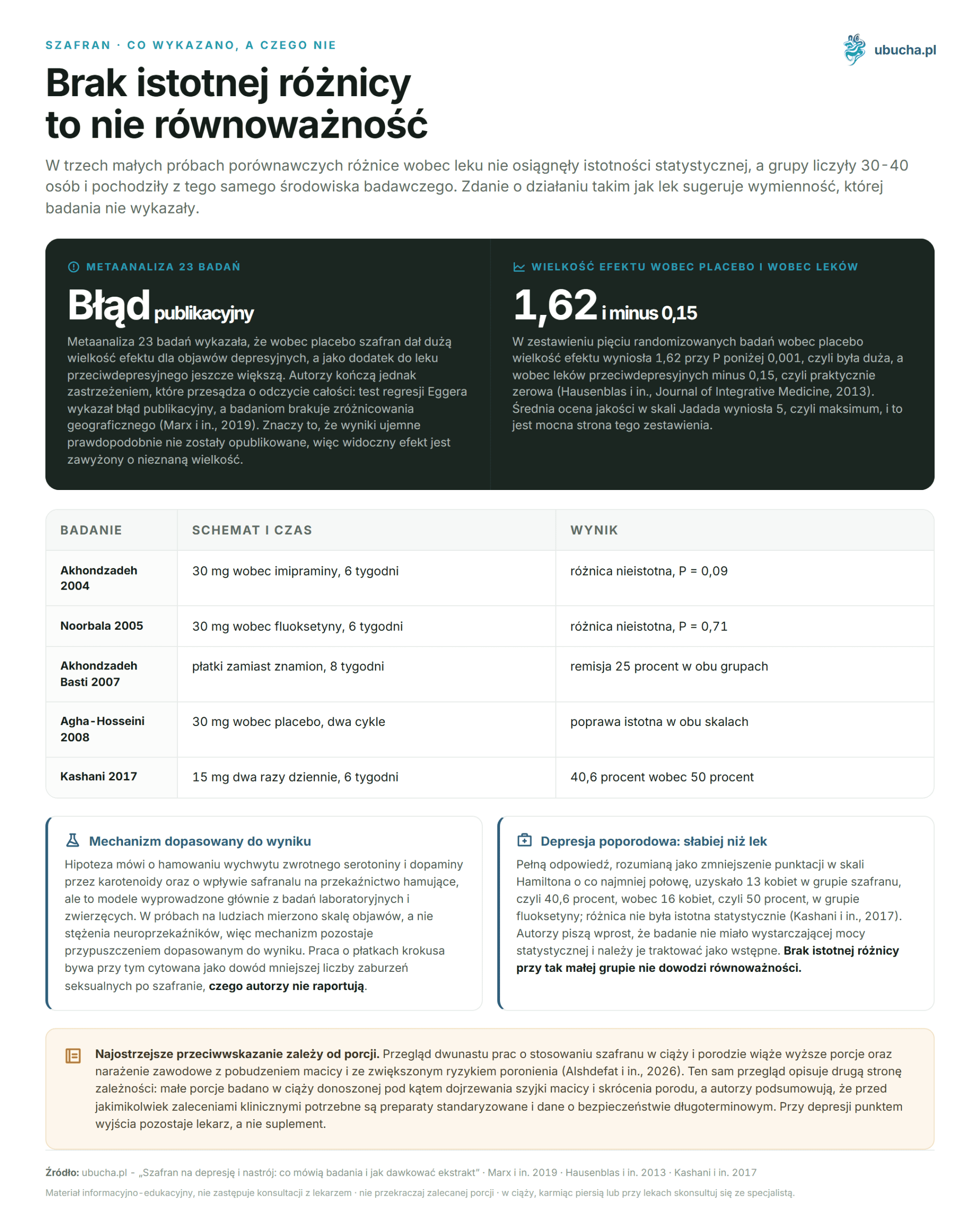
In three small comparative trials, the differences were not statistically significant, which does not mean equivalence. All three come from the same research environment in Iran and involved a total of 110 people with mild to moderate depression.
Akhondzadeh et al. (BMC Complementary and Alternative Medicine, 2004) randomly assigned 30 outpatients to saffron at a dose of 30 mg per day or to imipramine at a dose of 100 mg per day for six weeks. The difference did not reach significance (P equals 0.09). In the imipramine group, cholinolytic symptoms, including dry mouth, and drowsiness were more frequent.
Noorbala, Akhondzadeh et al. (Journal of Ethnopharmacology, 2005) repeated the setup on 40 people, this time against fluoxetine at a dose of 20 mg per day, also for six weeks. The result was similar (P equals 0.71), and the authors explicitly note that there were no significant differences in observed adverse effects between the groups.
Akhondzadeh Basti et al. (Progress in Neuro-Psychopharmacology and Biological Psychiatry, 2007) studied petals of the crocus, not stigmas, for eight weeks in 40 people, against fluoxetine. The remission rate was 25 percent in both groups. This work is sometimes cited as evidence of fewer sexual disorders after saffron, which the authors do not report.
What do meta-analyses of saffron show?
The effect is repeatable against placebo and disappears against drugs, and a publication bias hangs over the entire literature. Hausenblas et al. (Journal of Integrative Medicine, 2013) collected five randomized studies: two with placebo and three with an antidepressant as a comparator.
Against placebo, the effect size was 1.62 with P below 0.001, which was large. Against antidepressants, it was minus 0.15, practically zero, which the authors interpret as similar effectiveness of both arms. The average quality rating on the Jadad scale was 5, which is the maximum, and this is a strong point of this compilation.
A broader picture was provided by the meta-analysis by Marx et al. (Nutrition Reviews, 2019), which included 23 studies. Against placebo, saffron showed a large effect size for depressive symptoms, and as an adjunct to antidepressant medication, an even greater one. However, the authors conclude with a caveat that determines the reading of the whole: Egger’s regression test showed publication bias, and the studies lack geographical diversity.
Publication bias means in practice that negative results were likely not published, so the visible effect is inflated by an unknown amount. An earlier review by Hausenblas’s team from 2015 included twelve studies and showed how narrowly the topics are distributed: six concerned depression, four sexual disorders and infertility, one premenstrual syndrome, and one binge eating.
What doses were used in saffron studies?
Below is a summary of what was actually administered to study participants. This is a description of clinical trials, not a guideline on how much you should take. In the case of depression, the dosage of anything is determined by the attending physician, as the diagnosis dictates not only the preparation but also whether pharmacological treatment is even sufficient.
| Study | Participants | Scheme and time | Result |
|---|---|---|---|
| Akhondzadeh 2004 | 30 people, mild and moderate depression | 30 mg/d vs imipramine 100 mg/d, 6 weeks | difference not significant, P = 0.09 |
| Noorbala 2005 | 40 people, mild and moderate depression | 30 mg/d vs fluoxetine 20 mg/d, 6 weeks | difference not significant, P = 0.71 |
| Akhondzadeh Basti 2007 | 40 people, petals instead of stigmas | 15 mg 2x daily vs fluoxetine 10 mg 2x daily, 8 weeks | remission 25% in both groups |
| Agha-Hosseini 2008 | women 20-45 years with PMS symptoms | 30 mg/d vs placebo, two cycles | significant improvement in both scales |
| Kashani 2017 | women 18-45 years, postpartum depression | 15 mg twice daily vs fluoxetine, 6 weeks | 40.6% vs 50% response, difference not significant |
We noted in this editorial that the most frequently repeated detail from this table, namely the number of milligrams, is also the least informative. The studies differ in raw material: sometimes it is stigmas, sometimes petals, and the preparations were not standardized in the same way. Without this information, the number on the label does not indicate whether what is inside is the same as in the study. We described how to read a supplement label separately.
Does saffron help with anxiety and PMS symptoms?
For anxiety, there are aggregate data, and for PMS, there is one well-described study. The meta-analysis by Marx included, in addition to depression, also anxiety symptoms and showed a large effect size against placebo, with a significance level of P below 0.006. However, the same caveat about publication bias applies here as well.
In the case of premenstrual syndrome, the decisive study is Agha-Hosseini et al. (BJOG, 2008). It included women aged 20 to 45 with regular cycles and symptoms of the syndrome lasting for at least six months. Participants were randomly assigned to saffron at a dose of 30 mg per day or to placebo for two consecutive cycles.
The primary endpoint was a symptom diary, and the secondary endpoint was the Hamilton depression scale. In both tools, the difference in favor of saffron was significant in the third and fourth cycles. The authors describe the profile of adverse effects as acceptable and conclude that the result deserves further research, not that the matter is closed.
It is worth noting what is not in this study. Saffron was not compared to any method used standardly in severe premenstrual syndrome, so it is unknown how it performs alongside them. The result only indicates that it performed better than placebo.
Does saffron work for postpartum depression?
One study suggests that it may help, but it performed worse than the drug, and the difference did not reach significance. Kashani et al. (Pharmacopsychiatry, 2017) conducted a six-week double-blind study in women aged 18 to 45 with mild to moderate postpartum depression.
Participants received saffron in a 15 mg capsule or fluoxetine in a 20 mg capsule, twice daily for six weeks. A full response, understood as a reduction in the Hamilton scale score by at least half, was achieved by 13 women in the saffron group, or 40.6 percent, compared to 16 women, or 50 percent, in the fluoxetine group. The difference was not statistically significant.
The authors are much more cautious in this regard than most summaries. They state explicitly that the study did not have sufficient statistical power and should be treated as preliminary, and larger trials with longer treatment and a placebo group are needed before drawing conclusions. The lack of a significant difference in such a small group does not prove equivalence.
Postpartum depression is a condition in which self-experimentation with supplements carries a real risk of delaying treatment. If you are looking for a broader context, we wrote separately about safety during the perinatal period.
Does saffron affect memory and dementia?
For mild cognitive impairment and Alzheimer’s disease, the data is promising yet poorly substantiated. Avgerinos et al. (Neurological Sciences, 2020) reviewed the literature for randomized trials with oral saffron and found five studies involving a total of 325 people.
Four concerned patients with mild cognitive impairment or Alzheimer’s disease, one with individuals without disorders. In patients with disorders, the results on the ADAS-cog cognitive assessment scale and the Mini-Mental State Examination were significantly better after saffron than after placebo. No significant differences were found against donepezil and memantine. Saffron was well tolerated in all groups.
The authors themselves temper enthusiasm: the evidence comes from studies with potentially high risk of systematic error, and larger trials with low risk of error are needed for resolution. The formulation “equally effective as donepezil” is therefore justified only with this caveat alongside.
The results in individuals without cognitive disorders are much more modest and are based on one study from this five. Statements about saffron as a memory enhancer in healthy adults cannot be supported based on this review today.
When should saffron not be used?
The most severe contraindication concerns pregnancy and is dose-dependent. Alshdefat et al. (Journal of Evidence-Based Integrative Medicine, 2026) collected twelve works on the use of saffron in pregnancy and childbirth. Higher doses and occupational exposure have been associated with uterine stimulation and an increased risk of miscarriage.
The same review describes the other side of the relationship: small doses were studied in full-term pregnancy for cervical ripening and shortening of labor. However, the authors summarize that before any clinical recommendations, standardized preparations and long-term safety data are needed. For the reader, this means one thing: this is not a decision to be made independently.
The second situation requiring caution is psychiatric treatment. Since saffron has been studied as an adjunct to antidepressants and has performed strongest in this role, combining it with pharmacotherapy should only occur with the knowledge of the attending physician, not as a substitute for a conversation with them.
The third is the exacerbation of symptoms. All discussed trials involved depression of mild to moderate severity, and in the postpartum depression study, women with scores not exceeding the threshold of 18 were included. In more severe cases, with suicidal thoughts and relapses, none of these works say anything. You will find a compilation of supplements studied for low mood in a separate entry.
Frequently asked questions
Is saffron as effective as antidepressants?
In three small trials from a single research environment in Iran, involving a total of 110 people with mild to moderate depression, the differences compared to imipramine and fluoxetine did not reach statistical significance. However, with such sample sizes, the lack of difference does not prove equivalence, as the studies did not have the power to detect it.
How much saffron was administered in depression studies?
Most often, 30 mg per day of saffron extract for six to eight weeks, in one or two doses. This is a description of research protocols, not a recommendation. In the case of depression, the choice and dosage of any preparation is determined by a doctor, as the diagnosis dictates the entire treatment plan.
Does saffron cause fewer sexual side effects than fluoxetine?
Comparative studies have not shown this. Both Noorbala and colleagues (2005) and Akhondzadeh Basti and colleagues (2007) state that there were no significant differences in observed adverse effects between the groups. The claim of saffron’s superiority in this regard does not come from these works.
Does saffron help with PMS symptoms?
Agha-Hosseini and colleagues (BJOG, 2008) demonstrated significant improvement in women aged 20-45 with premenstrual syndrome symptoms after saffron compared to placebo, measured by a symptom diary and the Hamilton depression scale, in the third and fourth cycles. However, saffron was not compared to standard treatment.
Can saffron be used during pregnancy?
Not in the doses studied for depression. The review by Alshdefat and colleagues (2026) associates higher doses of saffron and occupational exposure with uterine stimulation and an increased risk of miscarriage. The authors emphasize that standardized preparations and safety data are needed before any recommendations are made.
Can the results of saffron studies be trusted?
With reservations. A meta-analysis of 23 studies (Marx et al., Nutrition Reviews, 2019) detected publication bias using Egger’s regression test and indicated a lack of geographical diversity in the trials. This means that the actual effect is likely smaller than that suggested by the published literature.
The article is for informational and educational purposes and does not constitute medical advice. Before starting supplementation, consult your doctor, especially if you are taking medications regularly, are pregnant or breastfeeding, or have a chronic illness.
Author: Michał Waluk · Published: 2026-06-22 · Updated: 2026-08-16