
Which CBD concentration to choose? 5%, 10%, 15%, 20% - complete guide
The concentration of CBD oil is arithmetic, not strength. Check how many mg a drop provides at 5, 10, 15, and 20 percent, how much 100 mg costs, and what absorption changes.
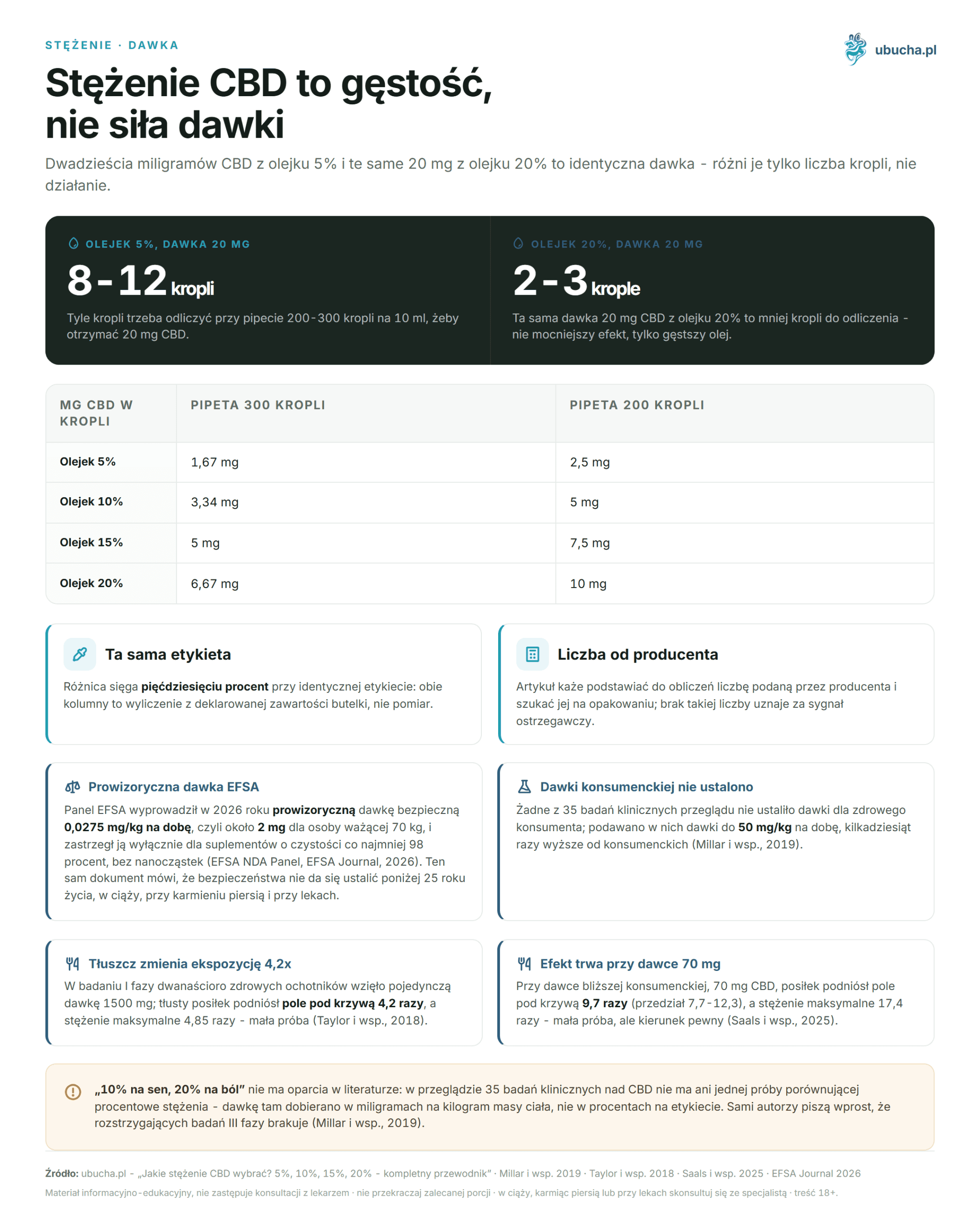
The percentage on the CBD oil label says less than it seems. The concentration does not describe the strength of the product, only its density: how many milligrams of CBD are contained in a milliliter. A 20% oil taken in three drops and a 10% oil taken in six provide exactly the same amount. Nevertheless, store descriptions assign 5% to beginners and 20% to advanced users, as if the percentage itself determined something. In a review of 35 clinical studies on CBD, there is not a single trial comparing percentage concentrations; doses were compared in milligrams per kilogram of body weight, dozens of times higher than consumer doses. This text breaks down the choice of concentration into what can be verified: the arithmetic of the bottle, the content of drops, the price per 100 mg, and two things that really change exposure to CBD.
KEY INFORMATION
• 5% is 50 mg of CBD per milliliter, or 500 mg in a 10 ml bottle. The rest follows from multiplication.
• The content of drops depends on the dropper: 200-300 drops per 10 ml is 1.67-2.5 mg at 5%.
• Doses for healthy consumers have not been established by any of the 35 clinical studies in the Millar review (British Journal of Clinical Pharmacology, 2019); they ranged from below 1 to 50 mg/kg per day.
• A fatty meal increased CBD exposure by 4.2 times (Taylor et al., CNS Drugs, 2018).
• The provisional safe dose according to EFSA is 0.0275 mg/kg per day, or about 2 mg for a 70 kg person (EFSA Journal, 2026).
What does the percentage concentration on the CBD oil label mean?
The percentage concentration indicates what part of the bottle’s content is CBD, and translates directly into milligrams. 5% means 50 mg of CBD in each milliliter, 10% means 100 mg, 15% means 150 mg, and 20% means 200 mg. A 10 ml bottle thus contains 500, 1000, 1500, and 2000 mg respectively.
| Concentration | CBD in 1 ml | 10 ml bottle | 30 ml bottle |
|---|---|---|---|
| 5% | 50 mg | 500 mg | 1500 mg |
| 10% | 100 mg | 1000 mg | 3000 mg |
| 15% | 150 mg | 1500 mg | 4500 mg |
| 20% | 200 mg | 2000 mg | 6000 mg |
This table is also the simplest test of label honesty. The packaging states three numbers: percentage, bottle capacity, and declared CBD mass. They must match. The notation “10%, 1000 mg, 10 ml” is consistent. The notation “10%, 1000 mg, 30 ml” is not, because 30 ml of ten percent oil would be 3000 mg. A discrepancy indicates either a labeling error or a product described to appear stronger.
It is worth noting the limit of what the percentage actually describes. It speaks to the content of the bottle, not how much CBD will enter the bloodstream, and not how much you should take. This is the first of three separate matters that product descriptions usually conflate into one.
How much CBD is in one drop?
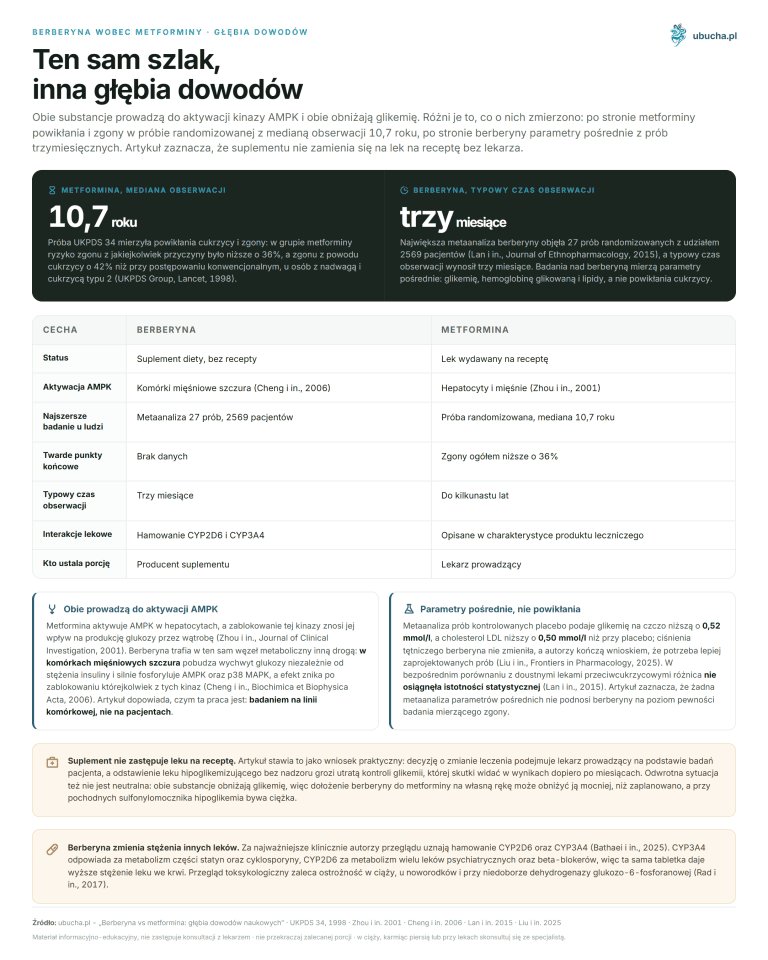
It depends on the dropper, not the concentration. A 10 ml bottle usually gives from 200 to 300 drops, so a drop of 5% oil contains from 1.67 to 2.5 mg of CBD. The difference can reach fifty percent with the same label, so for calculations, use the number provided by the manufacturer.
| Concentration | 300 dropper | 200 dropper | Drops for 20 mg |
|---|---|---|---|
| 5% | 1.67 mg | 2.5 mg | 8-12 |
| 10% | 3.34 mg | 5 mg | 4-6 |
| 15% | 5 mg | 7.5 mg | 3-4 |
| 20% | 6.67 mg | 10 mg | 2-3 |
The CANNOVA oils available at Bucha declare 1.67 mg of CBD per drop at 5% and 3.34 mg at 10%, which corresponds to three hundred drops from a 10 ml bottle. Anyone calculating the dose based on the popular assumption of two hundred drops will take half as much as planned. Therefore, the first thing you check after opening the package is not the percentage, but the number of milligrams in a drop.
Does a higher concentration of CBD work stronger?
No. Exposure is determined by the number of milligrams that enters the body, not the percentage on the label. Twenty milligrams of CBD from 5% oil and the same 20 mg from 20% oil is the same dose. They differ in the volume of carrier oil and the number of drops you need to count.
What do you actually buy with a higher concentration? Fewer drops for the same dose, a longer-lasting bottle, and a lower price per 100 mg. These are three practical reasons, not pharmacological.
For this convenience, you pay in coarseness. With 20% and a three-hundred-drop dropper, one drop is 6.67 mg, so you cannot measure a 5 mg dose at all, and you can only hit 15 mg roughly. With 5%, the same dropper gives a step of 1.67 mg, which is four times finer. If you are just checking how you react to CBD, a fine step is worth more than saving a few zlotys a month.
Hence the only sensible rule for transitioning between concentrations: you change them when counting drops becomes cumbersome, not when you want a stronger effect. A stronger effect is a different dose in milligrams, which you can set at any concentration. More about measuring itself can be found in the text Dosing CBD.
What dose of CBD have clinical studies established?
No study has established a dose for healthy consumers. A systematic review of 35 clinical studies from thirteen medical areas (Millar et al., British Journal of Clinical Pharmacology, 2019) included works in which 23 reported significant improvement in the primary endpoint, with doses ranging from below 1 to 50 mg per kilogram of body weight per day. No study provided CBD concentrations in plasma.
The scale of these numbers explains why they cannot be transferred to a bottle of oil. In randomized epilepsy studies, the average dose was 15 mg/kg per day, or about 1050 mg daily for a person weighing 70 kg. A whole 10 ml bottle of 20% oil contains 2000 mg, so it would last less than two days, and measuring such a portion with a three-hundred-drop dropper would require over 150 drops. In a phase I study, 750 or 1500 mg was given twice daily (Taylor et al., CNS Drugs, 2018). Where there was no signal at all, such as in small trials on diabetes, Crohn’s disease, ocular hypertension, fatty liver, and chronic pain, the average was 2.4 mg/kg.
This leads to something that product descriptions often omit: assignments like “10% for sleep, 20% for pain” have no basis in this literature. The review does not contain a single trial comparing consumer oil percentage concentrations, as studies select doses in milligrams per kilogram of body weight, not percentages on the label. The authors state directly that decisive phase III studies are lacking.
From a safety perspective, the only number from a regulatory body goes in the opposite direction from the marketing of concentrations. The EFSA panel derived a provisional safe dose in 2026 of 0.0275 mg per kilogram of body weight per day, or about 2 mg daily for a 70 kg person, and reserved it only for supplements with at least 98 percent purity of CBD, without nanoparticles (EFSA NDA Panel, EFSA Journal, 2026). The same document states that CBD safety cannot be established in individuals under 25 years of age, pregnant women, and those taking medications.
How much does 100 mg of CBD cost at different concentrations?
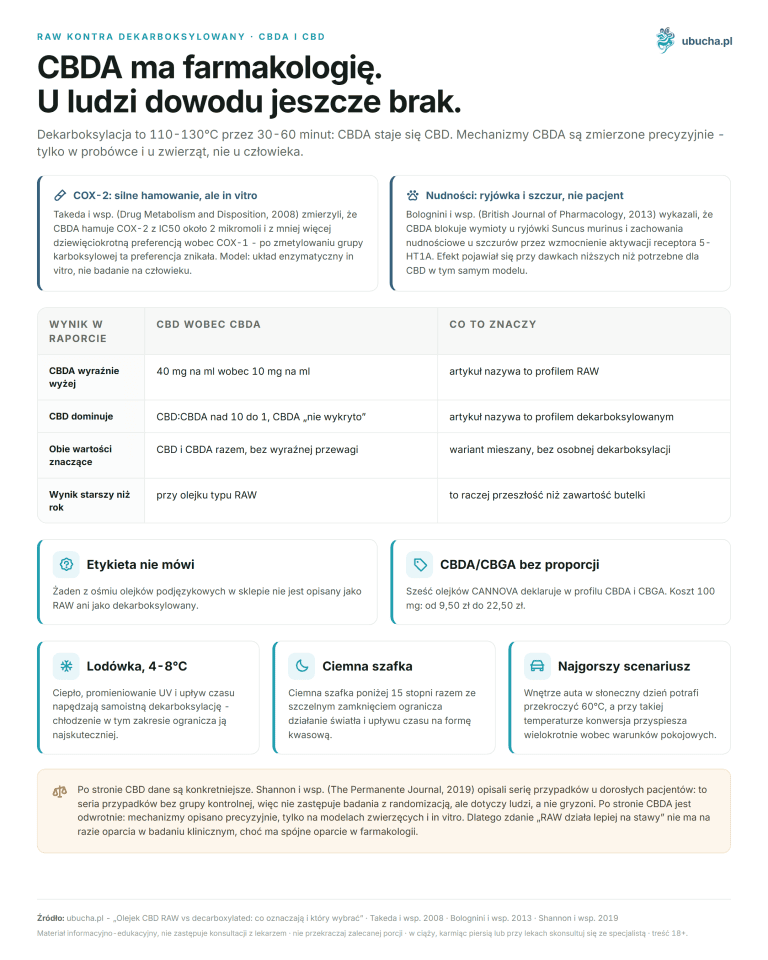
The higher the concentration, the lower the price per milligram, although the bottle itself costs more. In the category of oils at Bucha, there are currently six items, all in 10 ml bottles, three of which contain cannabidiol. When converted to 100 mg of declared CBD, their prices range from 9.50 to 13 PLN (as of August 15, 2026), with the cheapest being the strongest variant.
This spread looks modest until you multiply it by a month. Let’s assume for the calculation 20 mg daily, or 600 mg monthly: at the upper conversion, it comes to about 78 PLN, at the lower about 57 PLN. A difference of around 20 PLN a month gives over 250 PLN a year. With a dose half as small, the same proportion gives half as much, so savings only start to mean something with regular, higher dosing.
One item is missing from this comparison. Among the oils at Bucha, there is currently no 15% version with cannabidiol: fifteen percent occurs only in the CBG oil, which is a different phytocannabinoid, so comparing it with CBD by price per milligram says nothing. The assortment rotates faster than the article, so check the current data in the oils category before purchasing.
Price is still not the strongest argument in this choice, as seen in the above calculation. Twenty PLN a month loses to one question, which the next section answers: do you even absorb what you measure.
Does a meal change how much CBD you absorb?
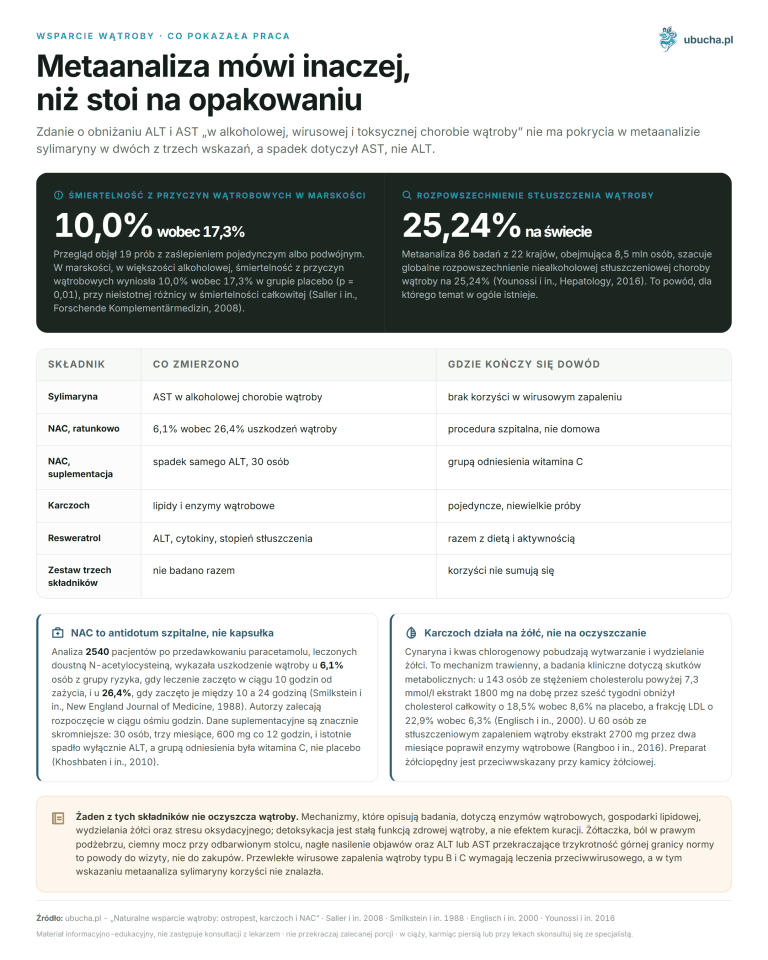
More than one step up the concentration scale. In a phase I study, a fatty meal increased the maximum concentration of CBD in plasma by 4.85 times, and the area under the curve by 4.2 times (Taylor et al., CNS Drugs, 2018). The same dose, a completely different exposure.
This number should be noted with a caveat that is usually not provided. The arm studying the effect of food included twelve healthy volunteers and a single dose of 1500 mg, which is a level far from the content of the bottle measured in drops.
A newer study concerns a dose closer to consumer levels. Eleven healthy volunteers, five men and six women, received a single dose of extract corresponding to 70 mg of CBD in a crossover design, once fasting and once after a standardized fatty meal (Saals et al., Scientific Reports, 2025). The ratio of geometric means was 17.4 for maximum concentration, with a 90% confidence interval of 12.4-24.2, and 9.7 for the area under the curve, interval 7.7-12.3. The group is small, but both intervals lie entirely above one: the direction is certain, the size of the effect is not.
What is not known, despite what the internet claims. A review of 24 pharmacokinetic studies in humans provides one single absolute bioavailability, 31 percent after smoking, and notes that for other routes of administration, none of the included studies attempted to determine it (Millar et al., Frontiers in Pharmacology, 2018). The circulating “13-19% orally” in this work does stand, but in the introduction, as background from earlier works involving animal studies, not as a measurement in humans. The practical conclusion is simpler than the dispute over percentages: take the oil with a meal containing fat and at a regular time, before you start looking for a stronger bottle.
Does full spectrum allow you to choose a lower concentration?
There is no evidence that can be transferred to consumer oil. The work most often cited here is a meta-analysis of observational data on drug-resistant epilepsy (Pamplona et al., Frontiers in Neurology, 2018), and its result is more complex than the popular shorthand about the entourage effect suggests.
The authors collected data from 670 patients across eleven observational studies. Improvement in seizure frequency was reported more often with CBD-rich extracts (71%) than with purified CBD (46%), with p below 0.0001. After applying the standard clinical threshold, which is a reduction in the number of seizures by at least half, the difference disappeared: 37% versus 42%, p = 0.52. The average daily dose was 6.0 mg/kg for extracts and 25.3 mg/kg for purified CBD, and adverse effects, both mild and severe, were reported more often with the purified preparation. These are non-randomized data collected in various centers, and the authors themselves state that the synergy of components needs to be confirmed in controlled studies.
What does this mean for choosing a bottle? That planning a lower concentration based on the label “full spectrum” has no basis. However, something else follows: full spectrum carries trace THC, and that changes the picture in tests. Eighteen healthy adults vaporized CBD-rich flower, providing 100 mg of CBD and 3.7 mg of THC. Three of them provided a total of six urine samples in which the concentration of the THC metabolite exceeded 15 ng/ml; all six tested positive at the screening threshold of 20 ng/ml, and two also at 50 ng/ml. After pure CBD, administered orally and inhaled, the authors found no conversion to THC in any of the studied forms (Sholler et al., Journal of Analytical Toxicology, 2022).
The caveat to this measurement is significant when choosing a bottle: the study concerned vaporized flower, not oil, so it says nothing about how much THC will accumulate after a month of taking a full-spectrum preparation. It does say that a one-time exposure to a few milligrams of THC was enough to exceed test thresholds. If you are subject to testing, choose isolate or broad spectrum, regardless of concentration.
How to calculate the dose when changing concentrations?
Divide your current dose in milligrams by the CBD content in a drop of the new oil. You took 5 drops of 10% oil at 3.34 mg each, totaling 16.7 mg. After switching to 20%, where a drop has 6.67 mg, the same 16.7 mg is 2.5 drops. The dose remains unchanged, but the bottle lasts twice as long.
The most common mistake is to keep the number of drops. Five drops of 10% oil converted to five drops of 20% oil doubles the dose, even though the routine looks identical. Therefore, with every bottle change, calculate the dose in milligrams before measuring the first portion.
We noticed while organizing product descriptions that two oils with the same percentage can differ in drop content by half because they have different droppers. A label with just the percentage is not enough for conversion. Look for the number of milligrams in a drop or the number of drops in the bottle on the packaging, and if the manufacturer does not provide either, treat it as a warning sign.
Before changing concentrations, record how many milligrams you take daily and at what time for two weeks. Without this number, changing bottles is guesswork, and you lose the only point of reference you have. Where to get the product itself and what to look for when buying, we described in the text Where to buy CBD in Poland.
Frequently Asked Questions
Which concentration of CBD oil should I choose at the beginning?
The lowest available, usually 5%, because it provides the smallest dosing step: from 1.67 to 2.5 mg of CBD per drop depending on the dropper. Not because it is weaker, but because it is easier to measure a small portion and record how much you are actually taking.
Does a higher concentration of CBD work stronger?
No. What matters is the number of milligrams that enters the body, not the percentage on the label. Twenty milligrams from 5% oil is the same dose as 20 mg from 20% oil. A higher concentration reduces the number of drops and the price per 100 mg, but does not change the CBD itself.
How many drops of 10% oil is 20 mg of CBD?
It depends on the dropper. With 300 drops in a 10 ml bottle, a drop has 3.34 mg, so 20 mg is 6 drops. With a dropper giving 200 drops, a drop has 5 mg and 4 drops will be enough. The number of milligrams in a drop is provided by the manufacturer on the packaging.
Is 15% CBD oil better than 10%?
It is not better, it is denser. The same dose in milligrams requires about two-thirds of the number of drops at 15% compared to 10%. In a review of 35 clinical studies, there is no trial comparing the percentage concentrations of oils, as the dose is selected in milligrams per kilogram of body weight.
Should CBD oil be held under the tongue?
There is no measurement that would resolve this. A review of 24 studies on the pharmacokinetics of CBD in humans (Millar et al., 2018) provides one absolute bioavailability, 31 percent after smoking, and notes that for other routes of administration, none of the included studies has determined it. The circulating percentages do not come from measurements in humans.
Can CBD oil give a positive THC test result?
Pure CBD did not give such a result, but products with trace THC can. In the study by Sholler et al. (2022), after vaporizing CBD-rich flower, providing 100 mg of CBD and 3.7 mg of THC, three out of eighteen participants provided a total of six urine samples exceeding the screening threshold of 20 ng/ml.
Is there an upper daily limit for CBD?
The EFSA panel derived a provisional safe dose in 2026 of 0.0275 mg per kilogram of body weight per day, which is about 2 mg for a person weighing 70 kg, and only for supplements with at least 98 percent purity. No safety limit has been established for individuals under 25 years of age, pregnant women, and those taking medications.
The full range of hemp oils along with current prices and declared drop content has been gathered in the oils category.
This article is for informational and educational purposes and does not constitute medical advice. Before starting to use cannabis or CBD for therapeutic purposes, consult a doctor, especially if you are taking other medications, are pregnant, or breastfeeding.
Author: Michał Waluk · Published: 2026-06-15 · Updated: 2026-08-15