
Resolving Inflammation: Lipoxins, Resolvins, and the Role of the CB2 Receptor
Inflammation does not extinguish on its own. Lipoxins and resolvins actively close it, and the CB2 receptor shifts macrophages to repair. What do studies say about this.
Inflammation should end, and its resolution is not a passive process. Charles Serhan’s team described a class of lipids called specialized pro-resolving mediators, or SPM: lipoxins, resolvins, protectins, and maresins. In animal experiments, synthetic counterparts of these molecules trigger anti-inflammatory and pro-resolving mechanisms and improve the clearance of pathogens (Serhan, Nature, 2014). The CB2 receptor of the endocannabinoid system operates in the same biological area: it is mainly located on immune cells and shifts macrophages from an inflammatory to a reparative state. Below, we explain the difference between inhibiting inflammation and resolving it, where CB2 fits into this scheme, and why chronic inflammation is often more a defect of resolution than an excess of inflammatory signals.
KEY INFORMATION
• The four families of SPM are lipoxins, resolvins, protectins, and maresins; in animal models, they trigger the resolution of inflammation (Serhan, Nature, 2014).
• CB2 activation shifted macrophages from children with celiac disease to the M2 phenotype (Tortora, Biomedicines, 2022).
• Mediators of resolution are derived from omega-3 fatty acids or arachidonic acid.
• In advanced atherosclerotic plaques, the ratio of SPM to pro-inflammatory lipids is strikingly low (Bäck, Nature Reviews Cardiology, 2019).
What is the difference between inhibiting inflammation and resolving it?
Inhibition blocks the formation of pro-inflammatory mediators. Resolution is a separate, active program: the removal of dead cells, halting the influx of additional neutrophils, and tissue rebuilding. Anti-inflammatory drugs do the first. Lipoxins and resolvins do the second, and only they close the inflammatory episode.
The textbook description of inflammation usually ends with its initiation and maintenance: prostaglandins, leukotrienes, and pro-inflammatory cytokines like TNF-alpha or IL-1beta. That is half the picture. The other half is the phase in which the body cleans up after itself, and this phase requires the synthesis of new signaling molecules, not just the cessation of the stimulus.
Serhan’s 2014 review summarizes what is known about these molecules. Synthetic counterparts of SPM administered to animals induce strong biological effects: anti-inflammatory mechanisms, pro-resolving mechanisms, and more efficient clearance of pathogens. These same structures also perform functions beyond inflammation itself, in defense against infection, in pain perception, in organ protection, and in tissue remodeling (Serhan, Nature, 2014). The review describes these effects as observed in animal experiments, not in humans.
The distinction has practical consequences. If chronic inflammation arises because the resolution program does not activate, then merely stronger inhibition will not close the matter. It will quiet symptoms and leave the tissue in a state where cleanup does not continue. This is a different therapeutic goal and a different way of thinking about inflammatory diseases.
What are lipoxins, resolvins, protectins, and maresins?
These are four families of bioactive lipids, collectively called SPM. The pathway diverges according to the substrate: mediators of resolution are derived from omega-3 fatty acids or arachidonic acid, and lipoxins belong to the latter branch. All belong to one biological program that does not block inflammation but rather resolves it.
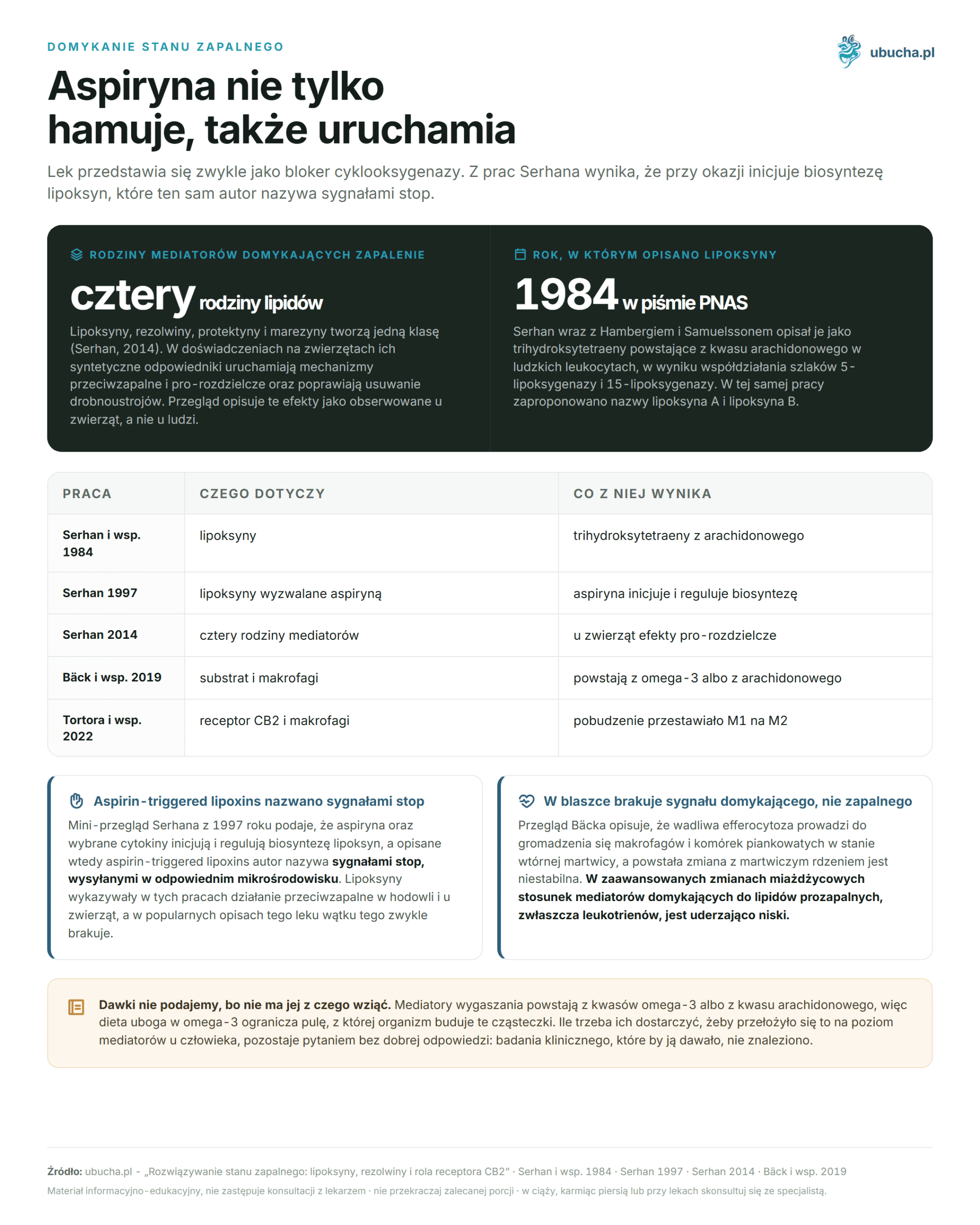
Lipoxins were the first to be isolated. Serhan, along with Hamberg and Samuelsson, described them in 1984 in PNAS as trihydroxytetraenes derived from arachidonic acid in human leukocytes, resulting from the interplay of the 5-lipoxygenase and 15-lipoxygenase pathways. In the same work, the names lipoxin A and lipoxin B were proposed (Serhan et al., PNAS, 1984).
A separate thread is aspirin. Serhan’s mini-review from 1997 states that aspirin and selected cytokines initiate and regulate the biosynthesis of lipoxins, and the aspirin-triggered lipoxins described then are called stop signals sent in the appropriate microenvironment (Serhan, Prostaglandins, 1997). Lipoxins exhibited anti-inflammatory effects in these studies in culture and in animals.
We have noticed that popular descriptions of aspirin usually lack this thread: the drug is presented solely as a cyclooxygenase blocker. Serhan’s work indicates that it also triggers the production of lipoxins, so the word “inhibition” describes its action only partially. This duality is a good example of how incomplete the picture of pharmacology of inflammation can be when built on a single mechanism.
| Subject | Study | Findings |
|---|---|---|
| Lipoxins | Serhan et al., PNAS, 1984 | Trihydroxytetraenes from arachidonic acid in human leukocytes; introduction of the names lipoxin A and lipoxin B |
| Aspirin-triggered lipoxins | Serhan, Prostaglandins, 1997 | Aspirin and selected cytokines initiate and regulate the biosynthesis of lipoxins; anti-inflammatory effects in culture and in animals |
| Four families of SPM | Serhan, Nature, 2014 | Lipoxins, resolvins, protectins, and maresins as one class; anti-inflammatory and pro-resolving effects in animals |
| Substrate and effect on macrophages | Bäck et al., Nature Reviews Cardiology, 2019 | Mediators of resolution are derived from omega-3 or arachidonic acids; shift macrophages to healing-promoting cells |
How does the CB2 receptor shift macrophages?
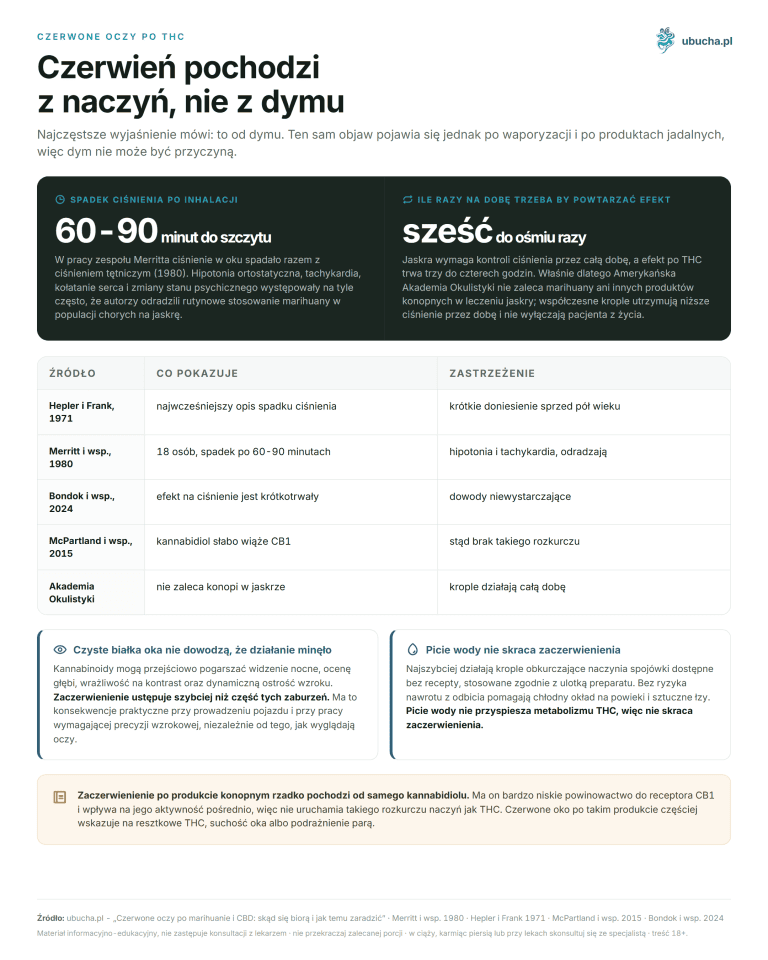
CB2 is a peripheral cannabinoid receptor, primarily present in immune system tissues. Its activation shifts macrophages from the pro-inflammatory M1 state towards the anti-inflammatory M2 state. Tortora’s 2022 study demonstrated this change in macrophages obtained from children with celiac disease.
Turcotte’s 2016 review gathers the basics. CB2 is mainly expressed in immune tissues, modulates the function of immune cells both in culture and in animal models of inflammatory diseases, and mice lacking this receptor exhibit an enhanced inflammatory phenotype (Turcotte et al., Cellular and Molecular Life Sciences, 2016). The authors of the review note that it remains an open question whether CB2 is suitable as a therapeutic target in inflammatory diseases.
Tortora’s work illustrates this mechanism with specific material. The team compared peripheral blood macrophages from children with celiac disease, found an excess of M1 macrophages and reduced CB2 expression, and pharmacological activation of the receptor shifted polarization to M2 and limited damage to the intestinal barrier in a culture model (Tortora et al., Biomedicines, 2022). This is a cell culture study, not a patient study, so the conclusion pertains to the mechanism, not treatment.
The connection with resolving lipids is clear here. Bäck’s 2019 review lists the shift of pro-inflammatory macrophages to inflammation-suppressing and healing-promoting cells as one of the main effects of resolving mediators (Bäck et al., Nature Reviews Cardiology, 2019). Thus, SPM and CB2 reach the same endpoint through two different pathways. If you want to first sort out the nomenclature of receptors, start with our guide: cannabinoids: what they are and how they work.
How does CBD fit into the resolution pathway of inflammation?
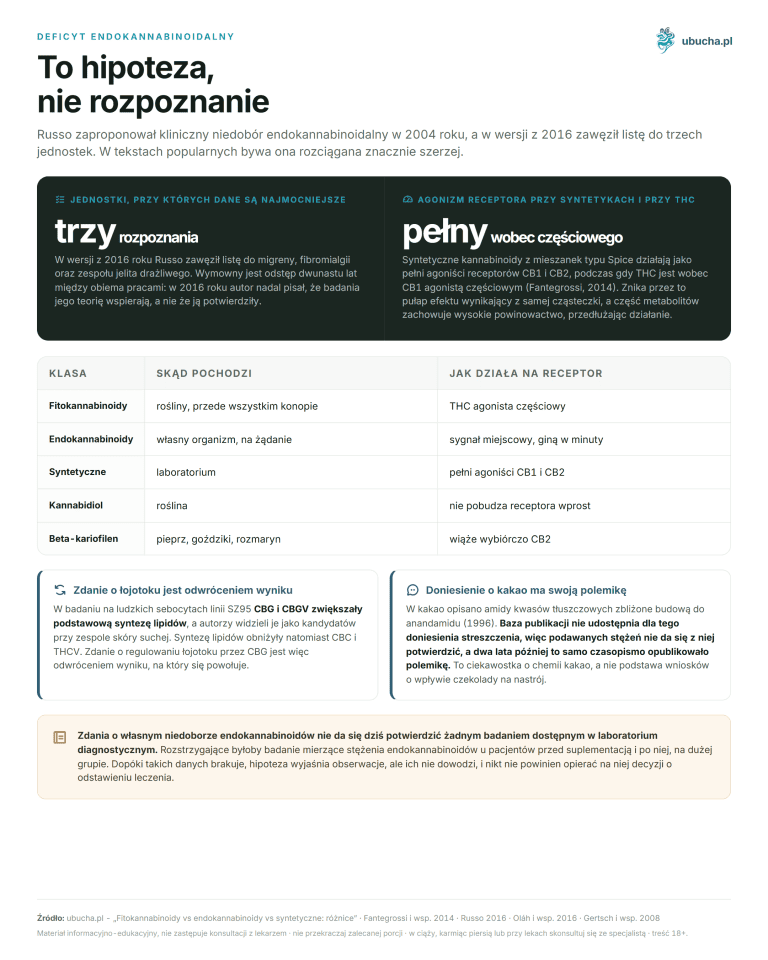
CBD is not a strong agonist of CB2, so its anti-inflammatory action is mainly described through other receptors. O’Sullivan’s 2016 review summarizes that some, though not all, of the anti-inflammatory effects of cannabinoids occur through PPAR receptors, primarily PPAR-alpha and PPAR-gamma.
The same review notes that PPAR activation usually works together with more classical cannabinoid targets: CB1 and CB2 receptors and the TRPV1 channel. Through PPAR, some effects of substances that inhibit the breakdown or transport of endocannabinoids are also realized, and cannabinoids themselves can be delivered to PPAR by fatty acid-binding proteins (O’Sullivan, British Journal of Pharmacology, 2016).
Esposito and colleagues examined the role of PPAR-gamma in a rat model of Alzheimer’s disease. Blocking this receptor clearly weakened the impact of CBD on reactive gliosis, and subsequently on neuronal damage; through the same receptor, CBD stimulated neurogenesis in the hippocampus (Esposito et al., PLoS ONE, 2011). This is an animal model, so the work does not speak to efficacy in humans.
From our observations, questions about the anti-inflammatory action of CBD usually end with concentrations of TNF-alpha, IL-6, or CRP, that is, measuring the intensity of inflammation itself. The resolution program is then outside the field of view, even though its absence is described as a mechanism in some chronic conditions. We further develop this thread in the text about how researchers explain the mechanism of CBD action in inflammatory states.
Why is chronic inflammation often a defect of resolution?
Because cleanup fails. Bäck’s 2019 review describes atherosclerosis as a disease where the clinical outcome is determined by the balance between pro-inflammatory and resolving mechanisms, and insufficient removal of dead cells pushes the change further instead of closing it.
The mechanism is described in detail. Faulty efferocytosis, or the engulfment of apoptotic cells by macrophages, leads to the accumulation of macrophages and foam cells in a state of secondary necrosis. An advanced lesion with a necrotic core forms, and such a plaque is unstable. The authors provide a measurement that explains the cause: in advanced atherosclerotic changes, the ratio of SPM to pro-inflammatory lipids, especially leukotrienes, is strikingly low (Bäck et al., Nature Reviews Cardiology, 2019). There is no lack of inflammatory signal, but there is a lack of closing signal.
Substrates are significant in this picture because mediators of resolution are derived from omega-3 fatty acids or arachidonic acid. A diet low in omega-3 fatty acids thus limits the pool from which the body builds these molecules. How much omega-3 needs to be supplied to translate into SPM levels in humans remains an unanswered question: we did not find a clinical study that provides it, so we do not give any dosage here.
Caution is warranted for another reason. Reduced levels of mediators of resolution have been described in atherosclerotic changes, but transferring this observation to other chronic diseases requires separate evidence, which is not present in the cited works. A similar problem with the limits of evidence is described in CBD in autoimmune diseases.
Frequently Asked Questions
What are lipoxins and resolvins?
These are two of the four families of SPM, or specialized pro-resolving mediators, which are lipids that resolve inflammation. Lipoxins are derived from arachidonic acid and were first described in 1984. Resolvins belong to the branch derived from omega-3 fatty acids. In animal experiments, synthetic SPM induce anti-inflammatory and pro-resolving effects (Serhan, Nature, 2014).
What is the role of the CB2 receptor in resolving inflammation?
CB2 is mainly found in immune tissues and modulates the function of immune cells; mice lacking this receptor exhibit an enhanced inflammatory phenotype (Turcotte et al., 2016). In cultures of macrophages from children with celiac disease, CB2 activation shifted polarization from M1 to the anti-inflammatory M2 type.
Does CBD activate the CB2 receptor?
Not in a way that would explain its anti-inflammatory action. O’Sullivan’s review from 2016 points to PPAR-alpha and PPAR-gamma receptors as mediators of some cannabinoid effects, usually acting together with CB1, CB2, and TRPV1 (O’Sullivan, 2016). The role of CB2 alone is not conclusive here.
Where does the body get substrates for resolvin production?
From dietary fats. The mediators of resolution are derived from omega-3 fatty acids or arachidonic acid (Bäck et al., 2019). We did not find a clinical study linking specific omega-3 intake to SPM levels in humans, so we do not provide any dosages.
What is the difference between inhibiting inflammation and resolving it?
Inhibition blocks the formation of pro-inflammatory mediators. Resolution is an active cleanup program: removing dead cells, halting the influx of neutrophils, and rebuilding tissue. Bäck’s review describes that faulty efferocytosis leads to secondary necrosis and to a plaque with a necrotic core, despite the presence of inflammatory signals.
EPA and DHA acids are sold as dietary supplements; you can find the store’s assortment in the supplements category.
This article is for informational and educational purposes only and does not constitute medical advice. Before starting to use cannabis or CBD for therapeutic purposes, consult with a doctor, especially if you are taking other medications, are pregnant, or breastfeeding.
Author: Michał Waluk · Published: 2026-08-09 · Updated: 2026-08-15