
CBD and Alcohol: Can They Be Combined? Facts and Risks
CBD and alcohol: what Consroe and Belgrave's 1979 studies really showed, what EFSA wrote about the 2 mg daily dose, and why drivers should not combine them.
The question of combining CBD with alcohol resurfaces weekly in search engines, and answers online range from “it’s completely safe” to “cannabidiol protects the liver from ethanol.” We checked what the studies these texts refer to actually say. The result is surprising. Two experiments from 1979 yielded results that cannot be reconciled without reading the methods. The most frequently cited liver study describes liver damage caused by CBD, not protection from alcohol. Additionally, the European Food Safety Authority issued a provisional safe dose in 2026 that is hundreds of times lower than the figures circulating in Polish guides. Below, we break down the topic into pharmacology, evidence, regulations, and situations where the combination must be absolutely avoided.
KEY INFORMATION
• EFSA in 2026 derived a provisional safe dose of CBD: 0.0275 mg per kilogram of body weight per day, about 2 mg for a 70 kg person (EFSA, 2026).
• CBD safety cannot be established for people under 25 years old, pregnant and breastfeeding women, and those taking medications.
• Consroe 1979: CBD lowered blood alcohol concentration but did not reduce impairment.
• Ewing 2019 study, cited as evidence of liver protection, showed liver damage in mice.
• Driving under the influence of alcohol is an offense; intoxication is a crime.
How does the body metabolize CBD and alcohol?
Both substances pass through the liver but via different pathways, and only at the enzyme level do they intersect. Most ethanol is oxidized in the liver, with the rate influenced by genetic and environmental factors (Cederbaum, Clinics in Liver Disease, 2012). Cannabidiol enters these same pathways from a different side.
A systematic review of cannabidiol pharmacokinetics in humans showed how little is known. The only measured absolute bioavailability concerns inhalation and is 31 percent. No study has established it for oral or sublingual forms, despite intravenous preparations being available. The half-life ranges from 1.4 to 10.9 hours after buccal spray and reaches 2-5 days after chronic oral administration, with maximum concentration increasing after meals and in fatty preparations (Millar et al., Frontiers in Pharmacology, 2018).
This has practical significance because bioavailability tables circulating in Polish guides give precise percentages for oral forms that no one has measured. The same review explains why the window for possible interaction with alcohol is long: with regular use, cannabidiol remains in the body for several days, not just hours.
The common point is liver enzymes. Cannabidiol affects targets involved in drug metabolism, primarily CYP3A4 and CYP2C19, and P-glycoprotein responsible for excretion. Safety review authors assess the interaction potential with commonly used drugs as high and recommend dose reduction of substrates and monitoring for adverse effects (Brown and Winterstein, Journal of Clinical Medicine, 2019). Ethanol adds to this system as an additional liver burden, not a neutral additive.
Does CBD lower blood alcohol levels?
Before discussing results, it is worth knowing what these doses mean at the table. Assuming a 70 kg person and a standard alcohol portion equal to 10 g of pure ethanol: the dose from Consroe’s study, 1 g per kilogram, is 70 g of ethanol, about seven portions - roughly three and a half half-liter 5% beers or a whole bottle of wine. The dose from Belgrave’s study, 0.54 g per kilogram, is about 38 g, nearly four portions - roughly two half-liter beers or two glasses of wine.
These are not occasional amounts, which is why they matter when reading results. Both experiments tested what happens after drinking a large dose at once, not a glass with dinner. Applying their conclusions to one beer stretches the data beyond what was measured.
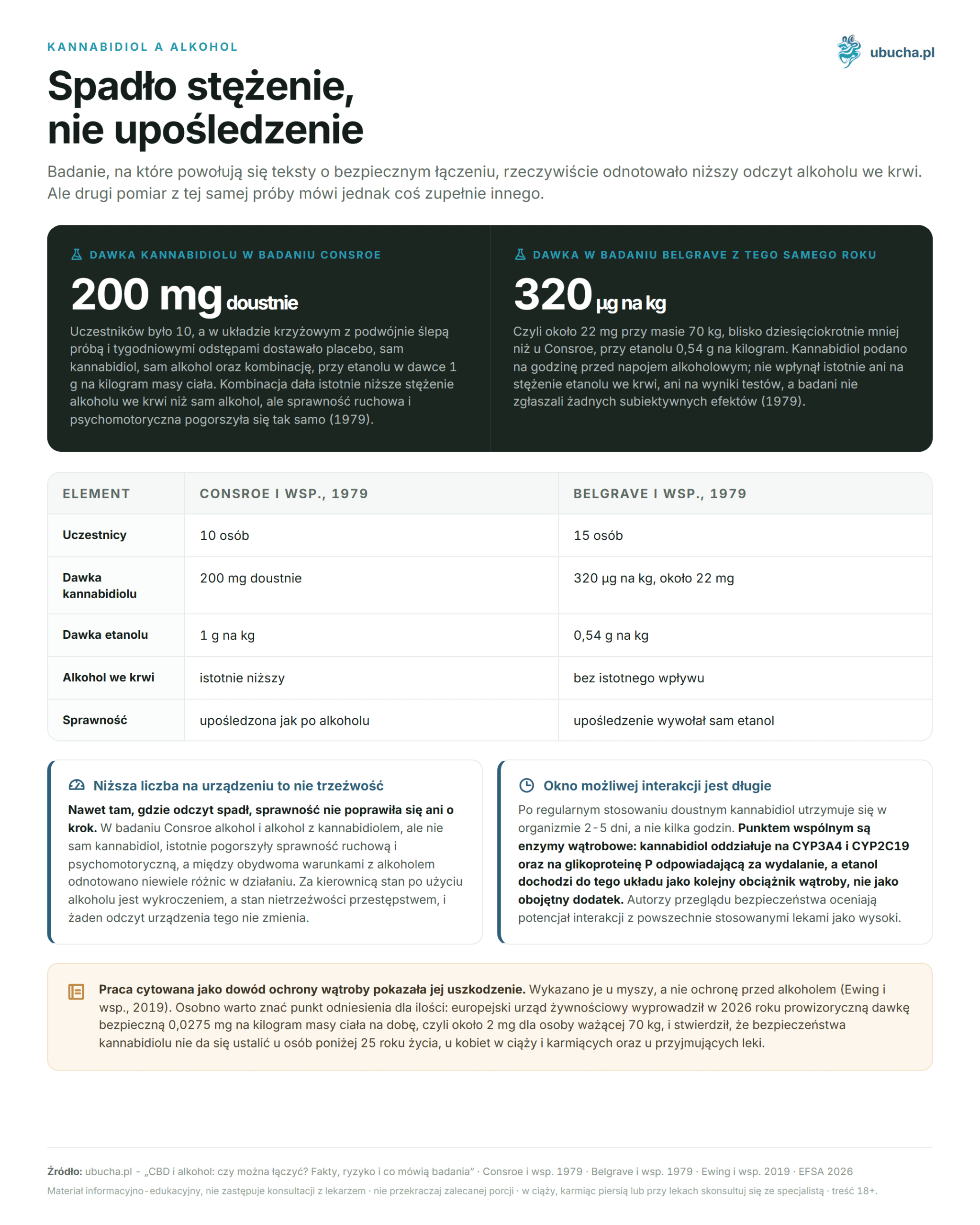
One study found an effect, the other did not, and the difference lies in the dose. Both experiments were conducted in 1979 and published in the same journal, so they are sometimes cited interchangeably. This is a mistake because the cannabidiol dose differs nearly tenfold, resulting in contradictory outcomes.
| Element | Consroe et al. 1979 | Belgrave et al. 1979 |
|---|---|---|
| Participants | 10 people (6 men, 4 women) | 15 people |
| CBD dose | 200 mg orally | 320 micrograms per kg, about 22 mg for 70 kg |
| Ethanol dose | 1 g per kg body weight | 0.54 g per kg body weight |
| Equivalent in drinks (70 kg, 10 g ethanol portion) | about 7 portions: 3.5 beers (0.5 l) or a bottle of wine | about 3.8 portions: 2 beers (0.5 l) or 2 glasses of wine |
| Effect on blood alcohol | significantly lower than alcohol alone | no significant effect |
| Effect on performance | impairment same as alcohol alone | impairment caused by ethanol alone, CBD had no effect |
In Consroe’s study, placebo, cannabidiol alone, alcohol alone, and the combination were administered in a crossover design with double-blind and weekly intervals. Alcohol and alcohol with CBD, but not cannabidiol alone, significantly impaired motor and psychomotor performance. The combination resulted in significantly lower blood alcohol concentration than alcohol alone, though there were few differences in effects between the two alcohol conditions (Consroe et al., Psychopharmacology, 1979).
Belgrave administered cannabidiol one hour before the alcoholic beverage and measured cognitive, perceptual, and motor functions at three time points. Ethanol impaired psychomotor coordination and cognitive performance. Prior CBD administration did not significantly affect blood ethanol concentration or test results, and participants reported no subjective effects of cannabidiol (Belgrave et al., Psychopharmacology, 1979).
The takeaway for readers is simple and inconvenient for marketing. Even where breathalyzer readings dropped, performance did not improve at all. A lower number on the device does not mean a sober person.
Does CBD protect the liver from alcohol?
There is no evidence for this in humans, and the study most often cited as the source says the opposite. Polish texts refer here to Ewing et al. 2019. This study exists but concerns cannabidiol hepatotoxicity, not protection from ethanol, and was published in Molecules, not where the references indicate.
Mice were given single doses of 246, 738, or 2460 mg per kilogram body weight, and in a subchronic part, 61.5, 184.5, or 615 mg per kilogram for ten days. Doses were derived by allometric scaling from the maximum recommended maintenance dose of cannabidiol in humans, 20 mg per kilogram. In the acute part, the highest dose increased liver-to-body weight ratio, ALT and AST activity, and total bilirubin concentration. In the subchronic part, 75% of animals receiving 615 mg/kg entered an agonal state between days three and four. The authors explicitly mention clear signs of liver damage (Ewing et al., Molecules, 2019).
Hope for protective effects comes from elsewhere and is much more cautious. A review of cannabidiol and alcohol data summarizes that preliminary preclinical results suggest reduced ethanol consumption and possible protection against some damage, including liver and brain injury. However, the same review states that studies with simultaneous administration of both substances in humans are so few that no definitive conclusions can be drawn (Nona et al., Experimental and Clinical Psychopharmacology, 2019).
We noticed in the corpus of Polish guides that these two findings are merged into one sentence about the liver being protected from weekend drinking. Separating them changes the recommendation: with liver disease, avoid both substances rather than counting on one neutralizing the other.
How much CBD is safe according to EFSA?
About 2 mg per day for a 70 kg person. The EFSA panel on nutrition and novel foods recalculated in 2026 data from subchronic studies using the benchmark dose method and an uncertainty factor of 400 to derive a provisional safe dose of 0.0275 mg per kilogram body weight per day (EFSA, EFSA Journal, 2026).
This value has a narrow scope. It applies only to dietary supplements with cannabidiol purity of at least 98 percent, without nanoparticles, produced by a process recognized as safe and excluding genotoxicity. The panel also states that CBD safety cannot be established for people under 25 years old, pregnant and breastfeeding women, and those taking medications. This sentence should appear in every text addressing dosing.
For the liver and alcohol topic, two further findings from the same document are important. Animal studies showed consistent liver toxicity, with liver mass and histopathological changes being the most sensitive endpoints. Human studies indicated hepatotoxic potential, especially with concurrent use of other drugs. The panel also noted that cannabidiol bioavailability is variable and depends on the carrier and food intake.
Polish texts circulate a safe dose of up to 1500 mg per day, attributed sometimes to the World Health Organization, sometimes to a 2017 safety review. We did not find this number in the summary of the review cited, and the organization’s document linked does not exist at the given address. The discrepancy with EFSA’s value is several hundredfold and concerns the amount the reader measures themselves.
What adverse effects does CBD alone have?
More frequent than suggested by the image of a harmless supplement and clearly dose-dependent. In a review of registration data, nearly half of people using cannabidiol experienced adverse effects, with occurrence correlating with dose size (Brown and Winterstein, 2019). The authors list the most common as:
- increased liver aminotransferase activity
- somnolence
- sleep disturbances
- infections
- anemia
The first meta-analysis of randomized placebo-controlled trials included twelve trials and 803 participants. Cannabidiol was associated with a higher chance of study withdrawal for any reason and a higher risk of serious adverse events. Separate signals concerned abnormal liver tests, pneumonia, diarrhea, and sedation (Chesney et al., Neuropsychopharmacology, 2020).
The same work contains a caveat that changes interpretation. Associations with abnormal liver tests and somnolence and sedation were limited to pediatric epilepsy trials, where cannabidiol might interact with clobazam or sodium valproate. Excluding these trials, the only remaining effect was diarrhea.
The conclusion is twofold and rarely fully presented. Sedation attributed to cannabidiol alone has weaker evidence than guides repeat. At the same time, the best-documented liver signal comes exactly from situations where a second liver burdening substance is added to cannabidiol. Alcohol is precisely such a second substance, but no controlled studies have examined this system.
An older safety review lists fatigue and diarrhea as the most common symptoms, along with appetite and weight changes. The same review points to cannabidiol’s effects on liver enzymes and drug transporters as an area needing further clinical research (Iffland and Grotenhermen, Cannabis and Cannabinoid Research, 2017). Nine years later, EFSA describes this area as still an open gap.
Do CBD and alcohol together lower blood pressure?
Cannabidiol alone lowers blood pressure measurably, and alcohol dilates peripheral vessels, so the direction of action of both substances is the same. They have not been studied together, but knowing the size of the single effect is useful because it explains dizziness reported after an evening with oil and wine.
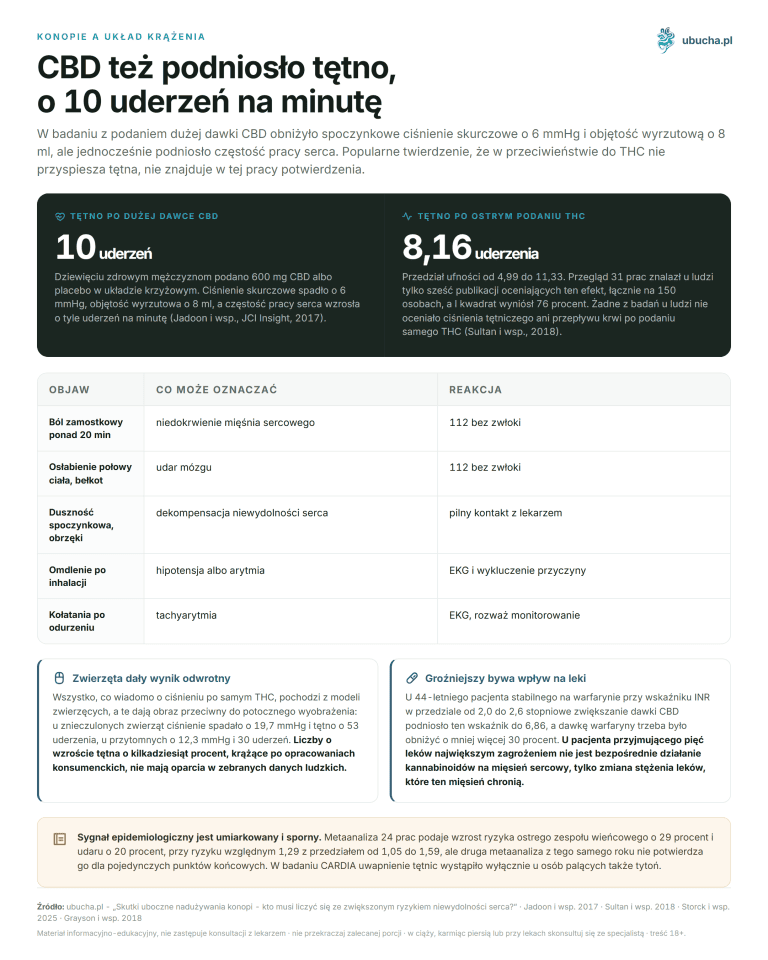
In a randomized crossover study, nine healthy men received a single 600 mg dose of cannabidiol or placebo. After cannabidiol, resting systolic blood pressure dropped by 6 mmHg, stroke volume by 8 ml, and heart rate increased, with maintained cardiac output. In response to cold stress, blood pressure increase was suppressed by 6 mmHg, and heart rate accelerated by 7 beats per minute, with lower total peripheral resistance (Jadoon et al., JCI Insight, 2017).
One must keep the scale of this study in mind. Nine healthy men is a small sample, 600 mg is several hundred times higher than EFSA’s provisional safe dose, and the authors explicitly state these hemodynamic changes should be considered by cannabidiol users. This is not a description of what happens after twenty milligrams.
The practical consequence concerns two groups. People with low baseline blood pressure and those taking antihypertensive drugs have reason not to test this combination on themselves. Dizziness when standing after alcohol is a known phenomenon; adding a substance that lowers resting blood pressure and increases heart rate does not improve this picture.
Does combining CBD with alcohol increase sedation?
Probably yes, but this does not come from studies on this combination, as none exist. It is inferred from what both substances do separately, which is a weaker basis than guides usually suggest.
On the cannabidiol side, the sedation signal is ambiguous. In a meta-analysis of randomized trials, somnolence and sedation were significant but only in pediatric epilepsy trials, where other antiepileptic drugs were background. Excluding these trials, sedation was indistinguishable from placebo. However, the registration data review lists somnolence among the most common adverse effects, so fully dismissing this effect is not justified.
On the alcohol side, the picture is clear and measured. In Consroe’s study, both alcohol alone and alcohol with cannabidiol significantly impaired motor and psychomotor performance, and participants overestimated elapsed time in a minute production task. Interestingly, their subjective responses indicated accurate self-assessment of intoxication and deficits, meaning they knew their state.
This last finding has practical value. A person after alcohol with cannabidiol likely has no illusions about their condition while looking at themselves, not the breathalyzer. The discrepancy appears only between perception and measurement: the device shows a lower number than after alcohol alone, even though performance is the same.
A separate question of whether cannabidiol itself is addictive or intoxicating is discussed in the article on CBD, addiction, and intoxication.
Why is so little known about combining CBD with alcohol?
Because almost no one has studied it, and what has been studied dates back to the 1970s. A review collecting data on cannabidiol and alcohol indices states plainly that little is known about cannabidiol interactions with other commonly used substances, and studies with simultaneous administration of both substances in humans are so few that no conclusions can be drawn (Nona et al., 2019).
The gap starts even earlier, at cannabidiol itself. A systematic pharmacokinetic review found only 24 studies with parameters measured in humans out of 792 reviewed. The authors mention data scarcity and discrepancies between studies despite widespread use and point to the need for solid research on various preparation forms.
The same conclusion repeats in official documents. A 2017 safety review indicated cannabidiol’s effects on liver enzymes and drug interactions as an area needing further research. The EFSA panel in 2026 noted that gaps identified four years earlier persist due to methodological limitations: lack of standardized protocols, short duration, and concurrent medication use by participants.
For readers, this means one thing. Any text providing a precise table of safe CBD doses with alcohol gives numbers no one has measured. A more reasonable reaction to lack of data is caution, not filling the gap with invented values.
Can you drive after using CBD and alcohol?
No, and this is not changed by the fact that cannabidiol alone performed neutrally in road studies. In a randomized public road driving study, 26 occasional cannabis users vaporized preparations with THC dominance, CBD dominance, balanced content, and placebo, each at 13.75 mg of each compound. Standard deviation of lane position increased significantly after THC preparations but not after the cannabidiol-dominant preparation (Arkell et al., JAMA, 2020).
However, the authors add a caveat often missing in Polish summaries: the effect size for the CBD-dominant preparation did not exclude clinically significant impairment, and the doses tested may not correspond to typical use. This is not a green light, just a lack of signal in one experiment on 26 people.
The same study provides a reference point for alcohol. At calibrated blood alcohol concentrations of 0.02% (0.2 per mille) and 0.05% (0.5 per mille), lane deviation increased by 1.12 cm and 2.4 cm, respectively, compared to placebo. These are exactly the two values defining Polish legal limits. The increase after THC-dominant preparation was 2.33 cm, between these points. Alcohol remains a factor that truly impairs lane keeping, regardless of what is added in the evening.
Also, the 1979 finding that cannabidiol lowered blood alcohol readings without reducing impairment means a driver looking at a breathalyzer after such a combination receives an underestimated result relative to their actual state. More about driving after oil use is in the post CBD and driving.
How does CBD differ from THC in this context?
By legal status and impact on driving, though they can coexist in one product. This distinction determines whether an evening oil is a problem at a morning roadside check, and most guides dismiss it with one sentence.
In the 2020 road study, the THC-dominant preparation increased lane deviation by 2.33 cm versus placebo, the balanced preparation by 2.83 cm, and the CBD-dominant preparation was indistinguishable from placebo. After four hours, none differed significantly from placebo, showing the impairment window after THC is narrow. Also, sixteen of 188 test drives were stopped for safety reasons (Arkell et al., 2020).
On the regulatory side, the threshold differs from pharmacology. The 0.3% THC limit distinguishing hemp from other cannabis is set at the EU level by Regulation 2021/2115, with the national basis in Article 4 point 5 of the Act on Counteracting Drug Addiction as amended on March 24, 2022 (Journal of Laws 2022 item 763). The national threshold corresponds to the EU one but does not derive from it: these are two separate regulations with the same value.
Counting method is often omitted but changes lab test results. The threshold is the sum of delta-9-THC and tetrahydrocannabinolic acid, rounded to one decimal place, not delta-9-THC alone. A full-spectrum product within this limit still contains THC, so for professional drivers, choosing a THC-free product with a certificate of analysis is a practical, not overly cautious, decision. Separately, note that HHC remains a controlled substance.
What does Polish law say about alcohol behind the wheel?
It distinguishes two states with different consequences, separated by blood alcohol concentration. The Act on Sobriety Education and Counteracting Alcoholism defines in Article 46 paragraph 2 the state after alcohol use as blood alcohol concentration above 0.2 per mille up to 0.5 per mille, and in paragraph 3 intoxication as concentration exceeding 0.5 per mille (Journal of Laws 1982 No. 35 item 230, current act).
| State | Classification | Sanction under the act |
|---|---|---|
| State after alcohol use | offense, Article 87 § 1 of the Code of Petty Offenses | fine not less than 2500 PLN, mandatory driving ban |
| Intoxication | crime, Article 178a § 1 of the Penal Code | imprisonment up to 3 years, financial penalty at least 5000 PLN |
Cannabidiol is not a controlled substance, but traffic regulations recognize substances acting similarly to alcohol. The basis for testing drivers for their presence is Article 129j of the Road Traffic Act, not Article 129i, which concerns alcohol. The same basis applies to the implementing regulation specifying testing methods (Journal of Laws 2014 item 948; consolidated text of the Road Traffic Act: Journal of Laws 2024 item 1251).
One distinction is worth knowing because it is often misrepresented in guides. The value of 1 nanogram THC per milliliter of blood, sometimes given as a responsibility threshold, is the detection limit of the method in the regulation. For urine, the act lists 20 nanograms per milliliter, and there is no threshold for saliva. This matters for users of full-spectrum products, which by definition contain trace THC; this is described in more detail in the post on CBD detection time in urine.
Who should avoid this combination completely?
There are more groups than most guides admit, some directly from the EFSA document. The panel stated that CBD safety cannot be established for people under 25 years old, pregnant and breastfeeding women, and those taking medications. Adding ethanol does not reduce uncertainty but adds a second variable.
| Group | Reason |
|---|---|
| People under 25 years old | EFSA cannot establish CBD safety in this group |
| Pregnant and breastfeeding women | same EFSA limitation; cannabidiol crosses the placenta |
| People taking chronic medications | CBD affects CYP3A4, CYP2C19, and P-glycoprotein; ethanol adds liver burden |
| People with liver disease | animal studies show consistent CBD liver toxicity; human signal increases with other drugs |
| Drivers and machine operators | alcohol measurably impairs lane keeping; CBD can lower breathalyzer reading relative to actual state |
| People after addiction therapy | evidence of CBD effect on alcohol consumption in humans is too sparse to build abstinence strategies |
Separately, drugs with a narrow therapeutic window, where even small concentration changes alter effects, are worth mentioning. The interaction review recommends dose reduction of substrates, monitoring adverse effects, or therapy change in such cases, emphasizing that cannabidiol can be both cause and victim of interactions. The decision is made by the attending physician, not the guide author or seller.
What does EFSA say about CBD in pregnancy and breastfeeding?
That safety cannot be established in this group, a stronger statement than usual caution. The panel lists pregnant and breastfeeding women explicitly, alongside people under 25 and those taking medications, as groups for which data do not allow assessment.
Behind this statement are specific observations from the document. Pharmacokinetic studies confirmed cannabidiol’s ability to cross the placenta and accumulate in the body, which the panel cites as further concern. Reproductive toxicity studies in animals reinforced worries about this endpoint, and prenatal exposure showed neurodevelopmental effects suggesting long-term and sex-dependent consequences.
The document also lists two areas Polish guides omit. Endocrine disorders were noted, including altered thyroid hormone levels and histopathological changes in adrenal glands. Immunotoxicity has not been studied, although cannabidiol interacts with immune pathways, so the panel recommends caution due to lack of data, not a negative result.
Alcohol in pregnancy is a separate well-described problem not resolved here. Combining both substances leads to the same practical conclusion: this is the only group in the entire text where considering doses, timing, or preparation form makes no sense. Consultation with the pregnancy care physician replaces any table.
Does CBD reduce alcohol craving?
In animals yes, in humans it has not been demonstrated. Separating these two levels is more important than usual because the topic concerns people seeking support in overcoming addiction and the cost of error is high.
In a rat study with a history of self-administering alcohol or cocaine, transdermal cannabidiol was given once daily for seven days. The preparation reduced substance seeking triggered by context and stress, without tolerance, sedation, or disruption of normal motivated behaviors. The effect lasted about five months after administration ended, though cannabidiol was detectable in plasma and brain only for three days. Anxiety decreased in the elevated plus maze test, and rats with alcohol dependence history did not develop high impulsivity (Gonzalez-Cuevas et al., Neuropsychopharmacology, 2018).
On the human side, a review collecting all available works on cannabidiol and alcohol-related indices states that little is known about cannabidiol interactions with other commonly used substances, and studies with simultaneous administration of cannabidiol and alcohol in humans are so few that no definitive conclusions can be drawn (Nona et al., 2019).
The practical consequence is inconvenient but honest. The result obtained in rats after transdermal administration is not a basis for replacing addiction therapy with oil. If you seek ways to reduce drinking, talking to a doctor or addiction therapist is evidence-based today, cannabidiol is not.
Does CBD help with hangovers?
No studies have tested this, and the popular justification is based on a mechanism not confirmed by hangover research. A review of biological hangover correlates showed that hormone, electrolyte, free fatty acid, triglyceride, lactate, ketone body, cortisol, and glucose levels did not significantly correlate with symptom severity.
More importantly for popular guides, dehydration markers including vasopressin were also not significantly associated with hangover severity. The best-documented link was between immune factors and symptom severity, supported by studies where prostaglandin synthesis inhibitors reduced hangover severity. The authors also list factors that do not cause hangovers but worsen their course: sleep deprivation, tobacco smoking, congeners, health status, and individual differences (Penning et al., Current Drug Abuse Reviews, 2010).
So where does the idea for cannabidiol come from? Its antiemetic effect. A review of cannabinoid regulation of nausea and vomiting states that CBD suppresses nausea and vomiting in a narrow dose range, probably via indirect activation of 5-HT1A receptors in the dorsal raphe nucleus. However, evidence comes from preclinical studies, and authors relate it to chemotherapy-induced nausea, not alcohol (Parker et al., British Journal of Pharmacology, 2011).
Summarizing this section: no study has tested cannabidiol on human hangovers. There is a study showing cannabidiol burdens the liver, which the day after drinking already has more work than usual.
How to reduce risk if you still combine?
The lowest risk comes from separating the substances in time and sticking to lower ranges. The following tips are not medical advice or encouragement; they are conclusions from the pharmacokinetics described above, intended for a healthy adult without chronic medications.
- Do not drive or operate machinery if you have consumed alcohol. Breathalyzer readings after cannabidiol may be underestimated relative to actual state, so the device does not resolve this issue.
- Space out intake in time. Cannabidiol remains in the body from several hours to days with regular use, so full separation may be impossible, but a few hours’ gap reduces overlapping peak concentrations.
- Remember that food changes actual dose. Maximum cannabidiol concentration increases after eating and in fatty preparations, so the same number of drops acts differently on an empty stomach and after dinner.
- Do not combine daily. The liver signal in clinical studies appeared with chronic administration and coexisting substances.
- Consult a doctor if you take any medications. EFSA could not establish cannabidiol safety in this group, and ethanol is another liver substrate.
- Stop if excessive drowsiness, dizziness, or nausea occur, and seek medical help if fainting, disorientation, or vomiting happen.
A separate note concerns full-spectrum preparations. They contain trace THC, a substance treated differently by traffic regulations than cannabidiol. Professional drivers find it easier to choose THC-free products with a certificate of analysis. Interactions of THC with alcohol are described separately in the post on mixing alcohol and marijuana.
Frequently Asked Questions
Can CBD be combined with alcohol?
There are no studies that would allow a positive answer. A review of works on cannabidiol and alcohol states that there are too few studies with simultaneous administration of both substances in humans to draw definitive conclusions. People taking medications, drivers, and patients with liver disease should avoid this combination.
Does CBD lower blood alcohol levels?
In Consroe’s 1979 study on ten volunteers, 200 mg of cannabidiol given with ethanol at a dose of 1 g per kilogram resulted in significantly lower blood alcohol concentration than alcohol alone. However, impairment of motor and psychomotor skills remained the same as with alcohol alone.
Does CBD protect the liver from alcohol?
No such effect has been demonstrated in humans. The study by Ewing et al. from 2019, cited as evidence of protection, describes liver damage in mice after cannabidiol. EFSA notes consistent liver toxicity in animal studies and potential hepatotoxicity in humans, especially with concurrent medication use.
How much CBD is safe according to EFSA?
In 2026, the EFSA panel derived a provisional safe dose of 0.0275 mg per kilogram of body weight per day, approximately 2 mg for a 70 kg person. This value applies to supplements with cannabidiol purity of at least 98 percent, without nanoparticles, and does not include people taking medications.
Can you drive after using CBD and alcohol?
No. Alcohol measurably worsens lane keeping, as confirmed by a road study published in JAMA in 2020. Cannabidiol can additionally lower breathalyzer readings without reducing impairment, so the device shows a more favorable result than the driver’s actual condition.
Does CBD help with hangovers?
There is no study that has tested this. A review of hangover correlates also showed that dehydration markers are not significantly associated with symptom severity, and the strongest link concerns immune factors. The antiemetic effect of cannabidiol has been described in preclinical studies on chemotherapy-induced nausea.
Does a breathalyzer detect CBD?
No. A breathalyzer reacts to ethanol in exhaled air, and cannabidiol does not register on it. A separate issue is tests for substances acting similarly to alcohol, performed under Article 129j of the Road Traffic Act, where trace amounts of THC in full-spectrum preparations matter.
Summary
Combining cannabidiol with alcohol is neither neutral nor protected by any defense mechanism. Two historic experiments showed that at a 200 mg dose, blood alcohol readings drop; at a nearly tenfold lower dose, nothing happens; and impairment in both cases is caused by ethanol alone. The study cited as evidence of liver protection describes liver damage in animals.
The strongest reference point today is EFSA. The provisional safe dose is about 2 mg per day for a 70 kg person, and cannabidiol safety cannot be established for people under 25 years old, pregnant and breastfeeding women, and those taking medications. The last group practically includes most people using oil for health reasons.
If you want one rule to remember, it is this: a breathalyzer does not measure a person’s state, only ethanol concentration, and cannabidiol can distort these two. With liver disease, chronic medications, and before driving, the decision is simple and requires no tests: these two substances do not meet on the same evening.
This article is for informational and educational purposes and does not constitute medical advice. Before starting cannabis or CBD for therapeutic purposes, consult a doctor, especially if you take other medications, are pregnant, or breastfeeding.
Author: Michał Waluk · Published: 2026-05-11 · Updated: 2026-08-24