
Tongkat Ali for Testosterone and Libido: What Studies Show (Table)
Tongkat ali in human studies: how many participants there were, how long the supplementation lasted, and what was actually measured. No dosage recommendations for the reader.
Tongkat ali, or the root of Eurycoma longifolia, has entered supplements with the promise of influencing testosterone, libido, and stress resistance. Behind this promise are several small studies on humans. In a randomized placebo trial involving 63 individuals with moderate stress, four weeks of supplementation with standardized aqueous extract reduced cortisol in saliva by 16% and raised testosterone in it by 37% (Talbott et al., Journal of the International Society of Sports Nutrition 2013). This article collects what has actually been measured: who studied, how many participants there were, how long the supplementation lasted, and what the result was. We do not provide numbers from studies as recommendations.
KEY INFORMATION
• Salivary cortisol decreased by 16%, testosterone increased by 37% after four weeks in 63 individuals with stress (Talbott et al., 2013).
• The strongest data comes from men with low testosterone, not from young and healthy individuals.
• Both randomized trials were funded by the manufacturer of the studied extract.
• Three out of five studies had no control group.
• The use in disease and medications is decided by a doctor, not the label.
What is tongkat ali and how does it work?
Tongkat ali is the root of the tree Eurycoma longifolia, which grows in Southeast Asia. In supplements, it most often appears as an aqueous extract. The root does not contain hormones or their precursors, so the changes in testosterone levels observed in studies do not come from external hormone delivery, but from some shift in internal regulation.
How exactly this mechanism works in humans has not been determined. The clinical publications described below measured the outcome, not the path the body took to get there. There is an elaborate description circulating online about the inhibition of aromatase and stimulation of Leydig cells via the cyclic AMP pathway. We did not find it in any of the clinical works cited in this text, so we do not repeat it.
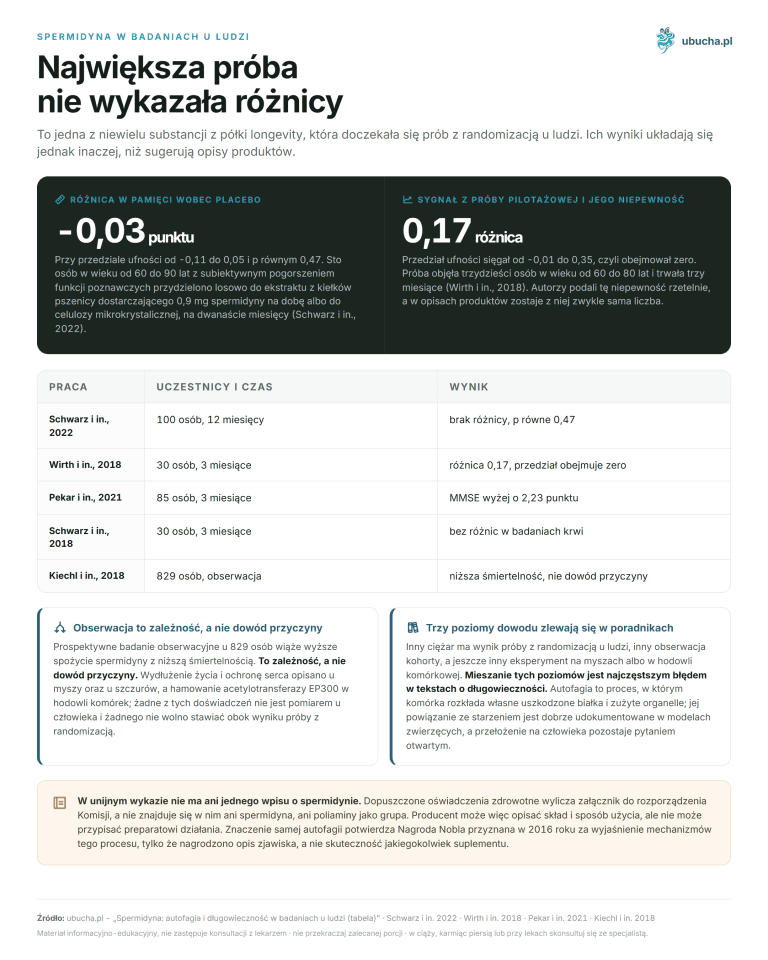
One mechanistic clue comes from a pilot study in older individuals. The increase in free testosterone in the participants is linked there to a decrease in sex hormone-binding globulin, which is a transport protein determining what portion of the hormone remains biologically active (Henkel et al., Phytotherapy Research 2014). This is one small trial, so it is a clue, not a determination.
A separate issue concerns who the effect was measured in. The participants were men diagnosed with late-onset hypogonadism, men aged 30-55, individuals with elevated stress, and physically active seniors. There are no trials in young adults with normal hormone levels in this set, so transferring these numbers to them is an overinterpretation.
What studies on tongkat ali have been conducted on humans?
There are several trials, and all are small. The largest involved 350 patients, the smallest 25 individuals. Supplementation lasted from one month to twelve weeks, and the preparations differed enough that the results cannot be combined into one number.
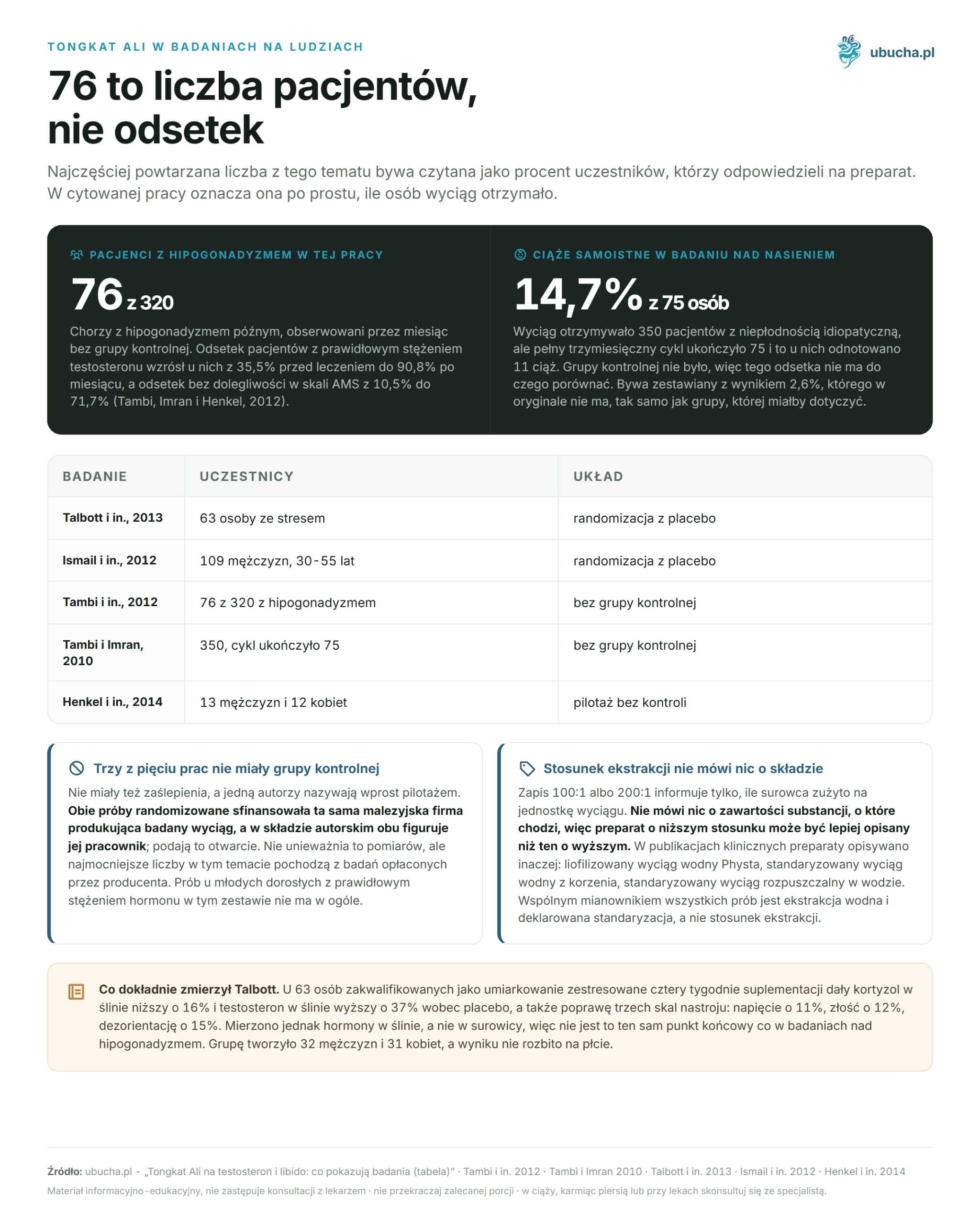
| Study | Participants | Preparation and duration | Measured outcome |
|---|---|---|---|
| Talbott et al., Journal of the International Society of Sports Nutrition 2013 | 63 individuals with moderate stress (32 men, 31 women) | Aqueous extract from the root, 4 weeks, randomized with placebo | Salivary cortisol decreased by 16%, testosterone increased by 37%; tension decreased by 11%, anger by 12%, confusion by 15% |
| Ismail et al., Evidence-Based Complementary and Alternative Medicine 2012 | 109 men aged 30-55 | Lyophilized aqueous extract Physta, 300 mg, 12 weeks, randomized with placebo | Better physical performance in SF-36 and erectile function in IIEF; libido increased by 14% in the 12th week; sperm motility 44.4%, semen volume 18.2%; fat mass loss with BMI from 25 |
| Tambi, Imran, and Henkel, Andrologia 2012 | 76 out of 320 patients with late-onset hypogonadism | Standardized aqueous extract, 200 mg, 1 month, no control group | The percentage of patients with normal testosterone increased from 35.5% to 90.8%, and without complaints on the AMS scale from 10.5% to 71.7% |
| Tambi and Imran, Asian Journal of Andrology 2010 | 350 patients with idiopathic infertility, 75 completed the full three-month cycle | 200 mg daily, observation up to 9 months, no control group | Improvement in all semen parameters; 11 spontaneous pregnancies, or 14.7% of those who completed the cycle |
| Henkel et al., Phytotherapy Research 2014 | 13 men and 12 women aged 57-72, physically active | 400 mg, 5 weeks, pilot without control group | Increase in total and free testosterone and handgrip strength in both sexes |
Two things need to be read together with the results. First, three out of five studies had no control group or blinding, and one is explicitly called a pilot. Second, both randomized trials were funded by the same Malaysian company producing the studied extract, and a company employee is listed as an author in both; they state this openly. This does not invalidate the measurements, but the reader has the right to know that the strongest numbers on this topic come from studies funded by the manufacturer.
After how long did changes appear in studies?
The shortest trial lasted four weeks, and that was enough to see a difference compared to placebo in the hormone profile in saliva and in mood scales (Talbott et al., 2013). A month of observation of patients with late-onset hypogonadism was enough for the percentage of those with normal testosterone in serum to increase from 35.5% to 90.8% (Tambi et al., Andrologia 2012).
Longer endpoints yield different results. In Ismail’s study, the difference in libido gradually increased and was only described for the twelfth week, and the improvement in semen parameters in Tambi’s 2010 study required a full three-month cycle, which the authors accepted as the unit of observation. A shorter observation would have nothing to measure.
If you are looking for a verifiable reference point, the most reliable reference point is a laboratory test performed before starting and after completing the observation: total testosterone, free testosterone, and sex hormone-binding globulin. These same parameters were used in the described works. Without them, you are only assessing well-being, which also changes in groups receiving placebo.
How to recognize a well-described extract?
The extraction ratio stated on the package as 100:1 or 200:1 only indicates how much raw material was used per unit of extract. It says nothing about the content of the substances in question. A preparation with a lower ratio may be better described than one with a higher ratio, as these are two different pieces of information.
In clinical publications, preparations were described differently. Ismail’s team provides a lyophilized aqueous extract called Physta, Talbott a standardized aqueous extract from the root, Tambi a standardized water-soluble extract. The common denominator of all trials is aqueous extraction and declared standardization, not the extraction ratio. A label that only states 200:1 has not yet said anything about the composition.
There are two practical conclusions. Look for information about the type of extract and what it is standardized for. Treat the lack of this information as a lack of information, not as a detail. Athletes subject to anti-doping control have an additional reason to be cautious: plant supplements can be contaminated with substances from the banned list, and independent batch testing programs, such as NSF Certified for Sport or Informed Sport, mitigate this risk.
What do studies say about semen and fertility?
The most frequently repeated number in this context is often cited incorrectly, so it is worth setting it straight. In a study published in the Asian Journal of Andrology in 2010, 350 patients with idiopathic infertility received 200 mg of extract daily, and semen analyses were repeated every three months for nine months. A full three-month cycle was completed by 75 patients, and significant improvements in all semen parameters and 11 spontaneous pregnancies, or 14.7% of that group, were recorded (Tambi and Imran, 2010).
In this study, there was no control group. Therefore, the percentage of 14.7% has nothing to compare to. It is sometimes compared with a supposed control group and a result of 2.6%, but in the original, there is neither such a group nor such a number. Without control, it is impossible to separate the effect of the preparation from the natural course and the passage of time, and idiopathic infertility, by definition, has no established cause.
The second source of data on semen is methodologically stronger. A randomized placebo trial involving 109 men describes after twelve weeks sperm motility of 44.4% and semen volume of 18.2% (Ismail et al., 2012). However, these were men aged 30-55 recruited for a study on libido and quality of life, not patients treated for infertility. A similar pattern of evidence has been described for another plant in the text about ashwagandha and semen parameters. In the case of confirmed fertility issues, an andrologist leads the treatment, and the supplement does not replace diagnostics.
Does tongkat ali lower cortisol?
In one randomized trial, yes. Talbott and his team administered a standardized aqueous extract to 63 individuals classified as moderately stressed, and after four weeks measured salivary cortisol lower by 16% and salivary testosterone higher by 37% compared to placebo. Three mood scales also improved: tension by 11%, anger by 12%, and confusion by 15%.
Two clarifications change the weight of this result. Hormones were measured in saliva, not serum, so this is not the same endpoint as in studies on hypogonadism. The group was mixed-gender, consisting of 32 men and 31 women, and the result was not broken down by gender in the summary. The aforementioned funding by the manufacturer pertains specifically to this work.
Comparing tongkat ali with other plants described as adaptogens should therefore be done cautiously: one trial on 63 individuals is too little to position it in a hierarchy. More about which plants have stronger backing in this area is discussed in the review of supplements for stress and cortisol, and separately we discuss tulsi, or holy basil.
Has tongkat ali been studied in women?
Women participated in two of the five described studies, but in none were they a separately analyzed group. In Talbott’s study, there were 31 out of 63 participants, in Henkel’s 12 out of 25. This is all we have, and it is significantly less than the data for men.
The only observation explicitly described as concerning women comes from a pilot study in seniors: the increase in free testosterone was attributed by the authors to a decrease in sex hormone-binding globulin. In the same study, testosterone and handgrip strength remained significantly lower in female participants than in male participants, which is an expected physiological difference, not an effect of the preparation.
The conclusion is cautious. There is no basis to claim that tongkat ali does not work in women, nor to claim that it works the same as in men. This has not been studied. There is no safety data during pregnancy and breastfeeding, so use is not recommended. In the case of hormonal contraception and hormone therapy, the decision is made by the attending physician, as the preparation affects the same axis.
Who should avoid tongkat ali?
The longest randomized safety observation lasted three months. The authors stated that all analyzed safety parameters and adverse events were comparable to placebo, and in the conclusions, they noted that such supplementation is well tolerated (Ismail et al., 2012). There are no longer observations in this set, so nothing is known about the safety of one-year use.
Groups for whom use is not recommended or requires a doctor’s decision arise directly from what has not been studied. Pregnancy and breastfeeding lack any data. Hormone-dependent cancers, testosterone therapy, and hormone treatment are situations where a preparation affecting the hormonal axis should not be added without the knowledge of the attending physician. Individuals taking medications regularly have the same reason to discuss with their doctor.
Descriptions circulating online of tongkat ali as an immune-boosting agent or harmful to the liver have no support in the studies described above, and therefore we do not repeat them here. This does not mean they are false. It means we did not find a source we could rely on. More about what in this age group has been studied and what has not is gathered in the text about supplements for men over 40.
Frequently Asked Questions
What were the doses used in studies on tongkat ali?
In the described studies, it ranged from 200 mg to 400 mg of extract daily, for a period of one month to twelve weeks. Tambi’s team used 200 mg, Ismail 300 mg of Physta extract, Henkel 400 mg. This is a description of research protocols, not a recommendation for the reader. The use of the supplement is decided by a doctor.
How quickly does tongkat ali raise testosterone?
The shortest randomized trial showed a difference compared to placebo after four weeks, but it measured testosterone in saliva. A month was also enough for patients with late-onset hypogonadism for the percentage of those with normal serum levels to increase from 35.5% to 90.8%. Endpoints related to semen required a full three months.
Does tongkat ali have proven safety?
In a three-month placebo trial involving 109 men, safety parameters did not differ from the control group. This is the longest such observation we found. Longer use has not been studied, and there is no data at all during pregnancy, breastfeeding, and with hormone-dependent cancers.
Did 76% of participants achieve normal testosterone?
No, and this is a common reading error. The number 76 refers in this study to the number of patients, not the percentage: 76 out of 320 patients with late-onset hypogonadism received the extract. The percentage of those with normal testosterone levels increased from 35.5% before treatment to 90.8% after one month.
Can tongkat ali be combined with ashwagandha?
We did not find a study that evaluated such a combination in humans. Both plants have their own separate clinical trials, but no one has checked a common protocol. Opinions about complementary mechanisms are reasoning, not measurement results. When taking medications, discuss any combination of preparations with your doctor.
Which extract is better, 100:1 or 200:1?
The extraction ratio itself does not determine this, as it speaks to the amount of raw material, not the content of ingredients. In clinical studies, preparations were described by the type of extract and standardization, most often as standardized aqueous extract. A label that only states the extraction ratio leaves the question of composition unanswered.
Does tongkat ali work in women?
This has not been studied separately. Women participated in two studies, totaling 43 individuals, but the results were not analyzed by gender. The only observation explicitly described for women concerns a decrease in sex hormone-binding globulin in a pilot study involving older women. Use during pregnancy and breastfeeding is not recommended.
Plant supplements described as adaptogens have been gathered in the category of adaptogens; tongkat ali is not currently included in it.
This article is for informational and educational purposes and does not constitute medical advice. Before starting supplementation, consult your doctor, especially if you are taking medications regularly, are pregnant or breastfeeding, or have chronic illnesses.
Author: Michał Waluk · Published: 2026-07-08 · Updated: 2026-08-16