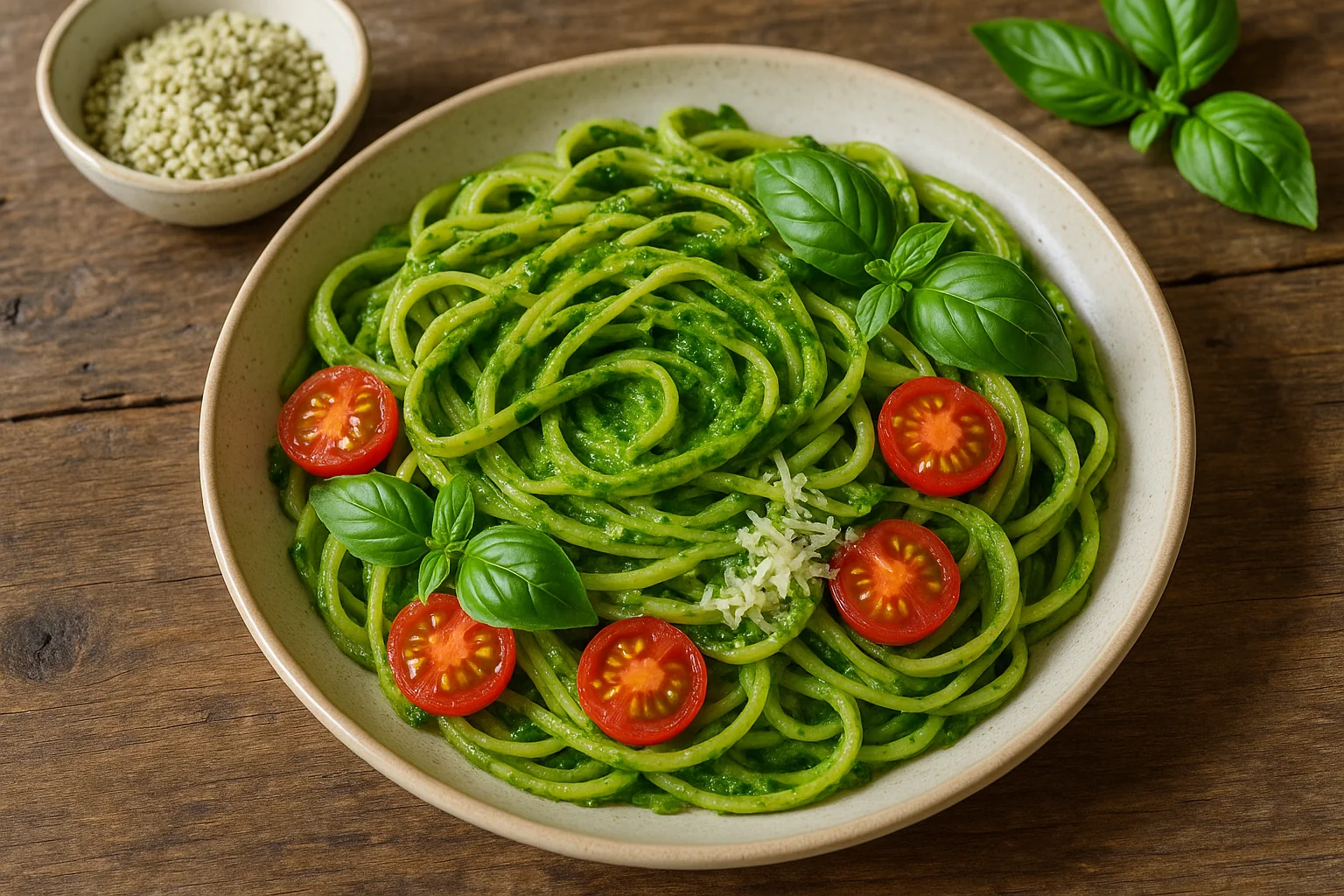

Pasta with Hemp Pesto and Cherry Tomatoes: Quick Dinner
Pesto made from hulled hemp seeds and hemp oil: a recipe for 15 minutes, nutritional values from studies, and what the work of House from 2010 really says about the seeds.
Hemp pesto is the simplest answer to the question of what to do with hemp seeds besides sprinkling them on salad. In a blender, they turn into a thick, green sauce with a nutty flavor, and it is made without cooking: the whole dish takes as long as cooking the pasta. Hulled seeds replace pine nuts practically one-to-one. It is also worth clarifying the numbers that circulate around hemp seeds, as some of them do not match the studies that are often cited. Below you will find a step-by-step recipe, shopping tips, four variations, and what research says about the nutritional value of seeds, which can be accessed without payment and without creating an account.
KEY INFORMATION
• Hulled hemp seeds contain an average of 35.9 percent protein and 46.7 percent fat, which is significantly more protein than whole seeds, which contain 24.0 percent (House et al., Journal of Agricultural and Food Chemistry, 2010).
• The same study notes that the limiting amino acid in all tested hemp seed products was lysine, so the term “complete protein” is an exaggeration.
• Hemp seed oil contains over 80 percent polyunsaturated fatty acids, and the omega-6 to omega-3 ratio usually falls within the range of 2:1 to 3:1 (Callaway, Euphytica, 2004).
• Pesto is blended with oil briefly and served without heating, and the finished product is stored in the fridge under a layer of oil.
What does adding hemp to pesto do?
It changes the proportions between protein and fat and lowers the cost. Traditional pesto alla genovese relies on pine nuts, which are expensive and seasonally capricious. Hulled hemp seeds have a nutty, slightly earthy flavor that plays a similar role in the sauce, and they contain a lot of protein: a study evaluating thirty samples of hemp seed products from Western Canada reports an average of 35.9 percent raw protein and 46.7 percent fat (House et al., Journal of Agricultural and Food Chemistry, 2010).
The second ingredient brings something different. Cold-pressed hemp seed oil contains over 80 percent polyunsaturated fatty acids, and the omega-6 to omega-3 ratio usually ranges from 2:1 to 3:1. The seeds themselves are also exceptionally rich in arginine, and the two main proteins in the seeds are edestin and albumin (Callaway, Euphytica, 2004). It is worth noting that this is a range, not a single value: stating only 3:1 as the “ratio of hemp oil” misses half of what the study actually measured.
Does this ratio matter for health? An analysis comparing the Western diet to that of our ancestors states that the omega-6 to omega-3 ratio has increased from about 1:1 to 20:1 or higher and that balancing it is important for health (Simopoulos, Nutrients, 2016). This is a thesis about the whole diet, not about one tablespoon of oil. There is a saying that the World Health Organization recommends a ratio below 4:1. A joint consultation by FAO and WHO does not formulate such a recommendation and states that there is no basis for indicating a specific ratio, so it is not included in this text.
How much protein do hemp seeds really have?
It depends on which form you buy, and the differences are significant. The work by House and colleagues measured three forms separately, and this comparison is the most practical information for someone standing in front of a shelf. Hulled seeds, which are used for pesto, have the highest fat content and a good amount of protein. The cake left after oil extraction has the most protein, but it does not work well in cold cooking. Whole seeds, with the shell, perform the worst in both categories.
We noticed while checking this recipe that one sentence about hemp seeds is almost literally repeated online: that they provide “complete plant protein” with all nine essential amino acids. We reached for the study that is usually cited with it. House and colleagues write something contrary: the limiting amino acid in all tested hemp seed products was lysine, and the PDCAAS for hulled seeds was 63-66 percent. Removing the shell improves this result, but does not complete it. Hemp seeds are a good source of plant protein, no worse than some grains and legumes. However, they are not complete protein in the sense of nutrition.
What ingredients do you need?
Proportions for two servings. Preparation takes five minutes, cooking the pasta ten, and both happen simultaneously. For several items on this list, the choice has a real impact on the outcome, so it is worth discussing them separately.
Buy hulled seeds, not whole ones. The shell is hard, does not break down completely in the blender, and leaves detectable bits in the sauce, while also lowering the fat content that builds the creaminess of the pesto. Use cold-pressed oil in a dark bottle, and keep it in the fridge after opening. Refined oil loses its green color and herbal aroma, which is what it is added to this sauce for. Basil is sweeter, while arugula brings a peppery bitterness that balances the richness of the seeds.
- 200 g pasta (spaghetti, penne, or fusilli)
- 60 g hulled hemp seeds, plus a tablespoon for sprinkling at the end
- 4 tablespoons of cold-pressed hemp seed oil, about 60 ml
- 30 g fresh basil or arugula, about two large handfuls
- 1 small clove of garlic
- 30 g grated parmesan or 3 tablespoons of nutritional yeast for a vegan version
- juice of half a lemon
- 150 g cherry tomatoes
- sea salt and freshly ground black pepper
- optional handful of baby spinach leaves for the pesto
How to prepare pasta with hemp pesto step by step?
The whole thing relies on the order: the pasta cooks by itself, the pesto is made in the meantime in the blender, and they are only combined at the end, off the heat. The oil is added last and blended briefly to preserve its color and aroma.
Safety: Do not heat hemp seed oil or pour it into boiling water. This oil is for cold use, and high temperatures spoil its flavor and fatty acid profile. Mix the sauce with drained pasta just before serving.
- Cook the pasta. Bring a large pot of salted water to a boil, add 200 g of pasta and cook al dente, usually 8-10 minutes according to package instructions. Before draining, reserve about 80 ml of the cooking water in a cup.
- Blend the pesto base. In a blender jug, add 60 g of hulled hemp seeds, a clove of garlic, parmesan, lemon juice, a pinch of salt, and freshly ground pepper. Blend for 20-30 seconds until a thick, grainy paste forms. Do not add oil or greens at this stage.
- Add basil and oil. Add fresh basil or arugula and pulse blend for 5 seconds. Then pour in the hemp oil and mix with a spoon or blend for another 15 seconds. A short contact with the blade preserves the color and aroma of the oil.
- Combine pesto with pasta. Drain the pasta and transfer it to a large bowl. Add the pesto and mix, adding two tablespoons of the reserved cooking water at a time. The starch from this water binds the oil into a creamy sauce that coats the pasta. Usually, three to four tablespoons are sufficient.
- Finish and serve. Divide the pasta onto plates, top with halved cherry tomatoes, and sprinkle with a tablespoon of hulled hemp seeds for crunch. You can drizzle the dish with a bit of fresh oil. Serve immediately, without reheating.
How to modify hemp pesto?
The base tolerates a lot of changes. Four directions work best, and the last point concerns the mistake that most often spoils this dish.
- With nuts: replace half of the hemp seeds with walnuts or cashews, meaning 30 g of seeds plus 30 g of nuts. Walnuts add deeper bitterness, while cashews add creaminess.
- Winter: instead of fresh basil, use 50 g of blanched kale for half a minute. The color comes out darker, the taste slightly bitter, and kale is available when basil costs a fortune.
- Spicy: add a quarter of a chili pepper or a teaspoon of harissa to the blender. For this version, sun-dried tomatoes in oil work better than cherry tomatoes.
- Gluten-free: use rice pasta, chickpea pasta, or buckwheat pasta. Buckwheat emphasizes the earthy tone of the hemp seeds more than wheat.
- What not to do: do not oversalt the pesto before combining it with the pasta. The cooking water and parmesan bring a lot of salt, and an oversalted sauce cannot be easily saved. Season at the end.
If you enjoy cold hemp oil, the same scheme works in several other dishes. We described it in pasta with zucchini and hemp oil and in buddha bowl with hemp dressing. A warm version, where the oil is added only to the plate, can be found in the recipe for tomato soup with hemp oil. Cherry tomatoes, by the way, have their own literature, collected in lycopene and its sources.
Frequently Asked Questions
Can hemp pesto be heated?
Do not heat it separately. Hemp seed oil is made up of over 80 percent polyunsaturated fatty acids (Callaway, 2004), which do not tolerate high temperatures well. Mix the pesto with hot, drained pasta just before serving: the heat of the pasta alone is sufficient.
What hemp seeds make the best pesto?
Hulled seeds, which are free of the hard shell. They provide a creamy texture without grittiness and have the highest fat content of all forms of the raw material, averaging 46.7 percent, with 35.9 percent protein (House et al., 2010). Whole seeds contain noticeably less of both, and leave detectable bits of shell in the blender.
What pasta goes well with hemp pesto?
The best are those with a large surface area where the sauce can cling: penne, fusilli, or rigatoni. For long pasta, spaghetti and linguine work well. In a gluten-free version, use rice pasta or chickpea pasta, while buckwheat will further emphasize the earthy tone of the hemp seeds.
Can hemp pesto be stored?
In the fridge, it lasts up to five days in an airtight jar, with a thin layer of oil poured on top to limit air contact. You can also freeze it in portions in an ice cube tray and store for up to three months. After thawing, the sauce loses some creaminess but is suitable for mixing with pasta.
Is pasta with hemp pesto vegan?
Just one swap is needed: instead of 30 g of parmesan, use 3 tablespoons of nutritional yeast. They provide a similar depth of umami and are often fortified with vitamin B12. Hemp seeds and hemp seed oil are 100 percent plant-based, so the rest of the recipe requires no changes.
Is food made from hemp seeds legal?
Yes, with THC content limits specified in milligrams per kilogram: 3.0 mg/kg for seeds and processed products, and 7.5 mg/kg for oil. The basis is Annex I, section 2.6 of Commission Regulation (EU) 2023/915, applicable since May 25, 2023. An older number 2022/1393, still repeated online, referred to a regulation that has already been repealed.
Are hemp seeds a complete protein?
Not in the strictest sense of the word. In a study of thirty samples of hemp seed products, the limiting amino acid was lysine, and the PDCAAS for hulled seeds was 63-66 percent (House et al., 2010). This result is no worse than some grains, nuts, and legumes, but it is not a complete protein.
This article is for informational and educational purposes and does not replace consultation with a doctor. If you are pregnant, breastfeeding, taking medications, or have chronic conditions, consult a specialist before using supplements or herbs.
Author: Michał Waluk · Published: 2026-06-22 · Updated: 2026-08-16