
CBD for Stress at Work: What Research Says and What We Don’t Know
There is no study on CBD and occupational stress. We check what has really been measured in anxiety trials and what has solid data on behaviors regarding stress at work.
Working at a computer involves notifications, interruptions, and a calendar without gaps. CBD is marketed today as a response to this state, usually in the form of a ready-made plan: this much in the morning, this much at noon, this much in the evening. We checked what such a plan is based on. It turned out that it is based on nothing. There is no randomized trial on the effect of CBD on occupational stress, and the existing data pertains to acute anxiety induced in a laboratory and individuals with psychiatric diagnoses. No one has tested amounts in the range of several milligrams, contained in a few drops of oil. Below we show what exactly has been measured, why these results cannot be translated into a workday, and what has solid data regarding occupational stress.
KEY INFORMATION
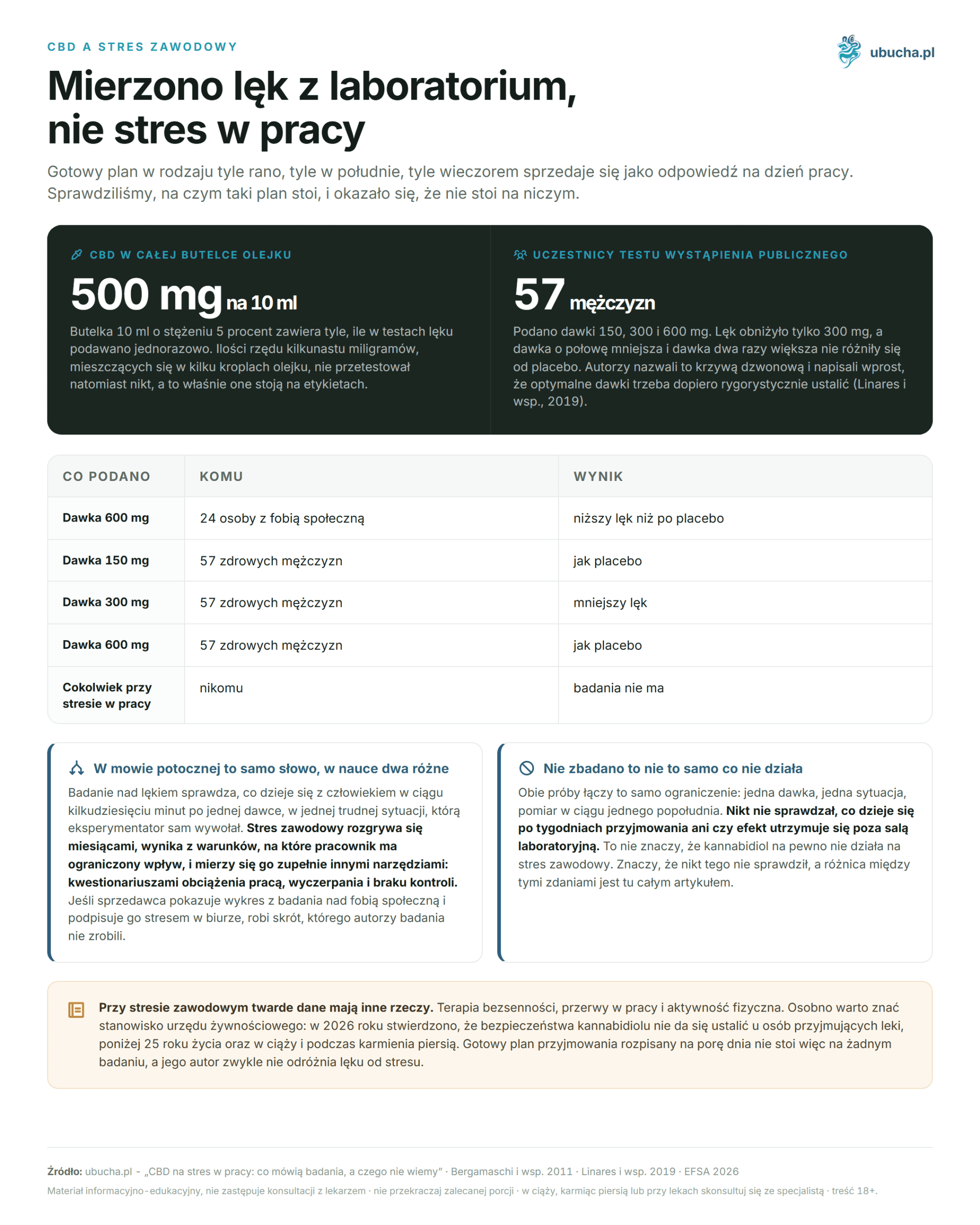
• Bergamaschi et al. (Neuropsychopharmacology, 2011) administered 600 mg of CBD at once to 24 individuals with social phobia before a simulated public speaking event; anxiety decreased compared to placebo.
• Linares et al. (2019) compared 150, 300, and 600 mg in healthy men. Only 300 mg worked.
• There is no study on CBD and stress in the workplace or on amounts from oil labels.
• EFSA in 2026 stated that the safety of CBD cannot be established in individuals taking medications, under 25 years of age, and during pregnancy and breastfeeding.
• For occupational stress, data supports insomnia therapy, breaks at work, and physical activity.
Does CBD reduce stress at work?
There is no study that has verified this. Clinical trials on CBD measured acute anxiety induced in a laboratory or symptoms in individuals with psychiatric diagnoses. None studied employees, task burdens, or indicators used in work psychology. Transferring those results to deadlines and notifications is a hypothesis, not a conclusion.
This difference is not a formality. Anxiety studies check what happens to a person within a few minutes after one dose, in one difficult situation that the experimenter has induced. Occupational stress unfolds over months, results from conditions that the employee has limited influence over, and is measured with completely different tools: work overload questionnaires, exhaustion, and lack of control.
CBD marketing blurs this boundary because the words “anxiety” and “stress” in everyday speech mean roughly the same thing. In science, they do not. If a seller shows a graph from a study on social phobia and labels it “stress in the office,” they are making a shortcut that the authors of the study did not make. This shortcut is repeated in almost every guide on CBD at work, including an earlier version of this article.
This does not mean that CBD definitely does not work for occupational stress. It means that no one has checked it, and the difference between “not studied” and “works” is the entire article here.
What exactly did studies on CBD and anxiety measure?
Two studies carry the most weight here. Bergamaschi et al. (Neuropsychopharmacology, 2011) administered 600 mg of CBD or placebo at once to 24 previously untreated individuals with social phobia, twelve people in each group, one and a half hours before a simulated public speaking event. In the CBD group, anxiety, discomfort, and cognitive impairment during the speech were lower than in the placebo group.
The second study complicates the picture. Linares et al. (Revista Brasileira de Psiquiatria, 2019) conducted the same test on 57 healthy men, but with three doses: 150, 300, and 600 mg. Only 300 mg reduced anxiety. The half-dose and the double dose did not differ from placebo. The authors called this a bell curve and stated directly that optimal doses need to be rigorously established.
Both trials share the same limitation: one dose, one situation, measurement within one afternoon. No one checked what happens after weeks of taking it or whether the effect persists outside the laboratory. More on this topic in the text CBD and Social Phobia.
How does occupational stress differ from laboratory anxiety?
Endpoints and biology. Anxiety in a public speaking test is a sudden spike in tension that subsides after a few minutes. Stress from working at a computer primarily involves interruptions and switching between tasks, spread throughout the day and repeated for years. These are two different phenomena, measured with different indicators.
This is even visible at the hormonal level. Becker et al. (Psychoneuroendocrinology, 2023) in a randomized experiment involving 186 individuals checked what simply interrupting work and multitasking does to the body. Salivary alpha-amylase, a marker of the sympathetic nervous system, increased. Cortisol, a marker of the hypothalamic-pituitary-adrenal axis, did not change in any of the studied conditions, nor did two immune markers.
This is important because the marketing narrative about CBD is based precisely on the cortisol axis. Meanwhile, the typical office stressor in this experiment did not affect it at all. This does not settle the matter, as one experiment on young volunteers does not capture the full physiology of work, but it shows how easily a mechanism described in another context can be attached to a problem it does not pertain to. Separately, we reviewed what really lowers cortisol.
The practical conclusion is simple. If the source of tension is interrupted work, then the first-choice intervention is changing the way of working, not a substance modulating the response to a single strong stimulus.
Does CBD improve concentration in healthy adults?
There is no data on this. Two trials that measured cognitive functions in adults without disorders did so to rule out harm, not to demonstrate benefit. In both, cognitive results did not differ from placebo, meaning CBD neither worsened nor improved them.
McCartney et al. (Journal of Psychopharmacology, 2022) in an alternating design administered to seventeen healthy volunteers, in four separate sessions, placebo and 15, 300, and 1500 mg of CBD, then tested driving on a simulator and cognitive performance. No dose impaired cognitive functions or caused a feeling of intoxication. Some comparisons with placebo were ambiguous because confidence intervals included both no difference and the threshold of significant harm.
Narayan et al. (Psychopharmacology, 2025) assigned thirty individuals with primary insomnia to two equal groups: for two weeks, one took 150 mg of CBD sublingually one hour before sleep, the other placebo. Attention, executive functions, working memory, and information processing the next day remained unchanged compared to placebo. Participants in the CBD group reported more often feelings of calmness and mental clarity, as well as dry mouth.
The statement “CBD sharpens the mind at work” therefore has no support in this data. It has a much more modest statement: under study conditions, CBD did not worsen cognitive results.
How much effect comes from the mere belief that one has taken CBD?
A lot. Spinella et al. (Psychopharmacology, 2021) invited 43 healthy individuals to two sessions. Each time they received hemp seed oil with no trace of CBD sublingually, but once they were told the preparation contained CBD, and once that it did not. They then underwent a standard acute stress test.
The mere belief changed perceived drowsiness and heart rate variability in a direction consistent with enhanced anticipatory stress regulation. There was no overall, systematic decrease in perceived stress and anxiety. But among those who strongly believed before the study that CBD had anxiolytic effects, reported anxiety was significantly lower precisely when they thought they had taken CBD.
This has direct implications for popular guides that instruct keeping a stress diary on a scale from 1 to 10 and assessing the difference after a month. Such a diary does not distinguish the action of the substance from the action of expectations, because the person keeping it knows what and when they took. The more you believe in the preparation, the less reliable your own notes are as evidence.
What dose of CBD for stress is supported by research?
No consumer dose. The trials described above on anxiety administered single doses ranging from 150 to 600 mg, the driving study reached 1500 mg, the insomnia study 150 mg at night, and the abuse potential study from 200 to 800 mg. Amounts in the range of several milligrams, or a few drops of oil, did not appear in any of these works.
It is worth seeing these numbers in the scale of the product. A 10 ml bottle of 5 percent oil contains a total of 500 mg. A 300 mg dose, the only one that worked in Linares, is more than half of such a bottle consumed in one go. Typical label recommendations, a few drops twice a day, are an order of magnitude lower.
On the other hand, there is a cautionary limit. The EFSA panel in a statement from 2026 (Update of the statement on safety of cannabidiol as a novel food) derived a provisional safe dose of 0.0275 mg per kilogram of body weight per day, or about 2 mg daily for a person weighing 70 kg, and noted that the safety of CBD cannot be established in individuals under 25 years of age, in pregnant and breastfeeding women, and in individuals taking medications.
Of course, one can assume that smaller amounts also do something. However, Linares’ result suggests caution: since 600 mg did not work, and 300 mg did, the relationship is not simple and cannot be intuitively extended downward. Therefore, in this text, you will not find a dosing scheme. There is nothing to build it on, and an invented scheme would look more credible than it deserves.
What has data regarding stress at work?
Three areas, all behavioral. The strongest numbers come from insomnia treatment, as sleep connects stress with functioning the next day. Next are breaks during the workday and physical activity. None of these interventions are spectacular, but each has been tested on employees and measured with their indicators.
Takano et al. (Sleep Medicine Reviews, 2023) gathered 21 studies with random assignment on cognitive-behavioral therapy for insomnia in working individuals. The severity of insomnia decreased significantly, and along with it, anxiety, depressive symptoms, and fatigue. The authors note that clinically significant change was provided by the therapist-led version, not the internet tool itself. Other ways to sleep without pills are described in a separate text.
| Intervention | What was measured | Result |
|---|---|---|
| Insomnia therapy for employees | 21 studies with random assignment | Significant improvement in sleep, less anxiety and fatigue |
| Short breaks at work | 22 trials from 19 publications, totaling 2335 individuals | Small improvement in vigor and fatigue, no change in performance |
| Physical activity | 10 longitudinal and interventional studies | Less exhaustion, only one high-quality study |
| CBD | No studies on occupational stress | Not established |
Breaks were described by Albulescu et al. (PLOS ONE, 2022): 22 independent trials from 19 publications, totaling 2335 individuals. The effect on vigor and fatigue was significant but small, and there was no effect on performance at all. The longer the break, the greater the improvement in task performance. Physical activity, on the other hand, reduced exhaustion in the review by Naczenski et al. (Journal of Occupational Health, 2017), although the authors considered only one of the ten collected studies to be of high quality.
Does the 20-20-20 rule have research support?
The numbers themselves do not have. The recommendation to look at an object 20 feet away for 20 seconds every 20 minutes was created as an easy-to-remember convention, not as a result of measurement. Two studies checked it and came to different conclusions, with the more methodologically robust one coming out against the rule.
Johnson and Rosenfield (Optometry and Vision Science, 2023) gave 30 individuals a forty-minute reading task from a tablet, four times, with twenty-second breaks every 5, 10, 20 minutes, or no breaks. Eye symptoms intensified in each of the four runs, and the break schedule did not affect either discomfort, reading speed, or accuracy of performance.
Talens-Estarelles et al. (Contact Lens and Anterior Eye, 2023) reminded 29 individuals about breaks using a program on their laptop for two weeks. Reported symptoms of dry eye and visual fatigue decreased, but no parameter of the eye surface and tear film improved, and the effect disappeared a week after stopping the reminders. The study compared the state before and after, without a separate control group.
Screen breaks make sense for the eyes and well-being, but the specific numbers in this rule are arbitrary. This also pertains to visual fatigue, not occupational stress, and mixing these two things is the same mistake as mixing anxiety with stress.
When does work stress require a doctor?
When it lasts for weeks, disrupts sleep, and begins to change daily functioning. A signal to visit is also growing indifference towards duties that you previously did not postpone, as well as physical symptoms without another explanation. Thoughts of giving up on life require immediate contact with a specialist, and in a threatening situation, the emergency number 112.
Insomnia lasting more than a month deserves separate attention, as it has first-choice treatment with proven effectiveness in employees, and it is not a supplement. Earlier versions of this article suggested that in the absence of effect, one should check the regularity of intake and the quality of the preparation. This reverses the order: with symptoms persisting for a month, the direction is diagnostics, not correction of supplementation.
It is also worth naming things as they are. WHO in the ICD-11 classification describes burnout as a phenomenon resulting from chronic work stress that has not been managed, and places it outside the disease chapter. Its three dimensions are energy depletion, distance from work, and a sense of decreased professional efficacy. None of these is removed by a preparation taken in the morning and evening, as the source lies in the organization of work.
Frequently Asked Questions
Does CBD help with stress at work?
There is no study that has verified this. Clinical trials measured acute anxiety induced in a laboratory or symptoms in individuals with psychiatric diagnoses. Occupational stress is a different phenomenon, described with different tools, and no one has yet checked whether CBD affects it.
How much CBD should I take for stress while working at a computer?
No one has established this. Linares et al. (2019) achieved an effect only at 300 mg at once, and there was none at 150 and 600 mg. The amounts on the labels of oils are an order of magnitude lower and have not been the subject of any such trial.
Does CBD improve concentration at work?
There is no data on this. McCartney et al. (2022) and Narayan et al. (2025) measured cognitive functions to rule out harm. The results did not differ from placebo in any direction.
Is CBD addictive?
In a controlled study Babalonis et al. (Drug and Alcohol Dependence, 2017) 31 regular marijuana smokers received 200, 400, and 800 mg of CBD orally. The preparation did not signal potential for abuse. This is one trial on a narrow group, so the topic is not closed.
Can you drive after taking CBD?
Cautiously. In the study McCartney et al. (2022) on a simulator, none of the doses impaired cognitive functions or caused intoxication, but some comparisons with placebo were ambiguous. Seventeen participants is too few to consider the matter resolved.
Will CBD help with burnout?
There is no study on CBD and burnout. WHO describes it as a professional phenomenon resulting from chronic work stress, not as a disease, and addresses it with changes in work organization and specialist help. For sleep problems, a proven path is insomnia therapy.
If you still want to try, start with a conversation with a doctor, and check products in the hemp oil category. We discuss evening use more broadly in the text CBD for Sleep.
This article is for informational and educational purposes and does not constitute medical advice. Before starting to use cannabis or CBD for therapeutic purposes, consult a doctor, especially if you are taking other medications, are pregnant, or breastfeeding.
Author: Michał Waluk · Published: 2026-06-22 · Updated: 2026-08-10