
Ashwagandha drops vs capsules - which form works faster? Guide 2026
Do drops or capsules of ashwagandha work faster? We check doses, clinical studies of KSM-66 and Sensoril, safety, and costs - a complete comparison.
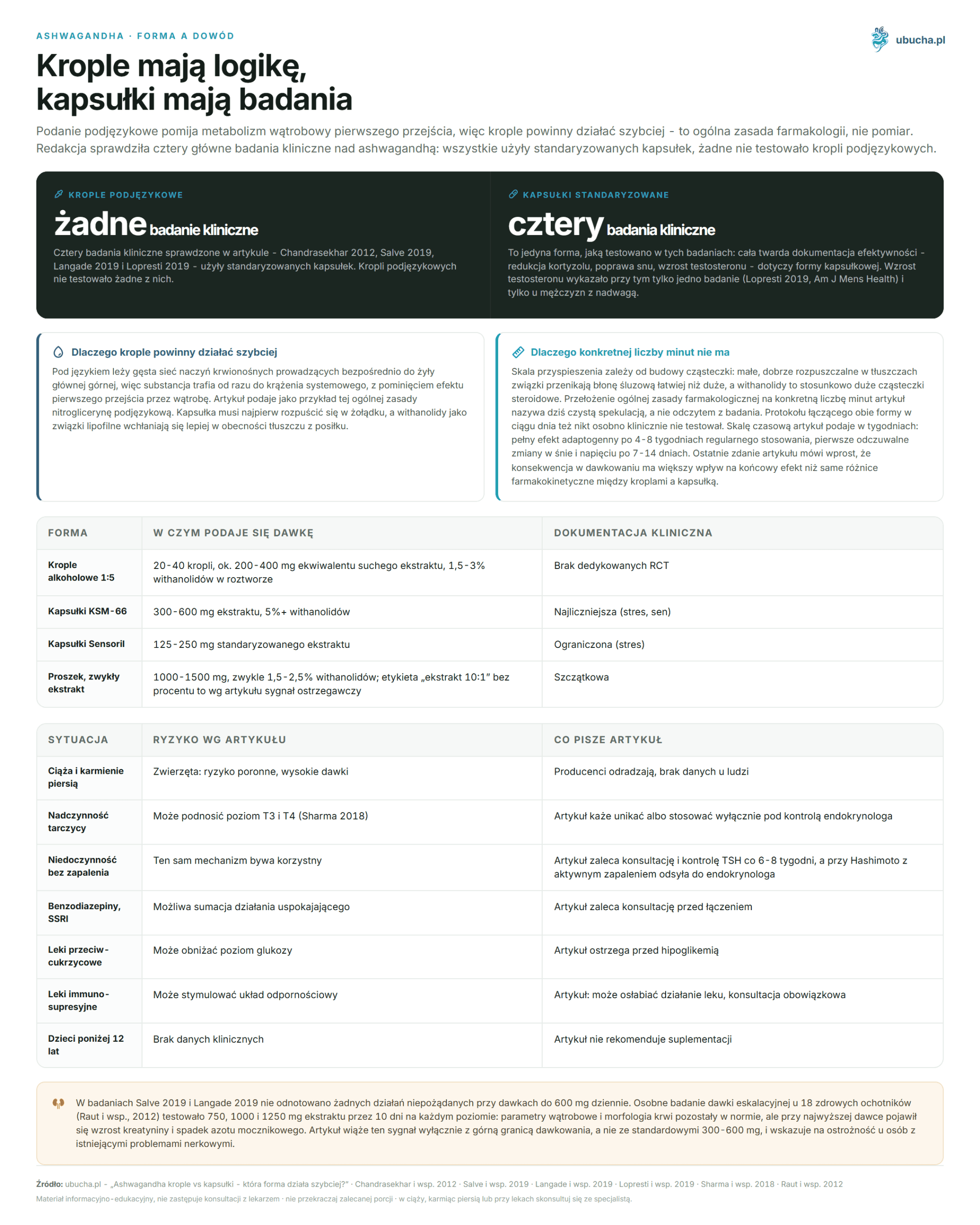
Ashwagandha can be purchased in the form of alcoholic drops, capsules with standardized extract, or powdered root, and each of these forms enters the bloodstream differently. Drops taken sublingually bypass the stomach and liver, so theoretically they work faster than a capsule, which must pass through the entire digestive tract - this is a general principle of pharmacology, also known from drugs like sublingual nitroglycerin. However, no one has published a study measuring the minutes between the dose and the effect separately for drops and capsules. In this guide, we show what actually results from clinical studies of KSM-66 and Sensoril: doses, cortisol reduction, sleep improvement, and typical side effects. At the end, you will find a comparison table of forms, approximate costs, and a list of common mistakes when purchasing.
KEY INFORMATION
- In the Chandrasekhar 2012 study (Indian J Psychol Med), 600 mg of KSM-66 daily reduced cortisol by 27.9% over 60 days, compared to 7.9% in the placebo group.
- Drops theoretically work faster because they bypass first-pass liver metabolism, but there is no clinical study that measured this directly for ashwagandha.
- The standard capsule dose is 300-600 mg of KSM-66 or 125-250 mg of Sensoril daily.
- In the Salve 2019 and Langade 2019 studies, no adverse effects were reported at doses up to 600 mg daily.
What is ashwagandha and what forms does it have?
Ashwagandha (Withania somnifera) is an adaptogenic plant from the nightshade family, used in Ayurveda for thousands of years. The Sanskrit name roughly means “smell of a horse” - it was traditionally associated with both the characteristic smell of fresh root and the vitality-boosting properties attributed to the plant. The active substances are withanolides - a group of about 40 plant steroids that are believed to have adaptogenic and anti-inflammatory effects (Mishra et al., Alternative Medicine Review, 2000). It is available on the market in three main forms: alcoholic drops, capsules with standardized extract, and powdered root.
Alcoholic drops 1:5 or 1:10 are an ethanolic extract from the root, designed for sublingual use. Capsules contain powdered extract with declared withanolide content - this is the only form that has been tested in the clinical studies described below. Powder from the root itself has the lowest concentration but the simplest composition and is sometimes added to drinks, such as traditional “Moon Milk” at night.
The choice of form is not trivial - it determines how quickly you will feel the effect after the first dose, how much withanolides you will actually take daily, and how much you will pay for a full, multi-week cycle. It is a practical decision that should be made consciously, rather than just based on what is readily available in the store.
Standardization varies significantly between products: KSM-66 declares a minimum of 5% withanolides, Sensoril 10%, and regular extracts without certification usually 1.5-2.5%. In practice, this means that 600 mg of KSM-66 provides about 30 mg of withanolides, 250 mg of Sensoril about 25 mg, and 1000 mg of uncertified powder only 10-25 mg. Therefore, the number of milligrams of ashwagandha on the label itself says little - it only counts when multiplied by the percentage of withanolides. More about adaptogens themselves and ashwagandha’s place among them can be found in our introduction to adaptogens for beginners.
Do ashwagandha drops work faster than capsules?
Probably yes, but there is no separate clinical study that measured this directly for ashwagandha. Drops held under the tongue are absorbed through the mucous membrane and bypass the liver, which generally shortens the time to effect - this is how sublingual nitroglycerin works, for example. A capsule must first dissolve in the stomach, and withanolides - being lipophilic compounds - are better absorbed in the presence of fat from food.
The mechanism is simple: under the tongue is a dense network of blood vessels leading directly to the superior vena cava, so the substance enters the systemic circulation immediately, bypassing the first-pass effect through the liver. A capsule must first dissolve in the stomach, and withanolides - as lipophilic compounds - are better absorbed in the presence of fat from food.
We checked four main clinical studies on ashwagandha (Chandrasekhar 2012, Salve 2019, Langade 2019, Lopresti 2019) and none of them tested sublingual drops - all used standardized capsules. This means that all the solid documentation of effectiveness (cortisol reduction, sleep improvement, testosterone increase) pertains to the capsule form. Drops have general pharmacological logic behind them, not their own clinical data - this is an important distinction if you care about documented effects, not just theoretically faster absorption.
It is worth adding that even with drugs where the sublingual difference is well measured (as with nitroglycerin), the scale of acceleration depends on the molecular structure - small, well-soluble lipophilic compounds penetrate the mucous membrane more easily than large ones. Withanolides are relatively large steroid molecules, so translating the general pharmacological principle into a specific number of minutes would today be pure speculation, not a reading from a study.
KSM-66 or Sensoril - which extract to choose?
KSM-66 contains a minimum of 5% withanolides exclusively from the root, Sensoril 10% from the root and leaves. KSM-66 has more studies on stress reduction and sleep (Chandrasekhar 2012, Langade 2019), Sensoril has less but still clinical documentation on cortisol (Auddy et al., Journal of the American Nutraceutical Association, 2008). The choice depends on whether the priority is the number of tested indications or a higher concentration of withanolides in a smaller capsule.
| Parameter | KSM-66 | Sensoril | Regular extract |
|---|---|---|---|
| Withanolide content | 5%+ | 10%+ | 1.5-2.5% |
| Source | exclusively root | root and leaves | usually root, without certification |
| Standard dose | 300-600 mg daily | 125-250 mg daily | 1000-1500 mg daily |
| Extraction method | the manufacturer declares ethanol-free extraction (so-called “milk-based”) | water-alcohol extraction | usually ethanol or water, without a standardized method |
| Best documented direction | stress, sleep | stress | limited clinical data |
| Approximate cost of a 60-day treatment | 80-150 PLN | 100-180 PLN | 30-60 PLN |
Regular extracts without standardization above 5% withanolides have limited clinical value because it is difficult to predict the actual dose of the active substance. The label “10:1 extract” without a declaration of the percentage of withanolides is a warning sign - this ratio only speaks about the proportion of raw material to extract, not about the phytochemical quality. If you care about clinical evidence and repeatability of effect, KSM-66 or Sensoril are a more sensible starting point than uncertified powder.
Both patented extracts have several dozen clinical studies combined - the KSM-66 manufacturer declares several dozen peer-reviewed publications, Sensoril less, but still tested multiple times. The exact, current number changes every quarter, so instead of providing one rigid number, it is worth checking the PubMed database for the latest publications before purchasing a larger quantity of the product. We have also separately outlined the dosing of both extracts in practice - see our comparison of KSM-66 and Sensoril if you are looking for an even more detailed comparison.
What do clinical studies show about ashwagandha?
Five RCT studies involving over 300 adults show a consistent picture: ashwagandha lowers cortisol, improves sleep quality, and in one study in men, it also raised testosterone and DHEA-S. The scale of the effect depends on the dose and duration of treatment - the longer and the higher the dose, the more pronounced the change.
| Study | Participants | Dose and time | Result |
|---|---|---|---|
| Chandrasekhar 2012 | 64 adults with chronic stress | 600 mg KSM-66/day, 60 days | cortisol -27.9% (placebo -7.9%), PSS-10 -44%, DASS: -64 to -77% in individual subscales |
| Salve 2019 | 60 adults, 58 completed | 250 or 600 mg KSM-66/day, 8 weeks | cortisol -16.5% (250 mg) / -32.6% (600 mg), improvement in sleep quality, zero adverse effects |
| Langade 2019 | 60 people with insomnia, 58 completed | 600 mg KSM-66/day, 10 weeks | PSQI improved by 30%, zero adverse effects |
| Lopresti 2019 (Medicine) | 60 adults with high perceived stress | 240 mg standardized extract/day, 60 days | significant decrease in anxiety on the HAM-A scale, decrease in cortisol and DHEA-S |
| Lopresti 2019 (Am J Mens Health) | 57 overweight men aged 40-70, 43 completed | 21 mg withanolide glycosides/day, 16 weeks | testosterone +14.7%, DHEA-S +18%, cortisol with no significant difference compared to placebo |
These are data from randomized controlled trials, which are the highest category of evidence in the hierarchy of evidence-based medicine - they should not be confused with consumer surveys or user opinions. Note that only one of the five studies (Lopresti, Am J Mens Health) showed a significant increase in testosterone, and only in overweight men - this is not a universal effect for every user.
Interestingly, there is a contrast between the two Lopresti studies from the same year: in the first (Medicine, 60 adults of both sexes), cortisol significantly decreased, while in the second (Am J Mens Health, 57 overweight men), the difference in cortisol turned out to be insignificant, even though testosterone and DHEA-S changed significantly. This shows that the result depends not only on the dose but also on who is being studied and for how long - the 8-week protocol from the first study and the 16-week protocol from the second essentially measured different physiological mechanisms.
How to dose ashwagandha - when and how much to take?
The standard clinical dose is 300-600 mg of KSM-66 daily in two portions, 125-250 mg of Sensoril daily, or 20-40 drops of 1:5 alcoholic drops daily. The full adaptogenic effect appears after 4-8 weeks of regular use, with the first noticeable changes in sleep and tension after 7-14 days.
| Period | Dose | What to pay attention to |
|---|---|---|
| Week 1-2 | 300 mg KSM-66 in the morning or 15 drops 1:5 sublingually | body’s reaction, sleep quality, tension level |
| Week 3-4 | 600 mg daily (300 mg in the morning + 300 mg in the evening) or 30 drops | whether the effect intensifies, dose tolerance |
| Week 5-8 | maintained dose | stress, sleep, concentration - then a break of 1-2 weeks |
Timing of the dose has practical significance, even if it does not change the mechanism of action. A morning dose works well when the goal is stable energy levels and stress resistance during the day, while an evening dose is prioritized for sleep. In the Langade 2019 study, the 600 mg dose was intentionally concentrated an hour before sleep, which corresponds to the practice also used with other sleep-supporting agents. If you start with drops, they are easier to dose flexibly throughout the day than a capsule with a fixed content.
Well-documented synergies include magnesium (preferably chelated with vitamin B6), L-theanine, lemon balm, and vitamin D3 - none of these combinations have described negative interactions in the clinical literature. Avoid combining with stimulating adaptogens (rhodiola, ginseng, cordyceps) in the evening, as they may disrupt sleep, and consult with a doctor about combining with benzodiazepines and SSRIs. If you are also interested in combining ashwagandha with CBD oils, we have described this separately in our guide on combining ashwagandha with CBD.
How much does ashwagandha cost and what is the most cost-effective option?
The approximate cost of a 60-day treatment in Poland ranges from 30-180 PLN, depending on the form and standardization: 1:5 drops usually cost 60-120 PLN, KSM-66 80-150 PLN, Sensoril 100-180 PLN, and uncertified extract 30-60 PLN. The price difference does not always reflect the difference in effectiveness, as the dose of withanolides matters, not just the price of the package.
| Parameter | 1:5 Drops | KSM-66 | Sensoril | Regular extract |
|---|---|---|---|---|
| Absorption time | shorter (bypasses the liver) | longer (through the digestive tract) | longer | longer |
| Withanolide content | 1.5-3% in solution | 5%+ | 10%+ | 1.5-2.5% |
| Standard dose | 20-40 drops | 300-600 mg | 125-250 mg | 500-1500 mg |
| Approximate cost for 60 days | 60-120 PLN | 80-150 PLN | 100-180 PLN | 30-60 PLN |
| Clinical documentation | no dedicated RCTs | most numerous (stress, sleep) | limited (stress) | minimal |
If you have to take more capsules of uncertified extract to match the dose of withanolides from KSM-66, the cost per milligram of active substance quickly equalizes. A reasonable compromise is KSM-66 or Sensoril for the first, evaluated treatment, and only then possibly switching to a cheaper equivalent if the effect is maintained.
Prices in Poland change from season to season and depend on the store, package size, and current promotions, so treat the above ranges as a reference point, not a rigid price list. Before comparing two offers, check not only the final price but also the number of servings in the package and the actual dose of withanolides per serving - only this allows you to calculate the cost per day of treatment in a comparable way between products from different manufacturers.
Is ashwagandha safe and what are its contraindications?
For the most part, yes: in the Salve 2019 and Langade 2019 studies (over 100 participants combined, doses up to 600 mg daily), no adverse effects were reported, and in the Chandrasekhar 2012 study, the number of mild events in the ashwagandha group was comparable to placebo. However, caution is needed with thyroid diseases, pregnancy, and certain prescription medications.
| Situation | Risk | Recommendation |
|---|---|---|
| Pregnancy and breastfeeding | animal studies suggest a risk of miscarriage at high doses | manufacturers advise against, no clinical data in humans |
| Hyperthyroidism | ashwagandha may raise T3 and T4 levels (Sharma et al., 2018) | avoid or use only under the supervision of an endocrinologist |
| Hypothyroidism without inflammation | the same mechanism may be beneficial | consult with a doctor, monitor TSH every 6-8 weeks |
| Benzodiazepines, SSRIs | possible summation of sedative effects | medical consultation before combining |
| Antidiabetic drugs | ashwagandha may lower glucose levels | risk of hypoglycemia, consult with a doctor |
| Immunosuppressive drugs | ashwagandha may stimulate the immune system | may weaken the drug’s effect, mandatory consultation |
| Children under 12 years | no clinical data | supplementation not recommended |
In the Sharma et al. (2018) study, eight weeks of supplementation with 600 mg of ashwagandha daily significantly improved TSH, T3, and T4 levels in patients with subclinical hypothyroidism - this is good news for this group, but a bad signal for those with hyperthyroidism, where the same mechanism may worsen symptoms. If you have Hashimoto’s with active inflammation, consult supplementation with an endocrinologist before starting.
A separate dose escalation study (Raut et al., 2012) in 18 healthy volunteers tested 750, 1000, and 1250 mg of extract for 10 days at each level. All participants except one tolerated each dose well, and liver parameters and blood morphology remained normal. However, at the highest dose, an increase in creatinine and a decrease in blood urea nitrogen were observed, suggesting caution in individuals with existing kidney problems - this is one of the few safety signals that pertains only to the upper limit of dosing, not the standard 300-600 mg.
What mistakes do buyers make when purchasing ashwagandha?
The most common mistake is buying a product without checking the percentage of withanolides on the label. The mere label “ashwagandha 1000 mg” says little about the dose of the active substance - without standardization, it may contain anywhere from a few to several dozen milligrams of withanolides (NIH Office of Dietary Supplements, 2024).
| Error | Why is it a problem | What to do |
|---|---|---|
| Lack of standardization of withanolides | “1000 mg of ashwagandha” may mean 5 mg or 50 mg of withanolides | look for declarations of “5%+ withanolides” or KSM-66/Sensoril certification |
| Ignoring the difference between root vs leaves | Sensoril (root and leaves) has a different profile of withanolides than KSM-66 (root only) | choose consciously, not just by price |
| Too short treatment | in the cited studies, effects appeared after 8-10 weeks, not after 2 | plan a minimum of 60 days before assessing effectiveness |
| Taking on an empty stomach | withanolides are lipophilic, absorption on an empty stomach is weaker | take capsules with a meal containing fat |
Another red flag is the label “10:1 extract” without the percentage of withanolides or the term “pure ashwagandha” without any standardization - such formulations say nothing about the real content of the active substance and may indicate a product of low clinical value regardless of the number of milligrams on the label. It is also worth checking the country of origin of the raw material (India is the standard for the root of Withania somnifera) and the expiration date - withanolides degrade over time, so the freshness of the batch translates into the actual effectiveness of the product.
Drops or capsules - which form is right for you?
The choice of form depends on the purpose of supplementation: drops are suitable for the need for quick, immediate calming, while KSM-66 or Sensoril capsules are for systematic work on chronic stress and sleep, where a documented, repeatable dose matters.
| Goal | Recommended form | Dose | Based on |
|---|---|---|---|
| Quick, immediate calming | 1:5 drops sublingually | 15-20 drops | general pharmacology of sublingual administration |
| Reduction of chronic stress | KSM-66 capsules | 600 mg/day, 60-90 days | Chandrasekhar 2012, Salve 2019 |
| Insomnia | KSM-66 capsules in the evening | 600 mg an hour before sleep | Langade 2019 |
| Testosterone and energy in overweight men | standardized extract (Shoden) | 21 mg glycosides/day, 16 weeks | Lopresti 2019 (Am J Mens Health) |
| Budget, occasional support | powder or regular extract | 1000-1500 mg/day | no dedicated RCTs, lower certainty of effect |
A practical hybrid protocol - drops in the morning for quick feeling, a capsule in the evening for longer action - is used by some advanced users, although it has not been separately tested clinically. If the topic of insomnia interests you more broadly, independently of ashwagandha itself, see our guide on ashwagandha for sleep and stress with a full list of combinations.
Regardless of the chosen form, it is worth assessing the effect after a closed testing period, not after a single dose. Keeping a simple journal - sleep quality, tension level, any adverse effects - allows for an objective comparison of form and dose, rather than relying solely on subjective impressions from the first days.
Summary: which ashwagandha works fastest?
Ashwagandha drops should theoretically work faster than capsules, as sublingual administration bypasses first-pass liver metabolism - this is a well-established principle of pharmacology, but there is no clinical study that measured this effect specifically for ashwagandha. KSM-66 and Sensoril capsules, however, have all the documented effectiveness: cortisol reduction, sleep improvement, and, in one study, testosterone increase in overweight men.
For quick, immediate calming: 1:5 alcoholic drops, 15-20 drops sublingually. For systematic reduction of stress and improvement of sleep: KSM-66 capsules 600 mg daily for 60-90 days. For men with low testosterone and overweight: standardized extract Shoden for 16 weeks. For the most budget-friendly entry: powder or regular extract 1000-1500 mg daily, with awareness of lower certainty of effect.
Safety: in clinical studies, doses up to 600 mg daily were well tolerated, and two of the four studies reported no adverse effects. Contraindications include pregnancy, breastfeeding, hyperthyroidism, and some medications - in such situations, medical consultation is essential before starting supplementation. Ashwagandha is an adaptogen, not a sleeping pill: the full effect requires weeks of regular use, not a single dose.
If after reading this comparison you are still unsure between forms, start with the one that you will find easier to use regularly for at least two months - consistency in dosing has a greater impact on the final effect than the pharmacokinetic differences between drops and capsules.
Frequently asked questions
Do ashwagandha drops work faster than capsules?
Probably yes, because sublingual administration bypasses first-pass liver metabolism - this is a general principle of pharmacology, also visible with other substances. However, there is no clinical study that measured this directly for ashwagandha: the four main RCTs (Chandrasekhar 2012, Salve 2019, Langade 2019, Lopresti 2019) tested only capsules, not drops.
How many drops of ashwagandha should I take daily?
The standard dose of 1:5 drops is 20-40 drops daily, divided into two portions, which corresponds approximately to 200-400 mg of dry extract equivalent. In comparison, in the Chandrasekhar 2012 study, the effective dose of KSM-66 capsules was 300 mg twice daily and reduced cortisol by 27.9% over 60 days.
What is the difference between KSM-66 extract and Sensoril?
KSM-66 contains a minimum of 5% withanolides exclusively from the root, Sensoril 10% from the root and leaves. KSM-66 has more clinical studies on stress and sleep (Chandrasekhar 2012, Langade 2019), Sensoril has less documentation on cortisol (Auddy et al., 2008). Dosage also differs: KSM-66 300-600 mg daily, Sensoril 125-250 mg daily.
How long does it take to see the effects of ashwagandha?
The first noticeable changes in sleep and tension appear after 7-14 days of regular use. Full cortisol reduction requires a longer treatment: in the Chandrasekhar 2012 study, a decrease of 27.9% was measured only after 60 days of supplementation with 600 mg of KSM-66 daily (Indian J Psychol Med, 2012).
What is a safe dose of ashwagandha?
In clinical studies, safe doses of standardized extract up to 600 mg daily for 8-12 weeks have been found. A separate dose escalation study (Raut et al., 2012) showed good tolerance even up to 1250 mg daily for 10 days, although at the highest dose a slight increase in creatinine was noted, suggesting caution in kidney issues.
Does ashwagandha have side effects?
In the Salve 2019 and Langade 2019 studies, no adverse effects were reported at doses up to 600 mg daily. In the Chandrasekhar 2012 study, events such as runny nose, constipation, or drowsiness occurred in similar numbers to the placebo group and were mild. Contraindications include pregnancy, breastfeeding, hyperthyroidism, and immunosuppressive drugs.
Can ashwagandha replace antidepressants?
No. Ashwagandha is an adaptogen supporting the hypothalamic-pituitary-adrenal axis, not a registered antidepressant. In the Lopresti 2019 study (Medicine), a 240 mg daily extract reduced anxiety and cortisol levels, but did not replace clinical depression therapy. Do not discontinue antidepressants without consulting a psychiatrist.
Alcoholic or glycerin ashwagandha drops?
Alcoholic drops (40-60% ethanol) extract withanolides better and have a longer shelf life, usually around 36 months. Glycerin drops are alcohol-free, gentler on the mucous membranes, and suitable for those avoiding alcohol, but dissolve withanolides less effectively. For the highest sublingual bioavailability, alcoholic drops in a ratio of 1:5 or 1:10 are more often chosen.
If none of the above situations apply to your topic, check our full offer of adaptogens - you will find ashwagandha in various forms and concentrations.
Sources
- Chandrasekhar K, Kapoor J, Anishetty S. A prospective, randomized double-blind, placebo-controlled study of safety and efficacy of a high-concentration full-spectrum extract of ashwagandha root in reducing stress and anxiety in adults. Indian Journal of Psychological Medicine, 2012. PubMed
- Salve J, Pate S, Debnath K, Langade D. Adaptogenic and Anxiolytic Effects of Ashwagandha Root Extract in Healthy Adults. Cureus, 2019. PubMed
- Langade D, Kanchi S, Salve J, Debnath K, Ambegaokar D. Efficacy and Safety of Ashwagandha Root Extract in Insomnia and Anxiety. Cureus, 2019. PubMed
- Lopresti AL, Smith SJ, Malvi H, Kodgule R. An investigation into the stress-relieving and pharmacological actions of an ashwagandha extract. Medicine (Baltimore), 2019. PubMed
- Lopresti AL, Drummond PD, Smith SJ. A Randomized, Double-Blind, Placebo-Controlled, Crossover Study Examining the Hormonal and Vitality Effects of Ashwagandha in Aging, Overweight Males. American Journal of Men’s Health, 2019. PubMed
- Mishra LC, Singh BB, Dagenais S. Scientific basis for the therapeutic use of Withania somnifera (ashwagandha): a review. Alternative Medicine Review, 2000. PubMed
- Sharma AK, Basu I, Singh S. Efficacy and Safety of Ashwagandha Root Extract in Subclinical Hypothyroid Patients. Journal of Alternative and Complementary Medicine, 2018. PubMed
- Raut AA, Rege NN, Tadvi FM, et al. Exploratory study to evaluate tolerability, safety, and activity of Ashwagandha (Withania somnifera) in healthy volunteers. Journal of Ayurveda and Integrative Medicine, 2012. PubMed
- Auddy B, Hazra J, Mitra A, Abedon B, Ghosal S. A Standardized Withania Somnifera Extract Significantly Reduces Stress-Related Parameters in Chronically Stressed Humans. Journal of the American Nutraceutical Association, 2008 (not indexed in Europe PMC, no available PMID identifier).
- NIH Office of Dietary Supplements. Ashwagandha - Health Professional Fact Sheet, 2024. ODS NIH
This article is for informational and educational purposes and does not constitute medical advice. Before starting ashwagandha supplementation, consult with a doctor, especially if you are taking medications regularly, are pregnant, breastfeeding, have an autoimmune thyroid disease, or are taking immunosuppressive drugs. Supplements do not replace a balanced diet and a healthy lifestyle.
Author: Michał Waluk · Published: 2026-05-11 · Updated: 2026-08-10