
Ashwagandha for Sleep and Stress - Dosage, Effects, and What to Combine It With (2026)
Ashwagandha for sleep and stress: how much to take daily, at what time, what the Chandrasekhar 2012 and Cheah 2021 studies really showed, and what not to mix it with.
Ashwagandha (Withania somnifera), known in Polish as witania ospała, is one of the best-researched adaptogenic plants. In a randomized study by Chandrasekhar et al. from 2012, 64 individuals with chronic stress took 300 mg of root extract twice daily for 60 days, and serum cortisol levels decreased by 27.9% compared to 7.9% in the placebo group (Indian Journal of Psychological Medicine, 2012). This text explains how much ashwagandha to take, at what time, what to combine it with, and what not to mix it with. It also shows where the evidence is strong and where it ends with a few small trials. Each number can be verified under the provided identifier.
KEY INFORMATION
• The working dose is 300-600 mg of standardized root extract daily; dose-response analysis indicates this range as optimal for stress (Akhgarjand 2022, Phytotherapy Research).
• In the Chandrasekhar 2012 study, a dose of 600 mg daily reduced cortisol by 27.9% compared to 7.9% in the placebo group (Indian J Psychol Med).
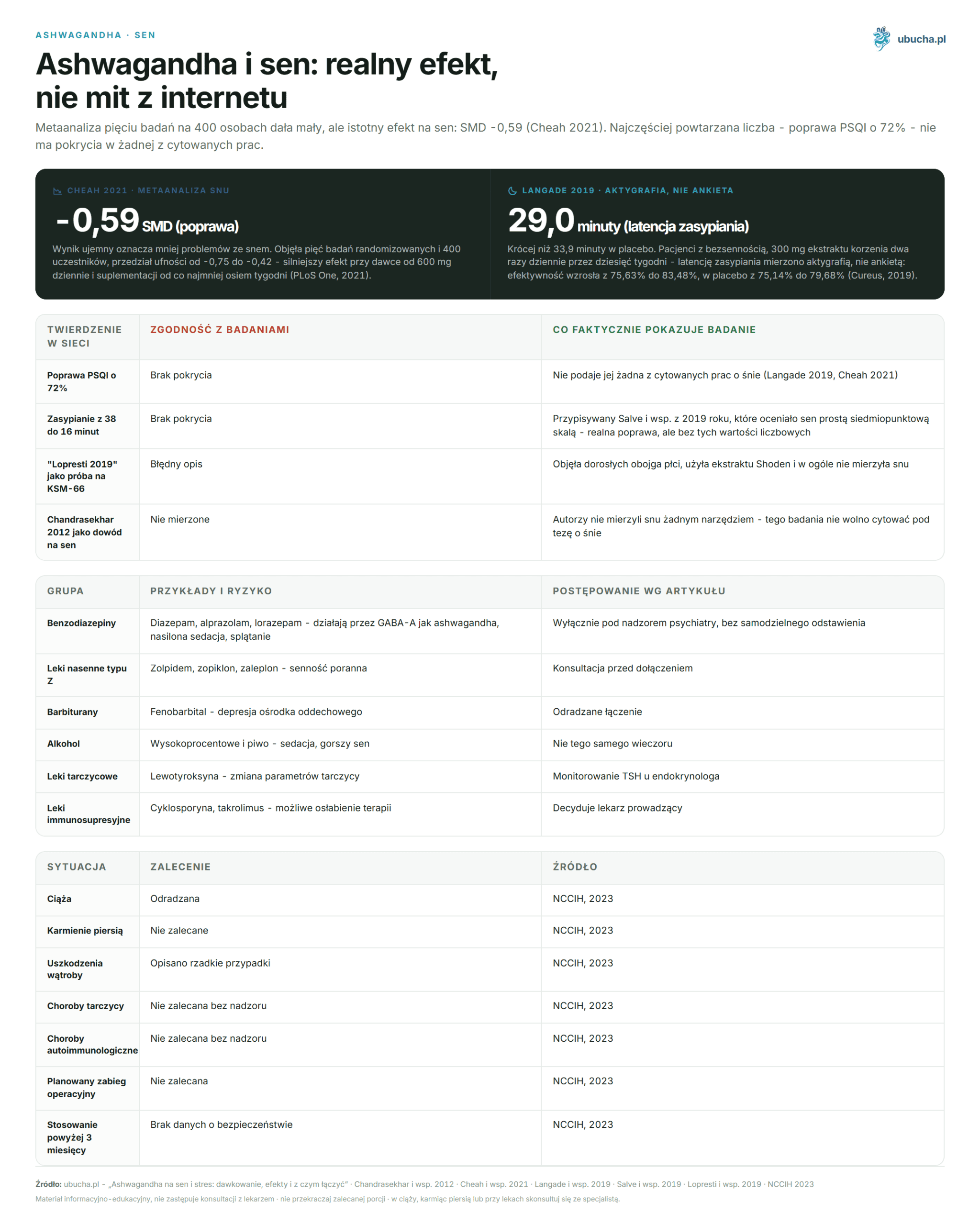
• A meta-analysis of five studies involving 400 people showed a small but significant effect on sleep: SMD -0.59 (Cheah 2021, PLoS One).
• Initial changes are visible after 2-4 weeks, and studies typically lasted 8-12 weeks.
• NCCIH advises against ashwagandha during pregnancy and breastfeeding, as well as in thyroid and autoimmune diseases (NCCIH, 2023).
How does ashwagandha affect sleep and stress?
Ashwagandha works through withanolides, which are steroid lactones present in the root and leaves. Their best-documented effect is the reduction of cortisol levels and stress scale scores. A systematic review by Pratte et al. from 2014 gathered five clinical studies, and in all five, the results for the group taking the plant were better than placebo (Journal of Alternative and Complementary Medicine, 2014).
The HPA axis is a hormonal cascade triggered by a stressor. The hypothalamus releases CRH, the pituitary responds with ACTH release, and the adrenal glands produce cortisol. In chronic stress, the circadian rhythm of this cascade becomes disrupted: cortisol does not drop in the evening as it should, sleep becomes shallow, and awakenings in the early morning become the norm. Studies on ashwagandha measure this parameter because it is quantifiable and repeatable across centers.
It is important to note what the evidence does not cover. The authors of the Pratte 2014 review stated directly that all included studies had unclear or high risk of systematic error, and the heterogeneity of methods and reporting made it impossible to conduct a meta-analysis. This is not a technical note. Marketing texts usually present this review as a meta-analysis, thus portraying it as stronger evidence than it actually is.
Separately, the GABAergic mechanism is described, which would explain the calming effect, as well as the influence on chaperone proteins and other mediators of the stress response. These data come from animal studies and cell models, not from clinical trials, so treat them as a hypothesis rather than a measured outcome in humans. In practice, what matters are the measurements of cortisol and psychometric scales.
What did the Chandrasekhar 2012 study really show?
Chandrasekhar et al. studied 64 individuals with a history of chronic stress in a randomized, double-blind, placebo-controlled design. The study group received a 300 mg capsule of root extract twice daily for 60 days. Serum cortisol decreased by 27.9% compared to 7.9% in the placebo group, and the Perceived Stress Scale score decreased by 44.0% compared to 5.5% (Indian Journal of Psychological Medicine, 2012).
The paper also states what raw material was used. In the materials and methods section, it states that it was KSM-66 extract from Ixoreal Biomed, standardized to a content of withanolides no less than 5%, measured by HPLC method. This is rare: most studies on ashwagandha describe the raw material in general terms, so it is impossible to link the result to a specific specification.
Participants reported stress lasting at least six weeks. Adverse events were mild and occurred similarly in both groups, and no serious events were recorded. The authors did not measure sleep with any tool, so this study should not be cited to support the thesis of improved sleep quality, although this is often done in marketing materials.
| Parameter | Ashwagandha Group | Placebo Group | Significance |
|---|---|---|---|
| Serum Cortisol | -27.9% | -7.9% | p = 0.002 |
| Perceived Stress Scale | -44.0% | -5.5% | p < 0.0001 |
| DASS, anxiety subscale | -75.6% | +4.3% | p < 0.0001 |
| DASS, depression subscale | -77.0% | -5.2% | p < 0.0001 |
| GHQ-28, anxiety and insomnia subscale | -69.7% | -11.6% | p < 0.0001 |
The result replicates on a larger scale. A meta-analysis by Akhgarjand et al. from 2022 included 12 randomized studies and 1002 participants aged 25-48 years. For anxiety, the standardized mean difference was -1.55, for stress -1.75, and the dose-response analysis indicated a range of 300-600 mg daily as optimal for stress (Phytotherapy Research, 2022). However, the authors note two things: the heterogeneity between studies was very high, and the certainty of evidence was low.
Does ashwagandha actually improve sleep?
Yes, but the effect is moderate and is mainly seen in individuals with insomnia. A meta-analysis by Cheah et al. from 2021 included five randomized studies and 400 participants. The overall effect on sleep was -0.59 in standardized mean difference, with a confidence interval from -0.75 to -0.42 (PLoS One, 2021). The authors describe it as small but significant.
The same paper indicates when the effect is more pronounced. It was stronger in adults with diagnosed insomnia, at a dose of 600 mg daily and with supplementation lasting at least eight weeks. Wakefulness after sleep improved, as did anxiety levels, while no impact on overall quality of life was noted.
The most detailed data comes from a study by Langade et al. from 2019. Sixty patients with insomnia took 300 mg of root extract twice daily for ten weeks, and sleep was measured by actigraphy, not a questionnaire. Sleep efficiency increased from 75.63% to 83.48%, while in the placebo group it increased from 75.14% to 79.68%. Sleep onset latency after ten weeks was 29.0 minutes compared to 33.9 minutes in the placebo group (Cureus, 2019).
Be cautious with numbers circulating on the internet. The popular claim of a 72% improvement in PSQI and a reduction in sleep onset from 38 to 16 minutes has no backing in any of these studies. The study by Salve et al. from 2019, to which this result is sometimes attributed, involved stressed healthy adults, not individuals with insomnia, and assessed sleep using a simple seven-point scale. It showed a significant improvement in sleep quality compared to placebo, but without those numerical values (Cureus, 2019).
The question remains whether the plant changes anything for someone who sleeps well. Langade et al. checked this in 2021, dividing 80 participants into two equal groups: healthy and those suffering from insomnia. After eight weeks, sleep parameters improved in both, but more noticeably in those with insomnia. Sleep onset latency and sleep efficiency reacted the strongest (Journal of Ethnopharmacology, 2021). So if you sleep well, expect the difference to be more symbolic than noticeable.
How much ashwagandha should I take daily?
The working range is 300-600 mg of standardized root extract per day. This range emerged as optimal for stress in a dose-response analysis involving 12 studies (Akhgarjand 2022). The lower limit is effective for mild tension, while the upper limit is for chronic stress and sleep issues, where the Cheah 2021 meta-analysis indicates a threshold of 600 mg daily.
The distribution of the dose depends on the goal. For sleep, it is taken as a single dose in the evening, about an hour before bedtime. For daily stress, it is divided into two portions, morning and evening, as in the Chandrasekhar 2012 study, where the scheme was exactly this: two times 300 mg. For both issues at once, it makes sense to shift the larger portion to the evening.
For beginners, it is advisable to give two weeks for acclimatization. The first week at a level of 150-200 mg in the evening allows for assessing gastrointestinal tolerance, the second at 300 mg, and the target dose is introduced from the third week. This gradual introduction limits nausea, which is the most common reason for discontinuation in the first month.
| Goal | Daily Dose | Scheme | Time | Duration |
|---|---|---|---|---|
| Sleep Support | 300-600 mg | Single dose or 2×300 mg | Evening emphasis | From 8 weeks |
| Chronic Stress | 300-600 mg | Divided 2x daily | Morning and evening | 8-12 weeks |
| Stress with Insomnia | 600 mg | 200 mg in the morning, 400 mg in the evening | Evening emphasis | 10-12 weeks |
| Introductory Phase | 150-300 mg | Single dose | In the evening, with a meal | 1-2 weeks |
One study directly compared two doses. Salve et al. divided 60 stressed adults into three arms: 125 mg twice daily, 300 mg twice daily, and placebo, and conducted it for eight weeks. The stress scale score decreased with both doses, but at 600 mg daily, it was at a higher level of significance than at 250 mg. The same behavior was observed for serum cortisol (Cureus, 2019). This is the strongest evidence to aim for the upper half of the range with clear symptoms.
Above 600 mg daily, the benefit stops increasing proportionally to the dose, and studies rarely go below 240 mg. A dose of around 100 mg, popular in cheap multi-ingredient preparations, lies below the threshold tested in clinical trials, so the lack of effect at such an amount says nothing about the plant.
What is the difference between KSM-66 and Sensoril?
They differ in raw material, declared standardization, and, most commonly confused, the scale of measurement of that standardization. KSM-66 is an extract from the root itself, described in the Chandrasekhar 2012 study as standardized to no less than 5% withanolides measured by HPLC method. Sensoril is made from both root and leaf, and the manufacturer declares no less than 10% withanolide glycosides.
These are not two points on the same scale. Withanolides and withanolide glycosides are different designations, so the statement “Sensoril is twice as strong” does not arise from these numbers, but from their confusion. The specification of Sensoril additionally states no less than 32% oligosaccharides and no more than 0.5% free withanolides. All these values come from the manufacturer’s materials, not from published scientific work, and should be read as such.
The practical consequence is simple. If you want to replicate the protocol from the study, check which raw material that study used and stick to its dosage: 600 mg daily in Chandrasekhar and Salve, 240 mg of Shoden preparation in Lopresti. Comparing just the percentages between brands makes no sense until it is known what exactly was measured. We expand on this in a separate text about the differences between KSM-66 and Sensoril.
Preparations simply described as “ashwagandha 500 mg”, without stated standardization, can contain any amount of withanolides. The powdered root itself, without extraction, has significantly less than the extract, so the equivalent dose tested would mean several grams of powder daily. A label without a percentage and without a certificate of analysis does not allow you to estimate what you are taking.
When should I take ashwagandha - in the morning or evening?
The timing depends on what needs to improve. For sleep issues, one dose is taken in the evening, while for daily stress, it is divided into morning and evening. Both schemes are supported by studies: Chandrasekhar 2012 and Salve 2019 dosed twice daily, while Lopresti 2019 once daily for 60 days.
The evening single dose is the scheme closest to studies on insomnia. Langade 2019 administered the extract twice daily, but the effect measured by actigraphy pertained to the night, so shifting a larger portion to the evening is logical. An hour before bedtime is a reasonable starting point that can be adjusted after two weeks of observation.
Withanolides are lipophilic, so the presence of fat in the meal promotes absorption. A capsule taken with a meal containing oil, nuts, or avocado is less likely to cause nausea than the same dose on an empty stomach. This is the simplest modification for poor gastrointestinal tolerance.
- If you miss the morning dose: take it within a few hours, and if half a day has passed, return to the evening schedule.
- Do not double the dose to make up for a missed one, as the concentration builds over weeks, not within a day.
- Set a fixed time and link it to another daily ritual, such as dinner.
- If you experience daytime drowsiness, shift the entire dose to the evening instead of reducing it.
- Several days of breaks reverse the effect, and rebuilding it takes another 2-3 weeks.
Regularity determines the outcome more than the time itself. In studies, continuous dosing was assessed over 60-90 days, and this is a realistic horizon for evaluation. A week of use does not answer the question of whether the plant works for you.
What to combine ashwagandha with?
It is most often combined with CBD, magnesium, L-theanine, or reishi. The justification is mechanistic: stress and insomnia have several independent axes, and a single substance covers one or two. However, it must be stated clearly that there are practically no studies on these specific combinations in humans, so we rely on the profiles of the ingredients separately.
The combination with CBD utilizes two different entry points. Ashwagandha lowers cortisol and stress scale scores, which was measured in Chandrasekhar 2012. Cannabidiol acts through the endocannabinoid system and 5-HT1A receptors. We do not know of any study that has tested this combination together, so its description remains a hypothesis supported by data on both ingredients separately. We expand on this topic in the text about combining ashwagandha with CBD.
| Ingredient | Action Point | Typical Dose | Time | Evidence Status for Combination |
|---|---|---|---|---|
| CBD | Endocannabinoid system, 5-HT1A receptors | 10-25 mg | Evening | No studies on the combination |
| Magnesium | Inhibitory neurotransmission, muscle tension | 200-400 mg of elemental | Evening | No studies on the combination |
| L-theanine | Alpha wave activity in EEG | 100-200 mg | Morning or afternoon | No studies on the combination |
| Reishi | Traditional sleep use | 1-2 g of extract | Evening | No studies on the combination |
Magnesium and L-theanine have their own justifications independent of ashwagandha in the context of tension and sleep, so adding them to the evening protocol makes sense. Reishi requires one safety consideration: it may interact with anticoagulant medications, so in such therapy, the decision is up to the attending physician. The practical evening arrangement is described in the guide to the evening supplementation protocol.
What should not be combined with ashwagandha?
Without medical consultation, do not combine it with sedative medications, sleeping pills, or alcohol. NCCIH also advises against its use for individuals before a planned surgical procedure and for those with autoimmune diseases and thyroid conditions, and indicates possible interactions with thyroid hormone medications (NCCIH, 2023).
The reason for the group of sedative medications is pharmacological. Benzodiazepines, Z-drugs, and barbiturates act through the GABA-A receptor, and ashwagandha is attributed with activity in the same system. The risk is excessive sedation, confusion, and falls, especially in older adults. Never discontinue benzodiazepines on your own, as sudden withdrawal can trigger a seizure.
| Group | Examples | Risk | Management |
|---|---|---|---|
| Benzodiazepines | Diazepam, alprazolam, lorazepam | Increased sedation, confusion | Only under psychiatric supervision |
| Z-drugs | Zolpidem, zopiklon, zaleplon | Morning drowsiness, prolonged effect | Consult before adding |
| Barbiturates | Phenobarbital | Respiratory depression | Do not combine |
| Alcohol | Spirits and beer | Increased sedation, worse sleep structure | Not the same evening |
| Thyroid medications | Levothyroxine | Change in thyroid parameters | Monitor TSH with an endocrinologist |
| Immunosuppressive medications | Ciclosporin, tacrolimus | Possible weakening of therapy | Decided by the attending physician |
Additionally, blood pressure-lowering medications and antidiabetic medications require attention, as effects may sum. Caution is advised with antidepressants from the SSRI and SNRI groups, although reported events are rare. In each of these cases, ask your pharmacist or attending physician before adding another preparation.
Who should not use ashwagandha?
NCCIH clearly states: ashwagandha should be avoided during pregnancy and should not be used while breastfeeding. The same institution notes that although these are rare cases, a number of liver damage incidents associated with supplements containing this plant have been reported (NCCIH, 2023).
The range of studied safety is temporally limited. NCCIH states that the plant may be safe for short-term use, up to about three months, and there is a lack of data to assess long-term safety. The Cheah 2021 meta-analysis ends with a similar caveat: there is insufficient information on serious adverse events to assess long-term use.
The impact on the thyroid is documented and works both ways. In a study by Sharma et al. from 2018, 50 individuals with subclinical hypothyroidism took 600 mg of extract daily for eight weeks, and TSH, T3, and T4 values significantly improved compared to placebo (Journal of Alternative and Complementary Medicine, 2018). This can be beneficial in hypothyroidism, while the same effect is undesirable in hyperthyroidism.
| Situation | Recommendation | Source |
|---|---|---|
| Pregnancy | Avoid | NCCIH, 2023 |
| Breastfeeding | Do not use | NCCIH, 2023 |
| Thyroid diseases | Not recommended without supervision | NCCIH, 2023 |
| Autoimmune diseases | Not recommended without supervision | NCCIH, 2023 |
| Planned surgical procedure | Not recommended | NCCIH, 2023 |
| Use beyond 3 months | Lack of safety data | NCCIH, 2023 |
Ashwagandha also affects hormones other than cortisol, and this is an argument for supervision, not panic. In a study by Lopresti et al. from 2019, sixty adults took 240 mg of Shoden extract once daily for 60 days. Morning cortisol and dehydroepiandrosterone sulfate significantly decreased, while testosterone levels increased in men but not in women, with the change not reaching significance compared to placebo (Medicine, 2019). If you are undergoing hormonal treatment, it is worth mentioning this to your attending physician.
For children and adolescents under 18, data is lacking, so the decision is up to the pediatrician. For individuals over 65, it is reasonable to start at the lower dose threshold. If you plan to use it for longer than a few weeks, periodic liver function tests are a sensible precaution.
What mistakes most often ruin the effect?
The most common are four, and all boil down to deviating from the research protocol: too low a dose, too short a time, unspecified raw material, and irregularity. None of these say anything about the plant itself, only about how it is used.
A dose below the tested threshold is the number one problem. Clinical trials worked on 240-600 mg daily of standardized extract, so a multi-ingredient preparation with a hundred milligrams of unspecified powder does not replicate any of those conditions. The second problem is patience: studies lasted 8-12 weeks, and an assessment after seven days has no basis.
- A preparation without stated standardization of withanolides and without a certificate of analysis does not allow you to estimate the amount of active substances taken.
- An irregular time disrupts plasma concentration, and along with it, the effect on the HPA axis.
- An assessment after a week or two is premature, as initial changes were reported after 2-4 weeks.
- Alcohol in the evening negates some sleep benefits, regardless of the dose taken.
- Sleep hygiene remains a prerequisite: fixed times, darkness, no screens before sleep.
A separate trap is reading the label from the largest number. The label “1000 mg” on the front of the package usually describes the mass of the raw material, not the content of withanolides, so a preparation with a thousand milligrams of unspecified powder may carry less than a 300 mg standardized extract. Only two numbers together are comparable: the mass of the extract and the percentage of standardization, preferably confirmed by a certificate of analysis.
The last mistake is the most human. Ashwagandha is a supplement of moderate potency, as shown by the size of the effect in the Cheah 2021 meta-analysis. If coffee after four PM and screens until one AM remain unchanged, no dose will make up for that. The plant works as part of a protocol, not instead of it.
Summary: ashwagandha in practice
The evidence is strongest for stress and cortisol. A meta-analysis of 12 studies involving 1002 individuals confirms the effect on anxiety and stress and indicates 300-600 mg daily as the optimal range, with low certainty of evidence and high heterogeneity between studies (Akhgarjand 2022). For sleep, the effect is small but significant, and more pronounced in individuals with insomnia (Cheah 2021).
The practical protocol boils down to four decisions. Choose an extract with stated standardization and a certificate of analysis, set the dose at 300-600 mg daily, adjust the timing to the problem, and give it eight to twelve weeks. For sleep issues, stick to the upper half of the range with an evening emphasis.
Limits are as important as the dose. Ashwagandha is not used during pregnancy or breastfeeding, should not be combined with sedative medications without supervision, and in thyroid and autoimmune diseases, the decision is up to the doctor. Safety has been studied for up to about three months of use, and the long-term horizon remains unknown.
Finally, one note about reading sources. The three numbers that frequently appear in marketing materials have no backing in the studies to which they are attributed: a 72% improvement in PSQI, a reduction in sleep onset from 38 to 16 minutes, and the Lopresti 2019 study presented as a trial on sixty men taking KSM-66. The latter study involved sixty adults of both sexes, used Shoden extract, and did not measure sleep at all. When checking a supplement, reach for the abstract of the study, not its summary on the package.
Frequently Asked Questions
How much ashwagandha should I take daily for sleep and stress?
The working range is 300-600 mg of standardized root extract daily. A dose-response analysis involving 12 randomized studies indicated this range as optimal for stress (Akhgarjand, Phytotherapy Research, 2022). For sleep issues, a meta-analysis indicates a threshold of 600 mg daily.
When should I take ashwagandha - in the morning or evening?
For sleep issues, one dose is taken in the evening, about an hour before bedtime. For daily stress, it is divided into morning and evening doses, as in the Chandrasekhar 2012 study, where the scheme was two times 300 mg. Regularity is more important than the time itself.
How long does it take for ashwagandha to start working?
Initial changes were reported after 2-4 weeks, and clinical studies typically lasted 8-12 weeks. In the sleep meta-analysis, the effect was more pronounced with supplementation lasting at least eight weeks (Cheah, PLoS One, 2021). An assessment after one week of use has no basis.
Can ashwagandha be combined with CBD?
We do not know of any clinical study that has tested this combination, so the description is based on the profiles of both ingredients separately. Ashwagandha lowers cortisol and stress scale scores, while cannabidiol acts through the endocannabinoid system and 5-HT1A receptors. With prescription medications, leave the decision to your doctor or pharmacist.
Does ashwagandha have side effects?
The most common are gastrointestinal discomfort and daytime drowsiness when taken too early. NCCIH also notes rare cases of liver damage associated with supplements containing this plant (NCCIH, 2023). In the Chandrasekhar 2012 study, events were mild and similar to the placebo group.
Is ashwagandha safe for long-term use?
NCCIH states that the plant may be safe for short-term use, up to about three months, and there is a lack of data to assess longer periods (NCCIH, 2023). The Cheah 2021 meta-analysis reaches the same conclusion. For longer treatments, periodic liver function tests are reasonable.
What should not be combined with ashwagandha?
Without medical consultation, do not combine it with benzodiazepines, Z-drugs, barbiturates, or alcohol, due to the summation of sedation. NCCIH also advises against it before surgical procedures, in autoimmune diseases, and thyroid conditions, and indicates possible interactions with thyroid hormone medications (NCCIH, 2023).
What is the difference between KSM-66 and Sensoril?
KSM-66 is a root extract, described in the Chandrasekhar 2012 study as standardized to no less than 5% withanolides by HPLC method. Sensoril comes from both root and leaf, and the manufacturer declares no less than 10% withanolide glycosides. These are two different measurement scales, so percentages cannot be directly compared.
Standardized herbal extracts, including ashwagandha, valerian root extract, and reishi extract, can be found in the herbs and herbal extracts category in the u Bucha store; capsules and tablets with ashwagandha range from about 21 to 119 PLN according to the catalog status as of August 10, 2026.
This article is for informational and educational purposes and does not constitute medical advice. Before starting supplementation, consult your doctor, especially if you are taking medications regularly, are pregnant or breastfeeding, or have chronic illnesses.
Author: Michał Waluk · Published: 2026-05-11 · Updated: 2026-08-10