
HHC-O and HHC-P: semi-synthetic derivatives of HHC (guide)
HHC-O has been a controlled substance in Poland since 2023, and HHC-P was added to the list in 2025. Check how they differ and what research says about them.
HHC appeared on the European market in 2021 as a “legal substitute for THC,” and as more countries included it under control, manufacturers released further variants: HHC-O with an acetate group and HHC-P with an extended carbon chain. In Poland, this race has largely been decided. HHC-O was added to the list of controlled substances along with HHC in May 2023, and HHC-P joined in May 2025 as a new psychoactive substance. However, another problem remains, which the regulations do not address: practically nothing is known about the effects of both derivatives in humans, and the numbers circulating in product descriptions come from a rule that no publication recognizes. This article explains how both derivatives differ chemically and pharmacologically, what is actually known about them from research, and what regulations apply to them.
KEY INFORMATION
• HHC-O, or O-acetylhexahydrocannabinol acetate, has been a controlled substance in Poland since May 5, 2023 (Dz.U. 2023 poz. 744).
• HHC-P, or hexahydrocannabiforol, was added to the list of new psychoactive substances on May 22, 2025 (Dz.U. 2025 poz. 598).
• In vitro studies indicate that HHC acetates do not stimulate the CB1 receptor and act as prodrugs (Persson et al., 2025).
• There are no studies on both compounds in humans, and the popular “rule” of thirtyfold potency increase has no source in the literature.
What is HHC and where did its derivatives come from?
HHC, or hexahydrocannabinol, is a hydrogenated derivative of tetrahydrocannabinol. It is produced from cannabidiol extract from industrial hemp: the raw material is first cyclized into a mixture of delta-8-THC and delta-9-THC, and then subjected to catalytic hydrogenation, resulting in a mixture of 9R and 9S epimers (Ujváry, Drug Testing and Analysis, 2024). Hydrogenation removes the double bond and makes the molecule more resistant to oxidation.
The derivatives arose due to legal, not pharmacological reasons. As HHC began to be listed as a controlled substance in various countries, chemists turned to variants differing by one substituent, still not mentioned by name in the regulations. A review dedicated to THC derivatives describes this mechanism directly: manufacturers use semi-synthetic processes starting from legal hemp products, and new variants appear in circulation every month (Caprari et al., Journal of Cannabis Research, 2024).
This is not a new phenomenon. The same race previously occurred with synthetic cannabinoids like JWH-018, sold in Europe as “Spice,” and its health effects have been extensively documented. The difference is that today’s variants start from hemp raw material, making it easier for them to pass as natural products. If you want to understand what these compounds act on, we described it in the text about CB1 and CB2 receptors.
What is HHC-O and how does it work?
HHC-O is hexahydrocannabinol acetate, meaning HHC with an acetate group attached to the phenolic ring. The Polish list provides its chemical name directly as acetate of 6a,7,8,9,10,10a-hexahydro-6,6,9-trimethyl-3-pentyl-6H-dibenzo[b,d]pyran-1-yl, meaning the hydroxyl group at position 1 is subject to esterification, not the side chain or position 9.
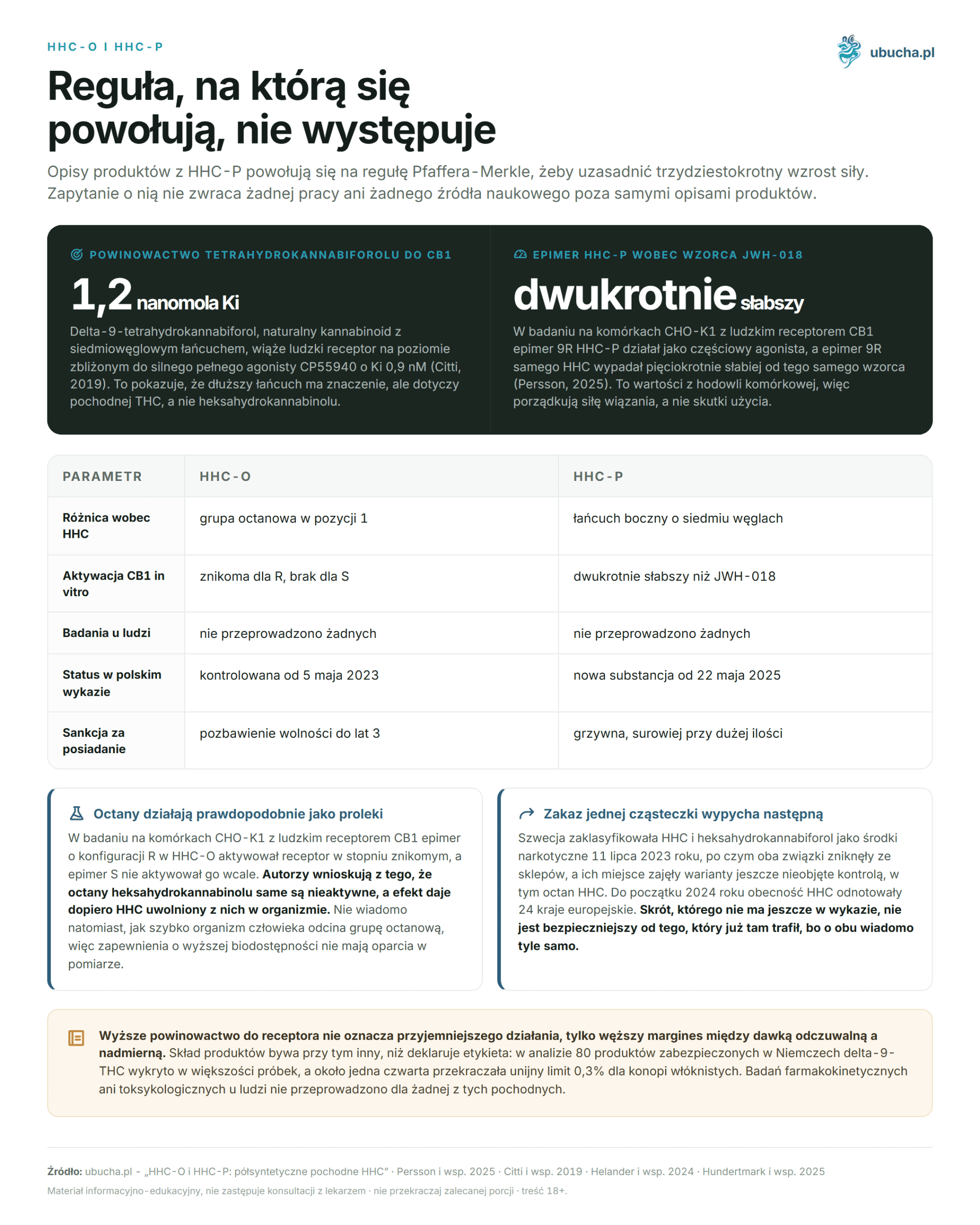
The pharmacology of this modification has already been measured. In a study on CHO-K1 cells with the human CB1 receptor, the R-configured epimer in HHC-O activated the receptor to a negligible degree, while the S epimer did not activate it at all. The authors conclude that hexahydrocannabinol acetates likely act as prodrugs, meaning they are inactive themselves, and the effect is only provided by HHC released from them in the body (Persson et al., Drug Testing and Analysis, 2025).
This resolves one issue, but not the other. It is known how HHC-O behaves towards the receptor in cell culture. However, it is not known how quickly and to what extent the human body detaches the acetate group from it, as no studies have been conducted in humans. Assurances of “higher bioavailability” and “longer action” therefore have no basis in measurement. The mechanism of the prodrug itself, in which the inactive form releases the active one, has been described in the context of acidic forms of cannabinoids.
Why is HHC-P considered the strongest in this family?
HHC-P, or hexahydrocannabiforol, differs from HHC in the length of the side chain: it has seven carbon atoms instead of five. This change does indeed increase activity, though not to the extent claimed in product descriptions. In the same study on cells with the human CB1 receptor, the 9R HHC-P epimer acted as a partial agonist with potency twice lower than JWH-018, while the 9R epimer of HHC itself was five times weaker than this standard (Persson et al., 2025).
Where does the “thirty times” figure come from? Probably from transferring data about another compound. Delta-9-tetrahydrocannabiforol, a natural cannabinoid with a seven-carbon side chain, binds to the human CB1 receptor with Ki 1.2 nM, which is at a level similar to the strong full agonist CP55940 with Ki 0.9 nM (Citti et al., Scientific Reports, 2019). This shows that a longer chain matters, but it pertains to the THC derivative, not HHC.
We have also noted that Polish descriptions of HHC-P refer to the “Pfaffer-Merkle rule.” There is no such rule: a query about it returns no work in the Europe PMC database or any scientific source outside of product descriptions. It is a name that sounds like a chemical law and serves as a footnote, lacking any publication behind it. Higher affinity for CB1 does not mean a more pleasant effect, only a narrower margin between the perceptible and excessive dose, and this is for a compound that has not been studied in humans.
How do HHC, HHC-O, and HHC-P differ?
The three compounds from the same family differ in substituents, mechanisms, and legal status. The following table summarizes what can be said about them based on sources, without values estimated from user reports.
| Parameter | HHC | HHC-O | HHC-P |
|---|---|---|---|
| Full name | Hexahydrocannabinol | O-acetylhexahydrocannabinol acetate | Hexahydrocannabiforol |
| Difference from HHC | Starting molecule | Acetate group at position 1 | Side chain with seven carbons |
| CB1 activation in vitro | 9R epimer five times weaker than JWH-018 | Negligible for R epimer, none for S epimer | 9R epimer twice weaker than JWH-018 |
| Studies in humans | None, profile undetermined | None | None |
| Status in Polish list | Controlled substance since May 5, 2023 | Controlled substance since May 5, 2023 | New psychoactive substance since May 22, 2025 |
The row with receptor activity requires one caveat. All these values come from cell culture, not from the body, so they order binding strength, not effects of use. For HHC-O, this is particularly important, as a compound with negligible in vitro activity may act strongly after transformation in the body.
Are HHC-O and HHC-P legal in Poland in 2026?
No. Both compounds are included in Polish lists, but on two different bases. HHC-O was added to the list of psychotropic substances along with HHC itself by the regulation of the Minister of Health from April 17, 2023, which came into effect on May 5, 2023 (Dz.U. 2023 poz. 744). From that day, the trade in these substances and their possession outside the provisions of the law is prohibited.
HHC-P joined two years later. The regulation from April 30, 2025, effective from May 22, 2025, added hexahydrocannabiforol to the list of new psychoactive substances along with delta-9-tetrahydrocannabiforol (Dz.U. 2025 poz. 598). A subsequent regulation, effective from July 28, 2026, added the delta-8 variant and tetrahydrocannabiforol acetate to this list (Dz.U. 2026 poz. 934).
The criminal consequences differ between these categories. Possession of a psychotropic substance contrary to the provisions of the law is punishable by imprisonment for up to 3 years, and in significant amounts from 1 to 10 years (Article 62 of the Act on Counteracting Drug Addiction, t.j. Dz.U. 2023 poz. 1939). Possession of a new psychoactive substance is subject to a fine, and in significant amounts, a fine, restriction of liberty, or imprisonment for up to 3 years (Article 62b). A broader comparison of the entire family is gathered in the post about hexahydrocannabinol and its legal status.
What happens to the market after each ban?
The ban on one molecule pushes the next onto the market. Sweden classified HHC and hexahydrocannabiforol as narcotic substances on July 11, 2023, after which both compounds disappeared from online and stationary stores, replaced by variants not yet under control, including HHC acetate (Helander et al., Scandinavian Journal of Clinical and Laboratory Investigation, 2024). The same pattern has repeated in other countries.
The scale of the phenomenon is European. By early 2024, 24 European countries had recorded the presence of HHC in their markets, along with HHC acetate and hexahydrocannabiforol. The authors compare this wave to the entry of synthetic cannabinoids like Spice in 2008, marking the first major change in the market for cannabis substitutes in over a decade.
For the reader, the conclusion is practical. A shortcut that is not yet on the list is not safer than one that has already made it there, as little is known about both, which is almost nothing. The composition of products can also differ from what the label declares: in an analysis of 80 products secured in Germany, delta-9-THC was detected in most samples, and about a quarter exceeded the EU limit of 0.3% for industrial hemp (Hundertmark et al., Drug Testing and Analysis, 2025).
Frequently Asked Questions
What is HHC-O?
HHC-O is hexahydrocannabinol acetate, meaning HHC with an acetate group attached to the hydroxyl group at position 1 of the ring. In vitro studies have shown that the compound itself stimulates the CB1 receptor to a negligible degree, so the authors consider HHC acetates to be prodrugs that release active HHC only in the body.
Is HHC-O legal in Poland?
No. HHC-O, listed as O-acetylhexahydrocannabinol acetate, has been a controlled substance since May 5, 2023, when the regulation Dz.U. 2023 poz. 744 came into effect. This regulation also included hexahydrocannabinol itself.
Is HHC-P legal in Poland?
No. Hexahydrocannabiforol, designated as HHC-P or HHCP, was added to the list of new psychoactive substances on May 22, 2025, based on the regulation Dz.U. 2025 poz. 598. Possession of such a substance is subject to a fine, and in significant amounts, even imprisonment for up to 3 years.
Is HHC-P thirty times stronger than HHC?
There is no source for this. In vitro studies showed that the 9R HHC-P epimer activated the CB1 receptor with a potency twice lower than JWH-018, while the 9R epimer of HHC itself was five times lower. The so-called “Pfaffer-Merkle rule” mentioned in product descriptions does not appear in any scientific publication.
How does HHC-P differ from THC-P?
Both have a seven-carbon side chain, but THC-P is a derivative of tetrahydrocannabinol and occurs in the plant, while HHC-P is its hydrogenated counterpart obtained in the laboratory. Delta-9-tetrahydrocannabiforol binds to the human CB1 receptor with Ki 1.2 nM, which is at a level similar to the strong agonist CP55940.
Are there studies on HHC-O and HHC-P in humans?
No. For both compounds, available data comes from cell cultures and analyses of products secured by authorities. No pharmacokinetic or toxicological studies have been conducted in humans, so the descriptions of effects circulating online are based solely on user reports.
If you are looking for cannabis products outside the list of controlled substances, a starting point is cannabis oils available in the store at Bucha.
This article is for informational and educational purposes and does not constitute legal advice. The legal status described in the article is valid as of the publication date: regulations regarding cannabis may change. Before making a decision, consult a lawyer or current legal acts.
Author: Michał Waluk · Published: 2026-08-09 · Updated: 2026-08-11