
Flaxseed for cholesterol and menopause symptoms: what studies show
How much does it really lower cholesterol, why it lost to placebo for hot flashes, and what cannot be written on the label. Effect sizes with intervals.
Flaxseed is attributed more than studies have shown, but not everything on this list is made up. Some has coverage: a meta-analysis of 28 randomized studies confirms a slight decrease in total cholesterol and LDL fraction. Some has none at all: the largest phase III trial regarding hot flashes showed no advantage of flax over placebo, and in the EU list of permitted health claims, flaxseed does not appear even once. The difference between these two statements is the subject of this text. We show what effect sizes were measured, in what form of the raw material and in what population, along with confidence intervals. We also state directly what was not measured, so as not to make a lack of measurement evidence of effectiveness.
KEY INFORMATION
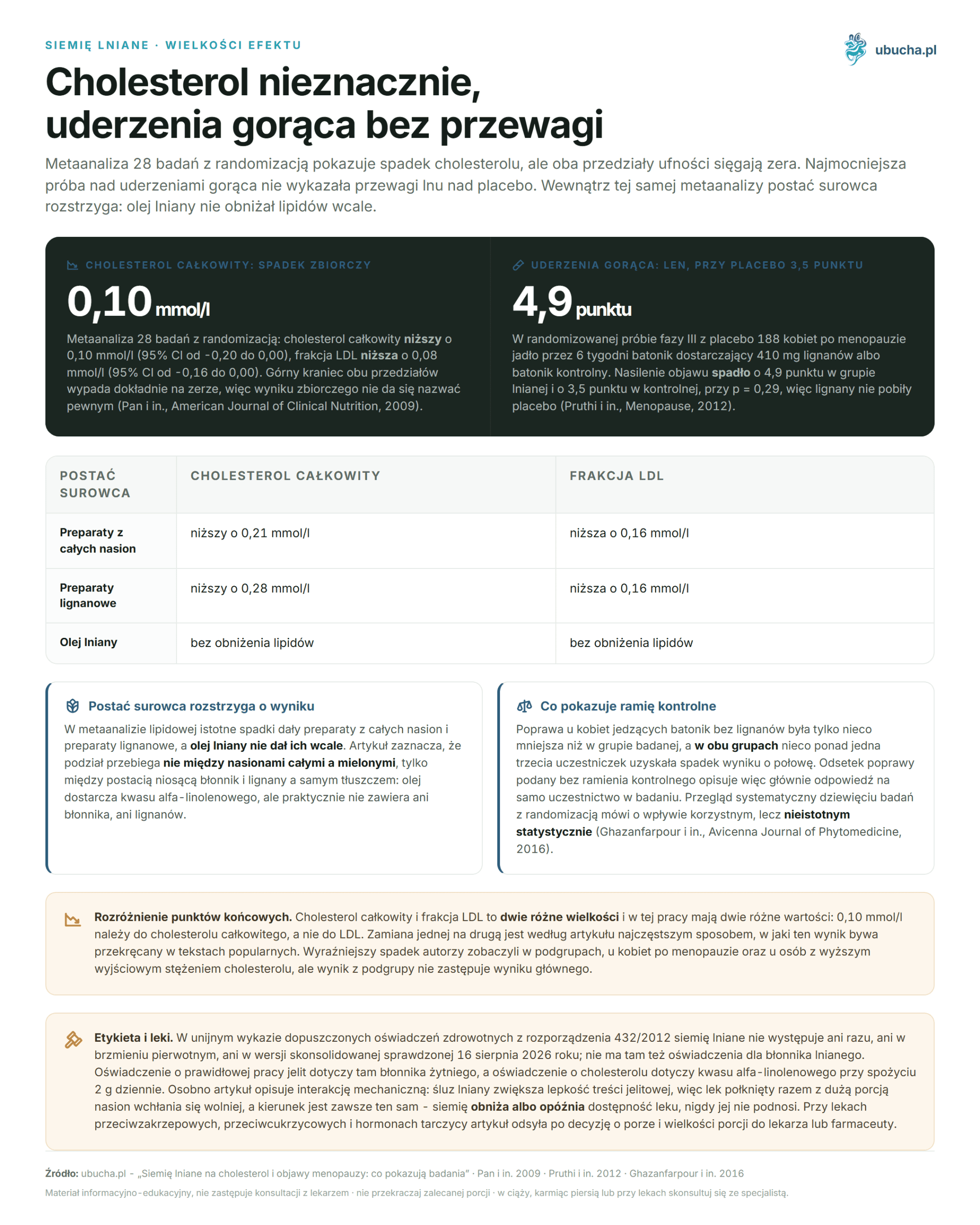
• Meta-analysis of 28 randomized studies: total cholesterol lower by 0.10 mmol/l (95% CI from -0.20 to 0.00), LDL by 0.08 mmol/l (95% CI from -0.16 to 0.00), meaning both intervals reach zero (Pan et al., American Journal of Clinical Nutrition, 2009).
• In a phase III trial involving 188 women, lignans did not outperform placebo: decrease of 4.9 versus 3.5 points, p = 0.29 (Pruthi et al., Menopause, 2012).
• In the same meta-analysis, flaxseed oil did not lower lipids; preparations from whole seeds and lignans did lower them.
• In regulation 432/2012, there is no health claim for flaxseed or flax fiber.
By how much does flaxseed lower cholesterol?
By less than most guides suggest, and with a confidence interval reaching zero. A meta-analysis of 28 randomized studies showed a decrease in total cholesterol of 0.10 mmol/l (95% CI from -0.20 to 0.00) and LDL fraction of 0.08 mmol/l (95% CI from -0.16 to 0.00) (Pan et al., American Journal of Clinical Nutrition, 2009). The upper limit of both intervals falls exactly at zero, so the aggregate result cannot be called certain.
The distinction of endpoints has practical significance here. Total cholesterol and LDL fraction are two different quantities and in this work have two different values. Swapping one for the other is the most common way this result is misrepresented in popular texts: the number 0.10 belongs to total cholesterol, not to LDL.
A more pronounced decrease was observed by the authors in subgroups, in postmenopausal women and in individuals with higher baseline cholesterol levels. This is a sensible indication of whom the raw material may change anything for, but the subgroup result does not replace the main result.
Separately, the flax fiber itself was measured. In a crossover double-blind study, 17 individuals consumed a drink or bread with its addition for a week. The drink reduced total cholesterol by 12 percent and LDL by 15 percent compared to the control diet; the bread reduced it by 7 and 9 percent, respectively. Fat excretion in feces also increased (Kristensen et al., Nutrition and Metabolism, 2012). The study measured fat excretion, not bile acid binding, so the popular bile explanation remains a hypothesis transferred from other studies. How measurement looks for a raw material with a stronger basis is described in our post about psyllium fiber for intestines and cholesterol.
What form of flaxseed was studied?
Four forms of the raw material are four different products: whole seeds, ground seeds, oil, and extracted lignans. In the lipid meta-analysis, significant decreases were provided by preparations from whole seeds (0.21 mmol/l total cholesterol and 0.16 mmol/l LDL) and lignan preparations (0.28 and 0.16 mmol/l). Flaxseed oil did not provide any.
This reverses the opinion that circulates in guides. The division does not occur between whole and ground seeds, but between the form carrying fiber and lignans and the fat itself. Oil provides alpha-linolenic acid but practically contains neither fiber nor lignans.
Grinding has a separate justification. The hard shell protects the seed’s interior from digestive enzymes, so grinding conditions the availability of alpha-linolenic acid and SDG lignan, while simultaneously exposing both to oxidation (Parikh et al., Nutrients, 2019). The same review provides the pathway of transformation: SDG broken down by the microbiota to enterodiol and enterolactone appears in plasma only 8-10 hours after consumption, and peak concentrations occur after about 15 and 20 hours.
Portion sizes from studies should be read as a description of the protocol, not as guidance for oneself. In the FlaxPAD trial, patients with peripheral artery disease consumed 30 g of ground flaxseed daily for six months and had lower systolic and diastolic blood pressure than the control group, with authors noting that not everyone responded. A separate issue is the transformation of alpha-linolenic acid into long-chain acids: it is limited and depends on sex, and supplementation with this acid raises EPA and DPA levels but not DHA (Brenna et al., Prostaglandins Leukotrienes and Essential Fatty Acids, 2009). Numbers for this transformation are compiled in our post about properties and dosing of omega-3.
Does flaxseed alleviate hot flashes?
The strongest study says no. In a randomized phase III trial with placebo, 188 postmenopausal women consumed for 6 weeks a bar providing 410 mg of lignans or a control bar. The average severity score of hot flashes decreased by 4.9 points in the flax group and by 3.5 points in the control group, with p equal to 0.29 (Pruthi et al., Menopause, 2012).
See what the control arm does here. Improvement in women eating the bar without lignans was only slightly less than in the study group, and in both groups, just over one-third of participants achieved a score reduction of half. Any percentage of improvement given without the control arm thus mainly describes the response to participation in the study itself, not the action of the raw material.
A systematic review encompassing nine randomized studies formulates this more cautiously: flax showed a beneficial effect on the frequency and severity of hot flashes, but this effect was not statistically significant (Ghazanfarpour et al., Avicenna Journal of Phytomedicine, 2016).
The mechanism itself also requires clarification. Enterolignans have weak affinity for estrogen receptors, so it is natural to question whether they activate estrogen-dependent endpoints. In a randomized placebo-controlled study, 100 individuals over 50 years old took a complex with flax lignan or placebo for six months while participating in a walking program. The preparation did not affect bone mineral density, body composition, lipoproteins, or inflammatory markers; however, a decrease in diastolic blood pressure was shown in men compared to men on placebo (Cornish et al., Applied Physiology Nutrition and Metabolism, 2009). This work did not measure vasomotor symptoms but shows how narrow the range is in which flax lignan changes anything. What has data today and what does not is compared in our post about supplements for menopause.
What are the known risks and interactions of flaxseed?
The best-documented interaction is mechanical, not chemical. Flax mucus increases the viscosity of intestinal contents, so a drug swallowed with a large portion of seeds is absorbed more slowly. The direction is always the same: flax lowers or delays the availability of the drug, never increases it.
The second issue concerns coagulation and is often described too strongly. In a 12-week double-blind study, 86 healthy volunteers took 2 g of flaxseed oil, fish oil, or hemp oil daily. None of these interventions changed collagen- or thrombin-stimulated platelet aggregation, and none changed the lipid profile (Kaul et al., Journal of the American College of Nutrition, 2008). This is a measurement for oil and for this portion, so it does not resolve the issue for large portions of seeds, but it also does not allow stating a clear antiplatelet effect of flax as a fact.
Cyanogenic glycosides present in flax are primarily linustatin and neolinustatin, considered the weakest sources of hydrogen cyanide in this group of compounds. A review dedicated to flax in the human diet states that consumption of 15 to 100 g of flaxseed did not raise plasma cyanide levels above baseline and that no poisoning with this raw material was reported in clinical studies (Parikh et al., Nutrients, 2019).
What follows from this in practice. If you are taking anticoagulants, antidiabetics, or thyroid hormones, decide on the timing and portion size of flaxseed with your doctor or pharmacist, not based on a table found online.
Frequently asked questions
Does flaxseed lower cholesterol?
Slightly and uncertainly. A meta-analysis of 28 randomized studies showed a decrease in total cholesterol of 0.10 mmol/l and LDL fraction of 0.08 mmol/l, with both 95 percent confidence intervals reaching zero (Pan et al., 2009). A more pronounced decrease occurred in postmenopausal women.
Does flaxseed help with hot flashes?
A phase III study involving 188 women showed no advantage over placebo: 4.9 versus 3.5 points decrease, p equals 0.29 (Pruthi et al., 2012). A review of nine randomized studies indicates a beneficial but statistically insignificant effect on the frequency and severity of the symptom.
Is it better to eat ground or whole flaxseed?
Grinding is a condition for the availability of alpha-linolenic acid and SDG lignan, as the shell protects the seed’s interior from digestive enzymes. This same action exposes both components to oxidation (Parikh et al., 2019). In a lipid meta-analysis, oil did not lower lipids, while preparations from seeds and lignans did lower them.
Is it allowed in the EU to say that flaxseed supports the intestines?
No. In the list of permitted health claims from regulation 432/2012, flaxseed does not appear even once, neither in its original wording nor in the consolidated version we checked on August 16, 2026. The claim about proper intestinal function refers to rye fiber, and the cholesterol claim refers to alpha-linolenic acid when consumed at 2 g per day.
Does flaxseed affect drug absorption?
Yes, and always in one direction. The sticky mucus slows transit and delays or reduces the absorption of a drug taken with a large portion of seeds. For anticoagulants, antidiabetics, and thyroid hormones, the interval between the dose and the meal with flaxseed should be determined with a doctor or pharmacist.
This article is for informational and educational purposes only and does not constitute medical advice. Before starting supplementation, consult with a doctor, especially if you are taking medications regularly, are pregnant or breastfeeding, or have a chronic illness.
Author: Michał Waluk · Published: 2026-08-09 · Updated: 2026-08-16