
Melatonin Extended Release vs Regular: What to Choose
Regular melatonin or extended-release? What do studies say about dosage, jet lag, and timing, and what melatonin products does the store at Bucha have.
On the shelf with sleep aids, there are two items that look similar but have different data behind them: regular melatonin and extended-release melatonin. The difference is not in strength but in the release profile, which determines what sleep problem the preparation was studied for. Additionally, there is something that is rarely written about: in Poland, melatonin can be a dietary supplement, a prescription-free drug, and in the extended-release form, it is a prescription medication. This article clarifies both: it shows what sleep problem each form was studied for, what dose has data behind it, and what is purely a marketing decision, and finally lists what is actually available in the store at Bucha, in what legal status and for how much per serving.
KEY INFORMATION
• The health claim about shortening the time to fall asleep pertains to 1 mg of melatonin taken close to bedtime, not doses of 5 or 10 mg (EFSA, 2011).
• The regular form has data for falling asleep and for jet lag; the extended-release form has been studied for sleep quality in people over 55 years old (Lemoine, 2007).
• In jet lag, 2 mg of slow-release melatonin proved relatively ineffective, suggesting that a short, high peak matters (Herxheimer and Petrie, 2002).
• Extended-release melatonin 2 mg is a prescription medication in Poland, not a dietary supplement.
• All melatonin preparations available in the store are dietary supplements in regular form, gummies declare 1 mg per serving.
What is melatonin and how does it affect sleep?
Melatonin is a hormone whose production is triggered by darkness and inhibited by light. Its task is to inform the biological clock in the suprachiasmatic nuclei of the hypothalamus that night is beginning and to activate the body’s night mode, from sleep to nighttime blood pressure and metabolism profile (Zisapel, Br J Pharmacol, 2018). It is a signal of time, not a sleeping aid in the classical sense.
This leads to a practical consequence. The most pronounced effects of melatonin are seen in disorders where its own rhythm is weakened or shifted: in circadian rhythm disorders, jet lag, and shift work, and in non-restorative sleep. Where the rhythm is fine, but sleep is disrupted by something else, melatonin alone changes little.
The scale of the effect is also moderate. A meta-analysis of seventeen studies involving 284 people showed a reduction in sleep onset time by 4.0 minutes, an increase in sleep efficiency by 2.2 percent, and an extension of sleep by 12.8 minutes (Brzezinski et al., Sleep Med Rev, 2005). These are real numbers, but far from the promise suggested by the packaging.
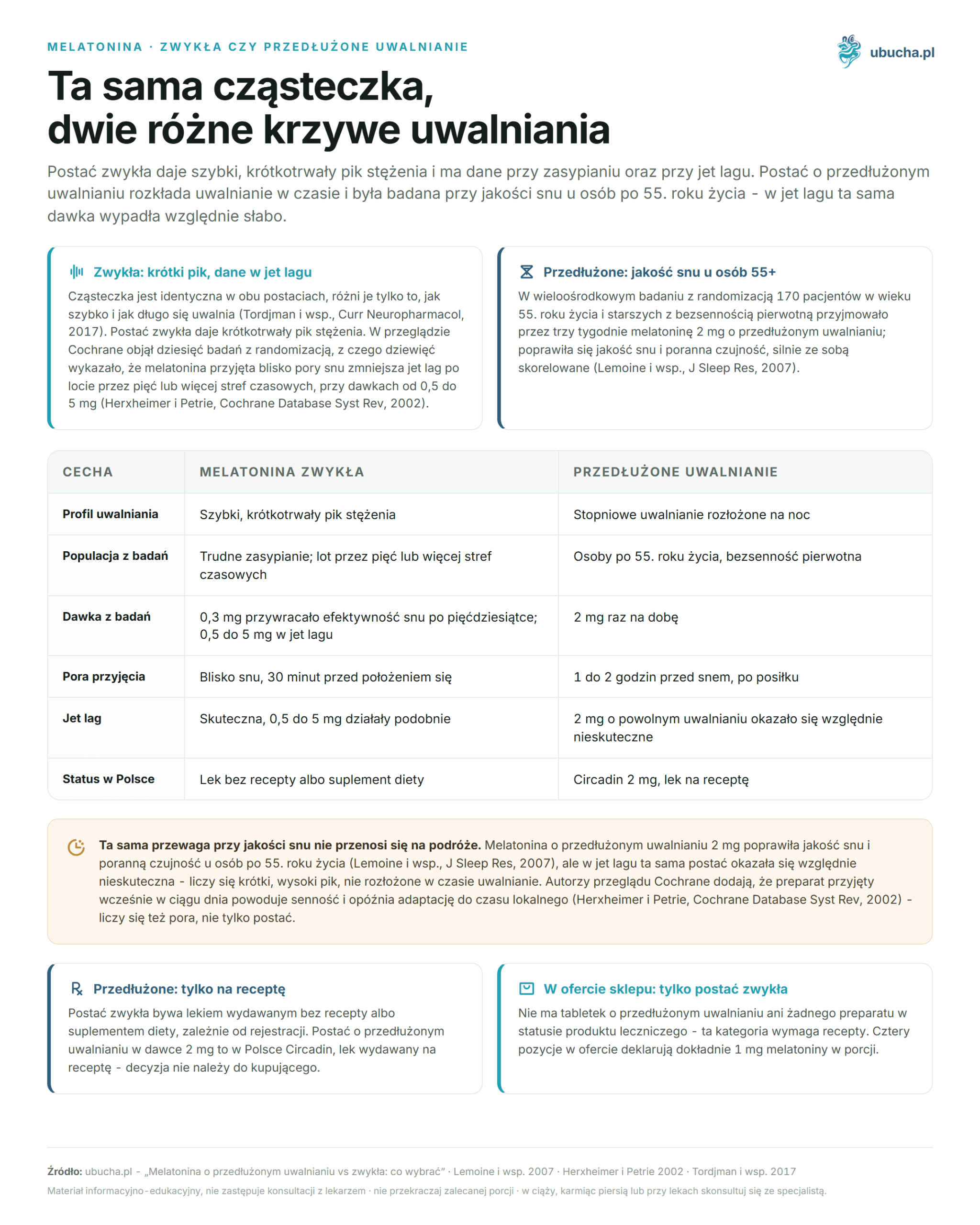
The molecule in both forms compared here is identical. They differ only in how quickly and how long it is released, and thus how the concentration curve looks after taking the preparation (Tordjman et al., Curr Neuropharmacol, 2017).
What is the difference between regular melatonin and extended-release melatonin?
The regular form provides a quick and short-lived peak concentration. The extended-release form spreads the release over time to resemble the natural nighttime secretion profile. This difference is not cosmetic: it translates into the studies where each form performed well and at what time it makes sense to take it.
| Feature | Regular Melatonin | Extended-Release Melatonin |
|---|---|---|
| Release Profile | Quick, short-lived peak concentration | Gradual release spread over the night |
| Study Population | Adults with difficulty falling asleep, travelers after flying through five or more zones | People over 55 years old with primary insomnia |
| Dose from Studies | 0.3 mg restored sleep efficiency after fifty; 0.5 to 5 mg in jet lag | 2 mg once a day |
| Time of Administration | Close to bedtime, in studies 30 minutes before lying down | 1 to 2 hours before sleep, after a meal |
| Jet Lag | Effective, doses from 0.5 to 5 mg worked similarly | 2 mg of slow-release proved relatively ineffective |
| Status in Poland | Prescription drug or dietary supplement, depending on registration | Circadin 2 mg, prescription medication |
The last row of the table is the one that often gets overlooked. The choice between forms is not a choice between two products on the same shelf in Poland, as the extended-release form at a dose of 2 mg requires a prescription.
Does a higher dose of melatonin work better?
There is no data for this, and there are several arguments against it. In a randomized, placebo-controlled study, fifteen people over fifty with confirmed decreased sleep efficiency and fifteen normally sleeping individuals received 0.1 mg, 0.3 mg, and 3.0 mg of melatonin 30 minutes before sleep for a week (Zhdanova et al., J Clin Endocrinol Metab, 2001). The physiological dose of 0.3 mg restored sleep efficiency while simultaneously raising melatonin levels in the blood to normal nighttime levels.
The pharmacological dose of 3.0 mg also improved sleep but caused hypothermia and maintained elevated melatonin levels until daytime hours. In normally sleeping individuals, none of the doses changed sleep, even though they also had low levels of their own melatonin.
The regulator set the threshold similarly low. The health claim about shortening the time needed to fall asleep requires 1 mg of melatonin taken close to bedtime (EFSA Journal 2011;9(6):2241), and a separate claim about alleviating jet lag requires 0.5 mg (EFSA Journal 2010;8(2):1467). The Cochrane review adds that in jet lag, doses above 5 mg did not work better than lower ones. Therefore, products with 10 mg have no support in studies on falling asleep or in approved claims. The origin of such numbers on the shelf is explained in the text about melatonin dosing.
When is regular melatonin a better choice?
When the problem is simply falling asleep or a shifted clock. This is the only form that relates to the approved claim about shortening the time needed to fall asleep with 1 mg per serving.
However, the strongest data pertains to jet lag. The Cochrane review included ten randomized studies, of which nine showed that melatonin taken close to the target bedtime, between 10:00 PM and midnight, reduces jet lag after flying through five or more time zones (Herxheimer and Petrie, Cochrane Database Syst Rev, 2002). The number of people that need to be treated to achieve one additional effect was 2. The benefit increases with the number of time zones crossed and is smaller for westward flights. The authors add a warning: taking the preparation at the wrong time, early in the day, causes drowsiness and delays adaptation to local time.
The third area is circadian rhythm disorders. The guidelines of the American Academy of Sleep Medicine support appropriately timed melatonin in delayed sleep phase syndrome, in blind adults with a rhythm other than circadian, and in children and adolescents with irregular rhythms and neurological disorders (Auger et al., J Clin Sleep Med, 2015). The same guidelines advise against melatonin in older adults with dementia.
When to choose extended-release melatonin?
This form has one well-studied application, and it is narrow. In a multicenter randomized placebo-controlled study, 170 outpatient patients with primary insomnia aged 55 and older took 2 mg of extended-release melatonin for three weeks (Lemoine et al., J Sleep Res, 2007). Sleep quality and morning alertness improved, and both improvements were strongly correlated, which the authors interpret as an increase in the restorative value of sleep.
After discontinuation, there was no rebound insomnia or withdrawal symptoms, and the incidence of adverse events was low and mostly mild. This is a reasonable argument for someone who wakes up unrefreshed despite a full night’s sleep.
However, the decision does not belong to the buyer. The product characteristics of Circadin describe it as a monotherapy for the short-term treatment of primary insomnia with poor sleep quality in patients aged 55 and older, at a dose of 2 mg once a day, 1 to 2 hours before sleep, after a meal, for a period of up to thirteen weeks. The preparation is available by prescription. Separately, it is worth remembering that in jet lag, slow-release 2 mg performed relatively poorly in the Cochrane review, so the advantage of this form does not transfer to travel.
Is melatonin a drug or a dietary supplement?
In Poland, it is both, and it is the same molecule. Some melatonin preparations are registered as prescription-free medicinal products, with product characteristics and a leaflet approved by the registration office. Some are dietary supplements, which are food reported to the sanitary inspection. The extended-release form at a dose of 2 mg is a prescription medication.
This difference has practical consequences and is not limited to the prestige of the packaging. A dietary supplement does not have a registered indication and cannot be presented as treating insomnia. It can only use approved health claims, such as shortening the time needed to fall asleep with 1 mg per serving and alleviating jet lag with 0.5 mg.
The reverse direction is equally important. The results of Lemoine’s study pertain to a specific medicinal product with a defined release profile and do not automatically transfer to a gummy with the same number of milligrams, as the release profile was the variable studied in that research. When reading the packaging, check two things: whether it states medicinal product or dietary supplement and how much melatonin is in one serving.
What melatonin products are available at Bucha?
It is worth stating clearly what is not available in the offer. There are no extended-release tablets or any melatonin preparation in the status of a medicinal product, as the first category requires a prescription. Everything that is available is dietary supplements in regular form, intended for adults.
Four items declare exactly 1 mg of melatonin per serving, which is the amount required by the approved claim about shortening the time to fall asleep. Two shots list melatonin in the ingredient list but do not provide its amount per serving, so the exact content must be read from the bottle label. The gummy melatonin has been discussed separately, along with how much melatonin was actually found in them. The cost column converts the price to one use, as the prices of packages with different numbers of servings do not allow for comparison.
| Product | What distinguishes it | Price | Cost per serving |
|---|---|---|---|
| Herbal Gummies with Melatonin GOOD SLEEP FORTE + L-theanine | 1 mg of melatonin, valerian and hops 70 mg each, L-theanine 100 mg; 30 gummies | 45.00 PLN | 1.50 PLN |
| CBD Cherry Gummies with Melatonin For Good Sleep FORTE valerian + hops, TOPICAL | 1 mg of melatonin plus 15 mg of phytocomponents from hemp; 30 gummies | 45.00 PLN | 1.50 PLN |
| CANNOVA + melatonin CBD 25 mg/piece 60 pcs. | 1 mg of melatonin and 25 mg of broad-spectrum phytocomponents in a gummy; packaging for two months | 89.00 PLN | 1.48 PLN |
| CANNOVA + melatonin CBD 25 mg/piece 3 pcs. | The same formula in a trial sachet, the most expensive per gummy | 10.00 PLN | 3.33 PLN |
| Brain Wash Mango OG Sleep Melatonine | Shot 100 ml, 40 servings; melatonin in the composition without specified amount per serving | 54.00 PLN | 1.35 PLN |
| BombDope Mojito Sleep 150 ml | Shot 150 ml, 60 servings of 2.5 ml each; melatonin in the composition without specified amount per serving | 69.00 PLN | 1.15 PLN |
Prices are from the store and are current as of August 8, 2026. The first four items can be found in the gummy category, and the last two in the shots category.
What are the interactions and limitations of melatonin?
The best-documented interaction concerns fluvoxamine. Five healthy volunteers took 5 mg of melatonin once alone and once together with 50 mg of fluvoxamine; the combined administration resulted in an average of seventeen times higher serum melatonin concentration, not due to increased production but due to inhibition of its elimination (Härtter et al., Clin Pharmacol Ther, 2000). The study was small, but the effect was significant enough that when treating with this medication, melatonin should be discussed with a doctor.
The Cochrane review notes two signals from case reports: the possibility of harm in people with epilepsy and in patients taking warfarin. The frequency of other adverse effects is described as low.
Data on the safety of short-term use is reassuring. A meta-analysis from 2005 found no evidence of adverse effects from melatonin and deemed it safe for use for three months or less (Buscemi et al., J Gen Intern Med, 2005). There is a lack of such data for longer use. Melatonin supplements from the store’s offer are intended exclusively for adults and are advised against for pregnant and breastfeeding women.
What to do if melatonin does not help?
Start by asking whether melatonin fits the problem at all. The same meta-analysis shows a reduction in sleep onset time of 11.7 minutes across the group, but the distribution of this effect is uneven: 38.8 minutes in delayed sleep phase syndrome versus 7.2 minutes in insomnia. Melatonin works strongest where the clock is shifted, not everywhere sleep is poor.
The second thing is timing, not dosage. The Cochrane review directly links effectiveness to taking the preparation close to the target bedtime and warns that early administration reverses the effect.
If that is not enough, there are two supplemental paths with data. L-theanine at a dose of 400 mg daily for six weeks increased sleep percentage and its efficiency in boys with attention deficit hyperactivity disorder, but did not change sleep onset time (Lyon et al., Altern Med Rev, 2011). Ashwagandha in a meta-analysis of five randomized studies with 400 participants showed a small but significant effect on sleep, more pronounced at doses of 600 mg daily and with use for eight weeks or longer (Cheah et al., PLoS ONE, 2021). Insomnia that persists despite such attempts is a matter for a doctor, not for another preparation.
Frequently Asked Questions
How much melatonin should be taken to shorten the time to fall asleep?
The health claim approved in the European Union states that 1 mg of melatonin should be taken close to bedtime (EFSA, 2011). In Zhdanova’s study, a physiological dose of 0.3 mg restored sleep efficiency in people over fifty, while 3 mg caused hypothermia and maintained melatonin in the blood until daytime hours.
When to choose extended-release melatonin and when regular?
The regular form has data for falling asleep and for jet lag, while the extended-release form has been studied for sleep quality in people over 55 years old (Lemoine, 2007). In Poland, the latter is Circadin, a prescription medication, so its use is determined by a doctor, not a shelf in a store.
Does melatonin cause addiction?
In a study with 2 mg of extended-release melatonin in 170 people over 55 years old, withdrawal after three weeks did not cause rebound insomnia or withdrawal symptoms (Lemoine, 2007). The data pertains to short-term use, so for longer use, it is advisable to establish a regimen with a doctor.
Does melatonin help with jet lag?
A Cochrane review included ten studies: in nine, melatonin taken close to the target bedtime reduced jet lag after flying through five or more time zones (Herxheimer and Petrie, 2002). Doses from 0.5 to 5 mg worked similarly, and above 5 mg did not work better.
How long before sleep should melatonin be taken?
The regular form is taken close to bedtime, and in Zhdanova’s study, it was administered 30 minutes before lying down. For Circadin, the product characteristics state 2 mg once a day, 1 to 2 hours before sleep, after a meal. Taking it early in the day delays rhythm adaptation.
Is gummy melatonin the same as pharmacy melatonin?
The molecule is the same, but the legal status is different. A dietary supplement is food and can only use approved claims, such as shortening the time to fall asleep with 1 mg per serving. A drug has a product characteristics and registered indication, and Circadin additionally requires a prescription.
Other preparations supporting the evening ritual, from herbs to multi-ingredient formulas, have been gathered in the supplements category.
This article is for informational and educational purposes and does not constitute medical advice. Before starting supplementation, consult a doctor, especially if you are taking medications regularly, are pregnant or breastfeeding, or have a chronic illness.
Author: Michał Waluk · Published: 2026-06-27 · Updated: 2026-08-08