
Melatonin Gummies: Do They Really Help You Sleep and How Many mg to Take
Melatonin shortens sleep onset by an average of 4 minutes, and 0.3 mg fits within physiology. Check how many mg makes sense in gummies, when to take them, and who they really help.
Melatonin gummies are one of the best-selling sleep products, and advertisements promise quick sleep onset. Research suggests a more cautious approach. A meta-analysis of seventeen trials showed that melatonin shortens the time to fall asleep by an average of 4 minutes and extends sleep by nearly fifteen minutes. The effect is real but small. Doses of 0.1-0.3 mg raise blood levels exactly to the range that the body achieves at night on its own; a typical gummy contains 3 to 10 mg, which is a multiple of that value. Below you will find how much melatonin makes sense, at what time to take it, what sleep problems it really helps with, and what not to expect from it. You will also find numbers from content studies, as the label on the gummy can be the least reliable element of the entire product.
KEY INFORMATION
• Melatonin shortens the time to fall asleep by 4.0 minutes and extends sleep by 12.8 minutes compared to placebo (Brzezinski et al., Sleep Medicine Reviews, 2005).
• Doses of 0.3 and 1.0 mg shortened the time to fall asleep in polysomnographic recordings, and the EU health claim requires 1 mg per serving (Zhdanova et al., 1995).
• In 25 examined gummies, the melatonin content ranged from 74% to 347% of the label declaration (Cohen et al., JAMA, 2023).
• The best-documented applications are jet lag and shift work, not chronic insomnia.
How does melatonin work and why is it not a sleeping pill?
Melatonin is a hormone secreted by the pineal gland after dark, and it acts as a time signal, not as a sedative. It does not turn off consciousness. It informs the body that night is approaching and shifts the biological clock. Therefore, the timing of intake is at least as important for the effect as the dose.
The secretion of endogenous melatonin begins to rise about two hours before the usual sleep time and peaks in the middle of the night. Light inhibits this process, while darkness activates it. The supplement adds an external signal: taken in the evening, it speeds up sleep onset; taken in the morning, it can shift the clock in the wrong direction.
This difference explains where melatonin performs well and where it falls short. It works well where the problem is a disrupted circadian rhythm: after flying through several time zones, with shift work, in people who naturally fall asleep at two in the morning. It performs poorly where sleep is disrupted by pain, anxiety, or sleep apnea, as it does not address any of these causes. If you go to bed at a reasonable hour and still wake up at three, melatonin is unlikely to be the answer.
By how much does melatonin really shorten the time to fall asleep?
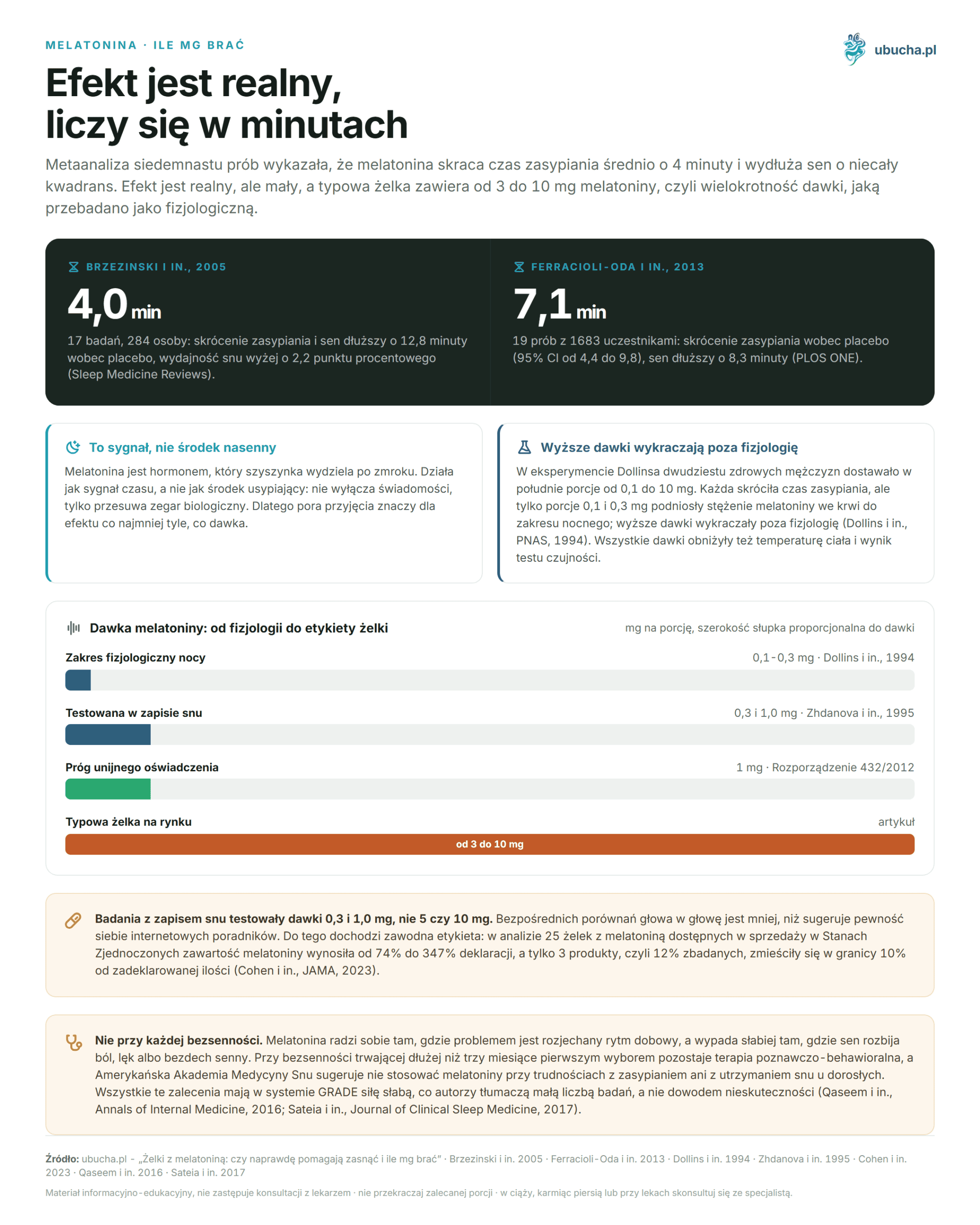
On average by 4 minutes. A meta-analysis of 17 studies involving 284 people showed a reduction in the time to fall asleep by 4.0 minutes, an increase in total sleep time by 12.8 minutes, and a 2.2 percentage point increase in sleep efficiency compared to placebo (Brzezinski et al., Sleep Medicine Reviews, 2005).
A newer analysis of 19 trials with 1683 participants provided a similar picture: time to fall asleep was shorter by 7.1 minutes (95% CI from 4.4 to 9.8), total sleep time was longer by 8.3 minutes (95% CI from 1.7 to 14.8), and a statistically significant but small improvement in sleep quality rated by participants, with an effect size of 0.22 (Ferracioli-Oda et al., PLOS ONE, 2013). Two independent analyses reached the same conclusion: the effect is repeatable, but it is measured in minutes, not hours.
This same analysis mentions one inconvenient fact for the rest of this article, and it is more honest to state it than to omit it. In its regression model, longer trials and those with higher doses produced a greater effect on sleep onset time and sleep duration, although neither dose nor trial duration affected sleep quality itself. However, the meta-analysis compares studies with different protocols, populations, and times of administration, so it does not answer the same question as a direct comparison of doses within a single study.
If you fall asleep in thirty-five minutes and expect it to be five minutes after taking a gummy, that promise is not supported by the data. Melatonin changes the moment when the body recognizes it is time to sleep. It does not have a sedative power comparable to drugs acting on the GABA receptor, and that is not its purpose.
How many mg of melatonin do you need for it to work?
From 0.3 to 1 mg. In a polysomnographic study, doses of 0.3 and 1.0 mg taken in the evening shortened the time to fall asleep and the transition to the second stage of sleep, did not suppress REM phase, and did not leave a morning hangover (Zhdanova et al., Clinical Pharmacology and Therapeutics, 1995).
How do we know where physiology ends? From measuring blood levels. In an earlier experiment by the same team, twenty healthy men received doses from 0.1 to 10 mg or placebo at noon, in a double-blind Latin square design with repeated measurement. Each of the tested doses shortened the time to fall asleep and extended sleep, but only doses of 0.1 and 0.3 mg raised melatonin levels in the blood to the range that the body achieves at night on its own; higher doses exceeded physiological levels (Dollins et al., PNAS, 1994).
It is worth noting in this study what guides usually omit. All doses, including the smallest ones, also lowered body temperature and the number of correct responses in an auditory vigilance test. Melatonin taken in the middle of the day thus affects attention, not just sleep, and this is the physiological reason why the timing of its intake is not determined by intuition.
EU regulation 432/2012 allows stating on the packaging that the product shortens the time to fall asleep only with 1 mg of melatonin per serving, and for alleviating subjective symptoms of jet lag with at least 0.5 mg (EUR-Lex).
A typical gummy contains from 3 to 10 mg, which is from three to thirty times more than the dose that still fits within physiology. Direct comparisons head-to-head are fewer than the confidence of online guides suggests: in sleep recording studies, doses of 0.3 and 1.0 mg were tested, not 5 or 10 mg. It is known, however, that with a larger serving, the concentration remains in the morning when it should have long since dropped. This is where daytime drowsiness, headaches, and a feeling of grogginess upon waking come from. If you want to stick with gummies, look for a product with 1 mg per piece or cut in half those with a higher dose.
Is there as much melatonin in gummies as the label claims?
Often not. In an analysis of 25 melatonin gummies available for sale in the United States, the content ranged from 74% to 347% of the label declaration, and only 3 products, or 12% of those tested, fell within 10% of the declared amount (Cohen et al., JAMA, 2023). One gummy contained no detectable melatonin at all, but 31.3 mg of cannabidiol.
This is not an isolated result. In a study of 31 melatonin preparations, the content ranged from 83% below to 478% above the label, differences between batches of the same product reached 465%, and in eight preparations, serotonin was additionally detected in amounts from 1 to 75 micrograms (Erland and Saxena, Journal of Clinical Sleep Medicine, 2017). The authors summarized this with a number that says more than the extremes: over 71% of preparations did not meet the declaration within 10% accuracy. The variation did not depend on the manufacturer or the form of the preparation.
The European market also has this problem. An analysis of 50 melatonin supplements purchased online, 25 from a legal supply chain and 25 from suspicious sources, showed that 12% of samples from the legal ones violated regulations: due to unauthorized health claims or due to content exceeding the limit allowed in Belgium, where the study was conducted by at least three times (Vanhee et al., Molecules, 2025). The highest contents were found in products from illegal online pharmacies.
We noticed when comparing labels that manufacturers rarely provide the batch number along with the content analysis result. If a brand provides a certificate of analysis for a specific batch, it is a better quality signal than a round number of milligrams printed on the front of the package.
At what time should you take a melatonin gummy?
60 to 90 minutes before the planned sleep time. The gummy must dissolve and be absorbed, and the chronobiological signal needs time to shift the clock. If you want to fall asleep at 10:30 PM, take it between 9:00 and 9:30 PM. Taken when turning off the light, it will not act as a sleep aid on demand.
Regularity matters more than precision to the minute. From our observations, the most common mistake is not the dose, but chaos in timing: sometimes at 8:00 PM, sometimes at midnight, sometimes not at all. Melatonin shifts the rhythm gradually, so conflicting signals cancel each other out. Set one hour and maintain it for at least two weeks before assessing the effect.
After taking it, limit bright light. A phone screen held close to the face inhibits the secretion of endogenous melatonin and works against what you just swallowed. Night mode helps only a little; dimming the lights in the apartment and putting the phone out of reach works better. You can find more about choosing between different forms of evening support in the post oil or gummies with melatonin for adults.
In what sleep problems does melatonin work best?
With a disrupted circadian rhythm. The best-documented case is sudden time zone change: in a Cochrane review, nine out of ten studies showed that melatonin taken close to the target sleep time at the arrival location reduces jet lag symptoms after crossing five or more time zones (Herxheimer and Petrie, Cochrane Database of Systematic Reviews, 2002). The authors provide a number needed to treat equal to 2, indicating a clearly stronger effect than with ordinary insomnia.
This same review complicates the picture of dosage. Doses from 0.5 to 5 mg worked similarly, with the caveat that after 5 mg, participants fell asleep faster and slept better than after 0.5 mg, and above 5 mg, there was no further improvement. The authors also point out the reverse trap: melatonin taken at the wrong time, early in the day, causes drowsiness and delays adjustment to local time. They also note case reports of harm in people with epilepsy.
Shift work is another such case. A person transitioning from night shifts to day shifts has a biological clock shifted relative to the schedule, and a small dose of melatonin taken at the new sleep time helps to adjust that clock. The effect builds up over several days, not after the first gummy. It works similarly for people with delayed sleep phase, who naturally fall asleep at one in the morning. For them, melatonin is taken several hours before the desired sleep time, not just before it.
Chronic insomnia looks different. Guidelines for physicians prioritize cognitive-behavioral therapy for insomnia over medications (Qaseem et al., Annals of Internal Medicine, 2016). The American Academy of Sleep Medicine went further and suggests not using melatonin for difficulties falling asleep or maintaining sleep in adults; in the same document, it also advises against valerian, tryptophan, and diphenhydramine (Sateia et al., Journal of Clinical Sleep Medicine, 2017). All these recommendations have weak strength in the GRADE system, which the authors explain by the small number of studies for each individual substance and the variability of results, not evidence of ineffectiveness.
Is melatonin a drug or a dietary supplement in Poland?
Both, depending on the product. The same substance can be registered as a drug and simultaneously sold as a dietary supplement. In the Polish Register of Medicinal Products, melatonin is listed as a drug in tablets of 1, 2, 3, and 5 mg, under ATC code N05CH01, in preparations from several manufacturers. Gummies and capsules with similar content stand alongside as dietary supplements, i.e., food.
At the EU level, some preparations require a prescription. Circadin, extended-release tablets with 2 mg of melatonin, were approved on June 29, 2007, for the short-term treatment of primary insomnia with poor sleep quality in patients over 55 years of age, in a scheme of one tablet per day for up to thirteen weeks (European Medicines Agency).
Supplements are subject to different rules. Regulation 432/2012 allows stating that the product shortens the time to fall asleep only with 1 mg of melatonin per serving, and for alleviating jet lag with 0.5 mg. The limits for content in supplements are set by each country separately, so the same product may be legal in one EU country and exceed the allowable threshold in another. When buying gummies from a foreign online store, you are practically checking someone else’s regulations, not Polish ones.
What are the side effects of melatonin gummies and who should be cautious?
Occasional use for several days is considered safe for adults by the authors of the Cochrane review on jet lag, and the frequency of adverse effects is low. The most commonly mentioned complaints are morning drowsiness, headaches, and nausea. The larger the dose and the longer the concentration remains in the morning, the greater the chance that one of them will occur.
Several groups of medications require caution. Fluvoxamine and other CYP1A2 inhibitors block the breakdown of melatonin, so even a small dose behaves like several times larger. It is also worth remembering about warfarin: authors of the Cochrane review noted case reports suggesting a possible interaction and indicated it as a matter requiring investigation. Melatonin also enhances drowsiness after benzodiazepines and other sleep medications. People who have had transplants and are taking immunosuppressive drugs should discuss it with their doctor. There is a lack of safety data on supplementation during pregnancy and breastfeeding, so melatonin is either discontinued or used only after consultation.
A separate issue is children. In the EU, a pediatric preparation with melatonin for children and adolescents aged 2-18 years with autism spectrum disorder and 6-17 years with ADHD has been registered, in both indications only when sleep hygiene alone has proven insufficient, and it is issued only by prescription (European Medicines Agency). Store-bought gummies are a different situation: authors of the JAMA analysis calculated that a child taking the studied products according to the packaging would receive 40 to 130 times more melatonin than 0.1-0.3 mg, which is the dose at which the effect was measured. Keep gummies out of reach of children and do not give them without consulting a pediatrician.
How long to take melatonin and how to check if it works?
Short-term and for a specific need. Melatonin works well in applications lasting several days or weeks: adjusting after travel, a series of night shifts, returning to an earlier sleep time. If the problem returns in the same form after discontinuation, the cause lies elsewhere, and the supplement will not remove it.
The effect is easiest to assess with a sleep diary. For two weeks before introducing gummies and two weeks after, record the time you go to bed, estimated time to fall asleep, number of night awakenings, time of waking up, and morning well-being rating on a scale from 1 to 10. Then compare the averages from both periods. If the time to fall asleep has clearly shortened, melatonin is working for you. If there is no difference, increasing the dose will not change that.
For insomnia lasting longer than three months, cognitive-behavioral therapy remains the first choice. Before reaching for another preparation, also establish a regular wake-up time and evening lighting, as without this, no supplement will restore the rhythm. How melatonin compares to other ingredients in evening blends is described in the post vitamin gummies: melatonin, B12, C, and D3.
Frequently Asked Questions
How many mg of melatonin in gummies is really enough?
From 0.3 to 1 mg. Doses of 0.3 and 1.0 mg taken in the evening shortened the time to fall asleep in a polysomnographic study and did not leave a morning hangover (Zhdanova et al., Clinical Pharmacology and Therapeutics, 1995). EU regulation 432/2012 allows a claim of faster sleep onset with 1 mg per serving. Typical gummies contain 3-10 mg.
When to take melatonin gummies?
60 to 90 minutes before the planned sleep time. The gummy must dissolve and be absorbed, and the chronobiological signal needs time to shift the biological clock. Taken when turning off the light, it will not act as a sleep aid on demand. More than precision to the minute, the same time every evening matters.
Do melatonin gummies cause addiction?
Melatonin does not cause addiction in the pharmacological sense: it does not produce withdrawal symptoms or tolerance typical of benzodiazepines. This does not mean it is suitable for daily use for years at a dose of 10 mg. A sensible scheme is the lowest effective dose for several days or weeks, for a specific need.
Can children take melatonin gummies?
Not without a doctor’s decision. In the EU, a pediatric preparation with melatonin has been registered, issued only by prescription, for children on the autism spectrum and with ADHD. Store-bought gummies are a different situation: a child taking them according to the packaging would receive 40 to 130 times more melatonin than 0.1-0.3 mg, which is the dose with measured effect (Cohen et al., JAMA, 2023).
Does melatonin help with every type of insomnia?
No. The best-documented uses are circadian rhythm disorders: jet lag, shift work, and delayed sleep phase. In chronic insomnia, the American Academy of Sleep Medicine suggests not using melatonin, and the guidelines of the American College of Physicians prioritize cognitive-behavioral therapy (Qaseem et al., Annals of Internal Medicine, 2016).
Is melatonin a drug or a dietary supplement in Poland?
Both, depending on the product. In the Polish Register of Medicinal Products, melatonin is listed as a drug in tablets of 1, 2, 3, and 5 mg, under ATC code N05CH01. The same contents in gummies and capsules are sold as dietary supplements, i.e., food, under different supervision rules.
The current selection of sleep-supporting gummies can be found in the gummies category, and more broadly selected preparations in the supplements category. In both places, start with the melatonin content per piece, as that determines everything described above.
This article is for informational and educational purposes and does not constitute medical advice. Before starting supplementation, consult your doctor, especially if you are taking medications regularly, are pregnant or breastfeeding, or have chronic illnesses.
Author: Michał Waluk · Published: 2026-05-28 · Updated: 2026-08-15