
Inositol for PCOS and Insulin Resistance: Dosage (Table)
Inositol for PCOS without a dosage table: a review of 30 studies for guidelines, comparison with metformin, where the 40:1 ratio came from, and after how long the effect was measured.
Polycystic ovary syndrome affects 10-13% of women worldwide, and even 70% of cases remain undiagnosed (WHO, 2026). In a significant portion of patients, insulin resistance underlies the symptoms, and it determines the course of action. Inositol has entered this discussion as a milder alternative to metformin, but it has been surrounded by promises that research does not confirm. This text organizes the state of evidence. You will find what systematic reviews prepared for international guidelines have shown, how direct comparisons with metformin fare, where the 40:1 myo to D-chiro ratio comes from, and after how long changes appeared in studies. Instead of a dosage table, you get a summary of the studies themselves: who conducted them, how many people participated, and what the outcomes were.
KEY INFORMATION
• A review of 30 studies prepared for the 2023 guidelines deemed the evidence limited and ambiguous (Fitz et al., JCEM 2024).
• In a meta-analysis of 26 studies, inositol increased the chance of a regular cycle compared to placebo.
• Compared to metformin, it performed similarly but caused gastrointestinal complaints less frequently.
• The numbers are provided solely as a description of research protocols, not as recommendations.
What is inositol and where does its connection to PCOS come from?
Inositol is a sugar alcohol that occurs in the body in several spatial forms. In the context of the ovaries, two are significant: myo-inositol and D-chiro-inositol. Both participate in insulin signaling within the cell, but they do so in different tissues and through different pathways.
The starting point for the entire hypothesis was a paper published in New England Journal of Medicine in the late 1990s. Nestler and colleagues hypothesized that women with PCOS lack the phosphoglycan messenger containing D-chiro-inositol and checked what happens when it is supplemented (Nestler et al., NEJM, 1999). The result was clear enough to open an entire branch of research.
Later works divided the roles of both forms. A review by Monastra and colleagues describes this division as follows: D-chiro-inositol mediates insulin action mainly in tissues outside the ovary, while myo-inositol acts on the ovary itself, influencing glucose metabolism and FSH signaling (Monastra et al., Gynecological Endocrinology, 2017). The authors estimate the prevalence of PCOS at 10-15% of women of reproductive age and explicitly state that the data on combining both forms are preliminary.
This division of roles has practical significance. Insulin resistance in PCOS is not a single defect but a set of disorders distributed across different tissues, so a preparation acting solely peripherally may not translate to ovarian function. If you are interested in a broader picture of substances studied for this indication, we have gathered them in a separate summary dedicated to supplements for insulin resistance.
What do studies on inositol in PCOS really show?
The evidence is numerous but weak. A 2023 meta-analysis included 26 randomized studies and 1691 patients, of which 806 received inositol, 311 placebo, and 509 metformin. The chance of a regular cycle was 1.79 times greater in the inositol group than in the placebo group, with a confidence interval from 1.13 to 2.85 (Greff et al., Reproductive Biology and Endocrinology, 2023). The same review noted a decrease in free testosterone and an increase in SHBG compared to placebo.
A year later, a review was published for the update of international guidelines on PCOS. It included 30 studies and 2230 participants, of which 19 studies could be statistically combined. The authors’ conclusion is more cautious: the evidence supporting the use of inositol in PCOS is limited and ambiguous, and the decision should be made jointly with the patient, considering this uncertainty (Fitz et al., Journal of Clinical Endocrinology and Metabolism, 2024).
The most severe assessment was given by the Cochrane database. A review of drugs increasing insulin sensitivity included 48 studies and 4451 women, but for D-chiro-inositol, only two studies were found, neither of which reported primary endpoints, namely live births or gastrointestinal adverse effects. The authors were unable to formulate any conclusions about it (Morley et al., Cochrane Database of Systematic Reviews, 2017).
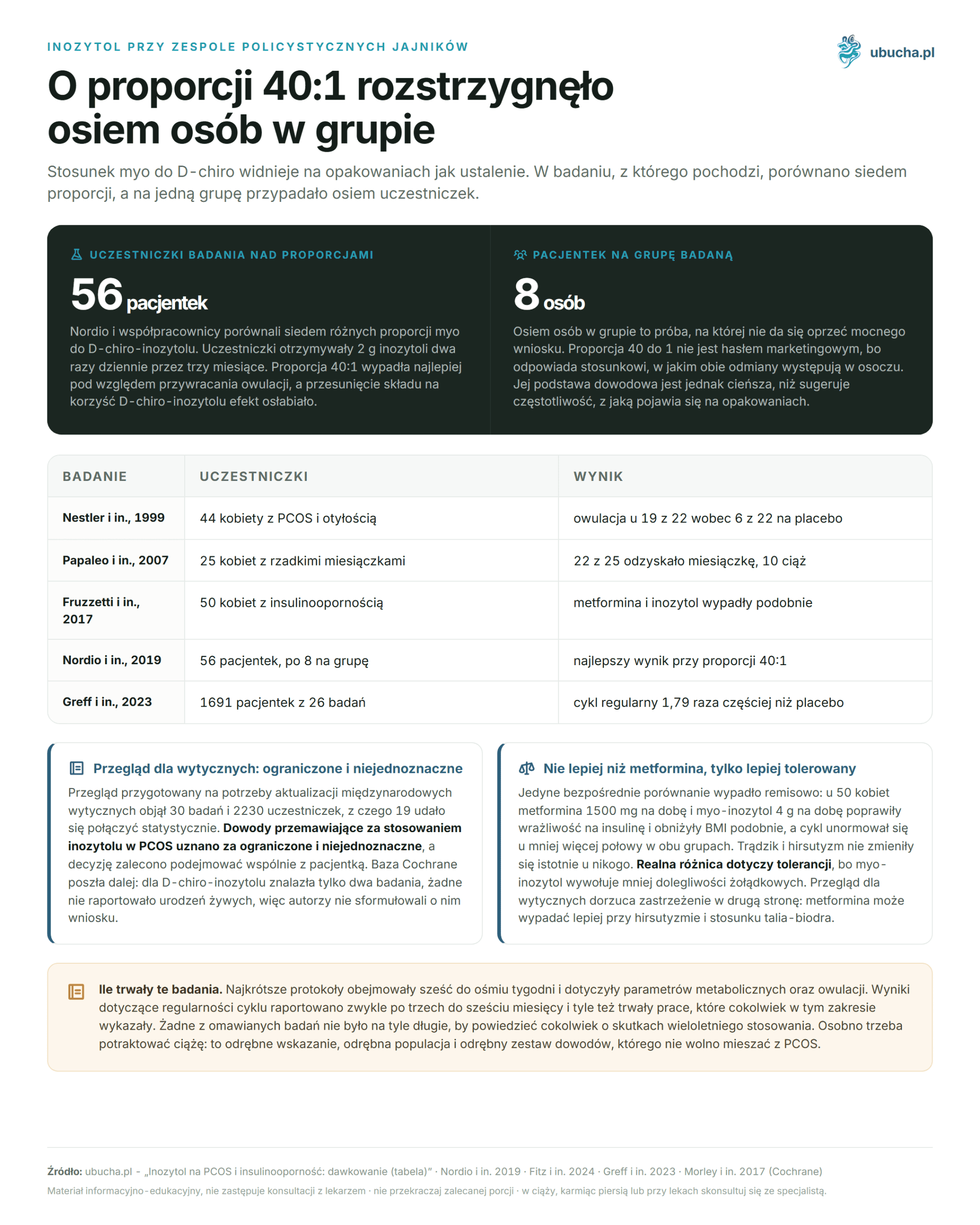
| Study | Participants | Research Protocol | Duration | Outcome |
|---|---|---|---|---|
| Nestler et al., 1999 | 44 women with PCOS and obesity | D-chiro-inositol 1200 mg once daily vs placebo | 6-8 weeks | ovulation in 19 out of 22 vs 6 out of 22 on placebo |
| Papaleo et al., 2007 | 25 women with PCOS and infrequent menstruation | myo-inositol with folic acid, 2 g twice daily | 6 months | 22 out of 25 regained spontaneous menstruation; 10 pregnancies |
| Fruzzetti et al., 2017 | 50 women with PCOS and insulin resistance | metformin 1500 mg/day vs myo-inositol 4 g/day | 6 months | similar results in both groups |
| Nordio et al., 2019 | 56 patients, 8 per group | seven ratios of myo to D-chiro, 2 g twice daily | 3 months | best result at 40:1 ratio |
| Greff et al., 2023 | 1691 patients from 26 studies | meta-analysis: inositol vs placebo and metformin | varied | regular cycle 1.79 times more often than on placebo |
Does inositol work better than metformin?
There is no data to confirm that. The only direct comparison in this table ended in a draw, and larger reviews at most speak of equivalence. The advantage of inositol lies elsewhere than in effectiveness.
Fruzzetti and colleagues randomly assigned 50 women with PCOS and insulin resistance or hyperinsulinemia to metformin at a dose of 1500 mg per day or to myo-inositol at a dose of 4 g per day and observed them for six months. Insulin sensitivity improved in both groups, BMI significantly decreased in both, and the cycle normalized in about half of the women, also in both. Acne and hirsutism did not change significantly in anyone (Fruzzetti et al., Gynecological Endocrinology, 2017).
The meta-analysis by Greff reached the same conclusion by a different route, describing inositol as not worse than metformin in most assessed outcomes. The review for the guidelines added an important caveat in the other direction: metformin may perform better regarding waist-to-hip ratio and hirsutism, and in terms of reproductive outcomes, there is likely no difference.
The real difference concerns tolerance. Myo-inositol causes fewer gastrointestinal complaints than metformin, and those that do occur are usually mild and self-limiting. This is an argument for the convenience of treatment, not its strength. Metformin remains a prescription drug, and the decision to replace anything with a supplement belongs to the attending physician, especially since both approaches act on the same mechanism.
What is the difference between myo-inositol and D-chiro-inositol?
They differ in the site of action, not in strength. Myo-inositol primarily acts on the ovary and the FSH pathway, while D-chiro-inositol acts on peripheral tissues. Hence the idea of administering both simultaneously in the ratio in which they occur in plasma, which is 40 to 1.
This ratio is not a marketing slogan, but its evidence base is thinner than the frequency with which it appears on packaging suggests. The study by Nordio and colleagues compared seven different ratios of myo to D-chiro in 56 patients, with only eight participants per group. The participants received 2 g of inositol twice daily for three months. The 40:1 ratio performed best in restoring ovulation, and shifting the composition in favor of D-chiro weakened the effect (Nordio et al., European Review for Medical and Pharmacological Sciences, 2019). However, eight participants per group is a sample on which strong conclusions cannot be based.
It is also worth noting that D-chiro-inositol is not a useless substance. It was D-chiro-inositol, administered alone at a dose of 1200 mg daily for six to eight weeks, that restored ovulation in 19 out of 22 women with PCOS and obesity in the NEJM study, compared to 6 out of 22 in the placebo group. In the same study, levels of free testosterone, area under the insulin curve, and blood pressure decreased.
After how long did changes appear in studies?
It depends on what is being measured. Metabolic parameters changed the fastest, as early as in six- and eight-week protocols. Results regarding cycle and ovulation were usually assessed after three to six months, and that is how long the studies that showed anything in this regard lasted.
The shortest protocol in this summary is six to eight weeks in Nestler’s study, where insulin, androgens, and ovulation were measured. Nordio assessed ovulation after three months. Papaleo and Fruzzetti conducted observations for six months and only reported the percentages of women with restored cycles during this window. None of these studies were long enough to say anything about the effects of long-term use.
Pregnancy should be treated separately. Inositol is sometimes studied in women with carbohydrate metabolism disorders during pregnancy, but this is a separate indication, a separate population, and a separate set of evidence, which we discuss in connection with myo-inositol in pregnancy and gestational diabetes. Conclusions from one indication should not be transferred to another.
The practical conclusion from all of this is that inositol is a substance with moderate and uncertain effects, studied in short protocols, on small groups, and with a large variety of preparations. If you are considering it for diagnosed PCOS, a conversation with a gynecologist or endocrinologist is part of the decision, not an alternative to it, especially when simultaneously taking metformin. The same caution applies to other ingredients studied for sugar metabolism, such as chrom.
Frequently Asked Questions
Does inositol cure PCOS?
No. None of the studies discussed showed a cure for the syndrome, only changes in selected parameters during the observation period. A review prepared for the international guidelines in 2023 classified the overall evidence as limited and ambiguous, which is far from claiming a cure.
Does inositol work better than metformin?
There is no evidence for that. In a direct comparison of 50 women, both substances yielded similar results after six months. Meta-analyses describe inositol as not worse, but not better, with metformin possibly performing better in terms of hirsutism and waist-to-hip ratio.
Where does the 40:1 myo to D-chiro ratio come from?
From the ratio in which both forms occur in plasma. A study comparing seven ratios in 56 patients indicated 40:1 as the most effective in restoring ovulation. However, each studied group had only eight participants, so this is a suggestion, not a conclusion.
Does D-chiro-inositol alone provide any benefits?
In a study published in NEJM, D-chiro-inositol administered alone restored ovulation in 19 out of 22 women, compared to 6 out of 22 on placebo. However, a Cochrane review found only two studies on this form, and neither reported live births, so the picture remains incomplete.
After how long did the studies measure the effect?
The shortest protocols lasted six to eight weeks and concerned metabolic parameters and ovulation. Results regarding cycle regularity were usually reported after three to six months. None of the studies discussed lasted longer than six months, so nothing can be concluded about long-term effects.
Is inositol safe?
In studies, it was well tolerated, and gastrointestinal complaints occurred less frequently than with metformin and were mild and self-limiting. This does not exempt one from medical consultation, especially when simultaneously treated with metformin, as both substances act on the same mechanism.
Preparations with inositol and other positions supporting carbohydrate metabolism can be found in the supplements category.
This article is for informational and educational purposes and does not constitute medical advice. Before starting supplementation, consult your doctor, especially if you are taking medications regularly, are pregnant or breastfeeding, or have chronic illnesses.
Author: Michał Waluk · Published: 2026-08-09 · Updated: 2026-08-11