
Apple Cider Vinegar for Diabetes and Glycemia: What Clinical Studies Say 2026
Apple cider vinegar lowers postprandial glycemia, but the effect is small, and the studies are small and short. Check the numbers, risks to enamel, and safety rules.
Apple cider vinegar has made it onto the list of home remedies for diabetes and holds a strong position there. However, the gap between promise and data is significant. Controlled studies do show a decrease in postprandial glycemia, but almost all involve a few dozen people, last a few weeks, and half are unblinded. A meta-analysis from 2025 rated the certainty of evidence as moderate for fasting glucose and low for HbA1c. Additionally, there are adverse effects that guides remain silent about: enamel erosion, esophageal irritation, and a reported case of hypokalemia. Below you will find what studies have actually measured, how large the effect is in numbers, who vinegar may harm, and why it cannot replace medications.
KEY INFORMATION
• A meta-analysis of seven trials in patients with type 2 diabetes: fasting glucose lower by 21.9 mg/dl, but five trials had a high risk of error (Arjmandfard et al., Frontiers in Nutrition, 2025).
• In blinded trials, the decrease in glucose was about 40% smaller than in open trials.
• Vinegar did not change the HOMA-IR insulin resistance index and does not replace antidiabetic medications.
• Eight weeks of daily vinegar consumption increased the dental erosion index by 18%.
Does apple cider vinegar lower blood sugar?
Yes, but the decrease is small and measured mainly on single meals. A systematic review with meta-analysis (Shishehbor et al., Diabetes Research and Clinical Practice, 2017) gave a standardized mean difference of -0.60 for the area under the glucose curve, with a confidence interval from -1.08 to -0.11. The authors themselves describe earlier trials as conflicting.
The width of this interval says more than the mean itself. Its lower bound is a clear effect, the upper is barely distinguishable from zero. With a few dozen small trials, such variability is the rule, not the exception.
A newer umbrella review (Shahmohammadi et al., Food Science and Nutrition, 2026) collected ten meta-analyses covering 38 primary studies and recalculated them with a common model. Fasting glucose decreased on average by 9.4 mg/dl, postprandial glycemia by 14.6 mg/dl, and HbA1c by 0.70 percentage points. The certainty of evidence for these results was rated as moderate. The HOMA-IR insulin resistance index did not budge, nor did fasting insulin and most lipid fractions.
Note what is missing in these numbers. None of the meta-analyses measured diabetes complications or cardiovascular events. All endpoints are laboratory markers observed over a few weeks. Improvement of a marker and real health benefit in diabetes are two different things, and the path from the first to the second goes through large, long-term studies that no one has conducted for vinegar.
What exactly did Johnston’s 2004 study show?
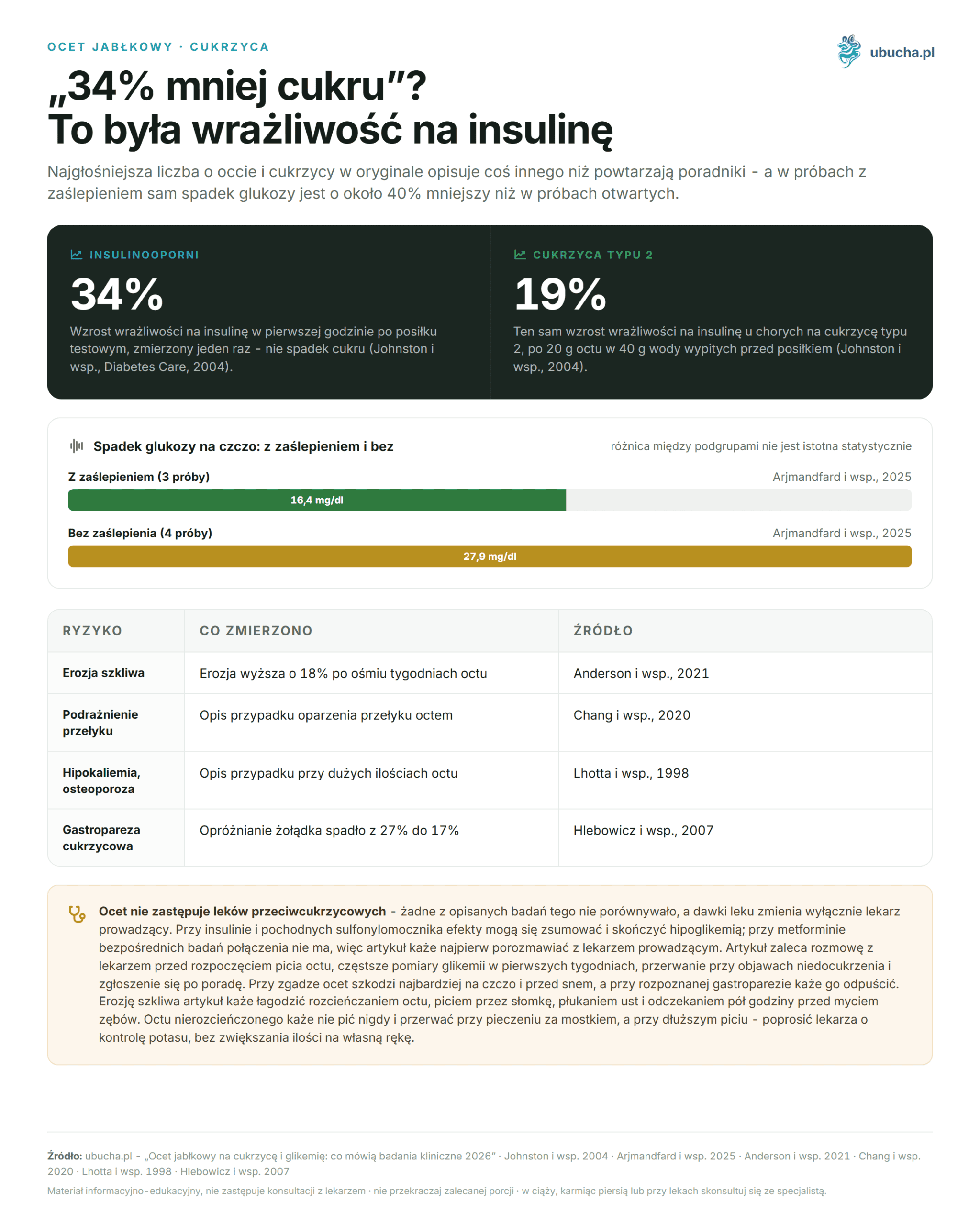
Increased insulin sensitivity, not a one-third decrease in sugar. In the paper Johnston et al. (Diabetes Care, 2004), 20 g of apple cider vinegar diluted in 40 g of water and consumed two minutes before a meal increased insulin sensitivity in the first hour after eating by 34% in insulin-resistant individuals and by 19% in patients with type 2 diabetes.
This is the most cited work on vinegar and glycemia, and at the same time the most misrepresented. In guides, the numbers 34% and 19% circulate as “sugar reduction,” although in the original they describe the parameter of insulin sensitivity calculated from glucose and insulin curves. The difference is not cosmetic. The first version promises one-third less sugar after a meal, the second speaks of more efficient insulin action for an hour.
The scale of the study also cools enthusiasm. Participants were divided into three groups of eight to twelve individuals: healthy with normal insulin sensitivity, insulin-resistant, and patients with type 2 diabetes. The test meal contained 87 g of carbohydrates, and the measurement covered the first hour after eating and was done once. No one has repeated this setup in a larger group.
There is another catch with this work that explains why the numbers swell so easily in citations. The report occupies two pages in Diabetes Care and has no abstract, so bibliographic databases show only the title. Those who do not reach for the full text copy percentages from someone else’s summary, and the title explicitly mentions insulin sensitivity, not diabetes control. It is worth returning to the source before accepting a number as your own.
How does apple cider vinegar affect glycemia?
By slowing gastric emptying and improving glucose uptake by muscles. Liljeberg and Björck (European Journal of Clinical Nutrition, 1998) showed in ten healthy volunteers that vinegar added to a starchy meal lowers glycemia and insulinemia, and a paracetamol marker indicates slower gastric emptying.
| Mechanism | What was measured | On whom |
|---|---|---|
| Slower gastric emptying | Lower marker level after a meal with vinegar, lower glycemia and insulinemia | 10 healthy volunteers (Liljeberg and Björck, 1998) |
| Glucose uptake by muscles | Increased glucose uptake in the forearm, decreased insulin and triglycerides | 8 individuals with impaired glucose tolerance (Mitrou et al., 2015) |
| The same in type 2 diabetes | Increased glucose uptake, decreased glucose and insulin in plasma | 11 individuals with type 2 diabetes (Mitrou et al., 2015) |
| Starch digestion | Effect only with complex carbohydrates, no effect with simple sugars | 4 crossover trials of 9-10 individuals (Johnston et al., 2010) |
| Intestinal absorption | Vinegar did not slow carbohydrate absorption, glucose rose even faster | 5 individuals (Salbe et al., 2009) |
The last row is the most interesting here. Salbe et al. (Nutrition Research, 2009) inhibited the participants’ own insulin secretion with octreotide to measure carbohydrate absorption alone. After vinegar, glucose rose slightly faster than after placebo. The popular explanation “vinegar blocks sugar absorption” therefore has no confirmation in humans.
The numbers in the table range from 5 to 11 individuals. With such trials, one atypical participant shifts the average, so treat the mechanisms as hypotheses with partial support, not as a described metabolic pathway. The works of Mitrou et al. (European Journal of Clinical Nutrition, 2015) and Mitrou et al. (Journal of Diabetes Research, 2015) measured glucose uptake using an arteriovenous method, which is precise, but on eight and eleven individuals.
How strong is the evidence for apple cider vinegar in diabetes?
Weaker than headlines suggest. A meta-analysis with GRADE assessment (Arjmandfard et al., Frontiers in Nutrition, 2025) included seven trials and 463 participants with type 2 diabetes. Five of the seven trials were rated as low quality, four were conducted without blinding, and all lasted from four to twelve weeks.
The results themselves sound good: fasting glucose lower by 21.9 mg/dl, HbA1c lower by 1.53 percentage points. However, the certificate beneath them is weak. The certainty of evidence on the GRADE scale was moderate for fasting glucose and low for HbA1c and HOMA-IR. The HbA1c analysis was based on four studies, and the heterogeneity of results reached 83%, meaning that individual trials practically measured different things. HOMA-IR did not change at all.
The most telling is the subgroup analysis by trial conduct method. In three blinded studies, fasting glucose decreased on average by 16.4 mg/dl. In four unblinded studies, it decreased by 27.9 mg/dl, which is seventy percent more. The difference did not reach statistical significance, but the direction is typical for the expectation effect on the part of the participant and researcher.
There is also geography to consider. Five of the seven trials came from Iran, and six from Asia. The authors themselves point this out as a limitation when transferring results to other populations and dietary patterns.
What risks does apple cider vinegar pose in diabetes?
Enamel erosion, esophageal irritation, hypokalemia with large amounts, and worsening of gastroparesis. Anderson et al. (Journal of Medicinal Food, 2021) measured an 18% increase in the dental erosion index in adults drinking diluted vinegar twice a day over eight weeks, with no changes in the control group.
| Risk | How do we know | What to do about it |
|---|---|---|
| Enamel erosion | Increase in erosion index by 18% after 8 weeks (Anderson et al., 2021) | Dilute, drink through a straw, rinse mouth with water, wait half an hour before brushing teeth |
| Esophageal damage | Described case of chemical burn from vinegar drink (Chang et al., 2020) | Never drink undiluted vinegar, stop if burning occurs behind the sternum |
| Hypokalemia and osteoporosis | Described case of hypokalemia and osteoporosis from consuming large amounts of vinegar (Lhotta et al., 1998) | Do not increase the amount on your own, ask your doctor to monitor potassium with long-term use |
| Diabetic gastroparesis | Vinegar further delayed gastric emptying in patients with neuropathy (Hlebowicz et al., 2007) | If diagnosed with gastroparesis, skip vinegar |
Gastroparesis deserves a separate mention because the mechanism of alleged benefit and the mechanism of harm are the same phenomenon here. Vinegar slows gastric emptying, and that is why it smooths the glycemic curve. In a person with autonomic neuropathy, the stomach already empties too slowly, so adding vinegar exacerbates bloating and fullness after meals. Hlebowicz et al. (BMC Gastroenterology, 2007) measured this effect in ten patients with type 1 diabetes diagnosed with gastroparesis: the median gastric emptying rate dropped from 27% after the meal to 17% after the meal with vinegar.
The case reports on which the two middle rows of the table are based concern extreme situations. Chang et al. (Clinical Endoscopy, 2020) described a fifteen-year-old with bloody vomiting and ulceration of the entire esophagus after daily consumption of commercial vinegar drink without sufficient dilution. Lhotta et al. (Nephron, 1998) described hypokalemia along with osteoporosis in a person consuming large amounts of apple cider vinegar. These are not common events, but they show where the limit lies.
Can apple cider vinegar replace antidiabetic medications?
No, and there is no room for discussion here. None of the described studies compared vinegar with an antidiabetic medication or checked what happens after discontinuing the medication. Diabetes without treatment leads to kidney, eye, and vascular complications that vinegar cannot reverse.
Independently discontinuing an antidiabetic medication or reducing its dose in favor of vinegar increases risk without compensation on the benefit side. Medication doses are changed only by the attending physician, based on measurements, not based on an article on the internet.
On the other hand, caution is equally necessary. Vinegar lowers postprandial glycemia, so when added to a medication that does the same, effects may sum up. With insulin and with sulfonylurea derivatives, which force insulin secretion regardless of blood sugar levels, such summation can end in hypoglycemia. There are no direct studies on these combinations, so no one can provide you with a predictable scale of the phenomenon.
The practical conclusion is simple. If you are being treated for diabetes, tell your attending physician about your intention to drink vinegar before you start, and for the first few weeks, measure your glycemia more often than usual. If symptoms of hypoglycemia appear, stop drinking vinegar and seek advice. Vinegar is not worth any episode of severe hypoglycemia.
How to use apple cider vinegar if the doctor sees no contraindications?
Diluted and with a starchy meal, in an amount agreed upon with the attending physician, because this article does not resolve that number. It is worth knowing how little was needed to measure anything. Johnston et al. (Annals of Nutrition and Metabolism, 2010) conducted four crossover trials with 9-10 individuals and noted a 20% reduction in postprandial glycemia with two teaspoons of vinegar, about 10 g, consumed during the meal.
This same work organizes practice with three observations. Vinegar consumed five hours before a meal worked worse than consumed with the meal. The sodium acetate did not work at all, so it is the acid itself that counts, not the acetate. With a drink of simple sugars, there was no effect, which limits the sense of vinegar to starchy meals.
The form also matters. Feise and Johnston (Journal of Nutrition and Metabolism, 2020) compared liquid vinegar with commercially available tablets in twelve healthy individuals. The liquid reduced the increase in glycemia after a meal by 31% compared to control, while whole swallowed tablets made no difference, despite higher declared acetic acid content.
Daily routine comes down to a few reflexes described in the recommendations column in the risk table above. Besides them, two rules apply. Do not drink vinegar on an empty stomach or before bed if you have heartburn. Do not increase the dose on your own, as above the amounts used in studies, only adverse effects increase. If after two weeks of glucometer measurements you see no difference, vinegar simply does not work for you, and there is no reason to continue.
Frequently Asked Questions
How much apple cider vinegar daily for diabetes?
We do not provide this number, as it is determined by the attending physician, knowing your medications and results. For the record: in seven trials collected by Arjmandfard et al. (2025), a more pronounced decrease in fasting glucose occurred above 10 ml per day, with the authors themselves calling the dose-response relationship uncertain.
Does apple cider vinegar lower HbA1c?
The data is inconsistent. Johnston et al. (Diabetes Research and Clinical Practice, 2009) noted a decrease in HbA1c by 0.16 percentage points with regular vinegar consumption, which is a change of no clinical significance. A meta-analysis from 2025 reported 1.53 points, but with a heterogeneity of results at 83% and low certainty of evidence on the GRADE scale.
Can apple cider vinegar be combined with metformin?
Only after consulting with the attending physician. Both lower glycemia, and there are no direct studies on this combination. For the first few weeks, measure your sugar more often and watch for symptoms of hypoglycemia. Metformin should not be discontinued or its dose reduced independently, regardless of what the glucometer shows.
Do apple cider vinegar tablets work the same as liquid?
No. Feise and Johnston (Journal of Nutrition and Metabolism, 2020) compared both forms in twelve healthy individuals. Liquid vinegar reduced the increase in glycemia after a meal by 31% compared to control, while whole swallowed tablets did not differ from control, despite higher declared acetic acid content.
Does apple cider vinegar help with type 1 diabetes?
There is very little data, and it is ambiguous. Mitrou et al. (Diabetes Care, 2010) described a decrease in postprandial glycemia in patients with type 1 diabetes. Hlebowicz et al. (BMC Gastroenterology, 2007) showed in ten patients with gastroparesis that vinegar further delays gastric emptying, making it difficult to match the insulin bolus to the meal.
Does apple cider vinegar damage teeth?
Yes, and this has been measured. Anderson et al. (Journal of Medicinal Food, 2021) noted an 18% increase in the dental erosion index after eight weeks of drinking diluted vinegar twice a day, with no changes in the control group. Dilution, using a straw, and rinsing the mouth limit the damage, but do not eliminate it.
We discuss the impact of apple cider vinegar on the esophagus and stomach in more detail in the text Apple Cider Vinegar for Reflux and Heartburn, and studies on prediabetes are discussed separately in the entry about apple cider vinegar in insulin resistance.
This article is for informational and educational purposes and does not constitute medical advice. Before starting supplementation, consult your doctor, especially if you are taking medications regularly, are pregnant or breastfeeding, or have a chronic illness.
Author: Michał Waluk · Published: 2026-06-22 · Updated: 2026-08-11