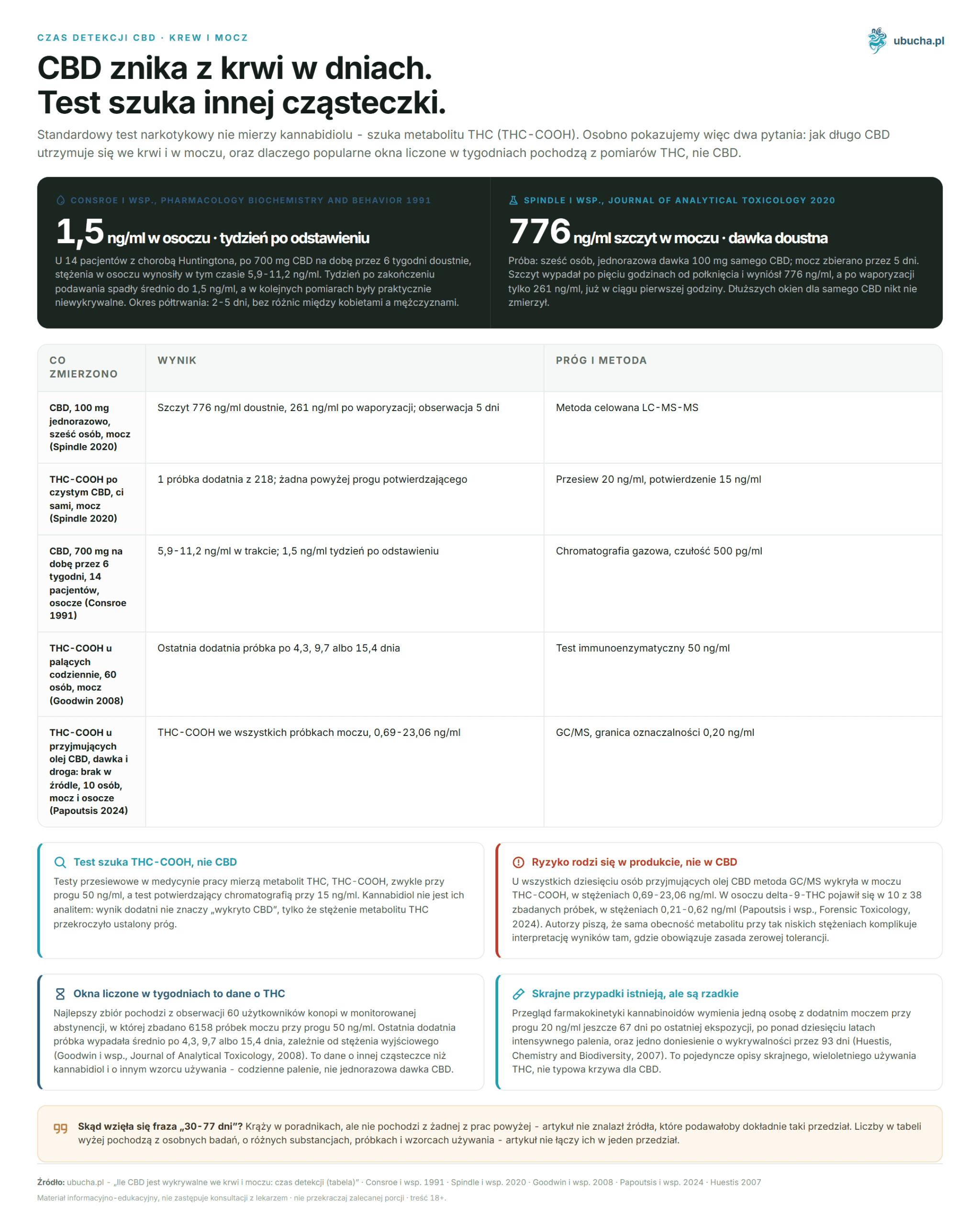

How much CBD is detectable in blood and urine: detection time (table)
Measured detection windows for CBD in blood and urine, cutoff thresholds used in drug tests, and what the Spindle study did not check at all.
The question always arises in the same context: occupational medicine testing, roadside checks, doping tests. The answer begins with a distinction that most guides miss. A standard drug test does not look for cannabidiol. It looks for the metabolite of tetrahydrocannabinol, namely THC-COOH, at a specified cutoff threshold. Without providing this threshold and method, any statement like “detectable for X days” is meaningless, as the same sample can be positive at one threshold and negative at another. Another thing that guides mix up is the two different molecules: data on the duration of THC can be presented as data on cannabidiol, even though both compounds metabolize differently. Below you will find values measured in studies with humans, specifying what they pertain to and at what cutoff threshold, as well as what the cited works on the internet did not check at all.
KEY INFORMATION
• Screening tests measure THC-COOH, usually at a threshold of 50 ng/ml, and the confirmatory test at 15 ng/ml. Cannabidiol is not their analyte.
• After a single 100 mg dose of pure CBD, one urine sample out of 218 was positive, and that was at a lowered threshold of 20 ng/ml (Spindle et al., Journal of Analytical Toxicology, 2020).
• Plasma: at 700 mg of CBD per day for six weeks, concentrations were 5.9-11.2 ng/ml, and one week after cessation, averaged 1.5 ng/ml (Consroe et al., 1991).
• Windows measured in weeks come from THC measurements in daily smokers, not from CBD measurements (Goodwin et al., 2008).
• In all ten individuals taking CBD oil, THC-COOH was detected in urine at concentrations of 0.69-23.06 ng/ml (Papoutsis et al., Forensic Toxicology, 2024).
What does a standard drug test really look for?
It looks for THC-COOH, or 11-nor-9-carboxy-delta-9-THC. Immunoassay tests used in occupational medicine usually operate at a screening threshold of 50 ng/ml, and the confirmatory test using mass spectrometry coupled with chromatography at a threshold of 15 ng/ml; these two values come from federal guidelines in the United States, to which the studies cited below refer. Cannabidiol itself is not an analyte in these tests.
This distinction determines the interpretation of every number of days. A positive result does not mean “CBD detected,” but rather “the concentration of the THC metabolite exceeded the established threshold.” The same urine sample can be positive at a threshold of 20 ng/ml and negative at 50 ng/ml, and that is exactly how the results looked in the study described below. Therefore, a detection window given without a threshold and method says nothing.
Measuring cannabidiol itself is technically possible, but requires a targeted method and is ordered in scientific studies or for product composition control. Employers or traffic police do not order it, as cannabidiol does not appear in the lists of controlled substances and has no threshold of liability.
This leads to the apparent paradox that arises in readers’ questions. Concentrations of cannabidiol in urine can be many times higher than concentrations of the THC metabolite, and yet the test result comes back negative because no one measures that substance. Conversely, this works with full-spectrum products: they contain the most cannabidiol, but the result is determined by trace amounts of THC.
How long does CBD stay in blood?
The longest published measurement in humans comes from a study on Huntington’s disease. Fourteen patients took 10 mg of CBD per kilogram of body weight per day, or about 700 mg daily, for six weeks. Average plasma concentrations during this time were 5.9-11.2 ng/ml.
The most important part for this topic is the section after cessation. One week after stopping administration, the CBD concentration averaged 1.5 ng/ml, and in subsequent measurements, it was practically undetectable. The authors estimated the half-life at about 2-5 days, with no differences between women and men (Consroe et al., Pharmacology Biochemistry and Behavior, 1991).
This value aligns with a systematic review of pharmacokinetic data in humans, which reports a half-life of 1.4-10.9 hours after aerosol administration, about 31 hours after smoking, and 2-5 days with chronic oral administration (Millar et al., Frontiers in Pharmacology, 2018). The same review states that the absolute bioavailability of CBD was measured in humans only after smoking and was 31%. Circulating ranges like 6-19% for oral administration or 31-56% for vaporization have no measurements behind them.
It is worth noting the scale of the dose. Seven hundred milligrams daily for six weeks is a clinical scheme in a neurological disease, many times higher than typical supplementation, so the times given are an upper, not an average estimate.
How much cannabidiol appears in urine and for how long?
The best-described measurement involved six healthy adults in an alternating design with four variants: 100 mg of CBD orally, 100 mg of CBD in a vaporizer, vaporized cannabis with a predominance of CBD (100 mg CBD and 3.7 mg THC), and placebo. Urine was collected before administration and for five days after.
Concentrations of cannabidiol itself were high: the average peak concentration was 776 ng/ml after oral administration and 261 ng/ml after vaporization, with the peak occurring five hours after ingestion and within the first hour after inhalation. After pure CBD, one sample out of 218 was positive, and that was only at a lowered threshold of 20 ng/ml, while none exceeded the confirmatory threshold of 15 ng/ml. After vaporizing CBD-dominant cannabis, nine samples were positive at the 20 ng/ml threshold, two also at 50 ng/ml, and four were confirmed by targeted method (Spindle et al., Journal of Analytical Toxicology, 2020).
The limitation of this work must be stated along with the result, as an extended version of it circulates on the internet. Samples were collected for five days, so the study does not answer what happens in the second or third week. Texts that refer to it with detection windows of 10-15 days attribute findings to it that it does not contain.
Where do detection windows measured in weeks come from?
From measurements of THC in people who smoke cannabis daily, not from measurements of cannabidiol. These are two different molecules with different metabolism, and mixing their data is the most common mistake in this topic.
The best collection comes from an observation of 60 cannabis users under monitored abstinence lasting up to 30 days, in which 6158 urine samples were tested at a threshold of 50 ng/ml. The last positive sample averaged 4.3, 9.7, or 15.4 days, depending on the baseline concentration of THC-COOH corrected for creatinine (Goodwin et al., Journal of Analytical Toxicology, 2008).
Extreme cases exist, but they are described individually. A review of cannabinoid pharmacokinetics in humans mentions one person whose urine was positive at a threshold of 20 ng/ml still 67 days after the last exposure, after more than ten years of heavy smoking, and one report of detectability for 93 days (Huestis, Chemistry and Biodiversity, 2007). The phrase “30-77 days” repeated in guides does not come from any of these works, and no source has been identified that would provide exactly that range.
| What was measured | Material | Result | Threshold and method |
|---|---|---|---|
| CBD, 100 mg once, six people | urine | peak 776 ng/ml orally, 261 ng/ml after vaporization; observation 5 days | targeted LC-MS-MS method |
| THC-COOH after pure CBD, six people | urine | 1 positive sample out of 218; none above the confirmatory threshold | screening test 20 ng/ml, confirmation 15 ng/ml |
| CBD, 700 mg per day for 6 weeks, 14 patients | plasma | 5.9-11.2 ng/ml during; 1.5 ng/ml one week after cessation | gas chromatography, sensitivity 500 pg/ml |
| THC-COOH in daily smokers, 60 people | urine | last positive sample after 4.3, 9.7, or 15.4 days | immunoassay test 50 ng/ml |
| THC-COOH in CBD oil users, 10 people | urine and plasma | THC-COOH in all urine samples, 0.69-23.06 ng/ml | GC/MS, limit of detection 0.20 ng/ml |
Can legal CBD oil yield a positive result?
It can, but the risk does not lie in the cannabidiol molecule itself, but in trace THC that ends up in the product along with the extract. Measurement in ten individuals taking CBD oil showed THC-COOH presence in all urine samples, at concentrations of 0.69-23.06 ng/ml, with a limit of detection of 0.20 ng/ml.
Delta-9-THC itself was not detected in urine, but it appeared in plasma in 10 out of 38 tested samples, at concentrations of 0.21-0.62 ng/ml (Papoutsis et al., Forensic Toxicology, 2024). The authors draw a cautious conclusion: the mere presence of the metabolite at such low concentrations complicates the interpretation of results where a zero-tolerance policy applies.
The second part of the problem is the composition of products. In an analysis of 80 unregulated cannabis products, delta-9-THC was detected above the limit of detection in 52 samples, at concentrations ranging from 0.008 to 2.071 mg/ml. Among 21 products described as THC-free, five contained detectable levels, from 0.015 to 0.656 mg/ml (Johnson et al., Drug and Alcohol Dependence, 2022). An earlier analysis of 84 products purchased online found THC in 21.4% of samples (Bonn-Miller et al., JAMA, 2017). Therefore, a certificate of analysis from an independent laboratory is the only information that resolves anything here. How the tests themselves work is broken down in our text about whether CBD shows up on drug tests.
What does Polish law say about CBD, drivers, and THC thresholds?
Cannabidiol does not appear in any of the lists of controlled substances. There is neither a threshold of liability nor an obligation to test for it. The lists are maintained by the regulation of the Minister of Health of August 17, 2018, regarding the list of psychotropic substances, narcotic drugs, and new psychoactive substances (t.j. Dz.U. 2024 poz. 1139 with amendments), and the word “cannabidiol” does not appear in it even once.
The value of 0.3% is sometimes presented in guides as the permissible THC content in CBD products, and this is a mistake. This threshold defines industrial hemp: it is the sum of delta-9-THC and tetrahydrocannabinolic acid in the flowering or fruiting tops of the plant, from which the resin has not been removed, rounded to one decimal place. The basis is Article 4 point 5 of the Act of July 29, 2005, on counteracting drug addiction (t.j. Dz.U. 2023 poz. 1939), as amended by the Act of March 24, 2022 (Dz.U. 2022 poz. 763). It pertains to the plant, not the finished product, and does not permit THC content in oil.
For drivers, Polish law does not establish a numerical concentration threshold. Testing for substances acting similarly to alcohol is conducted based on Article 129j of the Road Traffic Law, and the value of 1 ng/ml, which guides present as a liability threshold, is the limit of detection of the method from the 2014 regulation (Dz.U. 2014 poz. 948). For saliva, the regulation does not recognize any threshold. Separately, it is worth remembering that CBD remains unauthorized novel food in the EU, and sanitary notification is not authorization.
Frequently Asked Questions
Does CBD show up on a standard drug test?
CBD itself practically does not yield a positive result, as screening tests measure THC-COOH, not cannabidiol. After a single dose of 100 mg of pure CBD, one sample out of 218 was positive, and that was at a lowered threshold of 20 ng/ml, while none exceeded the confirmatory threshold of 15 ng/ml (Spindle et al., 2020). The risk comes from trace amounts of THC present in the product.
How long is CBD detectable in blood?
At 700 mg per day for six weeks, plasma concentrations were 5.9-11.2 ng/ml, dropping to an average of 1.5 ng/ml one week after cessation, and then were practically undetectable (Consroe et al., 1991). The half-life with chronic oral administration was estimated at 2-5 days. At supplemental doses, concentrations are correspondingly lower.
How long does CBD stay in urine?
The only controlled measurement collected urine for five days after a single 100 mg dose and showed peak concentrations of 776 ng/ml after oral administration and 261 ng/ml after vaporization (Spindle et al., 2020). No longer windows for cannabidiol have been measured, so the 10-15 days cited in guides is a number without research.
Where do numbers like 15 or 30 days come from?
From measurements of THC-COOH in people who smoke cannabis daily. In a study of 60 users at a threshold of 50 ng/ml, the last positive urine sample averaged 4.3, 9.7, or 15.4 days, depending on the baseline concentration (Goodwin et al., 2008). This data pertains to a different molecule than cannabidiol and a different usage pattern.
Is CBD isolate safer than full-spectrum oil?
In terms of the risk of a positive result, yes, because the source of the problem is THC, not cannabidiol. However, this does not guarantee safety: in an analysis of 80 products, five out of 21 described as THC-free contained detectable levels of this substance (Johnson et al., 2022). Only the certificate of analysis for a specific batch resolves this issue.
Does Polish law set a THC threshold for drivers?
No. Regulations do not specify a numerical concentration limit for drivers, and the value of 1 ng/ml from the 2014 regulation (Dz.U. 2014 poz. 948) is the limit of detection of the method, not a threshold of liability. There is no threshold for saliva in the regulations. The basis for testing for substances acting similarly to alcohol is Article 129j of the Road Traffic Law.
The oils available in our store have been collected in the oils category; always check the certificate of analysis for a specific batch. A broader discussion of the detection time itself has been gathered in the text about how long CBD stays in urine, and data on THC in the text about how long marijuana stays in the body.
This article is for informational and educational purposes and does not constitute legal advice. The legal status described in the article is valid as of the date of publication: regulations regarding cannabis may change. Before making decisions, consult a lawyer or current legal acts.
Author: Michał Waluk · Published: 2026-07-31 · Updated: 2026-08-16