
CBD vs THC vs CBG - properties, differences and uses 2026
CBD vs THC vs CBG - comparison of structure, receptor mechanisms, clinical uses and legal status in Poland in 2026. Table and cost per 100 mg.
Industrial hemp contains over five hundred chemical compounds, of which 125 are classified as cannabinoids, but clinical studies and store shelves focus mainly on three: CBD, THC and CBG. The names sound similar, the acronyms differ by one letter, yet each molecule does something different in the body. The first calms without intoxication, the second alters consciousness and in Poland is available only by prescription, the third is the chemical starting point for both others. This article compares them on four levels: molecular structure, receptor affinity, confirmed uses, and legal status. You will also find a table of oils from our catalog and a cost calculator per 100 mg. After reading, you will know which cannabinoid suits your goal.
KEY INFORMATION
• CBD and THC have the formula C21H30O2, CBG has C21H32O2 (PubChem, NIH).
• Only THC intoxicates because it strongly stimulates the CB1 receptor.
• In Poland, CBD and CBG are legal, THC only by prescription.
• The cheapest 100 mg of CBD costs 9.50 PLN, 100 mg of CBG costs 16.00 PLN.
What are cannabinoids and why do studies focus on these three?
Cannabinoids are lipophilic compounds with a skeleton of twenty-one carbon atoms that interact with the mammalian endocannabinoid system. A review published in the journal Molecules states that over 500 compounds have been isolated from industrial hemp, of which 125 are classified as cannabinoids (Radwan et al., Molecules, 2021). The popular internet claim of “over 150” is not supported by peer-reviewed literature.
Of these 125 compounds, the market and medicine have selected three, not by chance. CBD and THC accumulate in flower clusters in amounts measured in percent of dry mass. The rest, including CBN or CBC, occur only in trace amounts and for decades were background noise for analysts. CBG is the opposite exception: very little remains in the mature plant, but it is the precursor of all others.
The endocannabinoid system was discovered relatively recently. The CB1 receptor was cloned in 1990, CB2 three years later, and the first endogenous ligand, anandamide, was identified in 1992. The body produces its own cannabinoids. They regulate sleep and appetite, influence pain perception, mood, and inflammatory response. Plant molecules mimic or modify their action.
The practical conclusion for the reader is this: comparing CBD, THC and CBG by “which is stronger” makes no sense because they do not do the same thing with different strength. Each affects a different set of receptors, so the question is rather: which profile matches what you seek. Less known cannabinoids are discussed separately in the post about CBDA and CBC.
How do CBD, THC and CBG molecules differ?
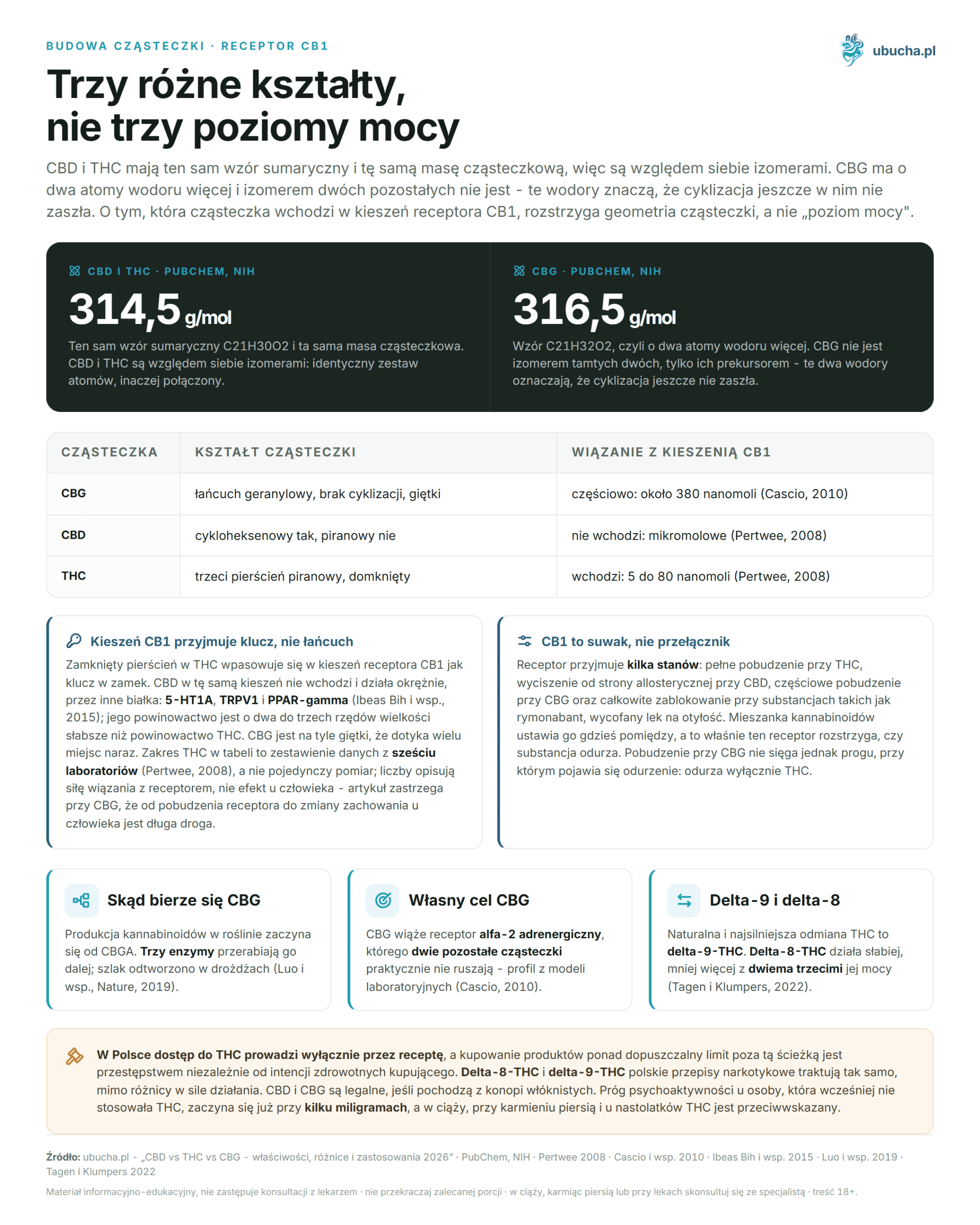
Here a common misconception repeated in hundreds of articles must be corrected. CBD and THC indeed have the identical molecular formula C21H30O2 and molecular mass 314.5 g/mol, so they are isomers of each other. However, CBG has the formula C21H32O2 and mass 316.5 g/mol, i.e. two more hydrogen atoms (PubChem, NIH). The statement “all three have the same formula” is simply false.
The difference comes from geometry. CBG is an open molecule: the geranyl chain hangs freely from the resorcinol ring and does not close into a second ring. These two extra hydrogens mean cyclization has not yet occurred. THC is the most closed molecule, with a third pyran ring formed by connecting the chain to the aromatic ring. CBD lies in between: it has a closed cyclohexene ring but free hydroxyl groups and no pyran ring.
This seemingly minor difference determines everything that follows. The closed ring in THC fits into the CB1 receptor pocket like a key in a lock. CBD does not enter that pocket and acts indirectly through other proteins. CBG is flexible enough to touch many sites at once but does not bind strongly to any. Three different shapes, not three levels of potency.
One more distinction is worth knowing. THC occurs in several stereoisomers, the natural and strongest being delta-9-THC. Delta-8-THC differs by the position of one double bond and is weaker, about two-thirds the potency of the natural form (Tagen and Klumpers, British Journal of Pharmacology, 2022). Polish narcotics law treats both isomers equally.
Why is CBG called the mother of cannabinoids?
Because it literally is. All cannabinoid production in the plant starts from cannabigerolic acid, CBGA, the acidic form of CBG. Three enzymes convert it further: THCA synthase produces tetrahydrocannabinolic acid, CBDA synthase produces cannabidiolic acid, and CBCA synthase produces cannabichromenic acid. This pathway was fully recreated in yeast, confirming the reaction order outside the plant (Luo et al., Nature, 2019).
Which enzyme dominates depends on the genetics of the variety. Industrial hemp has active CBDA synthase and practically inactive THCA synthase, so it accumulates CBD and only trace THC. Narcotic varieties are the opposite. This single genetic difference divides plants into legal and illegal, despite similar appearance and smell.
Acid forms do not act on receptors like neutral forms. Only decarboxylation, i.e. removal of the carboxyl group by heat or long aging, converts THCA to THC, CBDA to CBD, and CBGA to CBG. That is why raw hemp acts differently than vaporized hemp, and raw leaf infusions differ from heat-processed products.
The practical effect is that mature plants contain almost no CBG. Enzymes have converted nearly all CBGA, so typical material has less than one percent CBG, compared to several percent CBD. Dedicated CBG oils come from varieties bred to prevent conversion and accumulate the precursor. This explains the price difference, discussed later.
How does CBD act on receptors?
CBD is a molecule that does not fit the “ligand fits receptor” model. Its affinity for cannabinoid receptors is micromolar, two to three orders of magnitude weaker than THC’s affinity (Pertwee, British Journal of Pharmacology, 2008). Its pharmacology thus plays out elsewhere.
A review of CBD molecular targets highlights three proteins: serotonin receptor 5-HT1A, vanilloid receptor TRPV1, and nuclear receptor PPAR-gamma (Ibeas Bih et al., Neurotherapeutics, 2015). Activation of 5-HT1A explains anxiolytic effects, as buspirone targets the same receptor. TRPV1 mediates heat and pain sensation; prolonged activation desensitizes the signal, similar to capsaicin patches.
There is also an indirect mechanism more interesting than the above. CBD inhibits breakdown of anandamide, the body’s endogenous cannabinoid, raising its levels. Instead of replacing the body’s own messenger with a plant one, CBD prolongs the action of the existing one. This explains why effects are subtle and build over weeks, unlike THC’s immediate effects.
CBD also affects CB1 receptor allosterically, binding outside the main pocket and changing receptor shape so THC binds less well (Russo, British Journal of Pharmacology, 2011). Therefore, mixtures of CBD and THC produce milder intoxication than THC alone at the same dose.
How does THC act on receptors?
THC acts exactly as an agonist textbook describes: it enters the main pocket of CB1 receptor, strongly stimulates it, and triggers a cascade of signals. Data from six labs show affinity to CB1 ranging from 5 to 80 nanomolar, and to CB2 from 3 to 75 nanomolar (Pertwee, 2008). These nanomolar values are three orders of magnitude stronger than CBD’s.
CB1 receptor is densely located in the prefrontal cortex, hippocampus, basal ganglia, and cerebellum. Its activation alters glutamate and GABA release, the main excitatory and inhibitory neurotransmitters. This causes effects such as relaxed thinking, impaired short-term memory, altered time perception, and coordination problems.
The reward pathway acts separately. THC increases dopamine release in the ventral tegmental area and nucleus accumbens, which the brain interprets as reward. In the amygdala, the reaction can be bidirectional: low doses reduce anxiety, high doses may increase it up to paranoia. This explains why the same dose affects two people very differently.
Tolerance develops at CB1, unlike with CBD. With daily use, receptor density in the brain decreases, requiring higher doses for the same effect, but after a few weeks off, the system resets. This difference matters practically for planning long-term therapy and distinguishes THC from the other two molecules.
How does CBG act on receptors?
CBG occupies an intermediate position and is the least studied of the three. It stimulates CB1 and CB2 receptors partially and with much lower affinity than THC: about 380 nanomolar for CB1 and micromolar for CB2 (Cascio et al., British Journal of Pharmacology, 2010). The stimulation does not reach the threshold for intoxication.
More interestingly, the same study showed CBG binds the alpha-2 adrenergic receptor with very high efficacy and acts as an antagonist at 5-HT1A. Alpha-2 is targeted by clonidine and guanfacine, drugs used for hypertension and attention disorders, while the other two cannabinoids barely affect it. This is CBG’s most distinctive feature.
CBG also activates TRPV1 and influences GABAergic transmission by inhibiting reuptake. Its receptor profile is thus broader than CBD’s but described in far fewer studies and almost exclusively in lab models, not humans.
A fair assessment is: CBG has the most promising profile and the weakest evidence base. Almost all knowledge comes from cell and animal studies. Randomized clinical trials in humans are practically absent, and those decide if test-tube mechanisms translate to patient effects. Promises sound good but remain promises.
Which cannabinoid stimulates CB1 receptor and which calms it?
CB1 is the most abundant receptor protein in the human brain and determines intoxication. Only THC strongly stimulates it. CBD binds thousands of times weaker and acts allosterically, while CBG partially stimulates with moderate affinity. This single axis explains most legal and practical differences among the three molecules.
CB1 is not a simple on/off switch. It adopts several states: full activation by THC, allosteric calming by CBD, partial activation by CBG, and full blockade by substances like rimonabant, a withdrawn obesity drug. It’s more a slider with multiple positions than a switch, and cannabinoid mixtures set it somewhere in between.
We noticed this point is often misunderstood in customer conversations. People assume CBD and THC from the same plant act similarly but with different strength. In fact, they act oppositely on the same receptor, so CBD reduces THC-induced anxiety rather than increasing it.
The practical takeaway: if you want no intoxication, look at one number: THC content in the product. CBD or CBG concentration does not matter here because neither stimulates CB1 enough to cause effects. Even very large CBG doses do not produce psychoactive effects.
What does CB2 receptor do and which cannabinoid activates it?
CB2 is mainly outside the brain: in lymphocytes, macrophages, lymphatic tissue, and microglial cells. Its activation modulates inflammatory response by inhibiting cytokine release and leukocyte migration. Since CB2 does not cause intoxication, it is an attractive target for anti-inflammatory drugs without psychoactive effects.
The balance differs from CB1. THC partially stimulates CB2 with nanomolar affinity, CBD binds weakly and most of its anti-inflammatory action is via other pathways, mainly PPAR-gamma and inhibition of enzymes breaking down endocannabinoids. CBG lies between with micromolar affinity.
CB2 receptor density is not constant. It increases in inflamed tissue as immune cells upregulate expression in response to damage. This explains users’ observation that cannabinoid anti-inflammatory effects are more noticeable where the problem exists than in healthy tissue. The endocannabinoid system acts as an on-demand regulator.
Another relevant fact for extract choice: beta-caryophyllene, a terpene responsible for black pepper’s spicy aroma and many cannabis varieties, directly stimulates CB2. It is the only common terpene that is a formal cannabinoid receptor agonist, so extracts containing terpenes act on CB2 more strongly than isolates alone.
Thus, the difference between isolate and full extract is not just marketing. Isolate is one molecule and one target set. Extract contains other cannabinoids and terpenes hitting targets unavailable to the main substance. More on this in the post about terpenes in CBD oils.
Which receptors beyond CB1 and CB2 mediate cannabinoid effects?
If only CB1 and CB2 mattered, CBD would be almost inactive because it binds both weakly. Instead, four other proteins are responsible: 5-HT1A, TRPV1, alpha-2 adrenergic, and PPAR-gamma. These form the true map of differences among the three cannabinoids.
5-HT1A belongs to the serotonin system and regulates mood and anxiety response. CBD stimulates it, CBG acts as an antagonist, and THC barely affects it. TRPV1 responds to heat and pain stimuli; prolonged activation desensitizes pain transmission. Both CBD and CBG activate it.
Alpha-2 adrenergic regulates noradrenaline release, vessel tone, and arousal level. CBG binds it most strongly, its hallmark. PPAR-gamma acts in the cell nucleus, changing gene expression related to sugar and fat metabolism. CBD mainly stimulates it, explaining why some effects appear only after weeks of regular use.
This multitarget action has a cost. A substance affecting five proteins rarely produces one clear effect but several weaker ones. This explains disappointment among those expecting CBD to act like a sleeping pill. Pharmacologically, it is a broad, gentle shift rather than a strong hit at one point.
The picture is simple: THC has a narrow but very strong profile focused on cannabinoid receptors. CBD has a broad, dispersed profile beyond them. CBG stands in the middle, touching both worlds plus a receptor untouched by the other two.
Why does only THC intoxicate?
The answer fits in one sentence: only THC stimulates CB1 receptor strongly and directly enough. Its affinity is in nanomolar range, CBD’s in micromolar, and CBG’s in between as a partial agonist. The rest of the differences follow from this one.
Mechanically, CB1 activation in the ventral tegmental area increases dopamine release in the nucleus accumbens, perceived as reward. Simultaneously, CB1 in the hippocampus impairs new memory formation, and in the prefrontal cortex relaxes thought control. The sum of these effects is the state commonly called intoxication.
The psychoactive threshold for a THC-naive person starts at a few milligrams. By comparison, CBD doses used in anxiety studies reach six hundred milligrams without similar effects. It’s not a matter of degree but a different brain target.
Why the same dose affects two people differently? CB1 receptor density varies individually and decreases with regular use; THC metabolism depends on genetically determined liver enzymes. CBD content in the material also dampens effects. Three variables, one unpredictable outcome.
For CBG, the barrier is quantitative. It theoretically stimulates CB1 but so weakly that effective doses would be unattainable in any product. Practically, no one reports intoxication from CBG, and drug tests do not detect it because they look for THC metabolites, not cannabinoids in general. Detection times are discussed in the post about CBD detectability in blood and urine.
What clinical uses does CBD have?
CBD is the only cannabinoid that has completed full registration as a single active substance. The US agency approved Epidiolex on June 25, 2018, and the European agency issued EU authorization for Epidyolex on September 19, 2019, for indications including Dravet syndrome, Lennox-Gastaut syndrome, and tuberous sclerosis (EMA, 2019).
Registration was based on randomized placebo-controlled trials. In a trial of 120 children and young adults with Dravet syndrome, median monthly seizure frequency dropped from 12.4 to 5.9 with CBD, versus 14.9 to 14.1 with placebo; 43 percent of patients achieved at least 50% reduction versus 27 percent on placebo (Devinsky et al., New England Journal of Medicine, 2017).
The second area with decent evidence is anxiety. In a study of 24 patients with social phobia, a single 600 mg dose of CBD given 90 minutes before simulated public speaking reduced anxiety, discomfort, and cognitive impairment versus placebo (Bergamaschi et al., Neuropsychopharmacology, 2011). The trial was small and preliminary, as authors note.
Sleep and recovery have weaker evidence. In a retrospective series of 72 patients, 66.7 percent reported improved sleep in the first month, and 79.2 percent reduced anxiety, though sleep results varied over time (Shannon et al., Permanente Journal, 2019). There was no control group, so treat as suggestive, not proof.
What clinical uses does THC have?
THC has the longest medical history among the three and the most formal restrictions. In EU countries, an oral spray combining THC and CBD roughly 1:1 is approved for spasticity in multiple sclerosis patients unresponsive to standard treatment. Registration was national, not centralized.
The second major area is chronic pain, but results require cautious interpretation. A meta-analysis in JAMA covered 79 randomized trials with 6462 patients. Thirty-seven percent on cannabinoids achieved at least 30% pain reduction versus 31% on placebo, but confidence intervals included unity, so difference was not statistically significant (Whiting et al., JAMA, 2015).
Authors rated evidence quality for chronic pain and spasticity as moderate, and for chemotherapy-induced nausea, HIV-related weight gain, and sleep disorders as low. They also noted increased risk of short-term adverse effects, including serious ones. This is the most honest summary of current knowledge.
The third indication is nausea and vomiting after chemotherapy and appetite stimulation in wasting syndrome. Synthetic THC derivatives are used where classic antiemetics fail. In Poland, THC access is only by prescription; buying products exceeding legal limits outside this route is a crime regardless of health intent. Consequences are discussed in the post about marijuana possession liability.
What is known about CBG effects?
Much less than the other two, and it is fair to say so. CBG research consists of cell line studies, animal models, and one survey study. Randomized placebo-controlled clinical trials in humans are practically absent, so any efficacy statement should be read with this caveat.
The best documented direction is intestinal inflammation. In a mouse model of colitis induced by dinitrobenzene sulfonic acid, CBG reduced lesion severity, myeloperoxidase activity, and proinflammatory cytokines (Borrelli et al., Biochemical Pharmacology, 2013). Another direction is neuroprotection: in two Huntington’s disease models, CBG improved motor function and protected striatal neurons (Valdeolivas et al., Neurotherapeutics, 2015).
Separately, antibacterial activity stands out. CBG inhibited growth of MRSA USA300 strain at a minimum inhibitory concentration of 2 micrograms per milliliter, disrupted bacterial biofilm, and in a mouse infection model acted comparably to vancomycin by attacking the cytoplasmic membrane (Farha et al., ACS Infectious Diseases, 2020). This is a lab discovery not yet translated into any registered product.
The only human data come from a survey of 127 people using CBG-dominant products. Most used it for anxiety (51.2%), chronic pain (40.9%), depression (33.1%), and insomnia (30.7%). Forty-four percent reported no adverse effects; the most common were dry mouth and drowsiness (Russo et al., Cannabis and Cannabinoid Research, 2022).
Does CBG really improve concentration?
This claim is repeated by half the internet and we ourselves propagated it until recently, so we checked the source. In the only human survey, concentration and focus did not appear at all: respondents listed anxiety, chronic pain, depression, and insomnia, but no item concerned attention or mental performance (Russo et al., 2022). The “51 percent improved concentration” figure circulating in Polish articles is a misinterpretation of 51.2 percent of respondents using CBG for anxiety.
Where does the belief in CBG as a focus aid come from? Most likely pharmacology, not observation. CBG stimulates the alpha-2 adrenergic receptor, the same targeted by guanfacine and clonidine used in attention disorders. Inferring effect from mechanism is tempting but unreliable because the path from receptor activation to human behavior change is long.
The second probable source is a simple contrast with CBD. CBD at doses above 30 mg can cause drowsiness, while CBG usually does not. Lack of sleepiness is easily described as “greater focus,” though it is not the same. The difference lies in what is absent, not what the substance adds.
The cautious conclusion: CBG may be a good daytime choice because it does not cause sleepiness and has a distinctive receptor profile. However, no study shows improved attention, working memory, or reaction time in humans. If someone sells you CBG as a concentration aid, they are selling a hypothesis.
How do CBD, THC and CBG compare in safety?
Safety profile is where differences are sharpest. The 2018 WHO Expert Committee on Drug Dependence report rated CBD as well tolerated, with a favorable safety profile and no addiction potential (WHO ECDD, 2018). Common side effects are drowsiness, dry mouth, and diarrhea at higher doses.
THC has a much narrower margin. Short-term effects include increased heart rate, coordination and memory impairment, and anxiety reactions. Long-term, some regular users develop cannabis use disorder, and those with family history of psychosis have increased risk. THC is contraindicated in pregnancy, breastfeeding, and adolescents.
CBG fares least clearly here, not because it is more dangerous but because it has not been studied in large groups long-term. Available observations come from a survey where 44% reported no side effects and others mild symptoms. Lack of alarm signals is not proof of safety.
| Feature | CBD | THC | CBG |
|---|---|---|---|
| Intoxication | no | yes | no |
| Addiction potential | none per WHO | documented | no reports |
| Typical side effects | drowsiness, dry mouth | tachycardia, anxiety, memory impairment | dry mouth, drowsiness |
| Driving | allowed | prohibited | allowed |
| WADA list | removed in 2018 | banned in sports | never listed |
| Human data | randomized trials | randomized trials | one survey |
Drug interactions are a separate topic. CBD inhibits liver enzymes CYP3A and CYP2C, responsible for metabolizing about 30% and 25% of drugs respectively, i.e. over half the market combined. Interaction with clobazam is best documented; warfarin requires coagulation monitoring (Brown and Winterstein, Journal of Clinical Medicine, 2019).
Are CBD and CBG legal in Poland in 2026?
Yes, under one condition: they must come from industrial hemp. The anti-narcotics law defines these as varieties with total delta-9-THC and tetrahydrocannabinolic acid not exceeding 0.3 percent dry mass (Journal of Laws 2005 No. 179 item 1485). Pure CBD and CBG are not on any controlled substance list.
The limit was not always this high. It was raised from 0.20 to 0.30 percent by the amendment of March 24, 2022, published April 6 and effective May 7, 2022 (Journal of Laws 2022 item 763). The change aligned Polish law with the EU threshold and covered the entire chain from cultivation to finished product.
THC remains on the other side of this boundary. Possession of products exceeding the limit without prescription is a crime; the only legal access is through a doctor and pharmacy. Neither health intent nor availability in other EU countries changes this. Consequences are described in the post about marijuana possession liability.
For athletes, one more fact matters. The World Anti-Doping Agency removed CBD from the banned list effective January 1, 2018, and the urine threshold for THC metabolite is 150 nanograms per milliliter, raised in 2013 from 15 nanograms (Lachenmeier and Diel, Sports, 2019). CBG has never been on the list.
What is the entourage effect?
The entourage effect is a hypothesis that cannabinoids and terpenes act together more strongly than each alone. It was formulated by Ethan Russo in British Journal of Pharmacology in 2011, based mainly on pharmacology of individual components rather than human studies comparing extracts with isolates (Russo, 2011). After fifteen years, the evidence has changed less than expected.
The best proven part concerns the CBD-THC pair. The mechanism is known and reproducible: CBD changes CB1 receptor shape allosterically, making THC bind weaker and produce milder intoxication. The rest, i.e. the contribution of terpenes and minor cannabinoids, is based on pharmacological hints.
Terpenes themselves have documented effects. Beta-caryophyllene directly stimulates CB2. Linalool, responsible for lavender scent, affects GABAergic transmission. Myrcene is associated with calming effects, limonene with mood improvement. Whether concentrations in oils suffice for clear effects remains open.
How to check when buying? Terpene profile and cannabinoid content are given in the certificate of analysis (COA) issued for each batch. A producer who does not publish it asks you to trust what can be measured. The label claim of full spectrum alone says nothing about proportions.
Practically, it comes down to choosing among three extract types. Isolate contains one purified substance. Broad spectrum extract contains other cannabinoids and terpenes but no THC. Full spectrum extract retains everything including trace THC within legal limits. If you undergo drug testing, choice narrows to the first two.
Which cannabinoid to choose for your goal?
Choice depends on time of day and goal, not on which cannabinoid is better. CBD works well in the evening and for calming states: nervous tension, sleep difficulties, post-exercise recovery. CBG is chosen for daytime because it does not cause sleepiness and has a different receptor profile than CBD. THC remains a medical-only option.
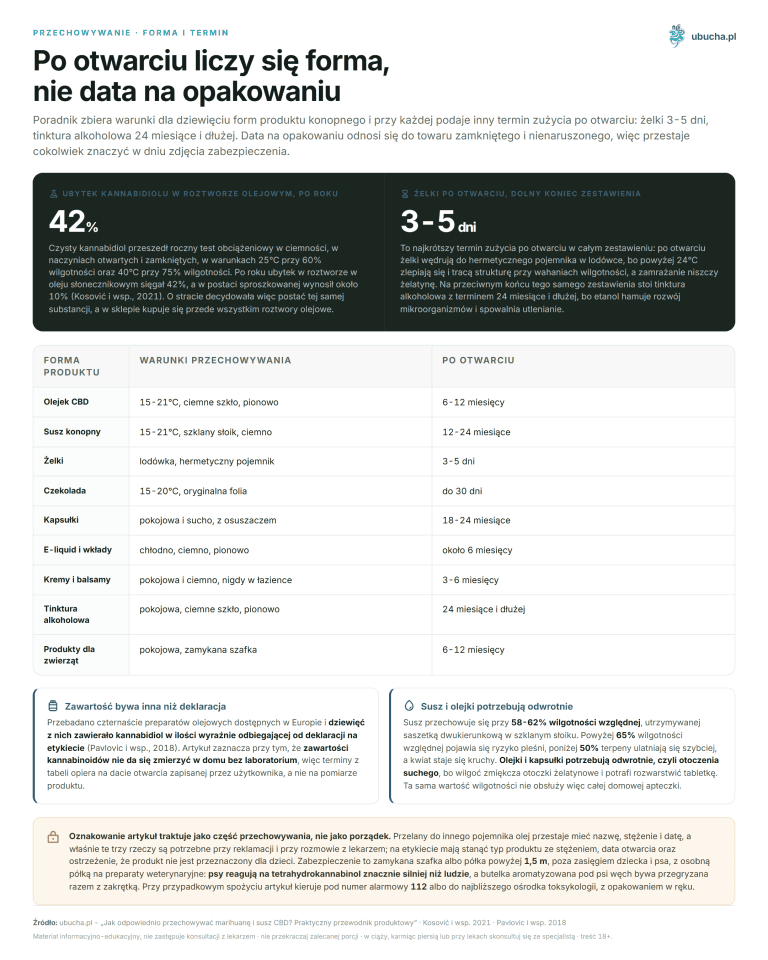
The table below lists all oils currently available in our category, ranked by cost per 100 mg of pure cannabinoid. This metric is the only fair comparative measure because bottle price alone says nothing without concentration. Prices come from the store API and reflect status as of August 8, 2026.
| Rank | Oil | Highlight | Price | Cost per 100 mg |
|---|---|---|---|---|
| 1 | CANNOVA Natural CBD Oil 2000 mg, 20%, 10 ml | Lowest unit cost in catalog | 190.00 PLN | 9.50 PLN |
| 2 | CANNOVA Natural CBD Oil 1000 mg, 10%, 10 ml | Dose concentration 20-40 mg daily | 110.00 PLN | 11.00 PLN |
| 3 | CANNOVA Natural CBD Oil 500 mg, 5%, 10 ml | Lowest entry threshold, small dose steps | 65.00 PLN | 13.00 PLN |
| 4 | CANNOVA Natural CBG Oil 1500 mg, 15%, 10 ml | Cheapest CBG per milligram | 240.00 PLN | 16.00 PLN |
| 5 | CANNOVA Natural CBG Oil 1000 mg, 10%, 10 ml | Medium concentration, about 5 mg per drop | 175.00 PLN | 17.50 PLN |
| 6 | CANNOVA Natural CBG Oil 500 mg, 5%, 10 ml | Trial version before higher concentration | 100.00 PLN | 20.00 PLN |
Check prices before purchase as the catalog rotates faster than article content.
How much does 100 mg of CBD and 100 mg of CBG cost?
The difference is greater than label price suggests and smaller than the common opinion that CBG is three times more expensive than CBD. Calculated per 100 mg pure cannabinoid, our catalog range is from 9.50 PLN to 20.00 PLN, just over double between extremes.
The chart shows two patterns. First, within each substance, cost efficiency increases with concentration: moving from 5 to 20 percent CBD reduces cost per mg by over a quarter, and from 5 to 15 percent CBG by a fifth. Second, at the same 5 percent concentration, CBG costs 20.00 PLN per 100 mg versus 13.00 PLN for CBD, i.e. 50% more.
This difference has an agricultural origin, not marketing. Mature plants convert nearly all CBGA to other cannabinoid acids, so CBG raw material comes only from specially selected varieties grown on a smaller scale. Regular material yields below one percent CBG and is unsuitable for extraction.
The practical buying tip: if testing CBG for the first time, a smaller bottle limits loss if the choice is wrong despite worse cost ratio. If you know the substance suits you and use it daily, higher concentration pays off in two to three months. Full offer is in the oils category.
How to dose CBD and CBG safely?
The rule is simple: start low, increase slowly. Typical CBD starting point is 10-20 mg daily, maintaining each change for 3-7 days before assessing effect. CBG users usually take 15-30 mg in the morning. THC dosing is only by doctor, as psychoactive threshold starts at a few milligrams.
Calculating drops is easier than it seems. In 5% oil, one drop is about 2.5 mg substance; in 10%, about 5 mg; in 15%, about 7.5 mg. This explains the practical advantage of lower concentrations initially: easier to adjust dose in small steps when one drop weighs less.
Administration form changes both speed and amount absorbed, but numbers must be given cautiously. A systematic review of CBD pharmacokinetics in humans found absolute bioavailability of 31% after inhalation; for oral route, no human measurement exists (Millar et al., Frontiers in Pharmacology, 2018). Internet figures of about 15% are estimates, not measurements.
Two things to remember. Dose-effect relationship for CBD is not linear; in some studies, medium dose performed better than high, so endlessly increasing dose can be counterproductive. Second, interactions: with ongoing pharmacotherapy, set dosing with a doctor. The titration scheme is described in the post about CBD titration, and differences between administration routes in the post about CBD bioavailability.
Frequently Asked Questions
Do CBD, THC and CBG have the same chemical formula?
No. CBD and THC have the identical molecular formula C21H30O2 and mass 314.5 g/mol, while CBG is C21H32O2 with mass 316.5 g/mol, i.e. heavier by two hydrogen atoms (PubChem, NIH). CBD and THC are isomers; CBG is not their isomer but a biosynthetic precursor.
Why is only THC psychoactive?
THC binds CB1 receptor with affinity in tens of nanomolar and directly stimulates it, producing euphoria and altered perception. CBD binds the same receptor thousands of times weaker and generally weakens THC’s effect. CBG weakly stimulates CB1 and at doses found in products does not intoxicate.
Are CBD and CBG legal in Poland in 2026?
Yes, if derived from industrial hemp varieties with total THC and tetrahydrocannabinolic acid not exceeding 0.3 percent dry mass. The limit was raised from 0.2 percent by the March 24, 2022 amendment to the anti-narcotics law. THC remains a controlled substance available only by prescription.
Will CBD show up in a drug test?
Pure CBD and CBG are not detected by drug tests because standard screening looks for THC metabolite, carboxy-THC. Risk comes from trace THC in full-spectrum products. Professional drivers and athletes should choose broad spectrum extracts with no THC.
How does CBG differ from CBD in practice?
CBG is the plant precursor of CBD and THC and stimulates the alpha-2 adrenergic receptor, which CBD practically does not affect. The popular claim that CBG supports concentration lacks confirmation in the only human survey. CBG is also noticeably more expensive than CBD.
Do cannabinoids interact with medications?
Yes. CBD inhibits liver enzymes CYP3A and CYP2C, metabolizing over half of drugs combined. Interaction with clobazam is documented; warfarin requires monitoring. Consult a doctor or pharmacist before combining with pharmacotherapy, especially antiepileptics.
How much does 100 mg of CBD and 100 mg of CBG cost?
In oils available at u Bucha store, 100 mg of CBD costs from 9.50 PLN to 13.00 PLN, and 100 mg of CBG from 16.00 PLN to 20.00 PLN, as of August 8, 2026. At the same 5% concentration, CBG is twice as expensive.
Can CBD and CBG be combined?
Yes, and such a mixture is natural because broad spectrum extracts contain both cannabinoids with terpenes. Their receptor profiles partially complement rather than duplicate. Start with one substance to know its effect, then add the other.
Summary
Three acronyms, one plant, and three completely different molecules. CBD calms without intoxication and is the only one with a registered drug. THC intoxicates, has the longest medical history and narrowest safety margin, and in Poland is available only by prescription. CBG is the chemical origin of both, has the most interesting receptor profile and the weakest evidence base.
For most seeking support without intoxication, the practical choice is broad spectrum extract. It provides access to other cannabinoids and terpenes while eliminating THC detection risk. Start with 10-20 mg daily, observe effects for 2-4 weeks, then decide on concentration or substance change.
Before purchase, check two things: the certificate of analysis for the batch and declared THC content if you undergo drug testing. These two matter more than brand name or packaging. The rest is dose selection, which you determine patiently and in small steps.
If you want to compare available forms and concentrations, visit the CBD and CBG oils category; if you prefer chewables or vaporization, check gummies and hemp flower.
This article is for informational and educational purposes and does not constitute medical advice. Consult a doctor before starting cannabis or CBD for therapeutic purposes, especially if taking other medications, pregnant, or breastfeeding.
Author: Michał Waluk · Published: 2026-05-11 · Updated: 2026-08-08