
CBD Oil for Sciatica and Nerve Pain: Effectiveness and Dosage
Does CBD oil help with sciatica and nerve pain? Results of Cochrane reviews, safety data, drug interactions, and the role of CBD in the treatment plan.
Sciatica can turn an ordinary day into a series of sacrifices. It is difficult to sit, difficult to stand, and going down stairs starts to require a plan. Pain radiates from the lumbar region through the buttock to the calf, often accompanied by tingling and numbness. CBD is increasingly mentioned in discussions about such pain because the endocannabinoid system does indeed participate in its modulation. The problem is that the mechanism is one thing, and the result of a randomized trial is another. The latest update of the Cochrane review did not show a clear effect of CBD-dominant preparations on neuropathic pain. You will not find a dosage table or titration plan here: in spinal disease, whether and how much to take is decided by a doctor. Below you will find what is known, what is not known, and where CBD may make any sense.
KEY INFORMATION
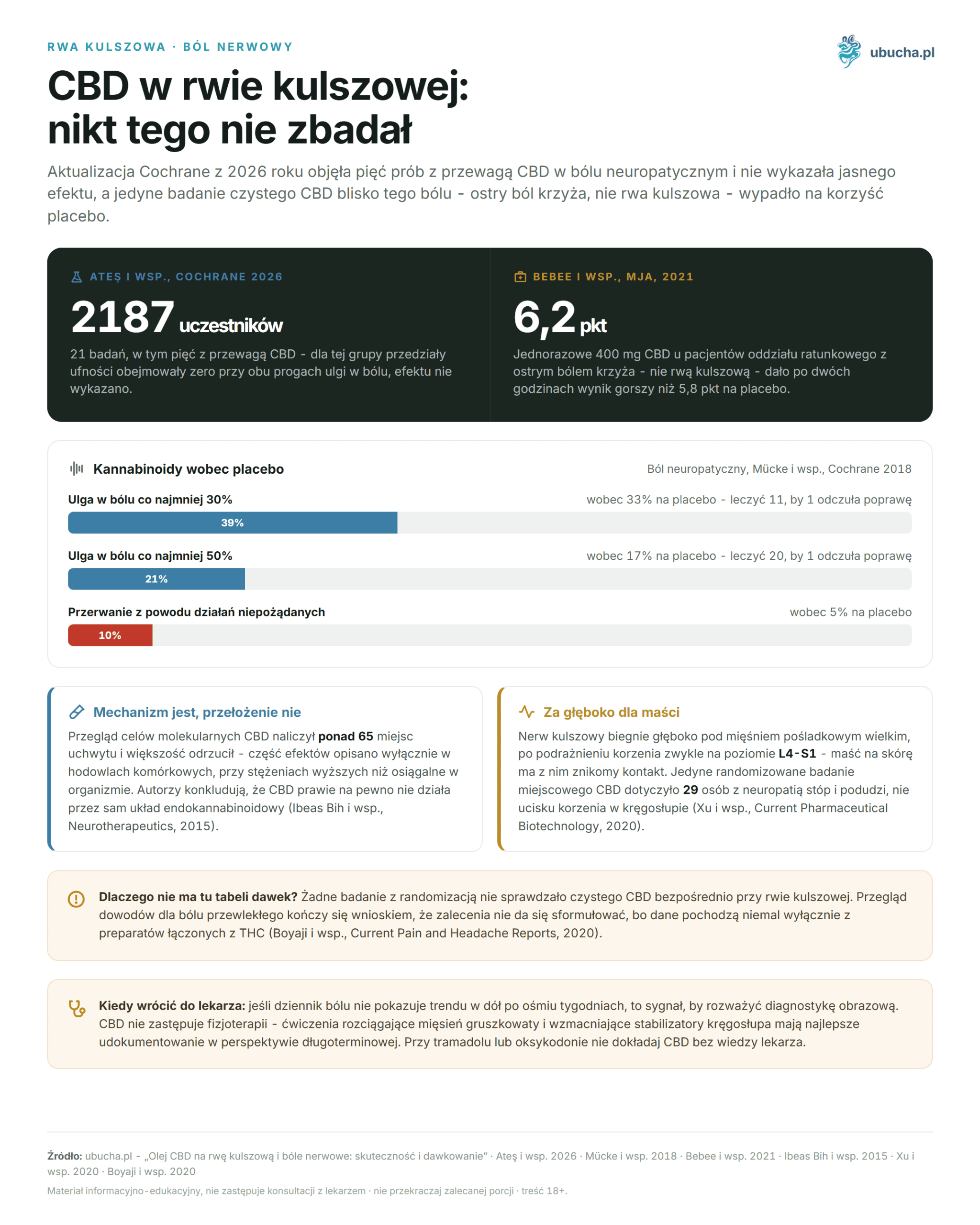
• The Cochrane review from 2018: at least 30% pain relief was reported by 39% of individuals on cannabinoid preparations compared to 33% on placebo (Mücke et al., Cochrane, 2018).
• The 2026 update, which included five trials with CBD-dominant preparations, did not show a clear effect on neuropathic pain relief.
• No randomized study has directly tested pure CBD for sciatica.
• CBD inhibits CYP3A4 and CYP2C19, so it may alter the concentration of opioids and other medications in the blood.
• Therapy was discontinued due to adverse effects in 10% of participants compared to 5% on placebo.
What is sciatica and why is nerve pain difficult to treat?
Sciatica is pain caused by irritation or compression of the sciatic nerve, most often due to a herniated disc at the L4-S1 level. The pain is neuropathic in nature: it originates from the damaged nerve, not from the surrounding tissue. Therefore, paracetamol and ibuprofen work less effectively here than for ordinary muscle pain.
The sciatic nerve is the longest nerve in the human body. It runs from the lumbosacral region through the buttock and down the entire leg, so irritation of the root in the spine can cause symptoms all the way to the calf and foot. Besides a herniated disc, causes can include spinal canal stenosis or piriformis syndrome.
Neuropathic pain operates under a different logic than nociceptive pain. A damaged nerve sends signals without an actual stimulus, and the threshold for stimulation decreases, so ordinary touch begins to hurt. This phenomenon is called allodynia. The prevalence of chronic pain with a neuropathic component is estimated in the population at 6-10% (Ateş et al., Cochrane Database of Systematic Reviews, 2026).
Treatment remains difficult despite available medications. Gabapentin, pregabalin, and amitriptyline form the first line, but they help a minority of patients and carry sedation and dizziness. This gap drives interest in cannabinoids, as patients seek something that complements therapy without adding another list of side effects.
How might CBD work for nerve pain?
Weaker and less reliably than product descriptions suggest. A systematic review of the molecular targets of cannabidiol identified over 65 binding sites in the literature, most of which were dismissed: some effects were described only in cell cultures at concentrations higher than achievable in the body. The authors conclude that CBD almost certainly does not act through the endocannabinoid system (Ibeas Bih et al., Neurotherapeutics, 2015).
This distinction determines how to read promises from labels. A molecular target described in a test tube does not automatically translate to relief for a person with sciatica, as the concentration of CBD in nerve tissue matters in the body.
| Molecular Target | What CBD does there | Strength of Evidence |
|---|---|---|
| TRPV1 | Modulates the channel that receives pain and temperature stimuli | Cell cultures, often at concentrations not achievable in the body |
| CB1 and CB2 Receptors | Does not directly stimulate them, unlike THC | Pathway through the endocannabinoid system considered very unlikely |
| GPR55, VDAC1, CaV3.x channels | Affects intracellular calcium regulation | Most reliable of over 65 described targets, without causal evidence |
| Inflammatory pathways, including PPAR-gamma | Reduces the secretion of pro-inflammatory cytokines | Animal models and cell studies |
Animal models perform significantly better than studies involving humans, but one must be careful about which substance is being discussed. Allodynia and pain hypersensitivity after nerve injury were reduced by the activation of CB2 receptors, meaning the action of their agonists, not cannabidiol, which is not an agonist (Rahn and Hohmann, Neurotherapeutics, 2009). CBD itself is attributed with analgesic and anti-inflammatory effects in neuropathy models, strongly dependent on dosage and route of administration (Mlost et al., International Journal of Molecular Sciences, 2020).
We have noticed a recurring misunderstanding in conversations with readers. The statement “CBD inhibits neuroinflammation” is true in relation to cell cultures and rats, yet it says nothing certain about a compressed L5 root in a specific person. Remember this difference before you spend hundreds of zlotys on a three-month treatment.
What do clinical studies say about cannabinoids for neuropathic pain?
The strongest summary comes from the Cochrane review. In the 2018 version, at least 30% pain relief was reported by 39% of participants taking cannabinoid preparations compared to 33% on placebo, and at the 50% threshold, it was 21% versus 17% (Mücke et al., Cochrane, 2018). The difference is real, but very small.
The authors calculated it into the number of people that need to be treated for one additional person to feel improvement: 11 at the 30% threshold and 20 at the 50% threshold. At the same time, 10% of participants discontinued treatment due to adverse effects compared to 5% on placebo. The benefit and harm have comparable scales here.
The 2026 review update shifts the picture even more towards skepticism. It included 21 studies and 2187 participants, including five trials with CBD-dominant preparations. For this group, the confidence intervals included zero at both the 30% and 50% thresholds, meaning no clear effect was demonstrated (Ateş et al., Cochrane, 2026). The certainty of evidence was rated as low and very low.
An older review, often cited in marketing materials, states the same more cautiously. A meta-analysis of 24 randomized trials involving 1334 patients provided limited evidence for chronic pain reduction compared to placebo, and the authors emphasized that most individual studies did not show an effect and that the clinical significance of the result remains uncertain (Aviram and Samuelly-Leichtag, Pain Physician, 2017). Separately, it is worth knowing about a trial with pure CBD for acute lower back pain: one hundred emergency department patients received a single dose of 400 mg of CBD or placebo, and after two hours, pain was rated at 6.2 points in the CBD group and 5.8 points in the placebo group, meaning the difference even favored placebo (Bebee et al., Medical Journal of Australia, 2021).
Does CBD ointment work for sciatica pain better than oil?
Topical preparations mainly reach the epidermis, muscles, and fascia. The sciatic nerve runs deep under the gluteus maximus muscle, so an ointment applied to the buttock has minimal direct contact with it. In typical sciatica, the systemic route, meaning sublingual oil, has better pharmacological justification.
There are not as large differences between routes of administration as product descriptions suggest. A systematic review of CBD pharmacokinetics in humans found that absolute bioavailability was measured primarily after smoking (31%), and there is a lack of such data for oral and sublingual routes. However, an increase in maximum concentration after a meal and in fatty formulations was confirmed (Millar et al., Frontiers in Pharmacology, 2018). Practical conclusion: if you are taking oil, take it with a fatty meal.
Topical CBD has its own data in peripheral neuropathy. In a four-week randomized trial, 29 individuals with symptomatic neuropathy of the lower limbs used CBD oil on the skin or placebo. The CBD group reported significantly less intense and shooting pain and fewer sensations of cold and itching (Xu et al., Current Pharmaceutical Biotechnology, 2020).
The limitations of this trial should be noted immediately. Twenty-nine individuals is a very small group, the observation lasted four weeks, and it concerned neuropathy of the feet and lower legs, not root compression in the spine. Transferring this result to sciatica is a hypothesis, not a conclusion.
In practice, a topical preparation can be a sensible addition when sciatica is accompanied by tension in the piriformis muscle. Relaxing this muscle reduces pressure on the nerve, so massage with hemp gel may help indirectly. More about external application forms can be found in the post about hemp ointment for joints and muscles.
Can a CBD dosage be given for sciatica?
No, and that is why there is no titration plan in this text. There is no dosage with proven effectiveness for sciatica, and the review of evidence for CBD in chronic pain concludes that recommendations cannot be formulated because almost all data come from preparations combined with THC (Boyaji et al., Current Pain and Headache Reports, 2020). Whether to reach for CBD in spinal disease and in what amount is decided by the attending physician.
However, it is worth knowing the numbers from studies, as they show the scale at which CBD has actually been tested. One hundred emergency department patients in Melbourne received a single dose of 400 mg or placebo, and after two hours there was no difference. In a retrospective case series from a psychiatric clinic, 72 individuals were included, almost all of whom received 25 mg per day; sleep improvement in the first month was noted in 66.7% of them, but results fluctuated over time, and patients presented with anxiety and insomnia, not root pain (Shannon et al., Permanente Journal, 2019). None of these studies concerned nerve root compression.
The upper limit is set by safety assessment. The EFSA panel derived a temporary safe dose in 2026 of 0.0275 mg per kilogram of body weight per day, or about 2 mg per day for a person weighing 70 kg, and noted that this applies only to supplements with at least 98% purity of CBD. The same document states explicitly that the safety of cannabidiol cannot be determined in individuals under 25 years of age, in pregnant and breastfeeding women, and in individuals taking medications simultaneously (EFSA NDA Panel, EFSA Journal, 2026). A person treating sciatica usually takes medications, so they fall into the last of these groups.
Adverse effects depend on the amount. A safety review noted them in nearly half of individuals using CBD, with elevated liver enzymes, sedation, and sleep disturbances at the forefront, and describes a clear dose-dependent relationship (Brown and Winterstein, Journal of Clinical Medicine, 2019). Since a single 400 mg dose did not outperform placebo in lower back pain, the reasoning “I’ll take more, it will work” has no support in the data.
How does CBD interact with medications for sciatica?
CBD inhibits the enzymes CYP3A4 and CYP2C19 and affects P-glycoprotein responsible for removing drugs from cells. A safety review describes it as a substance that can be both a perpetrator and a victim of interactions, and recommends caution in individuals taking multiple preparations simultaneously (Brown and Winterstein, Journal of Clinical Medicine, 2019).
| Medication | What happens when CBD is added | What to do |
|---|---|---|
| Tramadol, oxycodone | Slower hepatic metabolism, possible increase in blood concentration | Do not combine without the consent of the attending physician |
| Gabapentin, pregabalin | No enzymatic interaction, summation of sedative effect | Be cautious of sedation, do not drive at the start |
| Amitriptyline | Common CYP2C19 pathway, risk of increased adverse effects | Inform your doctor of the intention to use CBD |
| Ibuprofen, diclofenac | Other enzymes (CYP2C9), minimal overlap | Low risk, inform during long-term use |
Opioids require the most attention. Adding CBD to tramadol or oxycodone without the knowledge of a doctor poses a risk of sedation and respiratory depression without certain analgesic benefit. This is a poor exchange, especially for an older person.
Gabapentin and pregabalin behave differently than is often written about them. Both drugs are excreted by the kidneys with virtually no hepatic metabolism, so classic enzymatic interaction with CBD does not apply to them. The real risk is pharmacodynamic: summation of the sedative effect and worsening coordination. Before adding CBD to ongoing treatment, show your pharmacist a list of medications you are taking. The CYP450 mechanism and typical drug pairs are described in more detail in the post about CBD oil for seniors.
How to incorporate CBD into a sciatica treatment plan?
CBD is not a treatment for sciatica and there is no data that would allow it to be considered a standalone treatment. A sensible role is as an adjunct to physiotherapy for someone who has already undergone standard procedures and agreed to a trial with a doctor. The foundation remains movement.
Stretching exercises for the piriformis muscle and strengthening exercises for spinal stabilizers have the best long-term documentation. Pain blocks this mechanism: lack of movement weakens stabilizing muscles, weaker stabilization increases pressure on the root, and greater pressure means more pain. If CBD helps you enter a cycle of exercise, it has fulfilled its function.
The second point worth fighting for is sleep. The relationship between its deficiency and pain works both ways and involves the opioid, immune, and endocannabinoid systems (Haack et al., Neuropsychopharmacology, 2020). Therefore, improving sleep can be a real gain even when the pain itself does not subside, although it is harder to attribute it to one preparation than to an entire change in daily routine.
Ergonomics change more than supplements. Taking breaks to stand every 45-60 minutes, sitting without slumping in the lumbar region, and sleeping on your side with a pillow between your knees reduce pressure on the nerve every day, regardless of whether you take oil.
The last element is measurement. Keep a pain diary on a scale from 0 to 10, note the time of taking the preparation, and after eight weeks, look at the trend instead of the impression. Lack of improvement is a signal to return to the doctor and consider imaging diagnostics. Similar principles apply to back and spine pain.
Frequently Asked Questions
Does CBD really help with sciatica?
There is no good evidence for this. The Cochrane review update from 2026 included five studies with CBD-dominant preparations and did not show a clear effect on neuropathic pain relief. The mechanism is described, but it has not yet translated into clinical outcomes in humans.
How much CBD should I take for sciatica?
There is no dosage with proven effectiveness for sciatica, so no article will provide you with that number. The decision is made by a doctor who knows your medications. The EFSA panel derived a temporary safe dose of about 2 mg per day for a person weighing 70 kg and noted that for individuals taking medications, the safety of CBD cannot be determined.
How long does it take to see effects of CBD for nerve pain?
Eight weeks is sufficient for a fair assessment. If after this time the pain diary does not show a downward trend, further attempts on your own have no basis. In an emergency department study, a single dose of 400 mg of CBD did not show improvement compared to placebo for acute lower back pain.
Does CBD interact with pain medications?
Yes. CBD inhibits CYP3A4 and CYP2C19 and affects P-glycoprotein, so it may increase the concentration of tramadol and oxycodone. Gabapentin and pregabalin are excreted by the kidneys, so the risk here is the summation of sedation. Consult this with a pharmacist.
Does CBD ointment work for sciatica pain?
Topical preparations reach the epidermis, muscles, and fascia, while the sciatic nerve runs deep under the gluteus maximus. A small trial with topical CBD oil reduced pain in individuals with foot neuropathy, but this is a different issue than root compression in the spine.
Can CBD replace physiotherapy for sciatica?
No. Stretching and strengthening exercises for spinal stabilizers have the best documentation in the long term. CBD does not act on the cause of nerve compression. Its role is as an adjunct that may help some individuals start exercising.
Oil, capsules, or ointment for nerve pain?
For root compression in the spine, a systemic route is more sensible, as a topical preparation does not reach the nerve running under the gluteus muscle. Bioavailability has been measured in humans primarily after smoking, so comparisons of forms are based on concentration measurements, not clinical outcomes.
If after talking to your doctor you decide to try, you can find compositions and certificates in the hemp oil section in the Bucha store.
This article is for informational and educational purposes and does not constitute medical advice. Before starting to use cannabis or CBD for therapeutic purposes, consult your doctor, especially if you are taking other medications, are pregnant, or breastfeeding.
Author: Michał Waluk · Published: 2026-06-22 · Updated: 2026-08-14