
Selenium and iodine for the thyroid - dosing and what to remember (table)
Selenium and iodine for the thyroid: dosing table, how much to take, when and how to start. A practical guide from u Bucha.
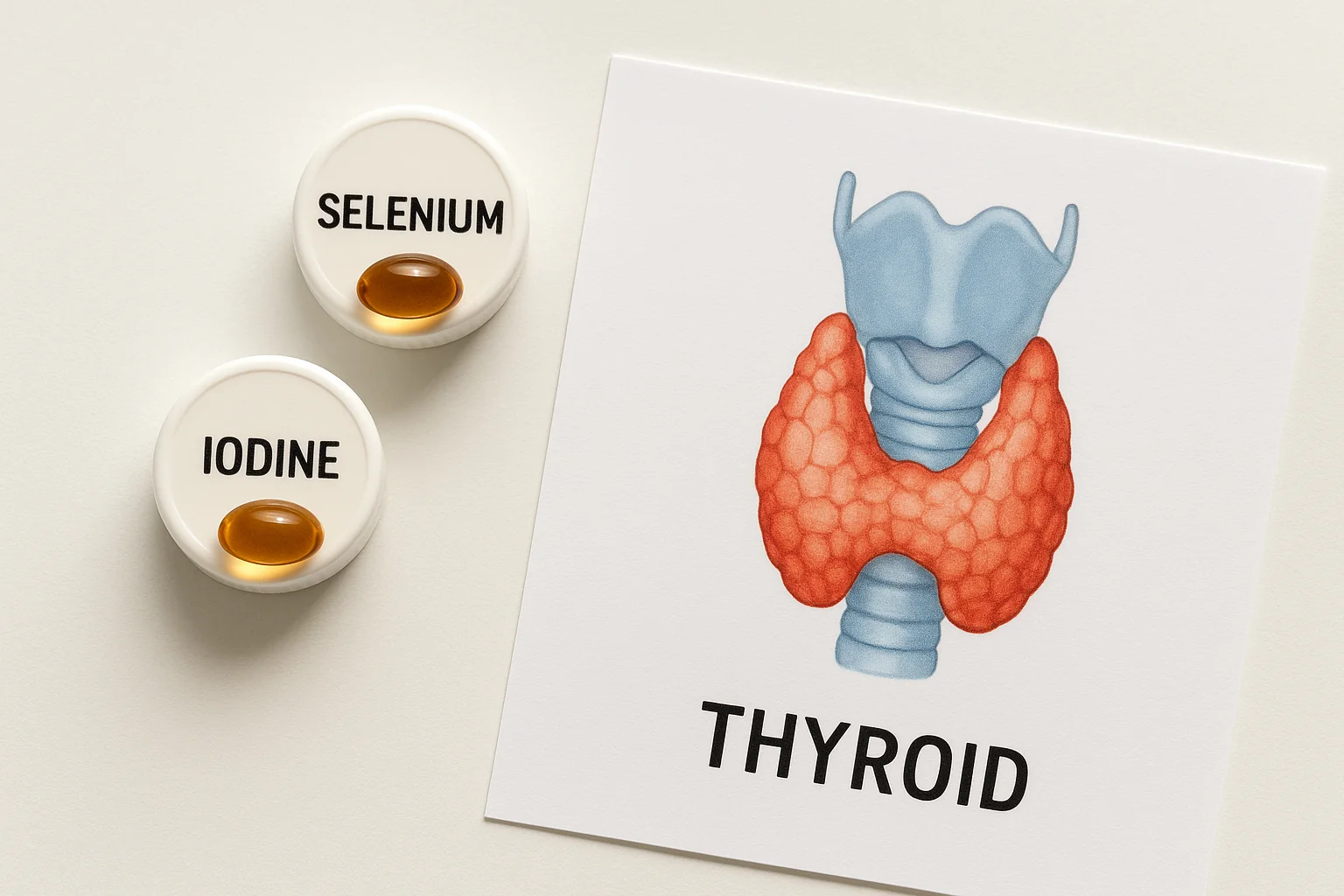
The thyroid is an organ that consumes more selenium per gram of tissue than any other organ in the body, as demonstrated in studies on selenoproteins published in Thyroid (PMC, 2013). At the same time, without iodine, the thyroid will not produce a single molecule of hormone. Both elements are essential, but "more" does not always mean "better," especially if you have Hashimoto's or another autoimmune thyroid disease. This article provides you with a specific dosing table for selenium and iodine, discusses safety limits, and shows how these two minerals work together.
KEY INFORMATION
• The thyroid contains more selenium per gram of tissue than any other organ (Rayman, Thyroid, PMC 2013).
• The RDA for selenium is 55 mcg/day, with an upper limit of 300 mcg/day according to EFSA; the RDA for iodine is 150 mcg/day according to WHO.
• Selenium is needed for deiodinase enzymes that convert T4 into active T3.
• Excess iodine in Hashimoto's can exacerbate autoimmunization through the Wolff-Chaikoff effect.
• Organic forms of selenium (selenomethionine) are absorbed better than inorganic forms (sodium selenite).
Selen i jod - dlaczego tarczyca potrzebuje obu?
The thyroid needs selenium because without selenoproteins, there is no T3 hormone. Deiodinase enzymes (DIO1, DIO2, DIO3) catalyze the removal of one iodine atom from T4, converting it into active T3. All three enzymes are selenoproteins. A study published in Thyroid (PMC, 2013) showed that selenium deficiency impairs this conversion and leads to elevated T4 with low T3.
Selenium also acts as an antioxidant guardian. Glutathione peroxidase (GPx) is a selenoprotein that breaks down hydrogen peroxide produced during thyroid hormone synthesis. The thyroid produces hormone in the presence of H2O2, which is toxic to follicular cells. GPx neutralizes this excess. Without selenium, thyroid cells literally oxidize.
Iodine, in turn, is a building block of the hormones themselves. T3 contains three iodine atoms, T4 four. Without iodine, the thyroid enlarges (goiter), trying to "capture" every available atom from the blood. It is estimated that iodine deficiency affects over 1.9 billion people worldwide and remains a leading cause of preventable hypothyroidism (Pearce et al., PMC, 2009).
Why both minerals together? Selenium protects the thyroid from oxidative stress caused by iodine. The more iodine you provide, the more H2O2 is produced, making selenium protection increasingly important. This is a biological dependency, not a supplement marketing strategy.
We have noticed a pattern in clinical studies that is rarely explicitly named: in studies on Hashimoto's, groups treated with iodine alone without selenium supplementation showed a stronger increase in anti-TPO antibodies than groups receiving both elements together. This suggests that selenium should be supplemented before iodine or at least simultaneously, not afterward.
Dosage table for selenium and iodine for the thyroid
The dosage of selenium and iodine varies depending on the purpose: prevention, support for Hashimoto's, pregnancy, and correction of deficiency require different amounts. EFSA sets the RDA for selenium at 55 mcg per day for adults and the upper safe limit at 300 mcg (EFSA, 2023). NIH ODS states 150 mcg as the RDA for iodine for adults and 220 mcg for pregnant women (NIH ODS, 2024).
| Skladnik | Starting Dose | Standard dose | Max dose | Kiedy brac | Form / Notes |
|---|---|---|---|---|---|
| Selenium (prevention) | 55 mcg/day. | 100 mcg/day. | 300 mcg/day. (EFSA UL) | In the morning, with a meal | Selenomethionine or yeast; avoid sodium selenite |
| Selenium (Hashimoto / thyroid support) | 100 mcg/day. | 200 mcg/day. | 300 mcg/day; do not exceed without testing | In the morning, with a meal containing fat | Selenomethionine; monitor selenium levels after 3 months. |
| Iodine (prevention, no Hashimoto) | 75 mcg/day. | 150 mcg/day. (RDA NIH ODS) | 500 mcg/day. (UL for adults according to NIH) | Rano lub w poludnie | Potassium iodide or iodized salt; account for dietary iodine |
| Iodine (pregnancy and breastfeeding) | 150 mcg/day. | 220 mcg/day. (RDA NIH ODS pregnancy) | 500 mcg/day; only under medical supervision | Z posilkiem | Included in the prenatal complex; do not supplement separately without advice |
| Iodine (Hashimoto) | 0-75 mcg/day. | Only from diet (fish, dairy) | No supplementation without testing levels | Do not self-supplement | Medical consultation required; risk of exacerbation |
How to read the tables? Start with the initial dose and maintain it for 4-8 weeks. For selenium, the full effect on selenium levels and GPx activity is seen after 3 months of regular supplementation. For iodine, count all sources: iodized table salt provides about 77 mcg of iodine per 5 g of salt, sea fish 100-200 mcg per serving, and dairy 50-90 mcg per glass of milk. Add these numbers to the supplement to avoid exceeding the safe limit.
When does selenium help, and when does it harm?
Selenium is an element with a very narrow therapeutic window. Too little leads to deficiency, too much to selenosis. EFSA sets the upper safe limit at 300 mcg per day, while NIH at 400 mcg per day (NIH ODS, Selenium, 2024). Above these values, the first symptoms of toxicity may appear.
Symptoms of selenosis are characteristic: garlic breath (excretion of dimethylselenium through the lungs), hair loss, brittle nails, nausea, and fatigue. At very high doses (above 900 mcg/day for a long time), peripheral nerve damage may occur. A meta-analysis published in Nutrients (PMC, 2019) confirmed that the risk of selenosis is real with supplements exceeding 400 mcg/day.
Does selenium really help with Hashimoto? A randomized study published in Frontiers in Endocrinology (PMC, 2022) showed that 200 mcg of selenomethionine daily for 6 months significantly reduced anti-TPO and anti-Tg antibody levels in patients with Hashimoto compared to placebo. The effect was moderate but reproducible in several independent clinical trials.
Our observations indicate that individuals using selenium supplements with inorganic sodium selenite (Na2SeO3) often report weaker effects in tests than those who chose selenomethionine or selenium yeast. The organic form not only absorbs better but also accumulates in tissues as a reserve, which may be important for irregular supplementation.
When absolutely not to take selenium without medical consultation: in kidney failure (selenium is excreted by the kidneys), with simultaneous supplementation of high doses of vitamin C above 1000 mg (it may block absorption), when planning general anesthesia.
Iodine in Hashimoto's - why you need to be careful?
Excess iodine can exacerbate autoimmune thyroiditis through at least two mechanisms. The first is the Wolff-Chaikoff effect: with a sudden increase in iodine concentration, the thyroid temporarily inhibits hormone synthesis, which in individuals with Hashimoto may trigger hypothyroidism. The second is the increased immunogenicity of thyroglobulin: iodinated thyroid proteins more strongly activate T cells of the immune system, as shown in Thyroid (PMC, 2012).
A cohort study conducted in China, published in Journal of Clinical Endocrinology and Metabolism (PMC, 2001), tracked over 3000 residents of areas with varying iodine intake for 5 years. In regions with higher iodine intake, the incidence of Hashimoto's and autoimmune hypothyroidism was significantly higher than in the group with moderate intake. This does not mean that iodine "causes" Hashimoto's, but that excess acts as a trigger in genetically predisposed individuals.
What does this mean in practice? With confirmed Hashimoto, do not supplement iodine without testing its current level in urine (ioduria). Normal iodine intake from diet usually meets the demand. Iodized salt, sea fish, and dairy products are sufficient sources for most people in Poland. Supplementation with additional iodine in Hashimoto requires clear indication and medical supervision.
Quote to cite: "The Wolff-Chaikoff effect involves transient suppression of thyroid hormone synthesis in response to a sudden increase in intrathyroidal iodine concentration. In individuals with Hashimoto's, the escape mechanism from this effect is weakened, increasing the risk of permanent hypothyroidism (Thyroid, PMC 2012)."
How to combine selenium with iodine - practical tips
Selenium and iodine work synergistically in the thyroid, but the order and proportions matter. An interventional study from 2002 published in Journal of Clinical Endocrinology and Metabolism (PMC, 2002) showed that iodine supplementation without simultaneous selenium supplementation led to increased oxidative stress in the thyroid in patients with deficiencies of both elements. Selenium must be in place before you increase iodine intake.
What does this look like in practice? If you plan to supplement both elements, start with selenium and take it for 4-6 weeks before adding an iodine supplement. During this time, the thyroid builds reserves of selenoproteins that will protect it from oxidative stress caused by iodine. This is particularly important with higher doses of iodine.
What to avoid when combining? Do not take selenium together with zinc at the same time, as both elements compete for transport through the same protein carrier. Vitamin E may support the action of selenium (both are antioxidants), so this combination is safe. Vitamin C in doses up to 500 mg does not significantly affect the absorption of selenium, but above 1000 mg it may limit it.
In pharmacological treatment of the thyroid (levothyroxine, Euthyrox), neither selenium nor iodine directly interact with the medications. However, iodine may affect the natural production of hormones, which can disrupt the dosing of the medication. Therefore, any changes in supplementation should be communicated to an endocrinologist.
Frequently Asked Questions
How much selenium should be taken daily for the thyroid?
For healthy adults, EFSA sets the RDA for selenium at 55 mcg per day, and the upper safe limit at 300 mcg (EFSA, 2023). In the context of thyroid support and Hashimoto's, clinical studies have used 100-200 mcg of selenomethionine daily. Never exceed 300-400 mcg without testing serum selenium levels.
Is iodine safe with Hashimoto's?
It depends on the dose. Small amounts of iodine from the diet (150 mcg/day) are usually well tolerated. The problem arises with additional iodine supplementation, as the Wolff-Chaikoff effect can cause temporary suppression of the thyroid and exacerbate autoimmunity (Thyroid, PMC 2012). Before supplementing iodine with Hashimoto's, consultation with an endocrinologist is required.
Which form of selenium to choose: selenomethionine or sodium selenite?
Selenomethionine is absorbed at about 90%, sodium selenite (inorganic form) achieves 50-70% bioavailability, as confirmed in pharmacokinetic studies cited by NIH ODS (2024). Organic forms of selenium (selenomethionine, selenium yeast) dominate in clinical studies concerning the thyroid. They are a better choice for daily supplementation.
When to take selenium: in the morning or in the evening?
In the morning, with a meal containing fat. Avoid taking it together with vitamin C above 1000 mg and with zinc - both compete for absorption. The most important principle is regularity: every day at the same time provides a more stable level of selenium than irregular dosing. If in doubt about absorption, choose selenomethionine instead of sodium selenite.
Can selenium and iodine be taken together?
Yes, but with a specific order. Start with selenium and take it for 4-6 weeks before adding an iodine supplement. Selenium builds a protective reserve of thyroid selenoproteins. An interventional study showed that iodine supplementation without selenium increased oxidative stress in the thyroid (Journal of Clinical Endocrinology and Metabolism, PMC 2002). The logic is simple: first the shield, then the building material.
This article is for informational and educational purposes and does not replace consultation with a doctor. If you are pregnant, breastfeeding, taking medications, or have chronic conditions, consult the use of supplements or herbs with a specialist.
Author: Michał Waluk · Published: 2026-05-04 · Updated: 2026-05-04