CBD for Panic Attacks: What Research Says and How Much to Take
A panic attack subsides within a few minutes and can be mistaken for a heart attack. Check what has really been studied regarding CBD and anxiety and why no one has established dosages.
A panic attack starts suddenly, peaks within a few minutes, and usually subsides within a few. During this time, it can resemble a heart attack: pressure in the chest, shortness of breath, palpitations, tingling in the hands. Therefore, the first such episode is not a topic for a supplement, but for a visit to a doctor who will rule out a cardiac cause. The second thing to say right away: panic disorder has a treatment with documented effectiveness, namely psychotherapy and medications prescribed by a doctor. CBD is not a substitute for them, and no study has shown that it is. Below we have gathered what has actually been tested and the reason why there is no honest answer to the question of dosage today.
KEY INFORMATION
• 13.2% of people have experienced a panic attack at some point, but 12.8% of them meet the criteria for panic disorder (de Jonge et al., Depression and Anxiety, 2016).
• The only randomized trial of CBD in patients with panic attacks showed no advantage over placebo (Kwee et al., 2022).
• Positive results in humans come from acute situations and mainly from social phobia, after doses of 150-600 mg at a time.
• No consumer dosing has been established.
• Chest pain and shortness of breath require medical evaluation first, not oil.
Can CBD replace treatment for panic attacks?
No, and there is no data to support that. The only randomized study conducted in patients with panic disorder was unfavorable to CBD: adding 300 mg to exposure therapy did not improve outcomes compared to placebo (Kwee et al., European Neuropsychopharmacology, 2022).
This finding has practical implications. If you have a diagnosed panic disorder and are taking medications, do not stop them to switch to oil. With benzodiazepines, sudden discontinuation can be dangerous in itself, and with antidepressants, it usually means a relapse of symptoms after a few weeks. If you are undergoing psychotherapy, the oil will not shorten or facilitate it.
CBD is sold in Poland as a supplement or cosmetic, not a medicine, and this is not a formality. The manufacturer does not have to demonstrate efficacy for any indication, and the label does not contain a therapeutic dose because no such dose for anxiety has been registered. Therefore, treat the oil as something you can at most add to treatment after talking to a doctor, not as the first move after the first attack. The first move is diagnosis.
What does a panic attack look like and when should a heart attack be ruled out?
A panic attack escalates rapidly, peaks within a few minutes, and usually subsides within a few. The problem is that without examination, you cannot distinguish it from an acute cardiac event, as the set of symptoms can be the same: chest pain, shortness of breath, palpitations, dizziness, tingling in the limbs.
The first episode in life requires medical evaluation, if only to perform an ECG and close the topic. This is not excessive caution: until someone checks the heart, the diagnosis of a panic attack remains a guess.
| Signal | Typical for panic attack | Reason to seek urgent help |
|---|---|---|
| Course over time | peaks after a few minutes, subsides in a few | symptoms last longer than 20 minutes or escalate |
| Chest pain | pressure that goes away with anxiety | radiates to the arm, jaw, or back |
| Shortness of breath | subsides after normalizing breathing | persists despite calm, blue lips |
| Context | another episode with a known course | first time in life, age over 40, heart disease in history |
A panic attack itself is common, but the disorder is much rarer. In a study of 142,949 people from 25 countries, 13.2% of respondents had ever experienced an attack, but 12.8% of them met the criteria for panic disorder, which gives 1.7% of the population, with a median age of onset of 32 years (de Jonge et al., Depression and Anxiety, 2016).
What has documented effectiveness in panic disorder?
Two things: psychotherapy and medications prescribed by a doctor. In a Cochrane network meta-analysis, which included eight forms of psychotherapy, cognitive-behavioral therapy was the best studied and often performed better than the others (Pompoli et al., Cochrane Database of Systematic Reviews, 2016). This same work states that the disorder affects 1 to 4% of people over their lifetime.
The authors of this work are cautious. They write that there is no clear evidence of high quality for the superiority of any psychotherapy over others, and effect sizes can be small. Cognitive-behavioral therapy wins mainly because it has been studied the most widely, not because the difference from the competition is huge. This is still an incomparably stronger position than that which CBD has today.
On the pharmacological side, a network meta-analysis published in BMJ compared 87 studies involving 12,800 participants (Chawla et al., BMJ, 2022). Selective serotonin reuptake inhibitors provided remission more often than placebo, with a relative risk of 1.38 with a confidence interval of 1.26-1.50; sertraline and escitalopram performed best. Adverse effects occurred more frequently with them than with placebo, with a relative risk of 1.19, compared to 1.76 for benzodiazepines and 1.79 for tricyclic antidepressants. Based on this, the authors indicated this group as the best compromise between the chance of remission and risk.
The authors add a caveat that is worth knowing before talking to a doctor: 86 out of 87 studies had methodological limitations or high risk of bias, so the certainty of these conclusions was rated as moderate to very low. However, this is still the best available material, and CBD does not even have that.
Has anyone studied CBD in people with panic attacks?
Yes, once, and the result was negative. In a Dutch randomized study, 80 patients resistant to previous treatment, with panic disorder with agoraphobia or social phobia, received 300 mg of CBD orally (39 people) or placebo (41 people) before each of the eight weekly sessions of exposure therapy.
No differences were found in anxiety questionnaire results either in the whole group or separately in each diagnosis, both halfway through treatment and after its completion, as well as after 3 and 6 months of observation. Contrary to the authors’ hypothesis, CBD did not accelerate the early response to therapy (Kwee et al., European Neuropsychopharmacology, 2022).
The same team then looked at fear conditioning in 69 patients from this trial. CBD reduced the expectation of an aversive stimulus under weak and ambiguous threat, but did not improve the extinction of fear (Kwee et al., Psychopharmacology, 2024). One result from this work deserves a separate mention: in individuals taking antidepressants, the extinction of perceived fear performed worse in the CBD group than in placebo, and in women from this subgroup, CBD interfered with learning the safety signal. The authors call this a signal for further investigation, not evidence of harm, but it is precisely this group that most often reaches for oil on their own.
Earlier, in an experiment on 48 people divided into three groups, 32 mg of CBD given after the extinction session improved the retention of extinguished fear, while the same 32 mg given before the session had no effect (Das et al., Psychopharmacology, 2013). In patients, this laboratory effect did not translate into therapy outcomes. The rest of the material concerns animals, such as work on panic reactions in rats and mice (Hernandes et al., Behavioural Brain Research, 2023).
What exactly has been studied in humans regarding CBD and anxiety?
Almost all positive results come from a single dose given before a specific stressor, most often before a simulated public speaking event, and most often in people with social phobia. This is a different situation than an unprovoked panic attack, which comes without warning.
A reference point for the entire field is a study in which 24 previously untreated patients with social phobia received 600 mg of CBD or placebo one and a half hours before the test. The group with CBD reported less anxiety, less discomfort, and fewer negative thoughts about their own performance (Bergamaschi et al., Neuropsychopharmacology, 2011). An earlier imaging study involved 10 patients with the same diagnosis after a dose of 400 mg (Crippa et al., Journal of Psychopharmacology, 2011), and in 15 healthy men, 600 mg of CBD changed the brain’s response to faces expressing fear (Fusar-Poli et al., Archives of General Psychiatry, 2009).
However, the most interesting is the experiment with three doses. In 57 healthy men, 150, 300, and 600 mg were compared with placebo in the same test. Only 300 mg reduced anxiety, while the other doses did not differ from placebo, which gives a dose-response curve in the shape of an inverted U (Linares et al., Brazilian Journal of Psychiatry, 2019).
How much CBD should I take for panic attacks?
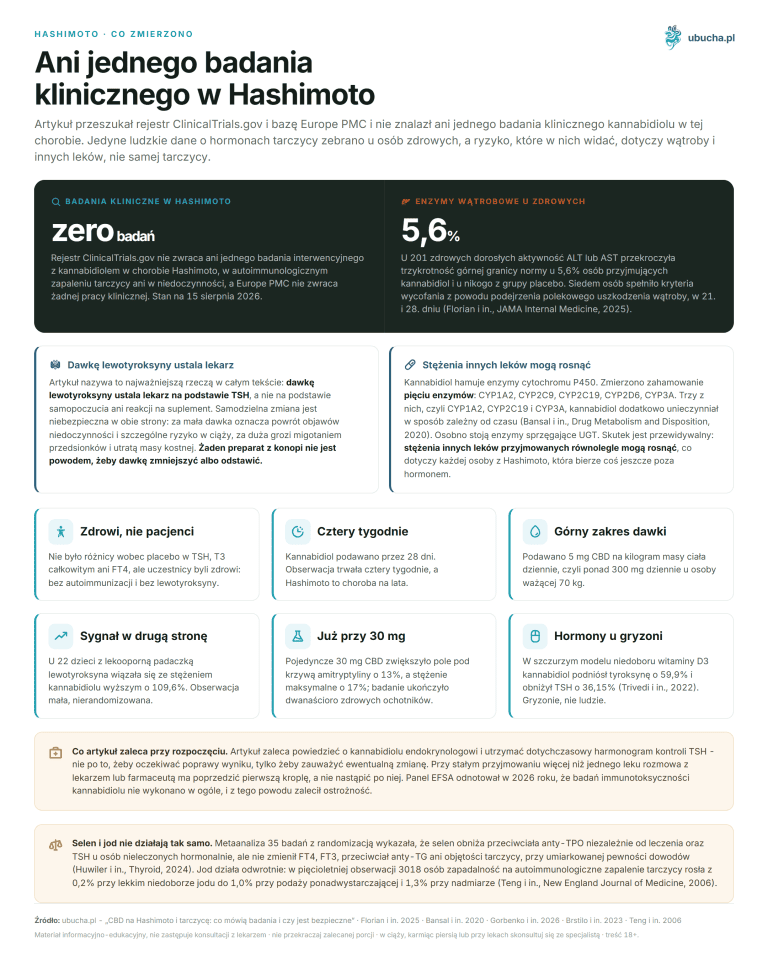
It is impossible to provide a dosage because no one has established it. There is no study on dosing CBD for panic attacks, so any number circulating on the internet is either a guess or taken from trials on a completely different issue. The title of this article promises an answer, and the honest answer is: there is no such dosage.
This is best seen in the comparison. The table below is not a dosing plan, but a list of who and for what was given something in studies on humans. No entry pertains to interrupting or preventing panic attacks.
| Study | Who and how many | What was given | Result |
|---|---|---|---|
| Kwee 2022 | 80 treatment-resistant patients, panic disorder with agoraphobia or social phobia | 300 mg before each of 8 therapy sessions | No difference compared to placebo |
| Linares 2019 | 57 healthy men | 150, 300, or 600 mg at a time | Anxiety reduced only by the middle dose |
| Bergamaschi 2011 | 24 untreated patients with social phobia | 600 mg at a time | Less anxiety during performance |
| Crippa 2011 | 10 patients with social phobia | 400 mg at a time | Less anxiety, changes in cerebral blood flow |
| Shannon 2019 | 72 outpatient patients, no control group | Preparation added to existing treatment | Decrease in anxiety in 57 people, no comparison |
The scale of these doses has no equivalent on the store shelf: trials administered from 150 to 600 mg at a time, and a whole 10 ml bottle of oil contains from 500 to 2000 mg depending on the concentration. One dose from the study is therefore a significant part of the package, not a serving from the label. Increasing the portion is not a shortcut, as in the three-dose test, the highest dose did not work. A separate problem is the duration of use: a review of the entire literature states that data from studies in humans are limited to single administration, and chronic dosing has been studied in few works (Blessing et al., Neurotherapeutics, 2015). Popular recommendations like “50 mg daily for eight weeks” have no basis in any experiment.
Why are reports of CBD’s effectiveness misleading?
Because the two most frequently cited pieces of evidence are not what they are taken for. The work by Shannon and colleagues is a retrospective review of psychiatric outpatient records, without a control group and without randomization, in which the preparation was an addition to existing treatment. Out of 103 reviewed records, 72 were included in the analysis; anxiety decreased in the first month in 57 people, or 79.2%, but there was nothing to compare it to (Shannon et al., The Permanente Journal, 2019).
The second experiment shows how much expectation can do. Forty-three adults were given sublingual hemp seed oil with no trace of CBD, once telling them it contained CBD, once that it did not. Those convinced that CBD works anxiolytically reported less anxiety in the session with the alleged CBD; there was also greater drowsiness and changes in heart rate variability (Spinella et al., Psychopharmacology, 2021).
Additionally, there is the arithmetic of the panic attack itself. Since the episode subsides within a few minutes anyway, anything you take during it will coincide with the resolution of symptoms and will be remembered as what helped. We have noticed that this is how most opinions attributing the interruption of an attack to oils sound. A single observation does not distinguish the action of a substance from the natural course of the attack, and that is what placebo-controlled studies are for.
How does CBD interact with anxiety medications?
Through liver enzymes. CBD interacts with CYP3A4 and CYP2C19, which the body uses to break down some psychiatric medications, as well as with P-glycoprotein responsible for their excretion, so the potential for interactions with chronically taken medications is high (Brown and Winterstein, Journal of Clinical Medicine, 2019). With benzodiazepines, such as alprazolam or clonazepam, this may increase the concentration of the drug in the blood. With escitalopram and sertraline, an interaction may occur via the same pathway.
This same work reminds that CBD also has its own profile of adverse effects, depending on the dose. They occurred in nearly half of users, with the most common being increased liver enzyme activity, drowsiness, and sleep disturbances. Drowsiness is significant here doubly, as it adds to sedation from benzodiazepines.
The practical conclusion is simple. Do not change the doses of medications prescribed by your psychiatrist on your own and do not suddenly stop benzodiazepines, as withdrawal syndrome can be more dangerous than anxiety itself. If you want to try the oil, tell your treating doctor about it before you start, not after the fact. Also, record the date of introduction and the size of the portion so that you can later link the change in well-being to a specific moment, not to an impression from a month ago.
More broadly on how CBD behaves with polytherapy, we write in the article on CBD interactions with medications, and on anxiety without panic attacks in the text CBD for neurosis and anxiety.
Frequently Asked Questions
Does CBD help with panic attacks?
There is no study that has shown this. The only randomized trial in patients with panic disorder with agoraphobia tested 300 mg of CBD added to exposure therapy and found no advantage over placebo (Kwee et al., European Neuropsychopharmacology, 2022). Positive results pertain to a different issue: one-time anxiety before public speaking, mainly in people with social phobia.
How much CBD should I take for panic attacks?
No one has established a dosage, and it cannot be provided honestly. Studies on anxiety used 150, 300, 400, or 600 mg at a time, but each of them concerned a different issue than a panic attack. In the test by Linares et al. from 2019, only 300 mg worked, while 150 mg and 600 mg did not differ from placebo.
Will CBD work during a panic attack?
There is no evidence to suggest that. A panic attack escalates within minutes and usually subsides within a few, so anything you take during it will coincide with the natural resolution of symptoms. Oral CBD takes several minutes to absorb, and there are simply no studies on interrupting a panic attack.
Can CBD replace cognitive-behavioral therapy?
No. Cognitive-behavioral therapy has been the best-studied of the eight psychotherapies compared in a Cochrane network meta-analysis and often performed better than the others (Pompoli et al., 2016). CBD has not had a single positive study in patients with panic attacks, so substituting one for the other means giving up treatment for an unknown.
Does CBD interact with anxiety medications?
Yes. CBD interacts with liver enzymes CYP3A4 and CYP2C19, which break down some psychiatric medications (Brown and Winterstein, 2019). With alprazolam and clonazepam, this may increase the concentration of the drug, and the drowsiness reported with CBD adds to sedation. Inform your psychiatrist before adding anything to your treatment.
Does a higher dose of CBD provide a stronger effect?
No. In the study by Linares et al. from 2019, 600 mg did not differ from placebo, although 300 mg worked, so the dose-response curve has the shape of an inverted U. In an experiment where participants were given oil without CBD, the mere belief that they had taken CBD was associated with greater drowsiness (Spinella et al., 2021).
If you still want to check the oil as an addition to treatment, in the store at Bucha you will find only oils from the CANNOVA brand in the hemp oils section. None of them is a medicine for panic attacks and will not replace a visit to a specialist.
This article is for informational and educational purposes only and does not constitute medical advice. Before starting to use cannabis or CBD for therapeutic purposes, consult your doctor, especially if you are taking other medications, are pregnant, or breastfeeding.
Author: Michał Waluk · Published: 2026-06-08 · Updated: 2026-08-14