
How to Take CBD? 4 Most Popular Methods and Dosage 2026
Sublingually, orally, inhaled, or topically? What is really known about CBD bioavailability, how long each method's effect lasts, and which mistakes spoil the result.
The question “how to take CBD” comes up more often in conversations than which oil to buy, and rightly so. The administration route changes the onset time, duration of effect, and how much of the molecule actually reaches the bloodstream. The four forms commonly found in stores are sublingual, oral, inhaled, and topical. In this guide, we compare them based on a review of CBD pharmacokinetics in humans, show which numbers circulating online lack research support, and break down the most common application mistakes. You will also find practical tips on starting dose, timing, and the length of a fair test. But first, we start with something usually missing from such summaries: reliable data on cannabidiol bioavailability is much scarcer than tables published on Polish websites suggest.
KEY INFORMATION
• In the systematic review by Millar et al. (PMC, 2018), only 24 of 792 analyzed studies contained pharmacokinetic data on CBD in humans. Absolute bioavailability was measured only for the inhalation route: 31%.
• For oral and sublingual routes, no such measurement in humans has been conducted, so figures like “13-19%” have no source to cite.
• Half-life depends on the administration route: 1.4-10.9 hours after mucosal spray, 2-5 days with chronic oral administration, 31 hours after inhalation.
• Fat in a meal drastically changes absorption. In the study by Birnbaum et al. (2019), a high-fat meal increased maximum CBD concentration 14-fold and total exposure 4-fold.
• CBD inhibits CYP3A4 and CYP2C19 and interacts with P-glycoprotein, so with chronic medications, the administration method is secondary to consulting a doctor.
Why does the CBD administration method change the effect?
The administration route determines three things at once: when the effect starts, how long it lasts, and what portion of the dose reaches circulation. The same milligram number on the label can therefore mean a completely different body exposure depending on whether the drops went under the tongue, into the stomach, or into the lungs.
Three mechanisms are at work here. The first is the first-pass effect through the liver, where cytochrome P450 enzymes metabolize part of the molecule before it reaches circulation. The second is the lipophilicity of cannabinoids: CBD practically does not dissolve in water and needs a fat carrier. The third is the surface area and blood supply of the absorption site, which is completely different under the tongue than in the lung alveoli.
The practical conclusion is simpler than it looks. If you need a fast start, choose a route that bypasses the digestive tract. If you need long, steady action through the night, choose the oral route and accept a later onset. If the problem concerns the skin or a specific muscle, use a topical preparation and do not expect systemic effects.
There is a fourth factor rarely mentioned in administration form comparisons: repeatability. A capsule with a factory-measured content delivers the same dose every time, while a vaporizer session depends on the number of inhales, temperature, and how much material remains in the chamber. A method with worse pharmacokinetic parameters but predictable can be better in practice than a theoretically more efficient method.
We describe the same division more broadly in the post about ways of consuming cannabis and CBD, including forms not covered by this guide.
How much CBD really reaches the blood with each administration route?
The honest answer is: much less than popular tables suggest. Millar et al. (PMC, 2018) searched PubMed and EMBASE and of 792 found studies, only 24 contained pharmacokinetic parameters of CBD in humans. Absolute bioavailability was measured only for inhalation and was 31%.
For other routes, no such measurement in humans has been done, although intravenous preparations that would allow comparison were available. The authors call this state frankly: data are scarce and discrepancies exist between studies. All precise percentage values attributed to oral or sublingual routes circulating on Polish internet have no support in this review.
What was measured is still enough to choose a method. Half-life after mucosal spray ranged from 1.4 to 10.9 hours, after chronic oral administration from 2 to 5 days, and after inhalation 31 hours. Maximum concentration increased with dose and appeared faster after inhalation than after oral or mucosal administration. Time to peak ranged from 0 to 4 hours.
| Administration Route | Measured Bioavailability | Half-life | Suitable For |
|---|---|---|---|
| Inhalation | 31% | 31 hours | quick symptom response |
| Oral mucosa | not measured in humans | 1.4-10.9 hours | daily base, easy dose control |
| Oral | not measured in humans | 2-5 days with chronic use | long, steady coverage |
| Topical | no significant systemic absorption | not applicable | skin and underlying tissues |
We expand this comparison in a separate post about CBD bioavailability.
How to take CBD sublingually?
Measure the dose with a pipette, place drops under the tongue, hold them there for 60 to 90 seconds, then swallow the rest. The goal is for part of the dose to enter through the mucous membrane and bypass the liver. This is the most commonly recommended starting form because it allows dose measurement with drop accuracy.
Under the tongue is a dense network of vessels, and the mucous membrane is thin. The molecule dissolved in carrier oil penetrates directly into the blood. The rest will be swallowed anyway, so the real action profile is mixed: faster onset from the mucosal route plus a longer tail from the oral route. For this reason, this form is often described as the most predictable in daily use.
Which oil to choose at the start? At 5% concentration, i.e., 500 mg CBD in a 10 ml bottle, one drop contains about 2.5 mg, so four drops give roughly 10 mg. This is arithmetic, not a measurement: actual drop volume depends on the pipette, temperature, and oil density, so always confirm the dose on the packaging of the specific product.
How long does the test last? Since the half-life after mucosal administration reaches nearly 11 hours, and with chronic use concentration stabilizes over several days, evaluating the method after a single dose makes little sense. The minimum fair test is two weeks of regular use at the same time of day, with effect recording.
When to expect the peak? In studies collected by Millar et al., time to maximum concentration ranged widely from 0 to 4 hours, depending on the preparation form and administration route. With the sublingual form, where part of the dose goes through the mucous membrane and part through the digestive tract, this spread is a natural consequence of the mixed absorption profile.
Why swallowing immediately spoils the result is explained in a separate post about the first-pass effect.
How to take CBD orally and why eat fat with it?
The oral form includes capsules, gummies, and oil added to food. The onset is the latest of all methods, but the effect lasts the longest, as with chronic use the half-life reaches 2 to 5 days. The biggest difference here is not the form itself but whether you take it with a meal.
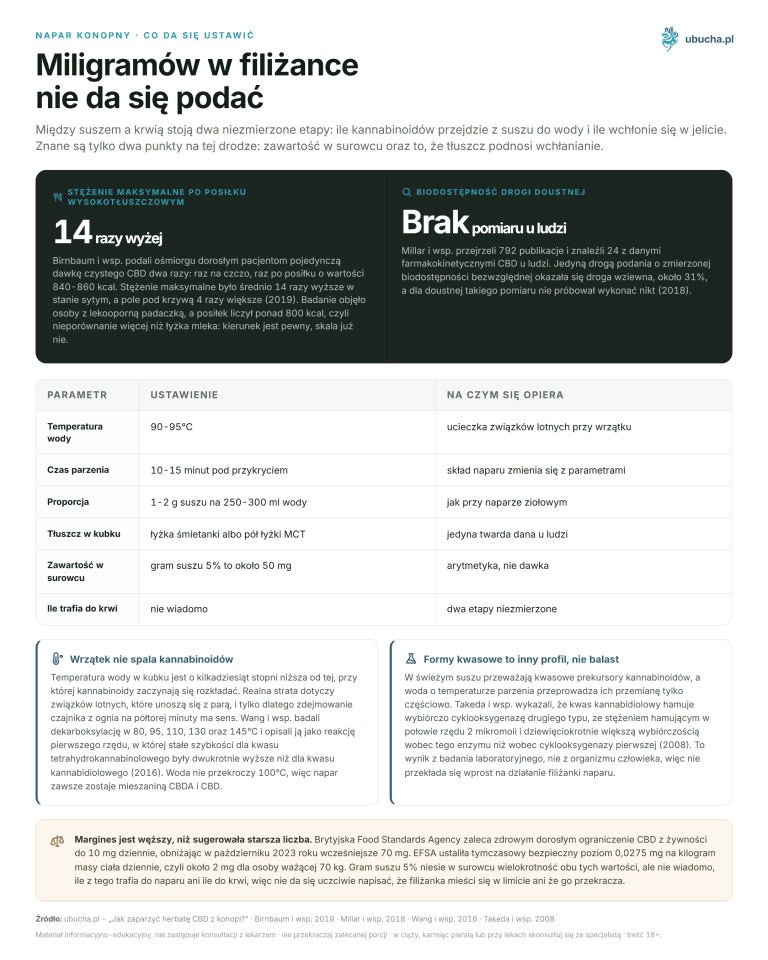
The scale of this difference was measured by Birnbaum et al. (PubMed, 2019). Eight adult patients with drug-resistant epilepsy took the same pure CBD capsule once fasting and once after a high-fat meal worth 840-860 kilocalories. Maximum plasma concentration was on average 14 times higher in the fed state, and total exposure 4 times higher. This is not a marginal correction but a magnitude change.
The same conclusion is confirmed by the review by Millar et al.: maximum concentration increases in the fed state and with lipid-based formulations. Practically, this means a capsule taken with water on an empty stomach and the same capsule taken after scrambled eggs with avocado are two different doses despite the identical milligram number on the packaging.
This also leads to a warning about repeatability. If you sometimes take the preparation fasting and sometimes after a meal, you introduce a variable you do not control and cannot assess whether the dose is correct. Set one time and one meal context, then change the dose.
One caveat to the Birnbaum study: it involved eight patients taking pure CBD at doses used in epilepsy, much higher than typical several milligrams from a store product. However, the direction of the relationship is well documented also in the Millar review, so the principle applies regardless of dose scale.
We dedicated a separate text to this topic about whether to take CBD oil before or after eating.
How to take CBD by inhalation and is it safer than smoking?
The inhalation route is the only one for which absolute bioavailability of CBD was measured in humans, and it was 31%. The onset is the fastest of all methods, as the molecule goes directly from lung alveoli into the blood. Vaporization differs from smoking in that the plant material is heated below combustion temperature.
A comparison of both forms was conducted by Abrams et al. (PubMed, 2007). Eighteen participants in hospital conditions received cannabis once from a vaporizer and once as a cigarette. Peak plasma THC concentrations and area under the curve over six hours were similar, while carbon monoxide levels in exhaled air after vaporization were lower. No adverse events were reported.
This study measured THC, not CBD, and it is worth remembering this when citing it. The conclusion concerns the delivery method itself: heating instead of burning provides comparable exposure with fewer combustion products. However, it is not proof of long-term lung safety, as that study did not conduct such observations.
A separate issue is cartridge quality. The American epidemic of lung injuries related to vaporization in 2019-2020 was linked to vitamin E acetate added to illegal THC cartridges. The practical conclusion is: buy only products with composition declaration and laboratory test results, and avoid cartridges of unknown origin.
Regarding equipment, in the vaporizers category at Bucha, prices currently range from 374 to 499 PLN (as of August 10, 2026). A device with temperature control is practically important as it allows staying below the combustion threshold.
How to use CBD topically and what not to expect?
Topical preparations act in the skin and tissues directly beneath it, without significant blood concentration. This is their advantage, not a drawback: they allow targeted action without burdening liver metabolism and without risk of systemic interactions. Expecting relaxation or sleep improvement from them is a misunderstanding.
The biological basis is well described. Tóth et al. (PMC, 2019) in a review of the skin endocannabinoid system show its elements present in the epidermis and dermis, and disturbances in this signaling are linked to atopic dermatitis and psoriasis. The authors emphasize that translational potential remains largely hypothetical.
The sebostatic mechanism was described by Oláh et al. (PMC, 2014). CBD inhibited lipogenesis and proliferation of human sebocytes via TRPV4 channels and had anti-inflammatory effects. This was a cell culture and organ culture skin study, not a patient trial, so it speaks about a possible mechanism in acne, not cream efficacy.
The closest to practice is the observation by Palmieri et al. (PubMed, 2019). Twenty people with psoriasis, atopic dermatitis, or scars used CBD ointment twice daily for three months. Hydration, elasticity, and PASI index improved, no irritant reactions were noted. The authors call their work retrospective and anecdotal, and there was no control group.
A separate problem in this category is packaging content. Spindle et al. (PMC, 2022) bought 105 topical cannabis products, some in physical stores, some online. Of 89 products declaring CBD content, only 24% were correctly labeled. Under-declaration was 58%, over-declaration 18%.
Even more interesting is the THC result. It was detected in 37 of 105 products, i.e., 35%, though always below 0.3%. Among these 37, four were labeled THC-free, and 19 did not mention it at all. For someone subject to anti-doping control or workplace testing, this is information about real risk, not theoretical.
How to combine CBD administration methods?
Combining makes sense when each method serves a different purpose. The most common setup is a steady base from a long-acting form plus an on-demand intervention from a fast-onset form. A topical preparation is added independently, as it does not enter circulation and does not add to the systemic dose.
The first setup is based on dividing the day. Sublingual or oral form builds the background, and the inhalation route, with the fastest start, stays in reserve for symptom escalation. This division makes sense directly from pharmacokinetics: with mucosal administration, half-life reaches nearly 11 hours, so the base actually persists.
The second setup combines systemic and local action. The oral preparation provides the background, the ointment or balm targets a specific joint or muscle. Since the topical form does not reach significant blood concentration, it does not need to be included in the daily milligram total.
What to watch for when combining. Sum milligrams only from systemic forms, change one thing at a time, and record times. If you change dose, timing, and form simultaneously, you won’t know what worked. With chronic medications, discuss each such setup with a doctor or pharmacist first.
There is also a reason to start with one method, not a complex setup. With chronic use, concentration stabilizes over several days, so adding a second form in the first week overlaps with the still incomplete adjustment to the first. A sensible moment to expand the scheme comes only after two weeks of observation.
Which method to choose at the start?
For a beginner, the most reasonable is oil taken sublingually at a low dose. The reason is not bioavailability, as no one has measured it for the sublingual route in humans, but control: the pipette allows changing the dose by single drops, which a capsule with fixed content or a vaporizer session does not.
The dosing principle is the same regardless of form. Start low, increase slowly, change one parameter at a time, and give each setting a few days. The dose-effect curve for CBD is not linear, as explained below, so increasing the dose does not always improve the result.
A person with a nighttime problem will benefit more from the oral form taken with a meal, as the effect spreads over many hours. A person who wants to react to sudden symptoms needs the inhaled form. A person with a skin problem starts with a topical preparation and does not expect systemic effects.
Amateur athletes have an additional limitation. Cannabidiol was removed from the World Anti-Doping Agency’s banned substances list in 2018, but other cannabinoids, including THC, remain banned. Anyone competing in events subject to control should choose only products with tests confirming no THC.
This caution is based on data, not prudence. In the cited analysis of topical products, THC was detected in over one-third of products, some labeled otherwise. Testing a specific batch is the only way to determine THC content.
What are the most common mistakes CBD users make?
The most common mistake is judging a preparation after a single dose. With chronic oral administration, the half-life is 2 to 5 days, so concentration stabilizes only after several days of regular use. A test shorter than two weeks mainly measures expectations, not pharmacology.
The second mistake is increasing the dose too quickly. Zuardi et al. (PMC, 2017) gave 60 healthy volunteers placebo, clonazepam, or CBD at 100, 300, or 900 mg before public speaking. Anxiety was reduced only by the 300 mg dose. Neither 100 mg nor 900 mg had this effect, described as an inverted U-shaped curve.
Two years later, the same team repeated the observation in another setup. Linares et al. (PMC, 2019) gave 57 healthy men oral CBD at 150, 300, or 600 mg or placebo before simulated public speaking. Anxiety during speech was reduced only by 300 mg. Doses 150 mg and 600 mg did not differ from placebo.
These are two independent studies, different dose sets, same conclusion. For the user, this means something non-obvious: no effect does not always mean “too little.” Sometimes it means “too much,” and the right move is to go down, not up.
The third mistake is changing everything at once. A new brand, higher concentration, different time, and different form in one week make the result uninterpretable. Change one thing and keep it for several days.
The fourth mistake is pouring oil into a hot drink. Cannabidiol hardly dissolves in water, so in tea without fat it separates and sticks to the cup walls. Since maximum concentration increases with lipid formulations and in the fed state, it is better to take the oil under the tongue or combine it with a fatty meal.
The fifth mistake is swallowing drops immediately. Then the sublingual method becomes only oral, with later onset and full first-pass liver effect.
How to check CBD product quality?
The administration method won’t save a product that contains something other than declared on the label, and this situation is more common than it seems. Bonn-Miller et al. (PMC, 2017) tested 84 CBD extracts sold online by 31 companies. Only 30.95% were correctly labeled.
The rest was split both ways. Under-declaration, i.e., more CBD than declared, was 42.85%, and over-declaration 26.19%. THC was detected in 18 of 84 samples, i.e., 21.43%, at concentrations up to 6.43 mg/ml. Vaporizable liquids performed worst, oils best.
Hence the first purchase filter: independent lab test results for a specific batch, not the manufacturer’s general declaration. The document should state CBD content, presence or absence of THC, and results for heavy metals, pesticide residues, and solvents.
The second filter is understanding the extract type. Isolate contains practically only cannabidiol. Broad spectrum includes other cannabinoids except THC. Full spectrum contains the full plant profile, including trace THC. For someone who must avoid THC due to anti-doping or workplace testing, this choice has practical importance, and batch testing is the only way to confirm it.
The third filter concerns storage. Producers usually declare a shelf life of several months, and the preparation keeps best in a dark bottle, away from light and heat. Color change or rancid smell mean the product should be replaced, not saved.
The fourth filter concerns producer claims. In Spindle et al.’s analysis, 28% of topical products contained therapeutic claims, and less than half noted that the product had not undergone drug approval procedures. Promises of treating specific diseases on supplement or cosmetic packaging are warning signs, not sales arguments.
Note the error direction in both cited analyses. It was more common for products to contain more CBD than declared than less. For a user counting dose in milligrams, this means the actual dose may be higher than recorded in the diary, and with an inverted U-shaped dose-effect curve, this directly affects the result.
What side effects can be expected?
CBD has a favorable safety profile compared to drugs used for the same indications but is not inert. The review by Iffland and Grotenhermen (PMC, 2017) lists fatigue, diarrhea, and changes in appetite and body weight as the most commonly reported. These are mild symptoms but can cause discontinuation with daily use.
The authors also emphasize what is unknown. There is a lack of studies on CBD’s effect on liver enzymes and drug transporters, and data on hormonal effects are missing. Most analyzed studies concerned epilepsy and psychotic disorders, i.e., doses much higher than typical several milligrams daily from store products.
The dose-dependence scale is shown by analysis of medicinal CBD product characteristics, where side effects occurred in nearly half of users. More frequent included increased aminotransferase activity and sedation. These data come from therapeutic doses used in epilepsy, so do not directly translate to several milligrams daily but indicate the direction: higher dose, more symptoms.
The practical conclusion for users is simple. Daytime fatigue usually means a dose too high or taken at the wrong time, not poor product quality. Diarrhea can be a reaction to the oil carrier, not cannabidiol itself, so changing the base oil sometimes solves the problem without dose change.
What to watch for with chronic medications?
With stable pharmacotherapy, the administration method becomes secondary. Brown and Winterstein (PMC, 2019) analyzed medicinal CBD product characteristics and reported side effects in nearly half of users, with clear dose dependence.
Common side effects included increased aminotransferase activity, sedation, and sleep disturbances. The interaction mechanism involves CYP3A4 and CYP2C19 enzymes metabolizing many drugs, and P-glycoprotein responsible for their transport and excretion. The authors call CBD both a victim and a cause of interactions.
Their recommendations are specific: consider lowering the dose of drugs metabolized by these pathways, monitor side effects, and seek alternative therapy in patients taking multiple drugs simultaneously. These are medical decisions, not sales advice, and do not depend on whether CBD is taken sublingually or in a capsule.
Note the direction of this interaction, as it is sometimes described oppositely. Inhibiting the enzyme metabolizing a drug usually raises its blood concentration, not lowers it. The risk is therefore increased drug effect and side effects, not loss of efficacy. For drugs with a narrow therapeutic window, this difference determines what to look for in monitoring.
Special caution applies to antiepileptic and anticoagulant drugs, as well as during pregnancy and breastfeeding. In these situations, CBD preparations are introduced only after consultation with the attending physician.
How to take CBD sensibly: summary
The four methods differ mainly in timing. Inhalation gives the fastest start and is the only one with measured human bioavailability of 31%. The sublingual route allows the most precise dose control. The oral route provides the longest coverage, especially with a fatty meal. The topical form acts where applied and nowhere else.
Three things to remember beyond tables. Precise bioavailability values for oral and sublingual routes lack human research support today. Fat in a meal changes exposure by an order of magnitude. A higher dose does not always mean a better effect, as shown by the inverted U-shaped curve.
The practical starting plan boils down to four decisions. Choose one method, set a fixed time and meal context, start with a low dose, and give yourself two weeks with effect recording. If you take chronic medications, start this conversation with your doctor, not with the form choice.
Finally, a note about the product itself. Since in the analysis of extracts sold online less than one-third of samples were correctly labeled, choosing the administration method makes sense only when you know what is actually in the bottle. Batch test results are a prerequisite, not an extra for the demanding.
Frequently Asked Questions
How to take CBD for the fastest effect?
The fastest onset is via inhalation, as the molecule goes directly from the lungs into the bloodstream. This is also the only route for which absolute bioavailability of CBD was measured in humans, and it was 31% (Millar et al., 2018). Oral forms require much more time because they pass through the liver.
How many drops of 5% CBD oil correspond to a 10 mg dose?
At 5% concentration, i.e., 500 mg in a 10 ml bottle, one drop contains about 2.5 mg, so 10 mg is roughly four drops. This is a calculation, not a measurement result: drop volume depends on the pipette and oil temperature, so confirm the dose on the packaging of the specific product.
Can different CBD administration methods be combined?
Yes, provided each serves a different purpose. A typical setup is a long-acting form as a steady base and an inhaled form as a reserve for symptom intensification. A topical preparation is added independently, as it does not reach significant blood concentration and does not add to the systemic dose.
Can CBD oil be added to hot tea?
It’s a poor idea, though not because of the temperature. Cannabidiol hardly dissolves in water, so in a drink without fat it separates and settles on the cup walls. Since exposure increases with fat carriers and after meals, it’s better to take the oil sublingually or combine it with food.
Do CBD creams penetrate into the bloodstream?
Not to an extent that would provide systemic effects. Topical preparations act in the skin and underlying tissues where elements of the endocannabinoid system are present (Tóth et al., 2019). Therefore, do not expect effects like drowsiness or relaxation from them, only local action.
How long does orally taken CBD last?
The oral route provides the longest coverage of all methods. With chronic use, the half-life of CBD ranges from 2 to 5 days (Millar et al., 2018), and concentration stabilizes only after several days of regular intake. For this reason, a single dose says little about effectiveness.
Is vaporization safer than smoking?
In the study by Abrams et al. from 2007, vaporization produced THC levels comparable to smoking but with lower carbon monoxide levels in exhaled air. This supports heating instead of burning, but is not proof of long-term lung safety, as that study did not conduct such observations.
Does a higher CBD dose always have a stronger effect?
No. In the study by Zuardi et al. from 2017, anxiety after public speaking was reduced only by the 300 mg dose, while 100 mg and 900 mg had no effect. The same relationship was repeated in an independent study, so increasing the dose can sometimes be a step backward, not forward.
Current assortment of oils for sublingual use can be found in the hemp oils category. Check stock and batch test results on the product page.
This article is informational and educational and does not constitute medical advice. Before starting cannabis or CBD for therapeutic purposes, consult a doctor, especially if you take other medications, are pregnant, or breastfeeding.
Author: Michał Waluk · Published: 2026-04-27 · Updated: 2026-08-10