
How to Make CBD Brownies? Recipe, Dosage, and Baking Science 2026
Step-by-step CBD brownies: decarboxylation, baking temperature, how much cannabinoid really remains per cake portion, and what EFSA 2026 says about dosage.
Bitter cocoa masks the herbal taste of hemp oil better than any other dessert base, which is why brownies have become the default homemade CBD baked good. The problem starts with numbers. Recipes circulating online specify portion content down to milligrams, although an analysis of fourteen European CBD oils found nine had concentrations clearly different from the label. This guide shows what can be controlled in a home kitchen: temperature, carrier fat, even portioning, and container labeling. It also shows what cannot be controlled and why the label number is not the same as the amount in a cake piece. You will find a basic recipe, vegan and gluten-free variants, legal status of raw material, and what EFSA wrote about safe cannabidiol doses in 2026.
KEY INFORMATION
• Nine of fourteen commercial CBD oils had content different from declared (Pavlovic, Molecules, 2018).
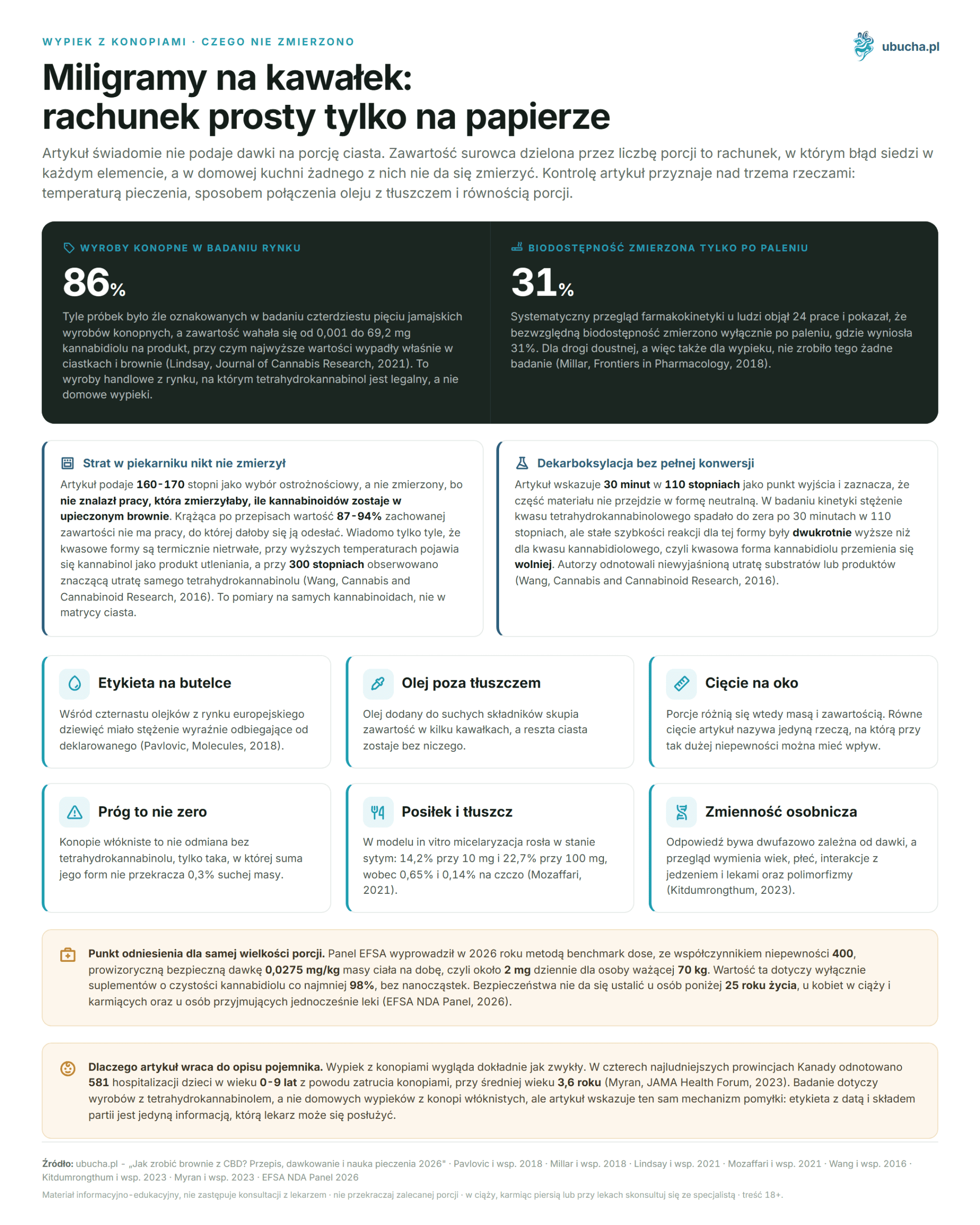
• EFSA derived in 2026 a provisional safe dose of 0.0275 mg/kg body weight per day, about 2 mg for a 70 kg person.
• CBD safety cannot be established for persons under 25, pregnant, breastfeeding, or taking medications.
• Acid cannabinoid forms degrade unevenly with heat, so full herb conversion should not be assumed.
Does brownie make sense as a cannabis dessert form?
Brownies solve two real problems of home cannabis baking: taste and portioning. Dark cocoa covers the herbal taste of oil, and the dense, moist cake can be cut into equal squares, unlike crumbly cakes or uneven muffins. Other promises around this recipe are much less documented.
Cannabidiol is lipophilic and needs fat as a carrier. Brownies have plenty: butter and chocolate form a continuous fat phase where oil distributes evenly if mixed before adding flour. Sprinkling oil on finished cake results in some pieces with all content and others with none.
The importance of fat is confirmed by digestion physiology. In a three-phase upper GI digestion model, cannabidiol micellarization in the fed state was 14.2% at 10 mg and 22.7% at 100 mg, versus 0.65% and 0.14% fasting (Mozaffari, Molecules, 2021). This in vitro study is not on humans, but the direction is clear: without fat and bile salts, cannabidiol barely passes to absorbable phase.
What brownies do not do? They do not increase effect strength predictably and do not replace any therapy. They are a dessert with an additive, not a drug delivery form.
Is home baking with cannabis allowed?
Homemade baked goods from legal hemp or retail oil are not prohibited. The situation is different with pharmacy-issued herb on prescription: self-processing such raw material at home is not legalized by any law provision. This distinction decides whether you bake cake or commit a crime.
Hemp plants have a sum of delta-9-THC and tetrahydrocannabinolic acid in flowering tops not exceeding 0.3% dry weight, rounded to one decimal place. This is based on article 4 point 5 of the anti-narcotics act of July 29, 2005 (consolidated text Dz.U. 2023 item 1939), as amended March 24, 2022 (Dz.U. 2022 item 763). The national threshold corresponds to the EU threshold in regulation (EU) 2021/2115 effective January 1, 2023, but they are separate regulations with the same numeric value.
Food from hemp seeds is regulated separately. Maximum allowed sum of delta-9-THC and THCA is 3.0 mg/kg for seeds and processed products, and 7.5 mg/kg for hemp seed oil, per Annex I section 2.6 of Commission Regulation (EU) 2023/915. These limits apply to raw food material, not finished cake.
Pharmacy herb is governed by other rules. Article 33a concerns pharmaceutical raw material for compounding prescription drugs in pharmacies. Articles 4 points 19 and 20 define processing as giving a new form, punishable under article 53 paragraphs 1 and 2. The law contains no exemption for patients with prescriptions. Hemp butter and cake from pharmacy herb fit the definition of giving a new form, so this provision is not guidance for patients.
What do you need for CBD brownies?
The list is short: fat with high fat phase content, dark chocolate, hemp oil or decarboxylated herb, kitchen scale, and oven thermometer independent of the oven. The last two determine repeatability more than anything else, as home ovens can have temperature deviations, and portion variation comes directly from uneven cutting.
Clarified butter works best here as it is almost pure fat without water and proteins that burn on the bottom when heated longer. Refined coconut oil gives a dairy-free version with similar consistency after solidifying. Liquid oils at room temperature, like rapeseed or olive oil, change cake structure and hinder even cutting.
| Item | Purpose | Watch out for |
|---|---|---|
| Scale accurate to 1 g | Measuring herb and fat | Eyeballing causes portion variation |
| 5 ml syringe without needle | Measuring hemp oil | Bottle pipette is less accurate |
| Oven thermometer | Control actual temperature | Dial setting may not match interior |
| Liquid thermometer | Monitor water bath | Butter should not sizzle |
| 20×20 cm pan | Even cake height | Thicker layer extends baking time |
| Sieve or gauze | Strain herb after infusion | Strong squeezing causes bitter taste |
You choose raw material in one of two ways. Hemp oil is ready to use and requires no prior processing as the producer decarboxylated during extraction. Herb requires its own oven step and straining but brings a fuller terpene profile. Oils are found in the hemp oils category.
Does hemp flour work in brownies?
It works as a partial substitute for wheat flour, but not for reasons most recipes claim. Hemp enters the bake as a technological and flavor ingredient, not as a source of record protein amounts, as numbers circulating under that claim come from studies where records belonged to other plants.
A study on nutritional value of minimally processed commercial protein products tested fava bean, narrow-leaf lupin, rapeseed meal, flaxseed, oil hemp seeds, buckwheat, and quinoa. Highest crude protein content above 30 g per 100 g dry weight was in fava bean, blue lupin, and rapeseed meal, not hemp (Mattila, Plant Foods for Human Nutrition, 2018). Sum of essential amino acids ranged from 25.8 g per 16 g nitrogen in oil hemp hulls to 41.5 g in quinoa. The popular claim of “30 g protein and 28 g fiber in hemp flour” comes from misattributing the first number to the wrong plant.
Regarding baking, a study on hemp oil extraction and its use in gluten-free baking showed hemp flour and oil suit classic cakes. Gluten-free cupcakes enriched with extract had mechanical properties and temperature profile comparable to reference sample, with height 4.1 cm and hardness 1.9 N (Baldino, Molecules, 2025). This is a technological, not nutritional, argument.
Use hemp flour cautiously in the recipe. It lacks gluten and binds water strongly, so replacing more than one quarter of wheat flour makes cake dense and dry. It also brings its own nutty-herbal flavor, which holds well in dark chocolate but dominates in sweeter versions.
How much cannabinoid really gets into one piece?
Less than arithmetic suggests, and it is impossible to say how much less. The calculation is simple only on paper: raw material content divided by number of portions. Each element has an error you cannot measure at home, and errors add up.
The first error is in the bottle. An analysis of fourteen European CBD oils found nine with concentrations clearly deviating from declared, and five within optimal ranges (Pavlovic, Molecules, 2018). Authors noted lack of uniform quality requirements for this product category.
The second error concerns the finished product and is visible even in commercial goods. A study of forty-five Jamaican cannabis products showed 86% were mislabeled, none had child-resistant packaging, and content ranged from 0.01 to 99.9 mg THC and 0.001 to 69.2 mg CBD per product, with highest values in cookies and brownies (Lindsay, Journal of Cannabis Research, 2021).
The dose reference changed in 2026. EFSA derived by benchmark dose method with uncertainty factor 400 a provisional safe dose of 0.0275 mg/kg body weight per day, about 2 mg daily for a 70 kg person (EFSA NDA Panel, 2026). This applies only to supplements with cannabidiol purity at least 98%, without nanoparticles. CBD safety cannot be established for persons under 25, pregnant, breastfeeding, or taking medications. Dose calculations for various oil concentrations are detailed separately in the home baking dose calculator.
The practical conclusion differs from most recipes. Instead of aiming for a specific milligram number per piece, record how much and what raw material went into the batch, cut cake into equal squares, and label the container. With such uncertainty about content, cutting precision is the only factor you can control.
Can THC be present in home baked goods?
In trace amounts, yes, regardless of raw material legality. Hemp is not THC-free but has a sum of delta-9-THC and its acid form not exceeding 0.3% dry weight. Zero and “below threshold” are different, and the recipe does not change raw material composition.
Separate limits apply to hemp seed food, expressed in mg/kg, not percent. Maximum allowed is 3.0 mg/kg for seeds and processed products, and 7.5 mg/kg for hemp seed oil. This level refers to sum of delta-9-THC and its acid form expressed as delta-9-THC with factor 0.877 for acid form. Based on Annex I section 2.6 of Commission Regulation (EU) 2023/915 effective May 25, 2023.
The spread in finished products is shown by the Jamaican study. THC content in forty-five tested products ranged from 0.01 to 99.9 mg per unit, and 30% exceeded recommended 10 mg THC per portion (Lindsay, Journal of Cannabis Research, 2021). This market allows THC products, but the number shows how wide differences can be when no one measures.
For readers, this means one practical advice. If a substance test result matters professionally or you drive company vehicles, homemade cannabis baked goods are not neutral and better avoided than relying on low amounts.
Is decarboxylation necessary before baking?
Yes, if baking with herb, as raw plant material contains mostly acid cannabinoid forms. Do not assume full conversion. The often repeated figure of over 90% conversion in half an hour lacks support from studies usually cited.
In a decarboxylation kinetics study, extracts were heated in a vacuum dryer at 80, 95, 110, 130, and 145 degrees Celsius up to 60 minutes (Wang, Cannabis and Cannabinoid Research, 2016). Concentration-time dependence was exponential, i.e., first-order reaction. Below 100 degrees, reaction did not finish within an hour. Tetrahydrocannabinolic acid concentration dropped to zero after 30 minutes at 110 degrees, 9 minutes at 130, and 6 minutes at 145.
For cannabidiol acid, the result was less convenient. Reaction rates for THCA-A were twice those for CBDA and CBGA, meaning cannabidiol acid converts slower. Authors noted unexplained substrate or product loss. This closes the topic of guaranteed home decarboxylation efficiency.
Practically, this means 30 minutes at 110 degrees as a starting point, thin layer of ground herb, and acceptance that some material remains in acid form. Baking cake alone does not replace this step, as herb embedded in fat has limited heat contact and baking time is shorter. The reaction mechanism is described in detail in the step-by-step decarboxylation post.
At what temperature to bake cannabis brownies?
At 160 to 170 degrees Celsius, about 20 degrees lower than classic recipes. The reason is caution, not measurement: no study measured how much cannabinoids remain in baked brownies. Numbers like “87-94% retained content” circulate without a study to reference.
Known facts concern cannabinoids, not cake. Acid forms are thermally unstable and degrade under light and heat. Studies cited in decarboxylation kinetics showed cannabinol as oxidation product at higher temperatures, and significant delta-9-THC loss at 300 degrees (Wang, 2016). The direction is clear, though cake matrix values are unknown.
This leads to simple decisions: lower setting, longer time, pan on middle rack, convection instead of bottom heat only. For traditional function, reduce temperature by 10 degrees and extend baking by a few minutes. Toothpick inserted in center should come out with moist crumbs, as overbaking dries cake without flavor gain.
Check your oven with an independent thermometer on the middle rack to verify setting matches interior temperature. If difference is large, adjust dial, not recipe.
How to make hemp butter step by step?
Hemp butter is fat infused with plant material after decarboxylation. The process involves maintaining a steady low temperature for several tens of minutes and straining herb. Extraction efficiency cannot be measured at home, so any percentage in such a recipe is an author estimate, not a measurement result.
| Step | What you do | Conditions |
|---|---|---|
| 1 | Decarboxylate herb | 110 degrees, 30 minutes, thin layer |
| 2 | Melt clarified butter | Lowest burner, 60-70 degrees |
| 3 | Infuse with stirring | 70-90 degrees, 90 minutes, stir every 10 minutes |
| 4 | Strain through gauze | No strong squeezing |
| 5 | Cool and label container | Fridge, date and batch composition |
Starting ratio is 250 g clarified butter per 3-5 g decarboxylated herb. This yields fat for two bakes. For dairy-free version, use the same amount of refined coconut oil. Do not raise temperatures even if process seems slow, as faster will not happen and losses increase.
You cannot test homemade butter by kitchen method. The test of eating a teaspoon and judging effects measures person sensitivity, not fat content, and leads to dose escalation if repeated. For a simpler version, skip infusion and use ready oil. Full infusion description is in the hemp butter step-by-step post.
What is the basic recipe for 16 portions?
The recipe is based on classic butter-chocolate base, with hemp oil added to melted fat before flour. The whole process takes about one and a half hours, with 25-30 minutes baking and one hour cooling. Cake is cut only after full cooling, as warm cake smears under the knife and portions become uneven.
- 150 g clarified butter or refined coconut oil
- 150 g 70% or darker dark chocolate
- hemp oil in amount recorded for batch or 200 g hemp butter
- 3 large room temperature eggs
- 180 g light cane sugar or erythritol
- 1 teaspoon vanilla extract
- 80 g wheat flour type 500
- 40 g unsweetened dark cocoa
- half teaspoon fine sea salt
- optional 80 g walnuts
Preheat oven to 160 degrees with convection and line 20×20 cm pan with parchment with edges. Melt chocolate with butter over hot water, ensuring water does not touch bowl bottom. Remove bowl, add hemp oil, and stir for one minute until smooth and glossy. Set aside to cool, as hot mixture curdles eggs.
In another bowl, beat eggs with sugar and vanilla for 3-4 minutes until doubled volume. Pour in cooled chocolate mixture, stirring with whisk. Sift flour, cocoa, and salt on top, then fold gently with spatula from bottom to top. Undermixing is better than overmixing, which activates gluten and gives rubbery texture.
Pour batter into pan, level, and tap pan on counter to release bubbles. Bake 25-30 minutes, checking with toothpick from 24 minutes. After removal, wait 15 minutes in pan, transfer to rack with paper, and cut after an hour into sixteen squares in a four-by-four grid. Store each portion in labeled container.
How to adapt recipe for vegan and gluten-free diets?
Both adaptations change only the grain and protein matrix, so baking temperature and fat-oil mixing remain unchanged. Time changes: flaxseed versions are moister and need 3-5 minutes longer, gluten-free mixes usually 2-3 minutes shorter. Check with toothpick earlier than basic recipe.
| Variant | Substitution | Baking time |
|---|---|---|
| Vegan | Coconut oil instead of butter; 3 tbsp ground flaxseed and 9 tbsp water instead of eggs | Longer by 3-5 minutes |
| Gluten-free | 50 g rice flour and 30 g almond flour plus quarter teaspoon xanthan gum | Shorter by 2-3 minutes |
| Sugar-free | Erythritol instead of cane sugar, batter unchanged | Unchanged |
| No nuts | Omit nuts, rest unchanged | Unchanged |
For vegan version, check chocolate ingredients as some high cocoa bars contain trace milk. For gluten-free, watch cross-contamination of cocoa and chocolate if baking for celiac. Both variants have denser structure than basic, which helps even cutting.
What mistakes spoil home cannabis baked goods?
Most common mistakes concern repeatability, not taste. The bake is good, but effect differs from previous batch because something changed unrecorded. The list below collects five situations where results predictably diverge.
| Mistake | What happens | How to prevent |
|---|---|---|
| Skipping decarboxylation | Acid forms remain in cake | 30 minutes at 110 degrees before infusion |
| Too high temperature | Thermal cannabinoid degradation increases | 160-170 degrees and independent thermometer |
| Oil added to dry ingredients | Content concentrates in few pieces | Mix with melted fat for one minute |
| Cutting by eye | Portions differ in mass and content | Four-by-four grid after cooling |
| No container labeling | Batches mix together | Label with date and batch composition |
The sixth mistake is not kitchen-related but effect reading. Eating another portion because the first “did not work” is the most common cause of unpleasant experiences with cannabinoid-containing food. Absorption from GI tract is slow and individually variable, so no effect after one hour does not mean no effect.
When and how long does CBD from cake work?
Slower than sublingual drops and less predictable than most recipes claim. A systematic review of human cannabidiol pharmacokinetics covered 24 studies and showed absolute bioavailability was measured only after smoking, at 31%. No study measured it for oral or mucosal routes (Millar, Frontiers in Pharmacology, 2018).
The same review reports known facts. Half-life ranged from 1.4 to 10.9 hours after mucosal spray. With chronic oral dosing, it extended to 2-5 days, and after smoking was 31 hours. Time to maximum concentration ranged from 0 to 4 hours, and maximum concentration increased in fed state and lipid formulations, which matters directly for butter-based baked goods.
The often repeated “edibles bioavailability 6-19%” does not come from this or any accessible study. The review states lack of data, not low value. This is important practically: no measurement means unknown fraction of ingested cannabinoid reaching bloodstream.
Individual variability adds complexity. A review on individual cannabinoid response divides sources into exposure factors (route, timing, frequency, food or drug interactions), personal factors (age, sex), and susceptibility factors (cannabinoid receptor and metabolizing enzyme gene polymorphisms). Authors recommend starting low, going slow, and staying low with edible products (Kitdumrongthum, Molecules, 2023).
Eat baked good on empty stomach or after meal?
After a meal, preferably one containing fat. The difference is not cosmetic, as it affects how much cannabidiol passes to absorbable form from intestinal lumen.
In a three-phase upper GI digestion model, cannabidiol micellarization efficiency in fed state was 14.2% at 10 mg and 22.7% at 100 mg. Fasting measurements were 0.65% and 0.14% (Mozaffari, Molecules, 2021). The food matrix was olive oil and vegetable puree, and authors link effect to micelle formation from hydrolyzed fats and presence of bile salts and lipase.
A human pharmacokinetic review confirms direction: maximum cannabidiol concentration rises in fed state and lipid formulations (Millar, Frontiers in Pharmacology, 2018). Butter and chocolate brownies are themselves a lipid formulation, so the recipe does part of the work, and the meal you eat after does the rest.
Practice: eat a cake piece as dessert after a fat-containing lunch or dinner, not as a snack between meals. Do not combine with alcohol, which burdens the same organ, and expect effect onset later than on empty stomach. Later start is not a reason to take another portion.
What to do if portion is too strong?
Wait it out in a calm place, drink water, and do not add anything else. There is no antidote usable in the kitchen, and most unpleasant cannabinoid food experiences resolve within hours as plasma concentration falls.
The surprise mechanism is well described. Cannabinoid response can be biphasic dose-dependent: low doses stimulate, high doses inhibit, with large interindividual variability. The same dose and preparation can be beneficial for one person and poorly tolerated by another (Kitdumrongthum, Molecules, 2023). Sources of variability include route, exposure frequency, food and drug interactions, age, and metabolizing enzyme gene polymorphisms.
Practically, three things: first, put the rest of the batch out of sight to avoid another piece. Second, do not drive or plan demanding tasks until symptoms subside. Third, record how much and what you ate for future reference beyond memory.
Seek medical help if you experience heart palpitations, severe anxiety, vomiting preventing drinking, or if a child or medicated person ate the portion. This is not a situation to wait out at home, and batch composition info from container label helps medical staff.
Is cannabis brownie safe?
For healthy adults, risk is low but not zero, and for some readers it cannot be estimated. A review of cannabidiol product data approved in the US found adverse events in nearly half of users, with dose dependence (Brown, Journal of Clinical Medicine, 2019).
Common events include increased aminotransferase activity, sedation, sleep disturbances, infections, and anemia. Authors note high interaction potential as cannabidiol affects typical drug metabolism targets including CYP3A4 and CYP2C19 and excretion via P-glycoprotein. Practical recommendations include dose reduction, adverse event monitoring, and considering alternative therapy, especially in patients with multiple diseases.
EFSA’s 2026 position adds toxicology. Animal studies showed consistent liver toxicity signals, human data indicate hepatotoxic potential especially with drugs, placental transfer, and hormonal changes. No studies on immunotoxicity. Safety cannot be established for persons under 25, pregnant, breastfeeding, or taking medications (EFSA NDA Panel, 2026).
In kitchen terms: if you take medications regularly, are pregnant, breastfeeding, or have liver disease, this bake is not for you, and talking to a doctor is not a formality. Do not combine with alcohol or drive after an unknown-content portion.
How to store raw material before baking?
Oil in a dark bottle, closed, cool, and away from light; herb in a sealed container away from heat sources. The reason is the same as for oven temperature control: cannabinoids and fat they dissolve in oxidize, and oxidation products are measurable.
An analysis of fourteen commercial European CBD oils included cannabinoid content, terpene fingerprint, and lipid oxidation products measured by GC-MS and HPLC (Pavlovic, Molecules, 2018). Authors considered oxidation profile an indicator of oil stability as extract carrier, and terpene fingerprint as variety quality indicator. In other words, fat condition tells about bottle state, not just label number.
Acid cannabinoid forms degrade under light, air, and heat, as noted in decarboxylation kinetics study (Wang, 2016). Raw material kept in a clear jar on a windowsill changes before entering the recipe, and you attribute difference to baking.
Rules are short. Close bottle after each measurement and keep in cupboard or fridge, store herb in opaque sealed container. Do not store either above stove or near oven. Add measured portion to fat just before baking, not in advance.
How to store and label finished brownies?
In fridge for several days or freezer for several months, always in a closed container with label and out of children’s reach. Labeling is not overkill. Cannabis baked goods look exactly like regular cake, and that is the whole problem.
Data from Canadian hospitals show scale. In four most populous provinces, 581 hospitalizations of children aged 0-9 due to cannabis poisoning were recorded, average age 3.6 years. In provinces allowing edible sales, about one third of poisonings involved cannabis, while in the banned province the rate remained similar (Myran, JAMA Health Forum, 2023). The study concerns THC products, not homemade hemp brownies, but the confusion mechanism is the same.
Practice is simple. Keep cake cut into portions in a sealed container, wrap each piece separately if freezing. Write baking date and batch composition on lid. Store container high or in a lockable cabinet, not on counter or front fridge door. Thaw in fridge overnight or at room temperature, no microwave.
Last point concerns emergencies. If a child eats such a portion, call poison control and bring labeled container, as batch info is the only thing doctors can use.
How do brownies differ from other cannabis forms?
Difference is in speed and predictability, not strength. Smoking acts fastest and is the only route with measured absolute bioavailability. Edible forms start slowly, last longer, and have greatest uncertainty about how much substance reaches bloodstream.
| Form | Speed | What is known about absorption |
|---|---|---|
| Baked good | Slowest | No measured absolute bioavailability |
| Sublingual drops | Intermediate | No measured absolute bioavailability |
| Smoking | Fastest | 31% in Millar 2018 review |
The table also shows how little is known. Two of three forms lack measured absolute bioavailability despite years of use and existence of intravenous preparations allowing such measurement. The pharmacokinetic review calls this a data gap and an obstacle to therapeutic cannabidiol use.
The practical kitchen conclusion: baked goods suit planned situations, not immediate reaction. Eat when you have free hours ahead, not when you need instant effect. If you like dessert form but do not want to bake, the same portioning problem is solved differently by homemade CBD chocolate, where mass divides into molds of equal volume and each mold has the same capacity.
Add CBG to brownies?
No studies tested CBG added to baked goods, so any ratio in a recipe is guesswork. The only human data come from a survey about ready cannabis products with predominance of cannabigerol, not cake.
The survey included 127 US adults aged 21+ who used products with over 50% CBG in last six months (Russo, Cannabis and Cannabinoid Research, 2022). Most common reasons were anxiety (51.2%), chronic pain (40.9%), depression (33.1%), and insomnia (30.7%). 44% reported no adverse effects, dry mouth 16.5%, drowsiness 15%.
These are self-reported data from a small sample without control group, and authors state CBG-predominant products should be studied in randomized clinical trials. This suffices to say people use CBG, and nothing more. There is no basis today to give any CBG to CBD ratio in brownie recipes.
Similarly for cannabinol, whose share in herb rises with oxidation. Popular attribution of sedative effect is market-driven, not human research-based, so “night” batches with CBN remain experiments without reference points.
Frequently Asked Questions
Does CBD break down during brownie baking?
I did not find a study measuring cannabinoid content in baked brownies. Acid forms are thermally unstable, and at higher temperatures oxidation products and cannabinoid losses occur (Wang, Cannabis and Cannabinoid Research, 2016). That is why the recipe calls for 160-170 degrees, lower than classic brownies.
How much cannabinoid to add per serving?
This post does not provide a dose per serving intentionally. EFSA derived in 2026 a provisional safe dose of 0.0275 mg/kg body weight per day, about 2 mg for a 70 kg person, and noted safety cannot be established for those under 25 years old, pregnant, breastfeeding, or taking medications (EFSA NDA Panel, 2026).
Is decarboxylation necessary before baking?
Yes, if baking with herb, but without assuming full conversion. In a kinetics study, tetrahydrocannabinolic acid concentration dropped to zero after 30 minutes at 110 degrees, while cannabidiol acid reacted twice as slowly, with unexplained substrate or product loss noted (Wang, Cannabis and Cannabinoid Research, 2016).
When does the cannabis baked good start to work?
Later than drops and less predictably. Time to maximum cannabidiol concentration ranges from 0 to 4 hours, and no study measured absolute bioavailability for oral route (Millar, Frontiers in Pharmacology, 2018). Lack of effect after one hour is not a reason to take another portion.
How long can such brownies be stored?
A few days in the fridge, several months in the freezer, always in a sealed container labeled with date and batch composition. Thaw in the fridge overnight or at room temperature, no microwave. Keep container out of children’s reach, as the baked good looks like regular cake.
Is home baking with cannabis legal?
Baking with legal hemp or retail oil is not prohibited. Pharmacy-issued herb is different: article 33a of the anti-narcotics act concerns raw material for pharmacy compounding, and articles 4 points 19 and 20 define processing as giving a new form, punishable under article 53.
Can you make brownies without hemp butter?
Yes, and it is simpler. Add ready oil to melted butter with chocolate and stir for a minute before mixing with other ingredients. This skips decarboxylation, infusion, and straining, saving about one and a half hours and two steps prone to temperature errors.
Summary
Homemade cannabis brownies give control over three things: baking temperature, how oil is combined with fat, and portion equality. They do not give control over cannabinoid content in a cake piece, as raw material often differs from label, and no one measured losses in the oven for such a matrix.
The workflow is clear. Decarboxylate herb for 30 minutes at 110 degrees, combine fat with oil before adding flour, bake at 160-170 degrees with convection for 25-30 minutes, and cut cake after full cooling into sixteen equal squares. Label container with date and batch composition.
Keep raw material and finished cake separately. Store oil closed, cool, and away from light; herb in opaque container; cut portions in labeled box out of children’s reach. Cannabis baked goods look exactly like regular cake, and that is the only reason date and batch labels matter.
The rest is caution. EFSA today gives a provisional safe dose around 2 mg daily for a 70 kg person and states safety cannot be established for persons under 25, pregnant, breastfeeding, or taking medications. If you belong to these groups, this recipe is not for you, and talking to a doctor is not a formality.
This article is for informational and educational purposes and does not constitute medical advice. Consult a doctor before starting cannabis or CBD for therapeutic purposes, especially if taking other medications, pregnant, or breastfeeding.
Author: Michał Waluk · Published: 2026-05-04 · Updated: 2026-08-10