
Eleuthero (Siberian ginseng) - for immunity and endurance (FAQ)
Eleuthero: answers to the most common questions and what studies say. u Bucha.
Eleuthero (Eleutherococcus senticosus) for decades it functioned in the shadow of Asian adaptogens - ashwagandha and Korean ginseng. Meanwhile, eleuthero was the first adaptogen thoroughly studied by Soviet scientists in the 1960s. Dr. Izrail Brekhman - a pharmacologist who coined the term 'adaptogen' - used eleuthero as the main subject of research. Trials were conducted on astronauts, Olympic athletes, and factory workers, documenting improvements in endurance, resilience, and adaptation to stress. This article answers the most common questions about eleuthero: what it is, how it works, how to dose it, and who should exercise caution.
KEY INFORMATION
• Eleuthero (Eleutherococcus senticosus) is the first plant adaptogen systematically studied scientifically - Soviet studies since the 1960s.
• Active substances are eleutherosides A-M, not ginsenosides - eleuthero is a different species than Korean ginseng (Panax ginseng).
• Clinical studies confirm improvements in physical endurance and a reduction in respiratory infections (Shikov et al., Journal of Ethnopharmacology, 2014).
• Standard dose of extract: 300-1200 mg/day in 2 doses in the morning and noon.
• Stosuj cyklicznie: 6-8 tygodni kuracji, 2-4 tygodnie przerwy.
• Caution with warfarin, digoxin, and uncontrolled hypertension.
Historia eleuthero - od Syberii do olimpijskich podium
Eleuthero grows wild in the forests of eastern Siberia, northern China, Japan, and North Korea. In traditional Chinese medicine (ci wu jia) it has been used to enhance strength and immunity, but it did not have the prestige of Korean ginseng due to its lower availability in China. A true breakthrough occurred in the Soviet Union.
In the 1960s, Dr. Izrail Brekhman from the Pharmacology Institute in Vladivostok conducted intensive research on plants with adaptogenic potential - defining an adaptogen as a substance that increases the non-specific resistance of the body to stress without disturbing normal functions. Eleuthero proved to be an ideal model: clear action, availability in Siberia, and a good safety profile. Soviet Olympic athletes used eleuthero as a supportive agent - without doping effects in the then-understood regulations.
A systematic review by Shikov and colleagues published in Journal of Ethnopharmacology in 2014 analyzed the available clinical studies on eleuthero and assessed them as indicating moderate evidence strength for improvements in physical performance, immunity, and cognitive parameters (Shikov et al., 2014). The authors emphasized that the methodological quality of older Soviet studies was uneven, but newer European and Japanese clinical trials confirm the basic observations.
Active substances of eleuthero - eleutherosides and their action
Eleuthero is chemically completely distinct from Korean ginseng (Panax ginseng). Korean ginseng contains ginsenosides (triterpenoid saponins) - eleuthero contains eleutherosides. Eleutherosides are a chemically heterogeneous group: it includes lignans (eleutherosides B, D, E), phenylpropanoids (eleutherosides B, B4), coumarins (eleutherosides B1), and polysaccharides (elenteosides I-M).
Eleutherosides B and E are the best-studied active substances. Eleutherosides E (syringaresinol diglucoside) show immunomodulating and adaptogenic activity in studies. Polysaccharides from eleuthero activate NK cells and macrophages - similar to beta-glucans from medicinal mushrooms, but through a different receptor-ligand mechanism.
A good quality extract of eleuthero should be standardized for the content of eleutherosides B and E - a minimum of 0.8-1% of the dry mass of the extract. Products without specified standardization may contain very different amounts of active substances.
| Product form | Starting Dose | Standard dose | Notes |
|---|---|---|---|
| Standardized extract (capsules) | 150-300 mg/day | 300-1200 mg/day (2 doses) | Min. 0.8% eleutherosides B+E; in the morning and at noon |
| Tincture (1:5) | 1-2 ml 2×/day | 2-4 ml 3×/day | With water or juice; not in the evening |
| Dried root (tea) | 1 g/day | 2-3 g/day | Boil for 15-20 min; 2 cups in the morning/noon |
| Cyclical protocol: 6-8 weeks of treatment → 2-4 weeks break → another treatment. Do not use continuously for more than 3 months. | |||
Eleuthero for endurance - what sports studies say
Studies on the impact of eleuthero on physical endurance have been conducted in both sports and professional contexts. One of the most frequently cited contemporary studies - published in International Journal of Sport Nutrition and Exercise Metabolism - showed that 8 weeks of eleuthero supplementation (800 mg daily) in trained cyclists significantly improved time to exhaustion and VO2max value. The mechanism is likely related to better utilization of free fatty acids as an energy source and delayed onset of glycogenolysis.
Eleuthero does not act as a stimulant like caffeine - it does not temporarily raise alertness. The effect is gradual and cumulative: the first noticeable changes in energy and endurance usually appear after 2-3 weeks of regular use, and the full adaptogenic effect after 4-6 weeks. Therefore, eleuthero works better as a substance used seasonally or throughout the entire training season, rather than as a supplement taken on an ad-hoc basis before competitions.
Eleuthero a stres chroniczny - mechanizm adaptogeniczny
The term "adaptogen" was coined by Dr. Israel Brekhman during research on eleuthero. The definition includes three criteria: the substance is harmless and does not disrupt normal physiological functions; it acts non-specifically - increasing resistance to a wide range of stresses (physical, chemical, biological); it normalizes the body's functions regardless of the direction of deviation from the norm. Eleuthero meets all three criteria in experimental and clinical studies.
The mechanism of action of the adaptogenic eleuthero involves several molecular pathways. Eleutherosides B and E modulate the activity of the HPA axis (hypothalamus-pituitary-adrenal) - which is normally excessively activated during chronic stress. The polysaccharides in eleuthero activate NK cells and macrophages, which explains the observed reduction in infection rates in studies. Syringaresinol (eleutheroside E) also exhibits protective effects on mitochondria - it may reduce oxidative stress during intense physical exertion or prolonged psychological stress.
The key concept here is non-specificity: eleuthero does not act by "driving" - it does not artificially raise energy levels like caffeine or amphetamines. It works through normalization: if the body is fatigued, eleuthero helps it recover better and utilize energy resources more efficiently. This is why the effects are gradual and require consistency - it is not a stimulant, but an adaptive modulator.
Eleuthero in the supplementation protocol - what to combine it with
Eleuthero pairs well in protocols combining several adaptogens. Classic combinations include: eleuthero in the morning + ashwagandha in the evening (dividing into energizing and stabilizing adaptogens throughout the day); eleuthero + Rhodiola rosea (Rhodiola rosea) as a synergistic combination of two Siberian adaptogens with complementary mechanisms (eleuthero for immunity and long-term endurance, rhodiola for acute support of cognitive functions and faster adaptation to exertion); eleuthero + vitamin C as basic immune support before the infection season.
Eleuthero is not a good combination with: high doses of caffeine (it may increase stimulation of the nervous system to an undesirable level), sedative medications (additive effect), and - as mentioned - warfarin or digoxin, where pharmacokinetic interactions have been described. With any pharmacological treatment, it is advisable to consult eleuthero supplementation with a doctor or pharmacist, providing specific medications being used.
For physically active individuals, the most effective protocol is a pre-season treatment: 6-8 weeks before an intense training season or winter infection season. Such a treatment allows for the full development of the adaptogenic effects of eleuthero before increased load occurs - both training and immunological.
Frequently Asked Questions
What is eleuthero and why is it called Siberian ginseng?
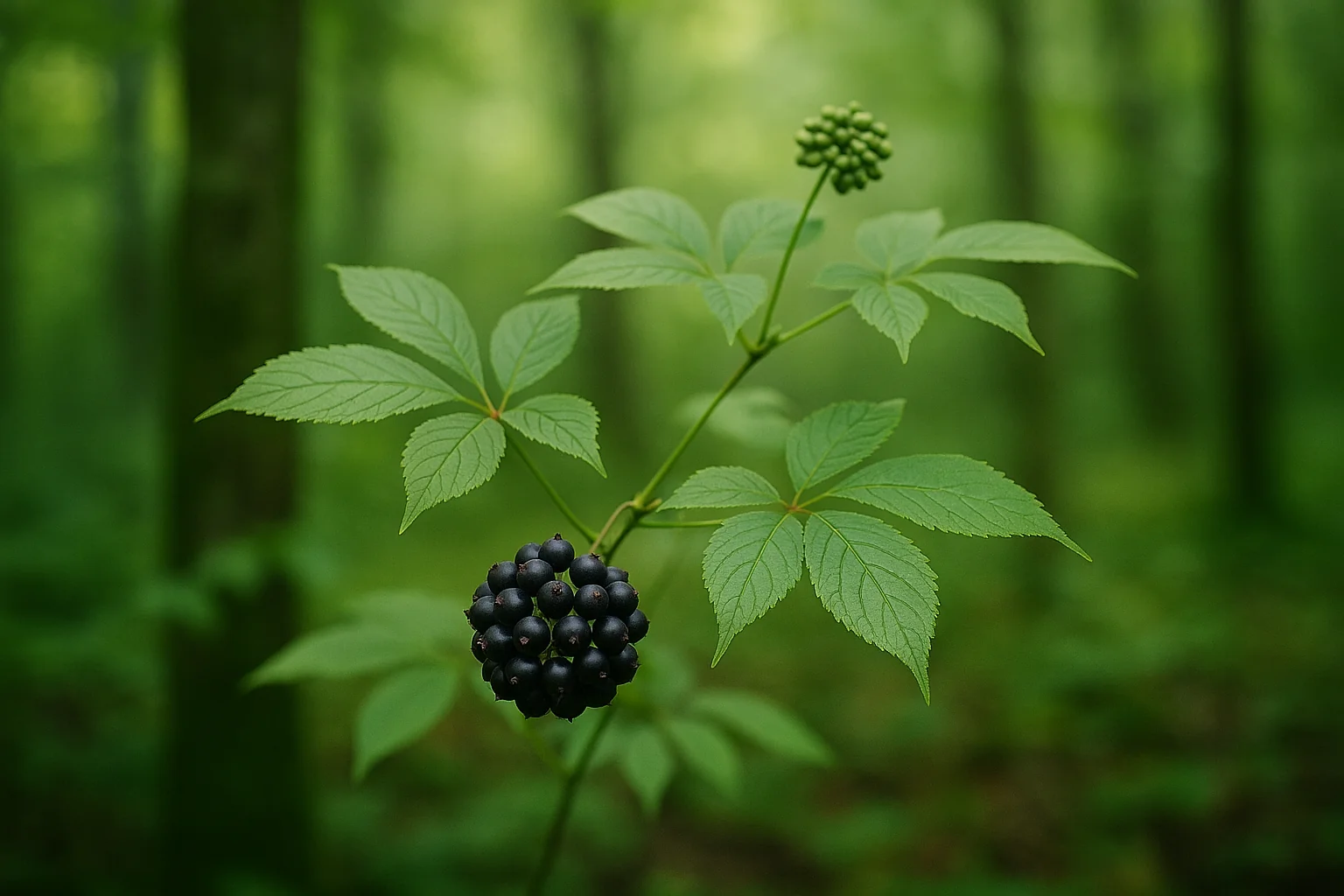
Eleuthero (Eleutherococcus senticosus) is a shrub from the Araliaceae family growing in the forests of Siberia, China, and Korea. The name "Siberian ginseng" is a trade name - eleuthero is not a species of ginseng (Panax), but has a similar adaptogenic profile. The active substances are eleutherosides (A-M), not ginsenosides as in true ginseng.
What does eleuthero act on - what do studies confirm?
Clinical studies confirm improvements in physical endurance and aerobic capacity (VO2max), reduction of subjective fatigue, support for the immune system (fewer upper respiratory infections), and improvement of cognitive parameters under stress. A systematic review from 2014 assessed available clinical studies and found moderate evidence for improvements in physical fitness and immunity.
How to dose eleuthero?
Standardized extract on eleutherosides: 300-1200 mg daily, divided into 2 doses (morning and noon). Tincture (1:5): 2-4 ml three times a day. Tea from the root: 2-3 g of dried root daily. Protocol: 6-8 weeks of treatment, followed by a 2-4 week break. Do not take in the evening - it may hinder falling asleep.
Is eleuthero different from Korean ginseng?
Yes - they are different plants with different active substances. Panax ginseng contains ginsenosides, while eleuthero contains eleutherosides. Panax acts more strongly as a stimulant; eleuthero is milder and better tolerated with long-term use. Both are adaptogens with slightly different action profiles.
Is eleuthero safe for long-term use?
Eleuthero has a good safety profile when used in recommended doses for 6-8 weeks. Cyclical use with breaks is recommended. It may interact with warfarin, digoxin, and sedative medications. With uncontrolled hypertension - caution is advised. Not recommended during pregnancy.
When is the best time to take eleuthero - in the morning or evening?
Definitely in the morning or at the latest by noon. Eleuthero may slightly activate the nervous system and hinder falling asleep when taken in the evening. The effects are gradual and cumulative - results are visible after 2-4 weeks of regular use, not after the first dose.
Does eleuthero help with immunity in winter?
Studies indicate that eleuthero may reduce the frequency and duration of respiratory infections. Russian clinical studies showed fewer sick days in the group taking eleuthero vs. placebo. Newer studies confirm a reduction in the duration of colds. Eleuthero works by modulating the immune response, not through direct antiviral action.
Can eleuthero be combined with ashwagandha?
Yes - it is one of the popular combinations in adaptogen supplementation. Eleuthero is an energizing adaptogen (better in the morning), while ashwagandha is a stabilizing and relaxing adaptogen (better in the evening). The scheme of morning-eleuthero, evening-ashwagandha is logical and has no known interactions between them.
This article is for informational and educational purposes and does not replace consultation with a doctor. If you are pregnant, breastfeeding, taking medications, or have chronic conditions, consult the use of supplements or herbs with a specialist.
Author: Michał Waluk · Published: 2026-05-04 · Updated: 2026-05-04