
CBD in the Diet 2026: Recipes, Culinary Trends, and Legal Status
CBD in the kitchen: why it needs fat, five recipes, 130°C thermal limit, and Novel Food status in Poland and the EU in 2026. Without dose tables.
Cannabidiol entered the kitchen by a roundabout way, through specialty cafes and non-alcoholic bars, and has already become surrounded by myths. The biggest one is: just add a few drops to anything. That’s not enough. CBD dissolves in fats, not water, and breaks down at high temperatures, so watery smoothies or cookies baked at 180°C are the most expensive way to throw oil in the trash. Below you will find what determines the result: absorption mechanism, ten culinary formats, five recipes, thermal limit, and current legal status in Poland and the EU. You won’t find dose tables or treatment advice here, nor baking recipes, because baking temperature negates the point of adding oil. There is also no brand comparison: the ready-made CBD food market in Poland is still awaiting Novel Food authorization, so there is nothing to compare.
KEY INFORMATION
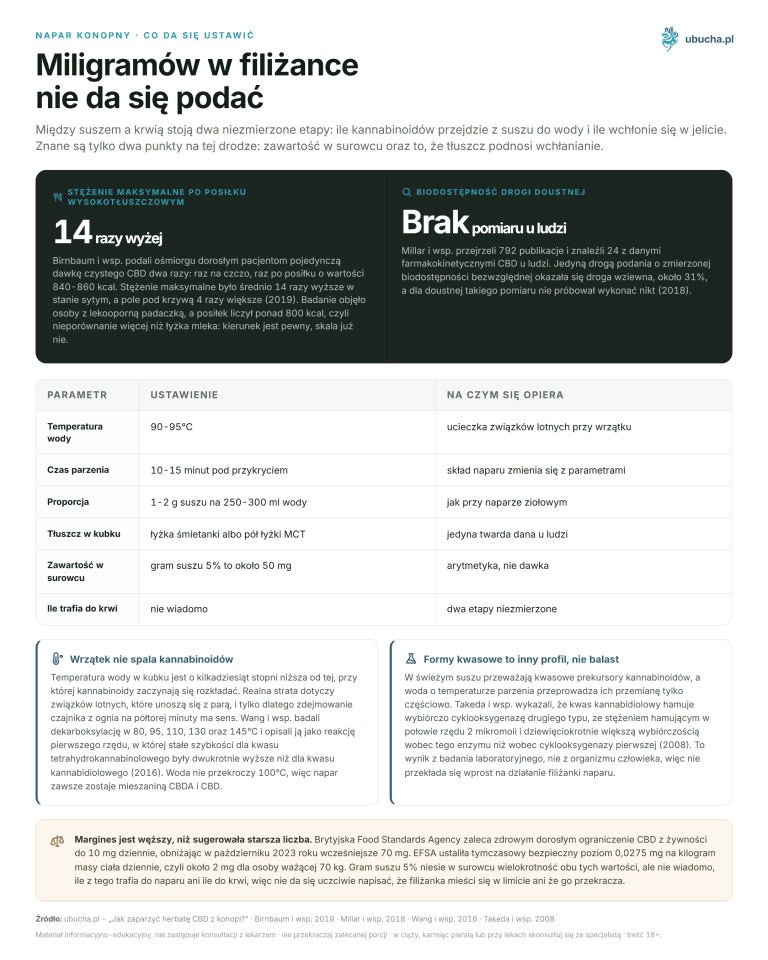
• A high-fat meal increases the area under the CBD concentration curve fourfold and the maximum concentration fourteenfold (Birnbaum et al., Epilepsia, 2019).
• After a meal with added oil, the effect starts after 30-90 minutes and lasts 4-8 hours (Newmeyer et al., Drug and Alcohol Dependence, 2017).
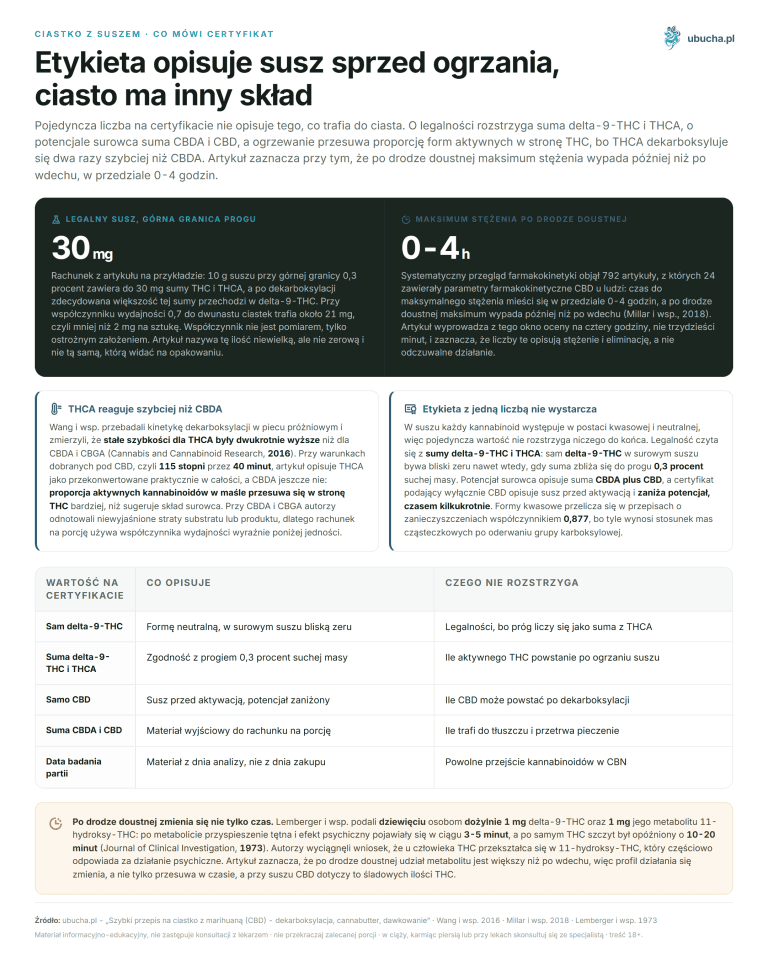
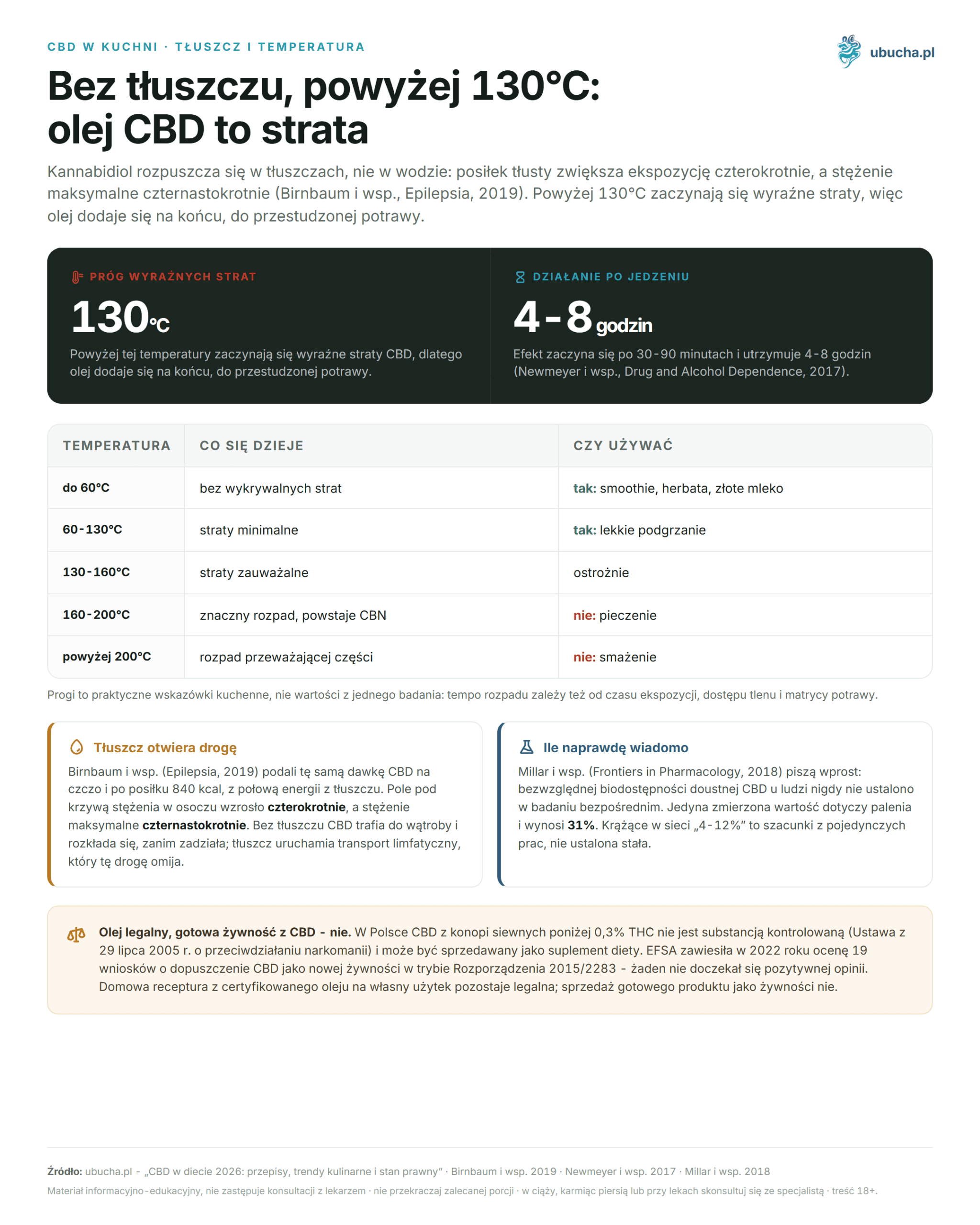
• Above 130°C, significant losses begin, so CBD is added at the end, to cooled dishes.
• In Poland, oil with THC below 0.3% is legal; ready-made CBD food is still awaiting Novel Food authorization.
Why does CBD in food need fat?
Because it is a lipophilic molecule and without a fat carrier it barely reaches the bloodstream. Birnbaum et al. (Epilepsia, 2019) administered the same dose fasting and after a meal providing 840 kcal with half the energy from fat. The area under the plasma concentration curve increased fourfold, and the maximum concentration fourteenfold.
The mechanism is simple. CBD taken without fat goes to the stomach, dissolves slightly in bile, and the rest is taken up by the liver in first-pass metabolism and broken down before the substance can act. Fat triggers lymphatic transport, which bypasses the liver and introduces the molecule into the bloodstream by a roundabout but much more effective route.
It is worth knowing how much we actually know. A systematic pharmacokinetic review by Millar et al. (Frontiers in Pharmacology, 2018) states directly that absolute oral bioavailability of CBD in humans has never been established in direct study; the only measured value concerns smoking and is 31%. The “4-12%” circulating online are estimates from individual studies, not a fixed constant. The direction of dependence remains indisputable: with fat, absorption is many times higher than without.
Not all fats act the same, and differences are large enough to know before choosing a recipe.
| Carrier | How it works | Where to use |
|---|---|---|
| Coconut MCT oil | fastest transport, short chains | smoothies, coffee, golden milk |
| Extra virgin olive oil | slower but longer release | dressings, bread dips |
| Avocado, nut butter | dense fat matrix | smoothie bowls, sandwiches |
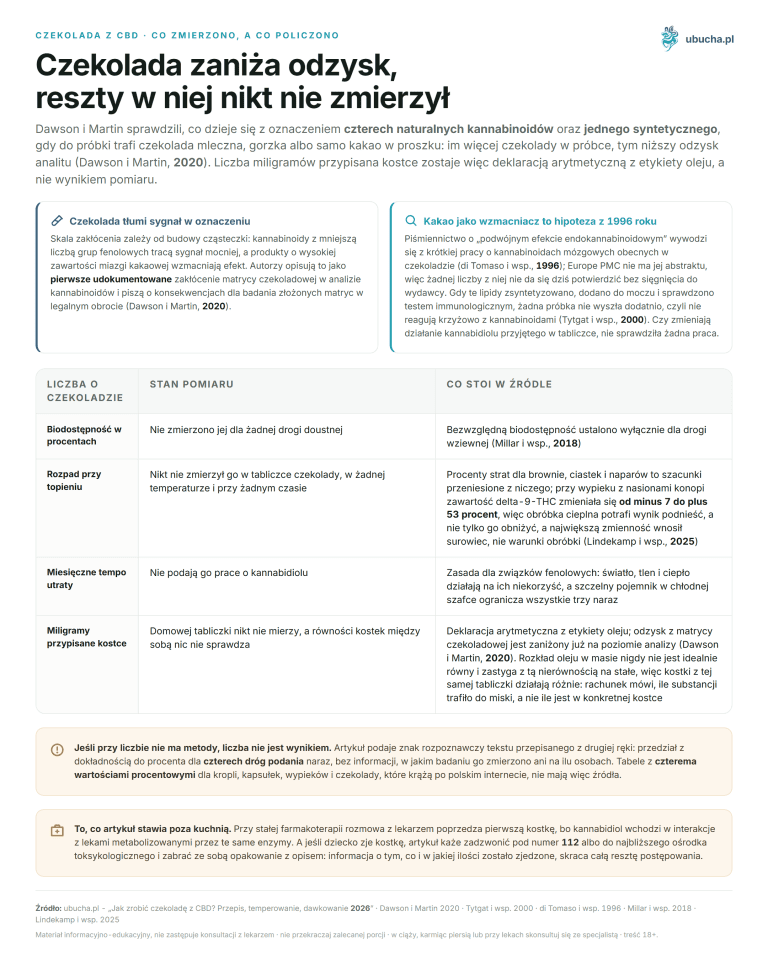
| Cocoa butter | about 35% fat in 70% chocolate | truffles, desserts |
| Skim milk, water | absorption near zero | do not use |
What are the CBD culinary trends for 2026?
Cold or cool formats dominate because only these protect the molecule. Drinks with added CBD grew in Europe by 38% year-on-year, and snack bars by 27% (Brightfield Group, 2025), despite unresolved Novel Food status. In Poland, the ready-made product market practically does not exist, so the same ideas are realized at home with certified oil.
| Format | Source of fat | Time of day |
|---|---|---|
| Coffee or cold brew | milk, honey | morning |
| Smoothie bowl | avocado, almond butter | morning |
| Date and chia bars | cashew nuts | snack |
| Dark chocolate truffles | cocoa butter | evening |
| CBD olive oil for salads | olive oil only | lunch |
| CBD honey | honey lipids, milk in tea | evening |
| Herbal infusion with CBD | plant milk or ghee | evening |
| Non-alcoholic cocktail | fat-based syrup | evening |
| Artisanal ice cream | milk or coconut fat | dessert |
| Chia pudding | coconut milk | morning |
Every format that has taken hold has a built-in fat carrier, and this is not a marketing coincidence but a condition for effectiveness. Water-based formats, tested in several waves of functional drinks, simply did not survive on the market.
Coffee with CBD works differently than coffee alone: caffeine stimulates, and cannabidiol suppresses the accompanying anxiety component, so the combination can be milder than espresso solo. The condition is milk or honey in the cup, because black coffee has nothing to carry the molecule. Dark chocolate truffles 70-85% performed best among all desserts for a simple technical reason: cocoa butter makes up about one third of their mass, and the forming temperature does not exceed 40°C, so nothing is wasted.
Herbal infusions are the most common disappointment. Chamomile with lemon balm and lavender for the evening or mint with ginger for digestion sounds reasonable, but the infusion itself is watery and cannabidiol passes through it almost unchanged. Only a spoonful of plant milk or a bit of ghee turns it into a carrier. Similarly with non-alcoholic cocktails: without fat-based syrup or milk foam, adding oil is just a cost. This difference best explains why two people using “the same” CBD describe completely different effects.
How to make smoothie, granola, and golden milk with CBD?
These are the three simplest entries, all within the safe thermal limit. Recipes give kitchen ingredient weights, and how much CBD oil to drop is indicated on the product label, not this text. For comparison, EFSA in its 2026 opinion set a provisional safe dose at 0.0275 mg/kg body weight per day, about 2 mg for a 70 kg person, and noted that safety cannot be established for people under 25, pregnant or breastfeeding women, or those taking medications.
For a morning smoothie for one person you need:
- 300 ml full-fat unsweetened coconut milk
- 1 ripe banana and half an avocado
- 1 tablespoon chia seeds and 1 teaspoon almond butter
- CBD oil 5% in the dose indicated on the product label
- 1 teaspoon raw honey and a pinch of cinnamon
- Blend milk, banana, avocado, almond butter, and chia for one minute.
- Add CBD oil with honey and blend another 10 seconds briefly to avoid aerating the mass.
- Pour into a glass, sprinkle with cinnamon, and drink immediately.
About 30 g of fat from milk, avocado, and almond butter provides full absorption support, and chia adds omega-3 and fiber.
Granola for eight servings is 300 g rolled oats, 100 g mixed nuts, 50 g pumpkin seeds, 50 g coconut flakes, 4 tablespoons honey, 3 tablespoons coconut oil, 1 teaspoon cinnamon, and CBD oil added only after baking. Mix dry ingredients, pour melted oil with honey and cinnamon over them, spread on a baking sheet, and bake 20 minutes at 150°C, stirring every seven minutes. Cool completely and only then drop CBD oil, distributing it over the whole mass so portions do not differ.
Adding oil before baking is the most common home mistake. At 150°C, a significant part is lost, and a breakdown product is among others CBN with a different action profile. After cooling, you retain full potency.
Golden milk is made from 250 ml coconut milk, 1 teaspoon turmeric, half a teaspoon grated ginger, a pinch of black pepper, 1 teaspoon honey, and CBD oil. Heat milk to 60°C, never to boiling, stir in turmeric with ginger and pepper, cook for two minutes. Remove from heat, cool to 50°C, then add honey and oil, and whisk.
How to make salad and truffles with CBD?
Two formats for the second half of the day. The salad uses a triple fat carrier, and truffles divide the oil into twelve equal pieces, so it is much easier than in other formats to control how much reaches one portion.
For a salad for two people take 100 g arugula, sliced avocado, 200 g roasted or smoked salmon, half a cucumber, 50 g cherry tomatoes, and 2 tablespoons sunflower seeds. The dressing is made from 3 tablespoons extra virgin olive oil, 1 tablespoon lemon juice, 1 teaspoon Dijon mustard, CBD oil, and spices. Mix dressing ingredients in a jar and shake vigorously, arrange vegetables with salmon, pour just before serving.
Omega-3 from salmon, monounsaturated fats from olive oil, and fat from avocado create triple absorption support here. This is the best way for CBD at lunchtime because the salad is cold anyway, so nothing needs to be watched.
For twelve truffles you need 150 g 70% dark chocolate, 3 tablespoons peanut butter, 3 tablespoons coconut cream, 1 teaspoon vanilla extract, CBD oil, and cocoa and flakes for coating.
- Melt chocolate in a water bath, ensuring the mass does not exceed 45°C.
- Remove from heat, stir in coconut cream and peanut butter.
- When the mass cools to 35°C, add CBD oil with vanilla and mix thoroughly.
- Chill for two hours in the fridge, form balls with a teaspoon, and coat in cocoa or flakes.
More hemp-based recipes are collected in the guide hemp in the kitchen and in the set 30 hemp recipes for a week.
Why won’t you find dose tables here?
Because they would have to list numbers that no one has measured. There used to be a table of portions by body weight and purpose and a first-week schedule; we removed both because body weight is not a cannabidiol content converter, and the schedule was not from any study. For a healthy adult, no dose per kilogram has been established, so any such table looks precise only because of format.
What has been measured is how food changes the course of action, and those numbers remain. Newmeyer et al. showed that after oral intake, the effect starts after 30-90 minutes and lasts 4-8 hours (Drug and Alcohol Dependence, 2017). The Birnbaum study adds a fourfold increase in exposure after a fatty meal. Both values speak about absorption and time, not how much to measure, and only such values have source support in the kitchen.
The only value related to body weight goes the other way because it is a limit, not a guideline: EFSA’s provisional safe dose is 0.0275 mg per kilogram per day, about 2 mg for 70 kg. How much oil to drop into a dish is indicated on the product label, and for medications taken regularly, a doctor or pharmacist decides. We write about dosing and the origin of online conversion numbers in a separate text on CBD dosing.
How does food differ from other administration routes?
Primarily by speed and duration of action, not strength. The choice of form changes how quickly you feel anything and how long it lasts, and also how much substance reaches the bloodstream. The difference between routes cannot be bypassed by a better recipe or more expensive oil because it is decided by absorption physiology itself.
| Route | Onset of action | Duration | When to choose |
|---|---|---|---|
| Food and drinks | 30-90 min | 4-8 h | evening, sleep, long tension |
| Sublingual oil | 15-30 min | 4-6 h | daily, predictable dose |
| Vaporization | 1-3 min | 2-3 h | when speed matters |
This is where the main advantage of the kitchen comes from: it’s not about effect strength but its extension over time. A portion eaten after dinner works through most of the night, which no other route can do. The flip side is that mistakes are hard to undo because the effect builds slowly and lasts long. This is the strongest argument to discuss amount with someone who knows your health situation instead of looking for a number online.
Which CBD form to choose for the kitchen?
For cooking, oil with lower concentration works best because it gives a finer measuring step and spreads more easily in the dish. Isolate wins wherever the taste must remain unchanged but requires prior dissolution in fat.
| Form | Taste | Best use | Limitation |
|---|---|---|---|
| Full-spectrum oil | herbal-grassy | dressings, smoothies, honey | interferes with light desserts |
| Broad-spectrum oil | milder, THC-free | flavored olive oil, salads | narrower availability |
| 99% isolate | neutral | ice cream, panna cotta, cocktails | must dissolve in fat |
| CBD honey | sweet | teas, oatmeal, toasts | imprecise dosing |
| Herbal macerate | distinctive, herbal | homemade infused olive oil | requires decarboxylation |
The difference between full spectrum and broad spectrum in the kitchen comes down to taste and THC. Full spectrum retains trace amounts of THC below 0.3% and a full set of terpenes, which are attributed with mutual enhancement of effect. The price is a strong grassy taste, which is an advantage in dressing but spoils everything in a white dessert. Broad spectrum removes THC, leaving terpenes, so it can be a compromise for those who want to exclude it completely for any reason.
Herbal macerate deserves a separate paragraph because it gives the most control over the final effect. Decarboxylated for 30 minutes at 110°C and soaked in olive oil for several days creates an aromatic oil with a profile that ready-made products cannot match. It costs more work and requires patience but allows you to set potency yourself and avoid a carrier you don’t want in the dish. Ready-made herbs can be found in the hemp herb category, and the fat extraction method step-by-step is described with hemp butter.
How to store CBD and not destroy it with temperature?
Two variables decide how much remains in the finished dish: processing temperature and oil storage conditions. The first eliminates frying and baking from available techniques, the second decides whether the bottle is still worth anything after six months.
Keep oil in a sealed dark bottle, amber or orange, at 8-15°C and away from sunlight. Use within six months after opening. Homemade products, i.e. truffles, granola, and bars, store in an airtight container in the fridge and eat within two weeks.
| Temperature | What happens | Use? |
|---|---|---|
| up to 60°C | no detectable losses | yes: smoothies, tea, golden milk |
| 60-130°C | minimal losses | yes: light warming |
| 130-160°C | noticeable losses | cautiously |
| 160-200°C | significant breakdown, CBN forms | no: baking |
| above 200°C | breakdown of most content | no: frying |
The thresholds in the table are practical kitchen tips, not values from a single study: breakdown rate also depends on exposure time, oxygen access, and dish matrix. The direction is constant, so the rule remains simple. Add CBD at the end, to a cooled dish. If you have a kitchen thermometer, use it once or twice with a new recipe, then you will know how long to wait for the dish to cool below the threshold.
How to recognize good CBD oil for the kitchen?
By documents, not the label. Four things distinguish a product you can trust in a recipe from one where you don’t know how much you actually add to food.
- Certificate of analysis: external lab test with date and batch number matching the bottle, not a general file from two years ago.
- Declared content: milligrams of CBD per milliliter, not just percent, and confirmed THC content below 0.3%.
- Purity: test results for heavy metals and pesticide residues.
- Extraction method: supercritical CO2 or ethanol; hexane extraction is a warning sign for food use.
Also packaging: dark glass with a dropper protects contents from light and allows measuring by drops. If the producer does not specify drop volume or milligrams per drop, precise dosing in the kitchen becomes guesswork because drops from different droppers can vary in volume by dozens of percent.
Separately, check if declared concentration matches test results. This is the most common discrepancy on the supplement market and costs the most in the kitchen because the entire recipe arithmetic is based on one number: how many milligrams are in a drop. If the certificate shows a lower value than the label, what you dropped into the smoothie is a different amount than declared, and the whole recipe arithmetic no longer matches.
Current assortment can be found in the hemp oils category, where stock changes continuously.
What is the legal status of CBD in food in Poland and the EU?
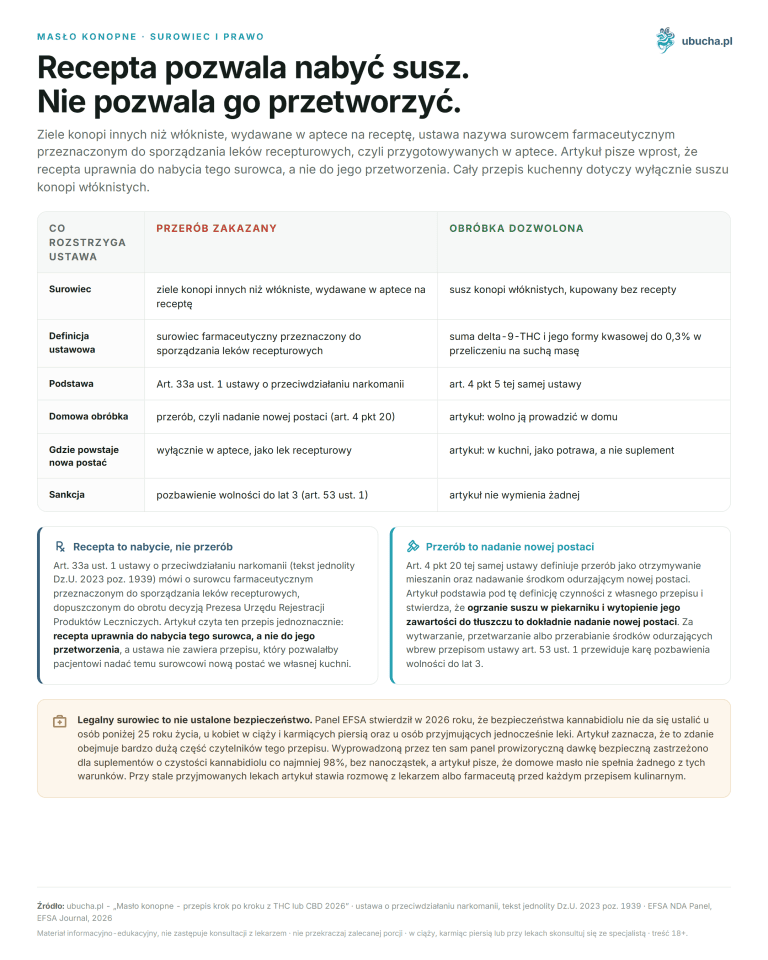
Separate: the oil itself is legal, ready-made food with CBD is not authorized. In Poland, cannabidiol from industrial hemp with THC content below 0.3% is not a controlled substance under the Act of July 29, 2005 on counteracting drug addiction and can be sold as a dietary supplement.
At the EU level, the matter is stalled. EFSA suspended in 2022 the assessment of 19 applications for CBD as novel food, citing data gaps on liver, hormonal system, reproduction, and neurodevelopment effects. To date, none of these applications has received a positive final opinion under Regulation 2015/2283.
For home cooking, this means a simpler situation than it seems. Novel Food regulation concerns placing food on the market, not what you prepare for yourself. You buy a legal supplement and use it in your own recipe for personal use. The boundary starts where sales appear: CBD products offered commercially as food require authorization, which currently no one in the EU has.
In practice, this means one more thing rarely written about. Since ready-made CBD food has not passed assessment, products that nevertheless reach the market have no official verification of dose or purity. Homemade recipes with certified supplements give more control in this situation than purchased products: you know how many milligrams you added, from which batch the oil comes, and what else is in the dish. This is a practical, not ideological, argument.
Frequently Asked Questions
Is CBD in food legal in Poland in 2026?
CBD oil with THC below 0.3% is legal under the Act of July 29, 2005 on counteracting drug addiction. The sale of ready-made food with CBD requires Novel Food authorization, which EFSA has not issued. Homemade use of certified oil in your own recipes remains legal.
How to know how much CBD oil to add to a smoothie or tea?
From the product label, not from online tables. For a healthy adult, no cannabidiol dose has been established, and the only provisional limit is EFSA’s ceiling: 0.0275 mg per kilogram of body weight per day, about 2 mg for 70 kg. For medications taken regularly, discuss the amount with a doctor or pharmacist.
Why does CBD work better with fat?
Because it dissolves in fats, not water. The same dose taken with a high-fat meal gives a fourfold increase in area under the concentration curve and a fourteenfold higher maximum concentration than on an empty stomach (Birnbaum et al., Epilepsia, 2019). Coconut milk, avocado, and olive oil work best.
Can I cook with CBD oil?
Only up to about 130°C. Above that, losses increase rapidly, and at 180°C in baked goods, most of the content is lost. Practical rule: add oil to cooked and cooled dishes, to smoothies, dressings, honey, or granola after cooling.
How long does CBD in food last?
The effect appears after 30-90 minutes and lasts 4-8 hours (Newmeyer et al., 2017). This is longer than sublingual oil, which acts 4-6 hours, and much longer than vaporization. This form works best for evening and sleep, less so for quick relief.
Does CBD in the diet have side effects?
EFSA in its 2026 opinion set a provisional safe dose of cannabidiol at 0.0275 mg/kg body weight per day, about 2 mg for a 70 kg person. Most reported effects are drowsiness, diarrhea, dry mouth, and appetite changes, usually above 100 mg daily. Safety cannot be established for people under 25, pregnant or breastfeeding women, or those taking medications.
Does CBD interact with medications?
Yes. CBD inhibits cytochromes CYP3A4 and CYP2C19, so it can increase levels of warfarin, clobazam, phenytoin, valproate, statins, and some antidepressants (Iffland and Grotenhermen, Cannabis and Cannabinoid Research, 2017). Consult your doctor if on chronic pharmacotherapy, and monitor INR if on warfarin.
Can I give CBD to children in food?
Not without a doctor’s indication. In children, CBD is used only in drug-resistant Dravet and Lennox-Gastaut epilepsies, as a registered medicine. It has no application in daily diet, and EFSA points to lack of data on developmental effects. Keep homemade CBD products out of children’s reach.
Summary
Two numbers are enough to do it right. Fat in a meal increases exposure fourfold, so every recipe must have a carrier. The 130°C limit excludes frying and baking, so add oil at the end, to a cooled dish. The third number, the portion, is intentionally not here: no one has established it for a healthy adult.
The fourth thing is not a number but equally decisive: legal status separates oil from ready-made food. You buy the supplement legally and use it in your kitchen without formalities. Selling a CBD product as food is another category, for which no one in the EU has authorization.
Start with one recipe, not five. Choose the one that fits your time of day, buy certified 5% oil, and stick to it for a week, noting your reaction. Only then add a second recipe. If you take any medications regularly, the first step looks different: talk to your doctor, then the kitchen.
This article is for informational and educational purposes and does not constitute medical advice. Before starting cannabis or CBD for therapeutic purposes, consult a doctor, especially if you take other medications, are pregnant, or breastfeeding.
Author: Michał Waluk · Published: 2026-04-25 · Updated: 2026-08-07