
How to Evaluate the Quality of CBD Flower: Terpenes, Appearance, COA (FAQ)
Evaluating CBD flower by sight, smell, and touch, and what to really look for in the testing certificate. Why the THC result alone does not determine the legality of the flower.
Price can be a misleading indicator of the quality of hemp flower. More expensive does not always mean better, and cheaper does not always mean worse, as the label and product photo reveal little of what truly determines the value of the material. Three senses and one document together provide a sufficiently accurate picture to distinguish flower worth its price from a product stored poorly. This text guides through visual, olfactory, and tactile evaluation, and then through the laboratory testing certificate, where the most often overlooked information is something completely different from what most buyers check. Along the way, I clarify two statements repeated in product descriptions so often that they have begun to be regarded as common knowledge: about the effects of individual terpenes and what the THC result on the certificate actually measures.
KEY INFORMATION
• The Polish threshold of 0.3% is calculated as the sum of delta-9-THC and tetrahydrocannabinolic acid, rounded to one decimal place (art. 4 point 5 of the Act on Counteracting Drug Addiction).
• A certificate stating only delta-9-THC does not determine whether the material is within the threshold.
• Terpenes are responsible for aroma and differ among strains, but attributing specific effects to them remains a hypothesis (Sommano et al., Molecules 2020).
• A white fluffy coating on the flower is mold, not trichomes.
What does good CBD flower look like?
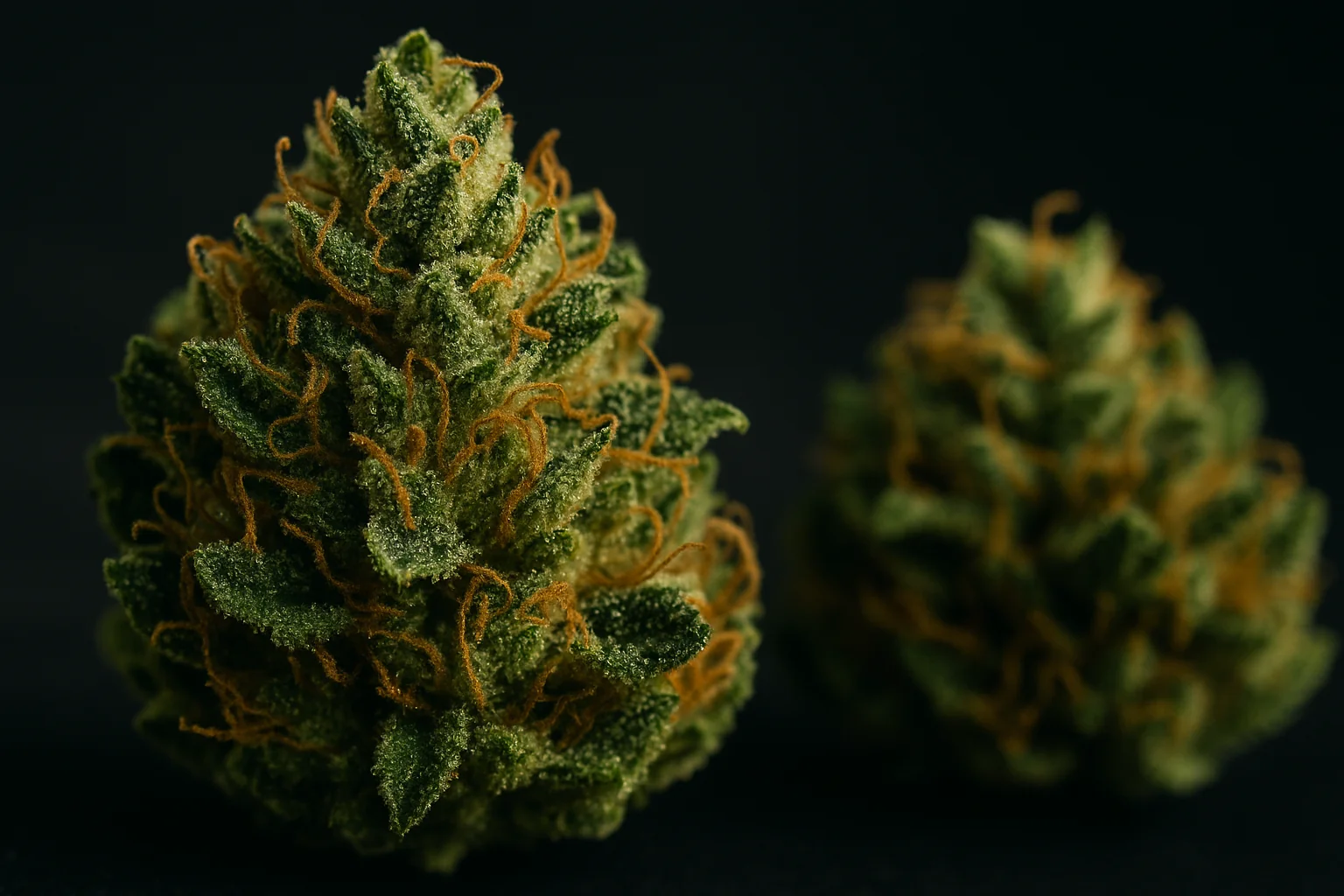
Dense, compact, and covered with visible trichomes. The flower should not crumble when touched or look like a loose clump of leaves. Trichomes, which are tiny secretory glands on the surface, give a characteristic frosty sheen. This is where cannabinoids and terpenes accumulate, so their abundance indicates the chemical richness of the material more than the size of the flower itself.
The color depends on the strain and in itself does not determine much. Most strains produce shades of green from light lime to dark olive. Orange or reddish hairs are floral traits and indicate maturity, while purple discoloration signifies a high content of anthocyanins, which is a varietal feature, not a defect. Amber trichomes appear with later harvests.
Warning signals, however, are unequivocal. Black or brown spots indicate rotting or mechanical damage. A white fluffy coating, especially uniform and resembling flour, is mold, not a layer of trichomes, and these two things are often confused by beginners. A grayish, powdery residue on the bracts looks similar and also disqualifies the material. Flower with such symptoms is unsuitable for use in any form, as fungal spores burden the respiratory system.
Visual assessment, however, has a hard limit. It will not detect pesticide residues, heavy metals, or microbiological contamination, which can only be checked in the laboratory. A nice appearance is a necessary condition, but not sufficient.
What does the smell say about the quality of the flower?
It primarily indicates whether the material has retained its terpenes. Terpenes are volatile compounds produced in the same trichomes as cannabinoids, and they are responsible for the aroma of cannabis. Hundreds have been identified, and their composition varies among chemovars, which are strains with different chemical profiles.
A distinct, complex aroma means that the flower was dried and stored carefully. A weak or completely neutral smell indicates that the volatile components have evaporated, usually due to too high a drying temperature or prolonged storage without humidity control. A musty note of a basement or wet hay is a signal of moisture and possible mold development. An intensely one-dimensional aroma, very sweet or candy-like, may be a trace of something added from the outside.
Here, one caveat is needed, which product descriptions usually do not make. Popular attributions like “myrcene calms, limonene stimulates” circulate as fact, while in scientific literature, they hold the status of a hypothesis. A review dedicated to cannabis terpenes states directly that the synergistic interaction of terpenes and cannabinoids has been a subject of speculation (Sommano et al., Molecules 2020).
Nevertheless, the practical conclusion remains strong. Smell is a reliable indicator of freshness and careful processing, even if it is not a reliable predictor of effect. If you want to read the strain profile more deeply, check how the genetic and terpene profile description works on product pages.
How to read a COA and what to look for?
A COA, or Certificate of Analysis, is a report from a laboratory test. It should provide cannabinoid content, results of tests for pesticide residues, heavy metals, and microbiological contamination, as well as the date of testing and batch number. A certificate without a date or without a batch number that cannot be matched to the number on the packaging does not confirm anything about your package.
However, the most often overlooked thing does not concern formalities, but the way THC is calculated. The Polish threshold of 0.3% refers to the sum of delta-9-tetrahydrocannabinol and tetrahydrocannabinolic acid in flowering or fruiting tops, and the sum is subject to rounding to one decimal place. This is how art. 4 point 5 of the Act on Counteracting Drug Addiction sounds (consolidated text Dz.U. 2023 poz. 1939).
The consequence is very practical. In unheated flower, the acidic form predominates, so a result stating only delta-9-THC will show a value significantly lower than what the regulation counts. Therefore, look for a separate row with THCA in the table. Be cautious of the position described as total THC: laboratories usually calculate it with a conversion factor, while the law speaks of the ordinary sum of both values, so these two numbers do not have to be the same. If the certificate states only the neutral form and nothing else, it lacks the information needed to assess the material’s compliance with the threshold.
It is also worth checking whether the scope of testing includes anything beyond cannabinoids. The cannabinoid profile is the cheapest to perform and most often published, while tests for contaminants are sometimes omitted. A certificate that only lists cannabinoids does not indicate what the crop was sprayed with or what soil it grew in.
What does touch and storage teach us?
Touch informs about moisture, and moisture determines everything else. Properly dried and cured material bends when squeezed and returns to shape, rather than crumbling to dust. Material that crumbles with gentle touch is over-dried, meaning that volatile terpenes have evaporated and the aroma will not return.
The opposite extreme is more dangerous. Excessively sticky flower, difficult to separate and leaving a trace of moisture on fingers, poses a risk of mold development, even if nothing is visible to the naked eye. The practical range in which the material should be maintained is about 55-65% relative humidity in the container, and ready-made humidity regulators are used to maintain it.
A slight stickiness of the trichomes themselves is, however, a good sign. Resin rich in cannabinoids leaves a delicate, aromatic residue on the fingers. Its complete absence in an otherwise nice-looking flower may be a trace of extraction or simply a feature of a strain with low resin production.
Storage conditions close the topic. An airtight glass jar, a dark and cool place, no plastic bags, as they generate static and pull trichomes from the walls. Ultraviolet light breaks down cannabinoids and terpenes, so a transparent container on a windowsill destroys the flower faster than the passage of time. Storage accessories solve this problem cheaper than the cost of one wasted batch.
Quality assessment makes sense only when you know what you are evaluating. What CBD flower is in terms of composition, THC threshold, and methods of use, we break down in a separate guide.
Frequently Asked Questions
How to recognize good CBD flower?
By a dense, compact flower with visible trichomes, a vibrant green color, and a distinct, complex aroma. The material should bend when squeezed, not crumble to dust. Black spots, white fluffy mold, and a musty smell disqualify the flower regardless of the declared cannabinoid content.
Does the THC result in the certificate determine the legality of the flower?
No, if it only states delta-9-THC. The Polish threshold of 0.3% refers to the sum of delta-9-THC and tetrahydrocannabinolic acid, rounded to one decimal place. In unheated flower, the acidic form predominates, so look for a separate row with THCA in the table. The total THC position may be calculated with a conversion factor, so it does not have to correspond to the sum in the law.
Do terpenes really determine the effect?
They are responsible for aroma and flavor, and their composition varies among chemovars. However, attributing specific effects to specific terpenes remains a hypothesis: a review dedicated to cannabis terpenes states that the synergistic interaction of terpenes and cannabinoids has been a subject of speculation rather than conclusive research.
What should a good COA contain?
The date of testing, a batch number that can be matched to the packaging, a cannabinoid profile that also includes acidic forms, and results of tests for pesticide residues, heavy metals, and microbiological contamination. A certificate that only lists cannabinoids does not indicate what the crop was sprayed with or what soil it grew in.
How to store hemp flower?
In an airtight glass jar, in a dark and cool place, with a relative humidity of about 55-65%. Avoid plastic bags, as they generate static and pull trichomes from the walls. Ultraviolet light breaks down cannabinoids and terpenes, so a transparent container placed on a windowsill deteriorates the material faster than time itself.
Is a white coating on the flower always mold?
Not always, but the distinction is simple. Trichomes look like tiny, shiny crystals giving a frosty sheen and are unevenly distributed. Mold creates a matte, fluffy, and even coating resembling flour, often with a musty smell. In case of any doubt, the material should not be used.
Hemp flower with laboratory testing certificates can be found in the flower category.
This article is for informational and educational purposes. It contains internal links to product categories available in the store at Bucha. Prices and specifications may change: check the current data on the product page before purchasing.
Author: Michał Waluk · Published: 2026-07-06 · Updated: 2026-08-24