
How long does CBD stay in urine? A complete guide to CBD detection times in 2026
How long does CBD stay in urine and does it show up in tests? Thresholds of 50 and 15 ng/mL, measured detection windows, legal status for drivers, and procedure after a positive result.
The question of how long CBD is detectable in urine always comes back in the same context: workplace testing, roadside checks, doping tests. The answer begins with a distinction that most guides miss. Drug tests do not look for cannabidiol. They look for THC-COOH, the metabolite of tetrahydrocannabinol, with a screening threshold of 50 ng/mL and a confirmation threshold of 15 ng/mL. In a controlled study after pure CBD, one sample out of 218 tested positive, and only at the lowered threshold of 20 ng/mL. The risk does not lie in the molecule itself, but in trace amounts of THC that end up in the product along with the extract. Below you will find measured detection windows, the mechanics of both types of tests, the legal status for drivers in Poland, and the procedure in case of a positive result.
KEY INFORMATION
• After a single dose of 100 mg of pure CBD, 1 sample out of 218 tested positive at the threshold of 20 ng/mL, and none exceeded the confirmation threshold of 15 ng/mL (Spindle et al., J Anal Toxicol, 2020).
• A standard screening test measures THC-COOH at a threshold of 50 ng/mL, and the confirmation test at 15 ng/mL. Cannabidiol is not an analyte in these tests.
• In 18 out of 84 CBD oils purchased online (21.43%), THC was detected that the label did not declare (Bonn-Miller et al., JAMA, 2017).
• In cannabis users, the last positive urine sample was found on average after 4.3, 9.7, or 15.4 days, depending on the initial concentration (Goodwin et al., 2008).
• Polish law does not establish a numerical THC threshold for drivers. The expert’s opinion decides, not the statutory threshold.
Can CBD cause a positive drug test?
CBD itself practically does not cause a positive result. Screening tests do not react to cannabidiol, only to THC-COOH. After a single dose of 100 mg of pure CBD, taken orally or in a vaporizer, 1 sample out of 218 tested positive, and none exceeded the confirmation threshold of 15 ng/mL (Spindle et al., J Anal Toxicol, 2020).
This study is worth describing in detail, as a distorted version of it circulates on the internet. Six healthy adults received in an alternating design four variants: 100 mg of CBD orally, 100 mg of CBD in a vaporizer, vaporized cannabis with a CBD predominance (100 mg CBD and 3.7 mg delta-9-THC), and placebo. Urine was collected before administration and for the next five days. Samples underwent immunoassay testing at thresholds of 20, 50, and 100 ng/mL and confirmation by LC-MS/MS at a threshold of 15 ng/mL.
The result separates two scenarios that the consumer usually treats as one. After pure CBD, there was not a single confirmed positive result. After vaporizing cannabis with THC, nine samples exceeded the threshold of 20 ng/mL, two of them also exceeded the threshold of 50 ng/mL, and four confirmed above 15 ng/mL. The difference was made by 3.7 mg of tetrahydrocannabinol, an amount easily delivered by a full-spectrum product.
The authors draw an unqualified conclusion: occasional intake of pure CBD will not yield a positive result in a test conducted according to federal guidelines for the workplace, while products containing delta-9-THC may produce such a result. The rest of this guide elaborates on that statement.
How does the body process and eliminate cannabidiol?
cannabidiol is metabolized in the liver by cytochrome P450 enzymes, and the resulting metabolites leave the body through urine and feces. A systematic review of 24 studies with pharmacokinetic parameters in humans reports a half-life of 1.4 to 10.9 hours after sublingual spray and 2 to 5 days with chronic oral administration (Millar et al., Front Pharmacol, 2018).
This same review shows how uncertain the numbers repeated in guides are. The bioavailability after smoking was 31%, but no study has established the absolute oral bioavailability in humans, even though the oral form is the most common. Peak concentration occurs between zero and four hours after dosing and increases when CBD is taken with food or in a fatty formulation. After smoking, the half-life extended to 31 hours.
The transformation is mainly due to CYP isoenzymes, which has two practical consequences. The first concerns interactions: cannabidiol inhibits the metabolism of some drugs, and a documented example is clobazam (Lucas et al., Br J Clin Pharmacol, 2018). The second concerns variability among individuals. The activity of liver enzymes varies individually, so the same dose produces different concentrations and different elimination times.
For drug tests, the pharmacokinetics of CBD is of secondary importance. The laboratory does not measure cannabidiol, only the THC metabolite. Knowledge of the half-life is useful for planning dosing, not for estimating whether a test will come back positive.
How much cannabidiol appears in urine?
Pure cannabidiol appears in urine at concentrations many times higher than the THC metabolite, but no one routinely measures it. After 100 mg administered orally, the average peak concentration in urine was 776 ng/mL, and after the same dose from a vaporizer, it was 261 ng/mL (Spindle et al., J Anal Toxicol, 2020).
The time course depends on the route of administration. After ingestion, the concentration of cannabidiol in urine peaked after five hours, while after inhalation, it occurred within the first hour. This corresponds to what happens in the blood: absorption through the lungs is rapid, while the oral route goes through the digestive tract and liver, thus delaying and stretching the entire profile.
Why doesn’t the laboratory test for this? Because there is no point. The workplace panel was created to detect controlled substances, and cannabidiol is not one of them. Its measurement requires a targeted method, usually chromatography coupled with mass spectrometry, and is ordered in scientific studies or product composition checks, not in workplace medicine.
It is also worth noting the time frame of this experiment. Samples were collected for five days after administration, so Spindle’s work does not answer the question of what happens in the second and third weeks of abstinence. Texts that refer to it when discussing detection windows counted in weeks attribute findings that exceed the collected data.
For the reader asking directly how long CBD stays in urine, the answer thus has two parts. Cannabidiol can be detected there by targeted methods for many hours after dosing, at concentrations in the hundreds of nanograms per milliliter. However, this does not translate to a drug test result, as it measures a different molecule and at a different threshold.
How long are cannabinoids detectable in urine, blood, and hair?
The detection window primarily depends on how intensive the use was. In a study of 60 cannabis users, observed in a closed research facility for up to 30 days of abstinence, the last positive urine sample was found on average after 4.3, 9.7, or 15.4 days, depending on the initial concentration of THC-COOH (Goodwin et al., J Anal Toxicol, 2008).
Goodwin’s work is important here because it undermines numbers repeated without source. A total of 6158 individual samples were tested at a threshold of 50 ng/mL, and the subjects were divided into three groups based on the initial concentration adjusted for creatinine. Even in the group with the highest initial concentration, the average time to the last positive result was 15.4 days, not several dozen. Significantly longer cases exist, but they are exceptions: in one heavy chronic user, THC-COOH was still detectable after 24 days (Lowe et al., Drug Alcohol Depend, 2009).
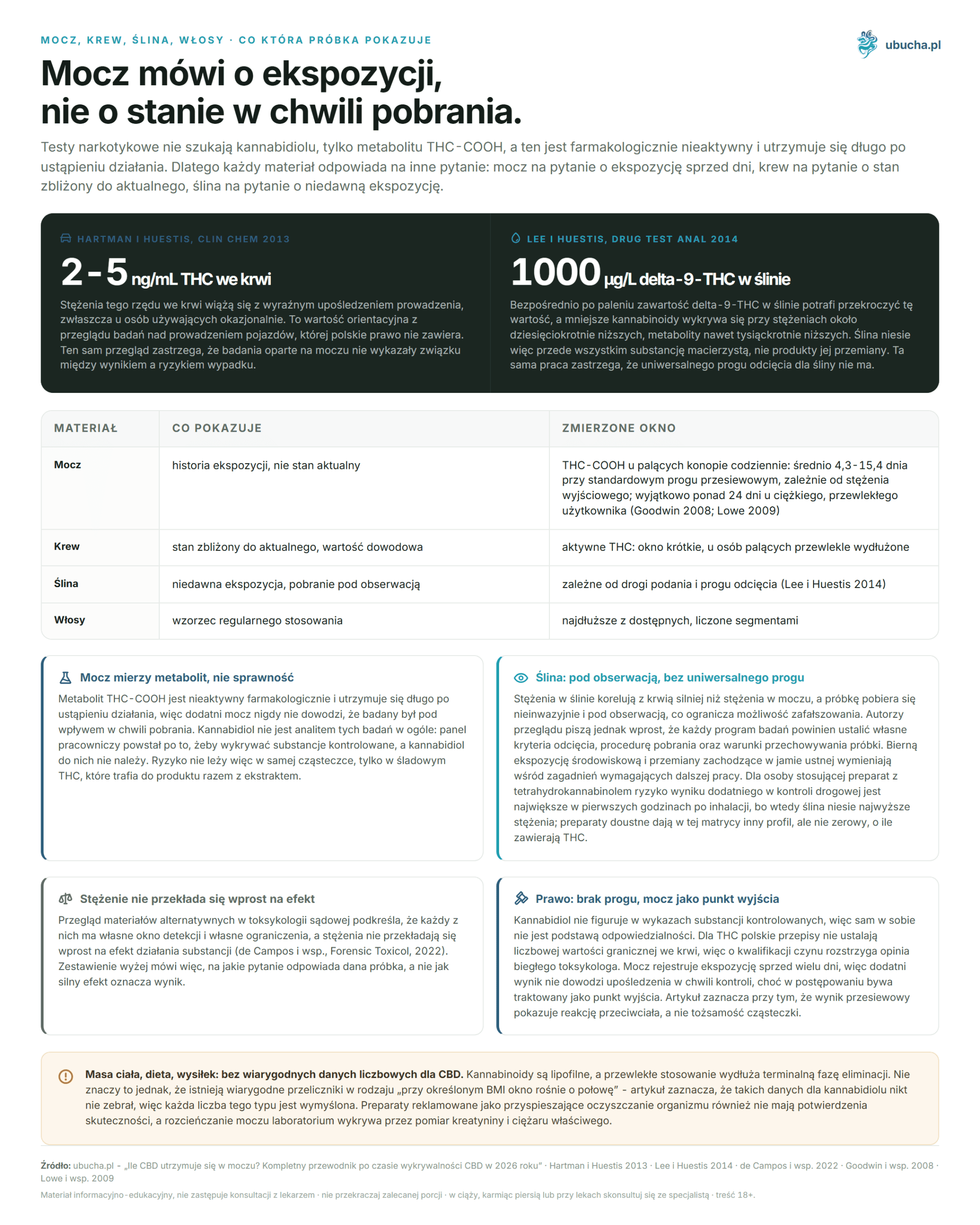
| Material | What it shows | Measured window |
|---|---|---|
| Urine | exposure history, not current state | average 4.3-15.4 days; exceptionally over 24 days |
| Blood | state close to current, evidential value | short window; in chronic smokers extended |
| Saliva | recent exposure, collected under observation | depends on route of administration and cutoff threshold |
| Hair | pattern of regular use | longest of available, counted in segments |
Saliva and hair follow a different logic. A review of alternative materials in forensic toxicology emphasizes that each has its own detection window and limitations, and concentrations do not directly translate to the effect of the substance (de Campos et al., Forensic Toxicol, 2022). You can also find numerical comparisons in our post on detection times in blood and urine.
Does a saliva test detect cannabinoids differently than urine?
Yes, saliva answers a different question than urine. It reflects recent exposure, and its concentrations correlate more strongly with blood than concentrations in urine, which is why it is used by road police. The sample is collected non-invasively and under observation, which limits the possibility of tampering (Lee and Huestis, Drug Test Anal, 2014).
The scale of concentrations here is completely different than in urine. Immediately after smoking, the delta-9-THC content in saliva can exceed 1000 µg/L, while smaller cannabinoids are detected at concentrations about ten times lower, and metabolites even a thousand times lower. Saliva thus primarily carries the parent substance, not its transformation products.
This same work notes, however, that there is no universal cutoff threshold for saliva. The authors state that each testing program should establish its own cutoff criteria, collection procedure, and sample storage conditions for its purpose. The detection window depends on the route of administration, dose, and history of use.
For a person using cannabis products, the practical conclusion is straightforward. If the product contains tetrahydrocannabinol, then in the first hours after inhalation, saliva carries the highest concentrations, and thus the risk of a positive result in a roadside check is greatest at that time. Oral products provide a different profile in this matrix, but not zero, as long as they contain THC.
A separate, still-researched issue remains oral contamination. The review mentions passive environmental exposure and transformations occurring in the oral cavity among the issues requiring further work before the interpretation of saliva results becomes as clear-cut as the interpretation of blood results.
What exactly does the screening test measure, and what does the confirmation test measure?
The urine test is conducted in two stages. First, the immunoassay detects the entire family of THC-COOH-like molecules at a threshold of 50 ng/mL. A positive result then goes for confirmation by chromatography coupled with mass spectrometry, where the threshold is 15 ng/mL, and a specific molecule is identified (Spindle et al., 2020).
The difference between these methods determines the fate of the test. The screening test is cheap and quick, but it only indicates that something has bound to the antibody. Confirmation separates the mixture and assigns the signal to a specific compound, thus distinguishing THC-COOH from cannabidiol and its metabolites. Therefore, a positive screening result is not a resolution in itself, but an indication for further testing.
Cutoff thresholds can be lowered. In Spindle’s study, urine underwent screening at three thresholds: 20, 50, and 100 ng/mL. That one positive sample after pure CBD appeared only at the lowest of these, and it never confirmed at the threshold of 15 ng/mL. So if you encounter a laboratory using a threshold of 20 ng/mL, the safety margin is narrower than with the standard threshold of 50 ng/mL.
It is worth remembering one consequence of this mechanism. A positive urine result never proves that the subject was under the influence at the time of collection. The THC-COOH metabolite is pharmacologically inactive and remains long after the effects have subsided. Urine indicates exposure, not psychophysical fitness.
What is the real risk of a positive result with pure CBD?
The risk comes from the THC content in the product, not from cannabidiol. In an analysis of 84 CBD oils purchased online, tetrahydrocannabinol was detected in 18 samples, or 21.43%, at concentrations up to 6.43 mg/mL, although the labels did not declare it (Bonn-Miller et al., JAMA, 2017).
This same work showed how inaccurate declarations of CBD content can be. The content that matched the label, within ten percent deviation, was found in 30.95% of products. The rest were divided into 42.85% containing more CBD than declared and 26.19% containing less. The label is therefore not a document on which to base risk assessment.
Newer measurements do not improve the picture. Among 80 unregulated cannabis products compared to one registered product, delta-9-THC was detected above the limit of quantification in 52 samples, ranging from 0.008 to 2.071 mg/mL. Among 21 products labeled as “THC-Free,” five contained detectable delta-9-THC, from 0.015 to 0.656 mg/mL (Johnson et al., Drug Alcohol Depend, 2022).
The effect is visible in the urine of users. In ten individuals taking CBD oil, GC/MS detected 11-nor-carboxy-THC in all urine samples, at concentrations from 0.69 to 23.06 ng/mL (Papoutsis et al., Forensic Toxicol, 2024). None of these values exceed the threshold of 50 ng/mL, but all are above zero. In zero-tolerance procedures, that is a difference that determines the outcome.
What determines the length of the detection window?
The history of use has the strongest effect. The division into three groups in Goodwin’s study was based precisely on the initial concentration of THC-COOH, that is, how much substance the body had managed to accumulate, and it stretched the last positive result from 4.3 to 15.4 days. A single dose and daily use over weeks are two different situations.
The second factor is the route of administration. A review of CBD pharmacokinetics reports a half-life of 1.4 to 10.9 hours after sublingual spray, about 31 hours after smoking, and 2 to 5 days with chronic oral administration (Millar et al., 2018). The form you choose thus changes the elimination time by an order of magnitude.
| Factor | Impact on detection window |
|---|---|
| Initial THC-COOH concentration | documented: last positive result after 4.3, 9.7, or 15.4 days |
| Chronic use | documented: detectability over 24 days in a heavy user |
| Route of administration | documented: half-life from hours to several days |
| THC content in the product | documented: 3.7 mg THC gave confirmed positive results |
| Body weight, diet, exercise | no reliable numerical data for CBD |
The last row of the table requires commentary, as it is often filled with fabricated percentages. Cannabinoids are indeed lipophilic, and chronic use extends the terminal elimination phase, which Lowe’s measurements confirm. However, this does not mean that there are reliable conversions like “at a certain BMI, the window increases by half.” No such data has been collected for cannabidiol, so any number of this type is fabricated.
Broad spectrum or full spectrum if you are subject to testing?
With regular workplace testing, only an extract with no detectable THC or an isolate makes sense. Product measurements show why: even the declaration of “THC-Free” can be false, as detectable delta-9-THC was found in 5 out of 21 products labeled as such (Johnson et al., 2022). The manufacturer’s declaration does not replace batch testing.
The scale of contamination can be greater than the word “trace” suggests. A review dedicated to the use of CBD by athletes states that over 30% of products on the German market delivered more than 2.5 mg of THC per day, and declarations about CBD content and lack of THC are often false or misleading (Lachenmeier and Diel, Nutrients, 2019). The authors directly advise against products from unreliable online sources.
Let’s compare these numbers with an interventional study, as only together do they provide an answer. Vaporized cannabis with a CBD predominance contained 3.7 mg of delta-9-THC in one session, and that was enough for four samples to confirm above 15 ng/mL. A product delivering several milligrams of THC daily thus fits exactly into the range where positive results appeared. This is not a distant theoretical risk, but the same scale of dosage.
The practical conclusion is short. The analysis certificate should come from an independent laboratory, pertain to the batch number on the package, and show THC as undetectable or below the limit of quantification. Without this document, it is impossible to assess risk, and in workplace testing, it is the only thing you can realistically control. You can find extracts in various formulations in the cannabis oil category.
How to read an analysis certificate so that it means something?
A certificate is only valuable when it provides the limit of quantification of the method. The statement “not detected” always refers to the sensitivity of the test used, not to absolute zero. In the analysis of 80 cannabis products, this limit was 0.005 mg/mL, and only in relation to it does such a statement mean anything (Johnson et al., Drug Alcohol Depend, 2022).
The second issue is the batch number. The composition changes between production batches, so a document describing a different batch than the one in your hand says nothing about the product you have. The analysis date should be later than the production date of that specific batch, and the laboratory should be independent of the manufacturer.
The third issue is the tolerance of declarations. In the study of oils sold online, those whose content was within ten percent of the declared value were considered compliant. This criterion was met by 30.95% of products, meaning two out of three preparations deviated from their own label by more than one-tenth (Bonn-Miller et al., 2017).
From these three elements, a simple checklist emerges: limit of quantification stated numerically, batch number matching the package, laboratory outside the manufacturer’s structure. The absence of any of these reduces the certificate to promotional material. In workplace medicine, it is the only document that can demonstrate due diligence.
It is also worth knowing what the certificate does not promise. It does not predict the result of your urine test, as this depends on the dose, frequency, and time since the last intake. However, it reduces the most banal risk: that the product contains tetrahydrocannabinol, of which no one warned you.
What are the consequences for a driver in Poland after using CBD?
Cannabidiol does not appear on the lists of controlled substances, so it is not in itself a basis for liability. The problem remains THC. Polish regulations do not establish a numerical threshold for it in the blood, so the qualification of the act is determined by the opinion of a toxicology expert, not the threshold written in the law.
Studies on driving give approximate values that the law does not contain. A literature review indicates that the risk of involvement in an accident increases about twofold after smoking cannabis, and THC concentrations in the blood of 2-5 ng/mL are associated with clear impairment of driving, especially in occasional users (Hartman and Huestis, Clin Chem, 2013).
This same review contains a caveat important for anyone using CBD. Urine-based studies have not shown a link between the result and the risk of an accident. Urine records exposure from many days ago, so a positive result does not prove impairment at the time of the check, although it may be treated as a starting point in proceedings.
A separate issue is the legality of the raw material itself. Industrial hemp is a plant in which the sum of delta-9-THC and tetrahydrocannabinolic acid in the flower tops does not exceed 0.3% dry weight, rounded to one decimal place, according to Article 4 point 5 of the Act on Counteracting Drug Addiction as amended by the Act of March 24, 2022. The national threshold corresponds to the EU threshold, but it does not follow from it. We have described this more broadly in the text on driving after taking oil.
Can an athlete use CBD according to WADA regulations?
Yes, cannabidiol has been removed from the World Anti-Doping Agency’s list of prohibited substances. All other cannabinoids still appear on it, and the threshold for a positive result has been set at 150 ng/mL of 11-nor-9-carboxy-THC in urine (Lachenmeier and Diel, Nutrients, 2019).
However, the exclusion of CBD does not mean a green light for any product containing this ingredient. The authors of the review advise athletes against products available without quality control, as full-spectrum cannabis extracts also contain other cannabinoids from the prohibited list and tetrahydrocannabinol contamination. In the cited measurements, over 30% of products on the German market delivered more than 2.5 mg of THC per day.
Comparing these two numbers explains why the threshold of 150 ng/mL is not as safe as it seems. It is indeed ten times higher than the confirmation threshold in workplace tests, but it concerns urine concentration, not dosage. Daily intake of several milligrams of THC over weeks accumulates the metabolite, and the athlete is responsible for everything that is in their body, regardless of whether they were aware of the contamination.
The practice is therefore the same as in workplace testing, only the stakes are higher. The analysis certificate for a specific batch matters, and purchase documentation should be kept in case of inspection. We have gathered regulations and studies from this area in our post on CBD in sports.
What to do if the test comes back positive despite using only CBD?
The first step is to request a confirmation test. The screening result shows an antibody reaction, not the identity of the molecule. Only chromatography with mass spectrometry identifies THC-COOH at a threshold of 15 ng/mL and determines whether the sample contains the tetrahydrocannabinol metabolite or something else (Spindle et al., 2020).
At the same time, it is worth gathering documentation before it disappears. This includes the original packaging with the batch number, the analysis certificate for the same batch, proof of purchase, and a record of dates and doses. The same product analysis that showed THC in one in five oils is only an argument in your favor if you can point to a specific preparation.
If the confirmation test also comes back positive, it indicates the presence of the THC metabolite, not a method error. Then the question shifts to the product: was its label true, and did the manufacturer’s laboratory confirm the absence of tetrahydrocannabinol? Johnson’s measurements show that the declaration “THC-Free” was often false in one-fifth of such labeled products.
There is no third way, and it is not worth looking for one. Products advertised as speeding up the body’s cleansing have no proven effectiveness, and diluting urine is detected by measuring creatinine and specific gravity. The only mechanism with documented action is time, described by the numbers from Goodwin’s work.
Summary
CBD itself is not an analyte in drug tests, and in a controlled study, it did not yield a single confirmed positive result. The risk comes from tetrahydrocannabinol present in the product, and its content can be inconsistent with the label in one-fifth of products or more often.
Detection windows are shorter than commonly believed. In daily cannabis users, the last positive urine sample was found on average between 4.3 and 15.4 days, and cases longer than three weeks were exceptions in heavy chronic users. Numbers in the range of several dozen days, repeated in guides, have no support in the cited measurements.
For a person subject to testing, this boils down to three decisions. Choose a product with an analysis certificate for a specific batch, keep purchase documentation, and in case of a positive result, request a confirmation test. Remember that a positive urine result indicates exposure, not the state at the time of collection, and that Polish law does not recognize a numerical THC threshold for drivers. If the test is to concern recent exposure, the appropriate matrix is saliva or blood, not urine.
Frequently Asked Questions
How long does CBD stay in urine?
Laboratories do not routinely test for cannabidiol, so the question actually concerns the metabolite of THC. In cannabis users, the last positive urine sample was found on average after 4.3, 9.7, or 15.4 days, depending on the initial concentration (Goodwin et al., 2008).
Does a standard drug test detect CBD?
No. The screening test measures THC-COOH at a threshold of 50 ng/mL, and the confirmation test at 15 ng/mL. After a single dose of 100 mg of pure cannabidiol, 1 sample out of 218 tested positive, and only at the lowered threshold of 20 ng/mL (Spindle et al., 2020).
Can oil labeled as THC-free give a positive result?
Yes, if the label is false. In an analysis of 80 unregulated products, five out of 21 labeled as “THC-Free” contained detectable delta-9-THC, ranging from 0.015 to 0.656 mg/mL (Johnson et al., 2022). Therefore, the batch analysis certificate matters, not just the label on the package.
What are the cutoff thresholds in cannabinoid testing?
The screening test usually uses a threshold of 50 ng/mL for THC-COOH, and confirmation by mass spectrometry has a threshold of 15 ng/mL. Some laboratories lower the screening threshold to 20 ng/mL, which narrows the safety margin for those using cannabis products (Spindle et al., 2020).
Can a driver in Poland be held accountable for using CBD?
Cannabidiol itself is not a controlled substance. Regulations do not establish a numerical THC threshold in the blood, so the expert’s opinion decides. Studies link clear impairment of driving with THC concentrations of 2-5 ng/mL in the blood (Hartman and Huestis, 2013).
Can an athlete use CBD according to WADA?
Yes, cannabidiol has been removed from the list of prohibited substances. Other cannabinoids remain banned, and the threshold for a positive result is 150 ng/mL of 11-nor-9-carboxy-THC in urine. However, THC contamination in cannabis products can be common (Lachenmeier and Diel, 2019).
How long does THC-COOH stay in a daily smoker?
Usually up to several days. In a study of 33 chronic users conducted under controlled abstinence, seven had detectable THC in urine from 3 to 24 days, and one had metabolites for at least 24 days (Lowe et al., 2009).
Does a positive urine result prove I was under the influence?
No. Urine shows exposure from many days ago, and the measured metabolite is pharmacologically inactive. Urine-based studies have not shown a link between the result and the risk of a traffic accident (Hartman and Huestis, 2013). The current state is assessed from blood.
This article is for informational and educational purposes only and does not constitute legal advice. The legal status described in the article is valid as of the publication date: regulations regarding cannabis may change. Consult a lawyer or current legal acts before making decisions.
Author: Michał Waluk · Published: 2026-05-11 · Updated: 2026-08-10