
CBD isolate vs full spectrum vs broad spectrum, complete guide to types of CBD 2026
Isolate, full or broad spectrum hemp? We compare composition, dose, THC test risk and real prices at the store u Bucha with cost per 100 mg conversion.
The label rarely tells the whole truth about what is in the bottle. When researchers bought 84 CBD products from 31 companies and tested them in a lab, only 30.95% had content consistent with the declaration, and THC was detected in 18 samples (Bonn-Miller et al., JAMA, 2017). That is why the question about the type of extract makes sense: isolate, full spectrum and broad spectrum differ in chemical composition, dose needed for effect, and risk of a positive THC test. In this guide, we break down the three types of extract, check what peer-reviewed studies say about them, and show product by product which extract types are really offered by the store u Bucha, along with a cost per 100 mg conversion.
KEY INFORMATION
• CBD-rich extract improved 71% of patients versus 46% for pure cannabidiol, at a fourfold lower dose (Pamplona et al., Frontiers in Neurology, 2018).
• Isolate is pure cannabidiol without terpenes or other cannabinoids.
• Broad spectrum retains the rest of the profile but without THC.
• Polish limit is 0.3% total THC and THCA.
• There is no isolate in the u Bucha offer today.
What is the difference between isolate and full and broad spectrum?
The three types of extract differ in one thing: how much of the plant remains in the final product. Isolate is pure cannabidiol purified to 98-99.9%. Full spectrum retains the entire natural profile including trace THC. Broad spectrum is the same profile but with the THC fraction removed.
This difference is not cosmetic because it concerns three things at once. First, composition: full extract contains alongside cannabidiol CBG, CBN, CBC, CBDA, terpenes and flavonoids, while isolate has none of these. Second, dose, as data from the meta-analysis will show shortly. Third, legal and professional risk, which practically boils down to one question: is THC detectable in the product.
It is worth immediately debunking the most common misconception. Isolate is not better because it is purer. Purity describes chemical homogeneity of the substance, not its effectiveness. A product containing only cannabidiol is easier to standardize and safer for someone under anti-doping control, but it loses everything the plant contributes beyond CBD itself.
Equally persistent is the myth that full spectrum simply means more cannabinoids than broad spectrum. Not true. Both types contain CBG, CBN, CBC and terpenes. The only real difference is the presence or absence of trace THC, usually in the range of a few tenths of a percent. Those unaware of this overpay for the word full while buying almost the same profile.
How is CBD isolate made and what remains after it?
Isolate is produced by multi-stage purification of raw extract until only one substance remains in the vessel. The result is a white crystalline powder with cannabidiol content above 98%, odorless, tasteless and without other plant components. It is the most processed form of hemp raw material sold retail.
The path is long. First extraction yields raw oil with full plant profile. Then freezing removes waxes and fats that would cloud clarity. Distillation separates cannabinoid fractions by boiling point. Finally crystallization precipitates cannabidiol from solvent, and solvent residues must be evaporated and shown in batch testing.
Each stage costs raw material. The purer the final product, the more mass is lost as technical waste, so a milligram of cannabidiol from isolate can be more expensive than from simpler extract, even though the raw material was the same. This is opposite to the shopping intuition that a simpler product should be cheaper.
After such processing, the bottle contains nothing but cannabidiol and carrier oil. The isolate analysis certificate looks characteristic: one value at CBD and ‘not detected’ for all others. If a declared isolate shows CBG or terpenes on the certificate, it is not an isolate but an extract mislabeled.
What exactly is in full spectrum extract?
Full spectrum extract retains the plant profile in the proportions formed in the flower. Alongside cannabidiol, it contains cannabigerol, cannabinol, cannabichromene, acid forms like CBDA, terpenes and flavonoids. It also contains trace THC, which distinguishes it from broad spectrum.
Production of such extract is technologically simplest, as it requires neither isolating cannabidiol nor removing a specific fraction. After extraction and freezing, decarboxylation converts some acid forms to neutral. Fewer steps mean less mass loss, visible later in milligram price.
On product pages you will find several variants of the same description: full spectrum phytocompounds, full phytocannabinoid profile or simply full spectrum. We checked all 386 items sold at u Bucha and some producers list specific compounds by name, e.g. CBDA, CBDV, CBN, CBC and CBGA. This is a good sign, showing the declaration is backed by batch testing, not marketing.
Darker color and thicker oil consistency are sometimes given as signs of richer profile. This is a hint, not proof. Color also changes with filtration method and raw material age, so visual assessment never replaces a batch analysis certificate listing numerical contents.
How does broad spectrum differ from full?
Broad spectrum is full extract with the THC fraction deliberately removed. Cannabidiol, cannabigerol, cannabinol, cannabichromene, terpenes and flavonoids remain, and THC content falls below the lab detection limit. Chemically it is the closest relative of full spectrum, not a separate raw material category.
Removing one fraction from a mixture of dozens of compounds requires precision. Preparative chromatography or selective crystallization are used, methods separating molecules with similar properties. The extra step costs, so broad spectrum can be more expensive to produce than full at the same declared content.
Why the effort? Because it removes a question troubling many users. An athlete, professional driver, critical infrastructure worker or someone in a substitution program need not worry how much trace THC accumulates in fat tissue with daily use. There is nothing to accumulate.
We noticed one thing while reviewing offers that producers mention reluctantly. Declaring broad spectrum without a batch analysis certificate is essentially empty, because absence of THC is a claim of non-existence. Such a claim can only be confirmed by testing, and testing of that specific batch, not a batch from a year ago.
What is the entourage effect?
The entourage effect is a hypothesis that cannabis components act together more strongly than separately. The term was introduced in 1998 by Ben-Shabat and Mechoulam in European Journal of Pharmacology, describing how inactive glycerol esters enhance the action of endocannabinoid 2-AG. Years later Ethan Russo expanded the concept to the whole plant.
Russo’s review in British Journal of Pharmacology collected mechanisms that may explain this synergy (Russo, British Journal of Pharmacology, 2011, vol 163, pp. 1344-1364). Beta-caryophyllene binds directly to CB2 receptor, making it a terpene with cannabinoid action. Myrcene influences calming profile. Linalool affects GABA transmission. Alpha-pinene is linked to working memory.
A boundary must be drawn here that popular descriptions omit. Most mechanisms were described in preclinical models, cell lines and animals. This is strong support for the hypothesis but not proof of efficacy in humans for specific indications. Russo himself formulates conclusions cautiously and treats them as guidance for breeding strains with planned terpene profiles.
For a product chooser, the practical conclusion is moderate and therefore useful. An extract containing terpenes and minor cannabinoids may work at lower cannabidiol content than isolate. There is no basis to expect a different kind of effect, e.g. psychoactive.
Does broad spectrum provide the same entourage effect as full?
No study has compared both extract types head to head in humans. Popular figures claiming broad spectrum delivers eighty-something percent of full spectrum’s effect come not from publications but sales materials. The honest answer is: probably similar, but no one has measured it.
Theoretical grounds are quite strong. Both extracts contain the same minor cannabinoids and terpene profile, and Russo describes synergy mainly at the level of terpenes and receptors outside the endocannabinoid system. Beta-caryophyllene binds CB2 receptor independently of THC presence, and linalool and myrcene act via completely different pathways.
The loss concerns one puzzle piece. THC is the only cannabis component with clear affinity for CB1 receptor in the brain, so its removal takes that element away. How much this matters in practice depends on CB1’s role in the application, which varies and remains unresolved for most uses.
From a purchasing perspective the question is easier than it looks. Since no difference has been measured and the risk of positive test with full spectrum is real and quantifiable, at similar prices broad spectrum wins for anyone subject to testing. For others both options are interchangeable, decided by administration form, taste and price per 100 mg. It is not worth paying extra for a word that changes nothing in your situation.
Does full extract really work at a lower dose?
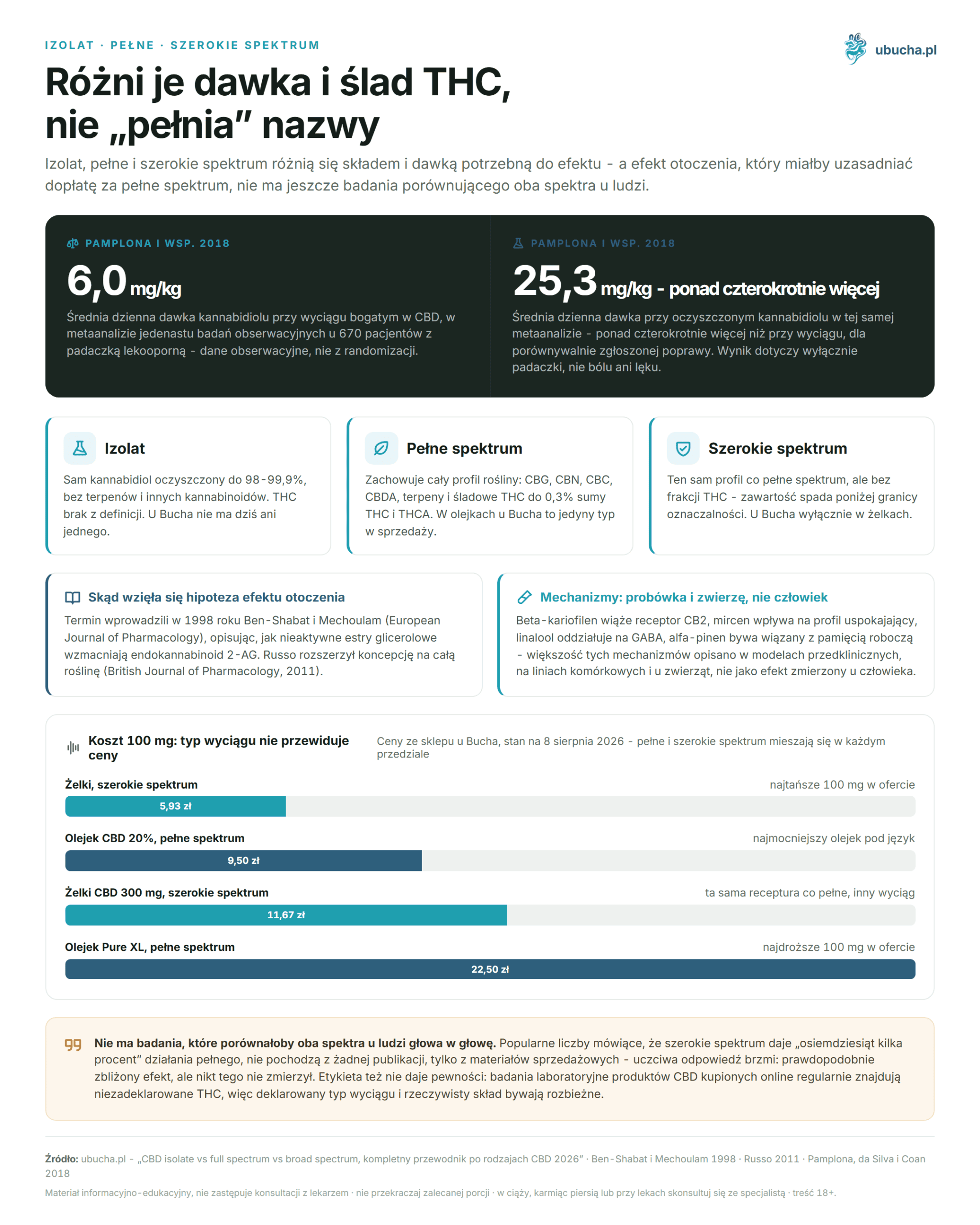
The strongest human data comparing extract with pure cannabidiol come from drug-resistant epilepsy. A meta-analysis of eleven observational studies included 670 patients and showed 71% improvement with CBD-rich extract versus 46% with pure cannabidiol (Pamplona et al., Frontiers in Neurology, 2018).
The difference in dose is even clearer. Average daily cannabidiol dose was 6.0 mg/kg for extract and 25.3 mg/kg for pure substance, over four times less. Mild adverse effects were reported by 33% on extract and 76% on pure cannabidiol, severe by 7% and 26% respectively.
These numbers require honest comment. They are observational data from studies with varying methodology, not randomized comparison. The proportion of patients with at least 50% seizure reduction was similar in both groups, 37% for extract versus 42% for pure substance, and the difference was not significant. Authors note risk of reporting bias in open studies.
Caution also applies to extrapolation. Drug-resistant epilepsy is not chronic pain or anxiety disorder, so the claim that extract is one third more effective for pain has no basis here. What can be said modestly is: in one well-documented indication extract allowed similar effect at several times lower dose and fewer adverse effects.
How much THC can a product legally contain in Poland?
Polish law uses the term industrial hemp and sets a threshold of 0.3% THC in dry weight of flower tops. Since May 7, 2022, the limit covers the sum of delta-9-THC and tetrahydrocannabinolic acid, not just delta-9-THC as before (Dz.U. 2022 item 763).
The change looks cosmetic but is not. Raising the threshold from 0.2% to 0.3% went together with including the acid form THCA, which in fresh raw material constitutes the majority. Producers who previously complied counting only neutral form had to recalculate raw material.
For buyers this means two things. Full spectrum extract from legal raw material contains THC by definition, though in non-intoxicating amounts. Broad spectrum extract and isolate contain none, so the question of compliance does not apply to them.
Transporting such products across borders is a separate matter. Thresholds in other countries may be lower or zero, and regulations apply to the product in your bag, not the country of purchase. If you travel often, extract without detectable THC saves explanations that no officer is obliged to accept.
Which type to choose if you are tested for THC?
The answer is short: one with a test confirming no detectable THC, i.e. isolate or certified broad spectrum. Cannabidiol itself is not banned in sport, but THC and other cannabinoids remain banned during competition, with a lab threshold of 150 ng/ml in urine (USADA).
The problem is not cannabidiol but what comes with it. USADA points out that undisclosed THC in products labeled as pure CBD is the source of trouble. This is confirmed by a lab study of 84 products bought online, where THC was found in 18, i.e. 21.43% (Bonn-Miller et al., JAMA, 2017).
Risk increases with duration and dose. THC metabolites accumulate in fat tissue and release slowly, so single use differs from daily supplementation for weeks. Someone tested periodically at work usually cannot predict test timing, losing the chance to stop use in time.
The practical rule for this group differs from others. It is not enough to choose a product with the right label, you must have access to testing of that specific batch. A producer providing batch test reports gives you an argument with your employer. One who does not leaves you with the label only.
What extract types does the store u Bucha really have?
We checked item by item in the store catalog, not in archival descriptions. In the Oils category there are six products and all six are full spectrum preparations by CANNOVA. Broad spectrum appears only in gummies. There is not a single isolate. Below are ten items sorted by cost per 100 mg declared content, from cheapest.
| Rank | Product | Extract type | Highlight | Declared content | Price | Cost per 100 mg |
|---|---|---|---|---|---|---|
| 1 | CANNOVA plus agrimony, gummies 25 mg, 60 pcs. | broad spectrum | cheapest milligram in offer | 1500 mg | 89.00 zł | 5.93 zł |
| 2 | Broad25 hemp gummies, Scandinavian fruits | broad spectrum | 25 mg in one gummy | 750 mg | 45.00 zł | 6.00 zł |
| 3 | CANNOVA Natural CBD Oil 20%, 10 ml | full spectrum | strongest sublingual oil | 2000 mg | 190.00 zł | 9.50 zł |
| 4 | Cherry gummies with melatonin FORTE | broad spectrum | extract combined with melatonin | 450 mg | 45.00 zł | 10.00 zł |
| 5 | CANNOVA Natural CBD Oil 10%, 10 ml | full spectrum | 3.34 mg in one drop | 1000 mg | 110.00 zł | 11.00 zł |
| 6 | CBD gummies 300 mg, 30 pcs., Broad Spectrum | broad spectrum | extract type in name | 300 mg | 35.00 zł | 11.67 zł |
| 7 | CBD gummies 300 mg, 30 pcs., Full Spectrum | full spectrum | same recipe, different extract | 300 mg | 35.00 zł | 11.67 zł |
| 8 | CANNOVA Natural CBD Oil 5%, 10 ml | full spectrum | 1.67 mg in one drop | 500 mg | 65.00 zł | 13.00 zł |
| 9 | CANNOVA Natural CBG Oil 15%, 10 ml | full spectrum | profile based on cannabigerol | 1500 mg | 240.00 zł | 16.00 zł |
| 10 | Green Out Pure XL hemp oil, 20 ml | full spectrum | strain terpenes, four drops | at least 200 mg | 45.00 zł | up to 22.50 zł |
Prices come from the store’s public interface, status as of August 8, 2026. Check again before purchase as catalog changes faster than text.
How much does 100 mg of extract cost in each form?
The range is fourfold and does not align with extract type division. The cheapest 100 mg costs 5.93 zł from a broad spectrum gummy, the most expensive 22.50 zł from a full spectrum oil. Within each extract type, differences are greater than between types.
There is a catch in this conversion that the shelf is silent about. Producers declare content in different units: some give milligrams of cannabidiol, others milligrams of total hemp phytocompounds. These are not the same quantities, so cost per 100 mg compares declarations, not lab results. Treat it as an ordering indicator, not a measurement result.
The second catch concerns form. Four drops under the tongue absorb partially bypassing the liver, while a gummy passes through the digestive tract entirely. A cheaper milligram from a gummy does not automatically mean a cheaper effect, only cheaper raw material in packaging.
How does CBG oil differ from CBD oil?
They differ by dominant cannabinoid, not extract type. In u Bucha’s offer, three of six oils base their profile on cannabigerol instead of cannabidiol, with identical full spectrum declaration. This is visible immediately in the cost: 16.00 to 20.00 zł per 100 mg versus 9.50-13.00 zł in cannabidiol versions.
The reason is botanical. The acidic form of cannabigerol, CBGA, is a precursor in the plant from which both CBDA and THCA form. The longer the plant matures, the less CBGA remains. Raw material rich in cannabigerol requires either earlier harvest at the cost of yield or a variety bred for this profile, both raising price.
Russo discusses cannabigerol among components with its own receptor profile, distinct from cannabidiol. The evidence base is narrower, as few human studies exist and most observations come from preclinical models. Treat CBG oil as a different profile to test, not a stronger version of CBD oil.
A practical tip: if you are just starting, it makes more sense to choose the cannabidiol-based version, as more is known about it and it costs less per milligram. Return to cannabigerol after a few weeks when you have your own reference point and want to see if a different profile works differently for you.
Why is there no isolate in this offer?
Because demand for isolate in a general hemp store is narrow. Isolate is mainly bought by those who must prove no THC, i.e. athletes, professional drivers or substitution program participants. Other customers gain nothing and pay for extra purification steps.
We reviewed descriptions of all 386 items available and the word isolate appears only in a negation: without isolates. This is a declaration by CANNOVA repeated on six oil pages meaning the raw material was not broken down to pure substance and reassembled.
The consequence for the reader is simple and better said plainly than pretending a ranking exists. If after reading you decide you need isolate, you will not find it today in the oils category and must look elsewhere. If you are interested in broad spectrum, you will find it in the gummies category, in several content variants.
This situation is not permanent. The catalog rotates faster than article content, and oil assortments in Polish stores change seasonally. Therefore, instead of pointing to one product, we show a method: check extract type on the page, then content, then price per 100 mg. In that order.
How to recognize extract type on label and batch test?
Start with name and description but do not stop there. A reliable product page states extract type clearly, declared content in milligrams per package and per serving, and links to a batch test report. Missing any of these three is a warning sign.
The test report reads faster than it seems. Isolate shows one value at cannabidiol and ‘not detected’ for other cannabinoids. Broad spectrum shows several cannabinoids and THC below detection limit, usually abbreviated LOQ. Full spectrum shows THC as a number, not absence.
Besides cannabinoid profile, the report should include contamination testing. Heavy metals, pesticide residues, solvent residues and microbiological purity are four items whose presence shows the lab tested the product, not just confirmed marketing claims. Test date should match the batch you hold.
Beware of a naming trap that can mislead even careful readers. Catalogs may have products with ‘oil’ in the name that are actually 100 ml shots with 2.5 ml serving, and gummies labeled hemp line with no hemp raw material in ingredients. Trade name does not replace ingredient list.
How to adjust dose to chosen extract type?
Start with the dose recommended by the producer and do not change it for the first two weeks. Producers give it differently for each form: four drops three times daily for CANNOVA oils, one to two gummies daily for TOPICAL lines. These are starting points for healthy adults, not therapeutic schemes.
Extract type affects this calculation in one specific way. Since Pamplona’s meta-analysis showed extract gave comparable effect at over four times lower dose than pure substance, a dose chosen for isolate will usually be higher than for full or broad spectrum. Transferring numbers from one product to another without recalculation makes no sense.
The second factor is administration form. Drops held under the tongue for several dozen seconds absorb partially through mucosa, bypassing first-pass liver metabolism. A gummy passes the entire digestive tract, acting slower and less predictably, but the dose is factory measured and cannot be confused by a few drops.
The third factor is timing. For evening support the whole dose usually fits in one administration about an hour before sleep. For daytime use splitting into two or three smaller doses works better. Regardless of scheme, record how much and when you take for the first month, as without notes effect assessment after a month is guesswork.
What mistakes to avoid when choosing CBD type?
The most common mistake is choosing isolate believing purer means more effective. Pamplona’s meta-analysis data show the opposite in drug-resistant epilepsy: extract worked at over four times lower dose than pure substance. Isolate makes sense when you need certainty about no THC, not when you want stronger effect.
The second mistake is buying full spectrum without checking your professional situation. If your employer does periodic tests, trace THC from a legal product can cause a positive result after weeks of daily use. It is worth calculating this before purchase, not after a call from HR.
The third mistake is comparing prices by package instead of milligrams. A 65 zł bottle looks cheaper than a 190 zł bottle, but per 100 mg the first costs 13.00 zł and the second 9.50 zł. Without this conversion the comparison only reflects wallet size that month.
The fourth mistake is judging after two days. The fifth is increasing dose at first lack of effect instead of maintaining it for two to four weeks. The sixth, most costly, is buying a product without a batch test report, as then every label claim remains just a claim, as shown by the JAMA study.
Does CBD interact with medications?
Yes, and extract type does not change this. Cannabidiol inhibits cytochrome P450 enzymes, mainly CYP3A4 and CYP2C19, also CYP2C8, CYP2C9 and CYP2D6 (Brown and Winterstein, Journal of Clinical Medicine, 2019). Many prescription drugs are metabolized via these pathways.
Authors list high-risk substrates including immunosuppressants and cytostatics, antidepressants and antipsychotics, opioids and benzodiazepines, statins, calcium channel blockers and warfarin. Enzyme inhibition raises drug serum levels, which for warfarin means bleeding risk, for statins muscle damage risk.
The relationship also works the other way. Drugs inducing CYP3A4 accelerate cannabidiol breakdown, so the same dose has weaker effect. Someone on older antiepileptic drugs may not feel a dose that works well for others.
The practical conclusion is not discouraging but concrete. If you take anything regularly, discuss cannabidiol use with your doctor or pharmacist before buying. Show your medication list and declared daily dose, as risk assessment is based on these, not extract type name.
What does this mean in practice?
Choosing extract type boils down to one decisive and two ordering questions. The decisive one is whether you are tested for THC. If yes, you need a product with batch test confirming no detectable THC. If not, full and broad spectrum are interchangeable for you.
The first ordering question concerns form. Sublingual drops give faster and fuller absorption, gummies convenience and fixed dose. The second concerns money and is decided by cost per 100 mg, not shelf price.
The rest is patience. Start with the lowest reasonable dose, maintain it for two to four weeks, then assess effect. Increasing dose after three days usually ends in quitting and believing the product does not work, though it was not given time to show anything.
Finally, the least flashy but most practical point. Extract type matters only when the producer can document it. Without batch test report, isolate, full spectrum and broad spectrum are three words on a label indistinguishable, and the JAMA study showed how much such words are worth.
Frequently Asked Questions
What is the difference between CBD isolate and full and broad spectrum?
Isolate is pure cannabidiol purified to 98-99.9%, without terpenes and other cannabinoids. Full spectrum retains the entire plant profile including trace THC. Broad spectrum is the same profile with the THC fraction removed. The difference concerns composition, not the potency declared on the label.
Does full extract work stronger than pure cannabidiol?
In a meta-analysis of 670 patients with drug-resistant epilepsy, 71% reported improvement on a CBD-rich extract versus 46% on pure cannabidiol, with an average dose of 6.0 instead of 25.3 mg/kg daily (Pamplona et al., Frontiers in Neurology, 2018). These are observational data from one disease, not from pain or anxiety.
How much THC can a legal hemp product contain in Poland?
Since May 7, 2022, industrial hemp plants have a limit where the sum of delta-9-THC and tetrahydrocannabinolic acid does not exceed 0.3% dry weight in flower tops (Dz.U. 2022 item 763). Previously, the limit was 0.2% counting only delta-9-THC, excluding the acid form.
Can a broad spectrum product cause a positive THC test?
It can, if the product is not what it claims to be. In a study of 84 CBD products bought online, THC was detected in 18 samples, i.e. 21.43% (Bonn-Miller et al., JAMA, 2017). USADA warns that undisclosed THC, not cannabidiol itself, is often the source of positive results in athletes.
Does the store u Bucha have broad spectrum oil or isolate?
No. All six oils in the Oils category are full spectrum preparations by CANNOVA, and the producer notes on the product pages that they are made without isolates. Broad spectrum appears in this offer only in gummies. There is not a single isolate today, catalog status as of August 8, 2026.
How to recognize the type of extract by looking at the label?
Look for the words full spectrum, broad spectrum or isolate and a batch test report. Isolate shows one result for cannabidiol and ‘not detected’ for the rest. Broad spectrum has many cannabinoids and THC below the detection limit. Full spectrum shows THC as a number, not as absence.
Can CBD be combined with prescription drugs?
Not without consultation. Cannabidiol inhibits among others CYP3A4 and CYP2C19, altering concentrations of anticoagulants, statins, antidepressants, opioids and benzodiazepines (Brown and Winterstein, Journal of Clinical Medicine, 2019). The type of extract does not change this risk, as cannabidiol itself is responsible.
Which type of extract to choose at the start?
If you are not subject to THC testing, start with full spectrum or broad spectrum extract in a small dose, as these benefit from the synergy described by Russo (British Journal of Pharmacology, 2011). If tests concern you, choose a product with a report confirming no detectable THC.
Current overview of full spectrum preparations is in the oils category, and broad spectrum variants in the gummies category. If you take medications regularly, are pregnant or breastfeeding, consult your doctor before buying cannabidiol.
This article is informational and educational. It contains internal links to product categories available at the store u Bucha. Prices and specifications may change: check current data on the product page before purchase.
Author: Michał Waluk · Published: 2026-05-11 · Updated: 2026-08-08