
Apple Cider Vinegar for Insulin Resistance and Blood Sugar: Dosage and Studies 2026
Apple cider vinegar and insulin resistance and blood sugar: what meta-analyses really showed, what dosage is supported by research, and where the evidence ends.
Apple cider vinegar is returning in guides on insulin resistance as a cheap way to balance blood sugar. Evidence exists, but it is narrower and less spectacular than most texts online suggest. Two independent meta-analyses agree that vinegar lowers fasting glucose and glycated hemoglobin in people with type 2 diabetes, and both consistently find no effect on the HOMA-IR index, which is the very parameter used to diagnose insulin resistance. This difference determines what can be expected from vinegar. Below, we separate what has been shown in studies involving humans from what is repeated without support, and we provide the source for each number.
KEY INFORMATION
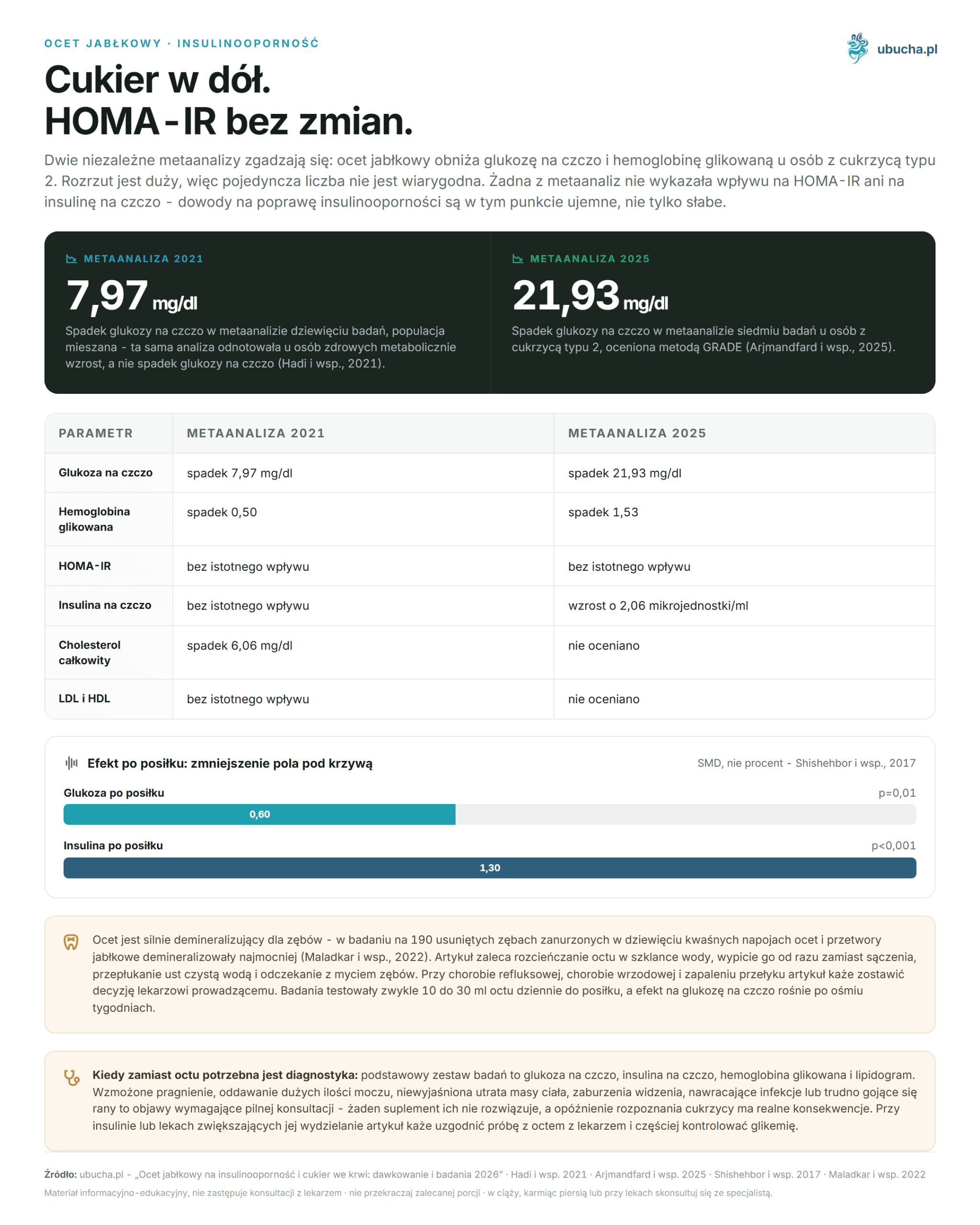
• Apple cider vinegar lowers fasting glucose: a meta-analysis of nine studies reports 7.97 mg/dl, while a newer analysis of seven studies in people with type 2 diabetes reports 21.93 mg/dl. The range is large, so a single number is not reliable.
• Neither of these two meta-analyses showed an effect of vinegar on HOMA-IR or on fasting insulin.
• The best-documented effect pertains to a single meal: vinegar reduces the area under the glucose and insulin curve after a carbohydrate meal.
• The doses studied are usually 10 to 30 ml per day, taken with meals; the effect on fasting glucose increases after eight weeks.
• Vinegar is strongly demineralizing for teeth. Dilute it and do not hold it in your mouth.
• Vinegar does not replace treatment. With abnormal glucose, diagnostics are needed, not a supplement.
What is insulin resistance and how is it diagnosed?
Insulin resistance is a state in which muscles and the liver, as well as adipose tissue, respond poorly to insulin. The pancreas compensates for this by increasing hormone secretion, so for a long time, glucose remains normal, while insulin levels rise. Therefore, insulin resistance can be invisible in a basic blood sugar test and only shows up when insulin is measured.
In clinical practice, the HOMA-IR index is used, which converts fasting glucose and insulin into a single value. Thresholds vary between laboratories, and the index itself is a population tool, not a verdict. A diagnosis is made by a doctor, taking into account waist circumference, blood pressure, lipid profile, as well as family history, and not a single result from an online calculator.
This note about HOMA-IR is significant for the entire text. This is the parameter that most often appears in promises regarding apple cider vinegar, and it is precisely this that the two largest meta-analyses did not address. If you are looking for an intervention that will lower HOMA-IR, the evidence for vinegar is negative at this point, not just weak.
Symptoms reported by patients are nonspecific: drowsiness after starchy meals, difficult-to-reduce abdominal fat, cravings for sweets a few hours after eating. None of these confirm a diagnosis on their own, as each also occurs with sleep deprivation, hypothyroidism, and ordinary protein deficiency in the diet. If you recognize this set in yourself, the appropriate step is a blood test, not ordering a supplement. We discuss other compounds studied in this indication in the text about inositol in PCOS and insulin resistance.
How does apple cider vinegar affect glucose after a meal?
The best-described effect of vinegar does not pertain to daily blood sugar control, but to a single meal. A systematic review with a meta-analysis from 2017 gathered studies measuring postprandial glycemia and showed a significant reduction in the area under the glucose curve, with a standardized mean difference of 0.60 (95% CI from 1.08 to 0.11, p=0.01), and an even more pronounced reduction in the area under the insulin curve, 1.30 (95% CI from 1.98 to 0.62, p<0.001) (Shishehbor et al., 2017, PMID 28292654).
Note how these results are presented. These are standardized mean differences, not percentages. The popular phrasing about a reduction in postprandial glycemia by 20 to 30 percent does not come from this work and cannot be derived from it, as the authors do not report the result in that form at all.
As for the mechanism, a review from 2014 outlines several proposed pathways: delayed gastric emptying and slower intestinal absorption, inhibition of hepatic glucose production, increased glucose utilization in tissues, and effects on satiety and energy expenditure. However, the authors conclude with a clear caveat that large, long-term studies with impeccable methodology are needed before formulating health claims (Petsiou et al., 2014, PMID 25168916). These are working hypotheses, not an established mechanism.
One claim must be directly refuted here. In texts about apple cider vinegar, it is repeated that acetic acid activates AMPK, the same pathway as metformin. In none of the studies involving humans cited in this article is such a measurement present. The comparison to metformin is a rhetorical figure added to studies that measured something else.
What do meta-analyses show about apple cider vinegar on blood sugar?
There are two available aggregate analyses, and it is worth comparing them side by side, as they differ in the scale of results to such an extent that this difference itself is informative. The first included nine studies in ten arms, in a mixed population. The second was limited to individuals with type 2 diabetes and assessed the certainty of evidence using the GRADE method, encompassing seven studies.
| Parameter | Meta-analysis 2021, 9 studies | Meta-analysis 2025, 7 studies, type 2 diabetes |
|---|---|---|
| Fasting glucose | decrease 7.97 mg/dl (95% CI 13.74 to 2.21) | decrease 21.93 mg/dl (95% CI 29.19 to 14.67) |
| Glycated hemoglobin | decrease 0.50 (95% CI 0.90 to 0.09) | decrease 1.53 (95% CI 2.65 to 0.41) |
| HOMA-IR | no significant effect | no significant effect |
| Fasting insulin | no significant effect | increase by 2.06 micro-units/ml |
| Total cholesterol | decrease 6.06 mg/dl | not assessed |
| LDL and HDL | no significant effect | not assessed |
The discrepancy is threefold for fasting glucose and threefold for glycated hemoglobin. This arises from a different selection of the population: the second analysis included only individuals with diagnosed type 2 diabetes, in whom there is simply more to lower. Presenting one of these numbers as a universal value for apple cider vinegar is an abuse in both directions (Hadi et al., 2021, PMC8243436; Arjmandfard et al., 2025, PMC11821484).
There is also a result that rarely makes it into guides. In the 2021 analysis, in metabolically healthy individuals, vinegar was associated with an increase, not a decrease, in fasting glucose. If your results are normal, there is no basis to expect any improvement from vinegar. A broader discussion of these works can be found in the post about apple cider vinegar and diabetes and glycemia.
Does apple cider vinegar improve insulin sensitivity and HOMA-IR?
At the level of the laboratory index, there is no evidence. Both meta-analyses checked HOMA-IR and both found no significant effect, despite differing in population selection and doses, as well as the number of studies included. The agreement of two independent analyses on a negative point is a stronger indication than agreement on a positive point, as it is harder to explain by chance.
The newer one also noted an increase in fasting insulin of 2.06 micro-units per milliliter. This is the opposite direction of what is expected with improved insulin sensitivity, and another reason not to describe vinegar as a remedy for insulin resistance in the strict sense.
So where does the popular claim of a 34 percent improvement in insulin sensitivity come from? It originates from a two-page report from 2004, whose title indeed speaks of improved insulin sensitivity after a high-carbohydrate meal in individuals with insulin resistance or type 2 diabetes (Johnston, Kim, and Buller, 2004, PMID 14694010). The work exists and is on topic, but it is a short report from over twenty years ago on a small group. The specific percentages attributed to it in Polish guides could not be confirmed in the available description of the study, so we do not repeat them here.
Closer to the tissue mechanism are two Greek studies from 2015. In an eleven-person group with type 2 diabetes, vinegar increased glucose uptake by the forearm muscles (p=0.0357) and reduced postprandial glucose and insulin, as well as triglycerides (Mitrou et al., 2015, PMC4438142). The second, in eight individuals with impaired glucose tolerance, yielded a similar picture (PMID 25626409). Both groups consisted of fewer than twelve individuals, and the measurement was conducted using the arteriovenous difference method with plethysmography, not a metabolic clamp with isotopic labeling.
Does apple cider vinegar affect cholesterol and triglycerides?
Insulin resistance is usually accompanied by lipid disorders, so the question about cholesterol arises almost always in conjunction with the question about sugar. Here, the data is narrower, as only the older of the two meta-analyses assessed lipids, but it is clear regarding direction and scale.
The 2021 analysis showed a significant decrease in total cholesterol by 6.06 mg/dl. At the same time, it found no significant effect on LDL or HDL fractions. This is an important distinction, as vinegar is often described in guides as a means of raising good cholesterol, which the aggregate analysis does not confirm.
The effect on lipids turned out to be conditional. Significant reductions in total cholesterol and triglycerides were observed in subgroups: in individuals with type 2 diabetes, in those taking no more than 15 ml of vinegar per day, and with use longer than eight weeks. Outside of these conditions, the aggregate result diluted.
The scale of this change also deserves comment. A decrease in total cholesterol of 6 mg/dl is statistically significant but clinically small: it is an order of magnitude that for many individuals falls within the natural variation between two measurements in the same laboratory. It is not a basis for discontinuing lipid-lowering treatment or for giving up lipid profile monitoring.
It is also worth noting what was not included in this analysis. The authors excluded studies shorter than two weeks and those in which vinegar was combined with other interventions. This makes the result cleaner, but narrows it down to vinegar alone and says nothing about the effects that can be expected with simultaneous dietary changes or the introduction of exercise. In practice, most people change several things at once, so attributing improvement solely to vinegar is then unjustified.
What dosage of apple cider vinegar is supported by research?
The studies included in the aggregate analyses most commonly used from 10 to 30 ml of vinegar per day, taken with meals. The 2025 analysis calculated the dose-response relationship and stated that each additional milliliter per day was associated with a decrease in fasting glucose of 1.255 mg/dl, with clearer effects observed above 10 ml per day.
However, the dose-response relationship is not a simple increasing line and does not authorize increasing portions indefinitely. In the 2021 analysis, a more favorable impact on total cholesterol and triglycerides was observed in the subgroup taking 15 ml per day or less, which is in the lower part of the studied range. The upper safety limit was not established in these works, as that was not their task.
However, the condition of time is clearer. A significant decrease in fasting glucose appeared in the subgroup of studies lasting longer than eight weeks. Shorter interventions primarily measured the response to a single meal. Therefore, if you plan to check the effect of vinegar on your own results, a reasonable horizon is at least two months, not a week.
The timing of intake directly follows from the design of the studies: vinegar was administered with meals or directly before them, as the response to that specific meal was measured. The popular practice of drinking vinegar in the morning on an empty stomach does not correspond to any of these protocols, so there is no support for it in the results described above.
Separately, it is worth mentioning the form. The studies on which this article is based were conducted on liquid vinegar, administered diluted with meals. We did not find any work involving humans that would check whether gummies, capsules, or powder from vinegar provide the same metabolic effect as a measured portion of liquid. Manufacturers convert the content into milligrams of extract, but this conversion is not proof of equivalence, as the effect is determined by the amount of acetic acid reaching the digestive tract along with the meal.
The practical conclusion is that dosing based on research can only be replicated with liquid vinegar, where milliliters are measurable. With other forms, you move outside the range that anyone has measured, and there is no basis to assume that the effect will be the same.
Does apple cider vinegar harm teeth and the esophagus?
The acidity of vinegar is a real problem, and this is an area where the evidence is strong. In a laboratory study on 190 extracted human teeth immersed in nine acidic beverages for periods from 12 to 96 days, vinegar and apple products caused the greatest demineralization, surpassing fruit juices and soft drinks (Maladkar et al., 2022, PMC9683876).
It must be stated directly what this study was. Teeth were immersed in liquid for many days, outside the oral cavity, without saliva and without its buffering capacity. The conditions are much harsher than when drinking diluted vinegar with a meal, so the result cannot be translated to the rate of enamel loss in humans. The number repeated online stating a 15 to 20 percent decrease in enamel hardness over three months in humans does not come from this work or any other that we could verify.
However, the direction remains clear, and the authors formulate practical recommendations based on it: limit the frequency of consumption and the time of contact of the beverage with teeth, and after consumption, use rinses and buffering agents. This translates into simple rules. Dilute vinegar in a glass of water, drink it all instead of sipping, rinse your mouth with clean water, and wait before brushing your teeth.
Separate caution is warranted for the upper gastrointestinal tract. In cases of reflux disease, peptic ulcer disease, and esophagitis, acidic liquid may exacerbate symptoms, so in these diagnoses, it is wise to leave the decision to try it to the attending physician. We expand on this topic in the text about apple cider vinegar for reflux and heartburn.
Can apple cider vinegar replace metformin or other medications?
No, and this is not a matter of a cautious formulation, but of magnitude. Vinegar acts most strongly on the response to a single meal, and its effect on long-term parameters is uncertain in scale, as indicated by the discrepancy between the two meta-analyses. Treatment of type 2 diabetes is based on pharmacotherapy tailored to the degree of control, diet, and physical activity, not on an addition to lunch.
We also did not find any work involving humans that directly compared apple cider vinegar with metformin. All comparisons of the two agents circulating in guides are comparisons of results from separate studies with different populations and endpoints. Such indirect arithmetic does not justify a conclusion about interchangeability.
Caution is, however, justified when combining. Since vinegar lowers glucose after meals, and the newer analysis noted an increase in fasting insulin, in individuals taking insulin or medications that increase its secretion, it is reasonable to coordinate the trial with a physician and monitor glycemia more frequently at the beginning. We do not have data that would allow us to assess the frequency of hypoglycemia in such combinations, so this is a recommendation based on pharmacology, not measured risk.
Discontinuing medication in favor of vinegar is a decision of a different weight than adding vinegar to treatment. In the first case, you are giving up therapy with proven effectiveness in favor of an intervention whose effect on long-term parameters is uncertain, and on the insulin resistance index itself, zero. The consequences of uncontrolled diabetes accumulate over years and do not give early symptoms, so the lack of immediate deterioration in well-being after discontinuing medication is not a signal that the decision was safe.
If you are looking for other substances studied in this context, we separately describe berberine and its comparisons with metformin. The same principle applies there: a supplement is not a substitute for a drug, even if the mechanism sounds similar.
When is diagnostics needed instead of supplementation?
Apple cider vinegar is a dietary supplement, not a diagnostic tool, and does not change the course of a disease that has not been diagnosed. If you suspect carbohydrate metabolism disorders, the proper order is first testing, then a conversation with a doctor, and only at the end, possible dietary supplements.
The basic set, from which evaluation usually begins, includes fasting glucose, fasting insulin, glycated hemoglobin, and lipid profile. Interpretation is up to the doctor, as the thresholds for diagnosing prediabetes and diabetes are established in guidelines and change management, not just the description of the result.
There are also situations where delaying is risky. Increased thirst, urinating large amounts, unexplained weight loss, vision disturbances, recurrent infections, or slow-healing wounds are symptoms requiring urgent consultation. No supplement resolves them, and delaying the diagnosis of diabetes has real consequences.
A separate reason to talk to a doctor is taking medications regularly. This especially concerns antidiabetic medications, but also any situation where you plan to introduce an acidic liquid into your daily diet with a chronic illness. A consultation is brief but allows you to avoid resolving on your own questions that studies on vinegar simply do not answer.
It is also worth remembering the proportions. The effects attributed to vinegar in studies are smaller than those provided by weight reduction, regular physical activity, and sleep regulation. If any of these areas require work on your part, that is where the greater part of possible improvement lies, regardless of whether you reach for vinegar.
What have studies on apple cider vinegar not checked?
An honest picture of the evidence also includes its limits, and with apple cider vinegar, these limits are wide. The following gaps do not mean that something is harmful or ineffective. They mean that no one has measured it, so no claim in either direction has support.
First, there is no study directly comparing apple cider vinegar with an antidiabetic drug in the same patients. All such comparisons arise from juxtaposing results from separate studies with different endpoints, which does not allow for a conclusion about interchangeability.
Second, the length of observation. Aggregate analyses included studies lasting from two weeks to several months. They say nothing about the effects of daily vinegar consumption for a year or longer, and this is how vinegar is often used by individuals who consider it a permanent element of their diet.
Third, the size of the studies. Mechanistic works, which most guides refer to, were conducted on groups of eight and eleven individuals. Aggregate analyses included seven and nine studies. These are numbers where a single new work can clearly shift the final result, and partially explain why both meta-analyses provide such different values for the same parameters.
Fourth, populations. We did not find data regarding pregnant and breastfeeding women or children. We also did not find studies allowing the assessment of the frequency of hypoglycemia when combining vinegar with insulin or medications that increase its secretion. Repeated warnings online about lowering potassium and affecting bone density are based on single case reports with very high consumption, not on studies of the doses discussed in this article. They are not therefore untrue, but it is impossible to calculate the risk for a person drinking 15 ml of vinegar with lunch.
How to use apple cider vinegar for eight weeks and what to measure?
If after the above caveats you want to check the effect of vinegar on yourself, the only sensible way is a planned trial with measurement before and after. Without a baseline test, it is impossible to distinguish the effect of vinegar from changes in diet, sleep, or activity, which usually accompany such resolutions.
The time frames result from what the aggregate analyses showed: a significant decrease in fasting glucose appeared in studies lasting longer than eight weeks, so a shorter trial resolves nothing.
- Before starting, perform fasting glucose and insulin as well as glycated hemoglobin, preferably in the same laboratory.
- Start with 10 ml of vinegar diluted in a glass of water, taken with the main carbohydrate meal.
- After a week of good tolerance, you can increase to 15 to 20 ml per day, remaining in the lower part of the range studied in lipid works.
- Do not exceed 30 ml per day and do not divide the dose into more than two meals.
- After eight to twelve weeks, repeat the same tests in the same laboratory.
- Stop earlier if you experience burning in the esophagus, nausea, or increased heartburn.
Interpret the result cautiously. Glycated hemoglobin reflects about three months, so in an eight-week trial, it will only partially respond. If the parameters did not budge, that is information consistent with what could be expected from the data described above, not proof that you did something wrong.
Also, ensure that the trial remains a trial of a single variable. If you introduce a new diet and exercise along with vinegar, after eight weeks you will not be able to say what worked. This is how the studies included in the 2021 analysis were constructed, where works combining vinegar with other interventions were rejected, and for the same reason, it is worth repeating this principle for yourself.
There is also no reason to treat the trial as an obligation. Apple cider vinegar does not build any reserves in the body whose loss would be costly, so discontinuing it after an unsuccessful trial does not require tapering off or a transition period. You simply stop.
Frequently Asked Questions
Does apple cider vinegar lower blood sugar?
Yes, but the range is uncertain. A meta-analysis of nine studies reports a fasting glucose reduction of 7.97 mg/dl, while a newer analysis of seven studies in people with type 2 diabetes reports 21.93 mg/dl. The effect is best documented for a single carbohydrate meal.
Does apple cider vinegar improve HOMA-IR?
No, according to available evidence. Two independent meta-analyses assessed HOMA-IR and neither found a significant effect of apple cider vinegar on this indicator. The newer one additionally noted an increase in fasting insulin, which is the opposite direction expected with improved insulin sensitivity.
How much apple cider vinegar was used daily in studies?
Most commonly from 10 to 30 ml per day, taken with meals. A dose-response analysis indicated clearer effects above 10 ml per day, while a more favorable impact on lipids was observed in the subgroup taking 15 ml per day or less. The upper safety limit was not established in these studies.
When to drink apple cider vinegar: on an empty stomach or with meals?
With meals or directly before them, as it was administered in studies measuring glycemic response. Drinking vinegar in the morning on an empty stomach does not correspond to any of these protocols, so the results described in this article cannot be transferred to such a method of use.
How long does it take to see the effects of apple cider vinegar?
The response to a single meal is immediate and has the strongest support. A significant decrease in fasting glucose, however, appeared only in studies lasting longer than eight weeks, so a trial shorter than two months does not resolve anything about fasting parameters.
Does apple cider vinegar damage tooth enamel?
In a laboratory study on extracted teeth, vinegar caused the greatest demineralization among nine acidic beverages. The conditions were much harsher than in the oral cavity, but the direction is clear. Dilute the vinegar, do not hold it in your mouth, rinse with water, and wait before brushing your teeth.
Can apple cider vinegar replace metformin?
No. There is no study involving humans directly comparing apple cider vinegar with metformin, and the effect of vinegar on long-term parameters is uncertain in scale. Any changes in diabetes pharmacotherapy are determined by the attending physician, never undertaken independently.
Can a healthy person benefit from apple cider vinegar?
There is no evidence. In a 2021 meta-analysis, in metabolically healthy participants, vinegar was associated with an increase, not a decrease, in fasting glucose. The effects described in this article pertain to individuals with carbohydrate metabolism disorders and do not transfer to those with normal results.
Apple cider vinegar for daily use can be found in the supplements category.
This article is for informational and educational purposes only and does not constitute medical advice. Before starting supplementation, consult with a doctor, especially if you are taking medications regularly, are pregnant or breastfeeding, or have a chronic illness.
Author: Michał Waluk · Published: 2026-05-11 · Updated: 2026-08-10