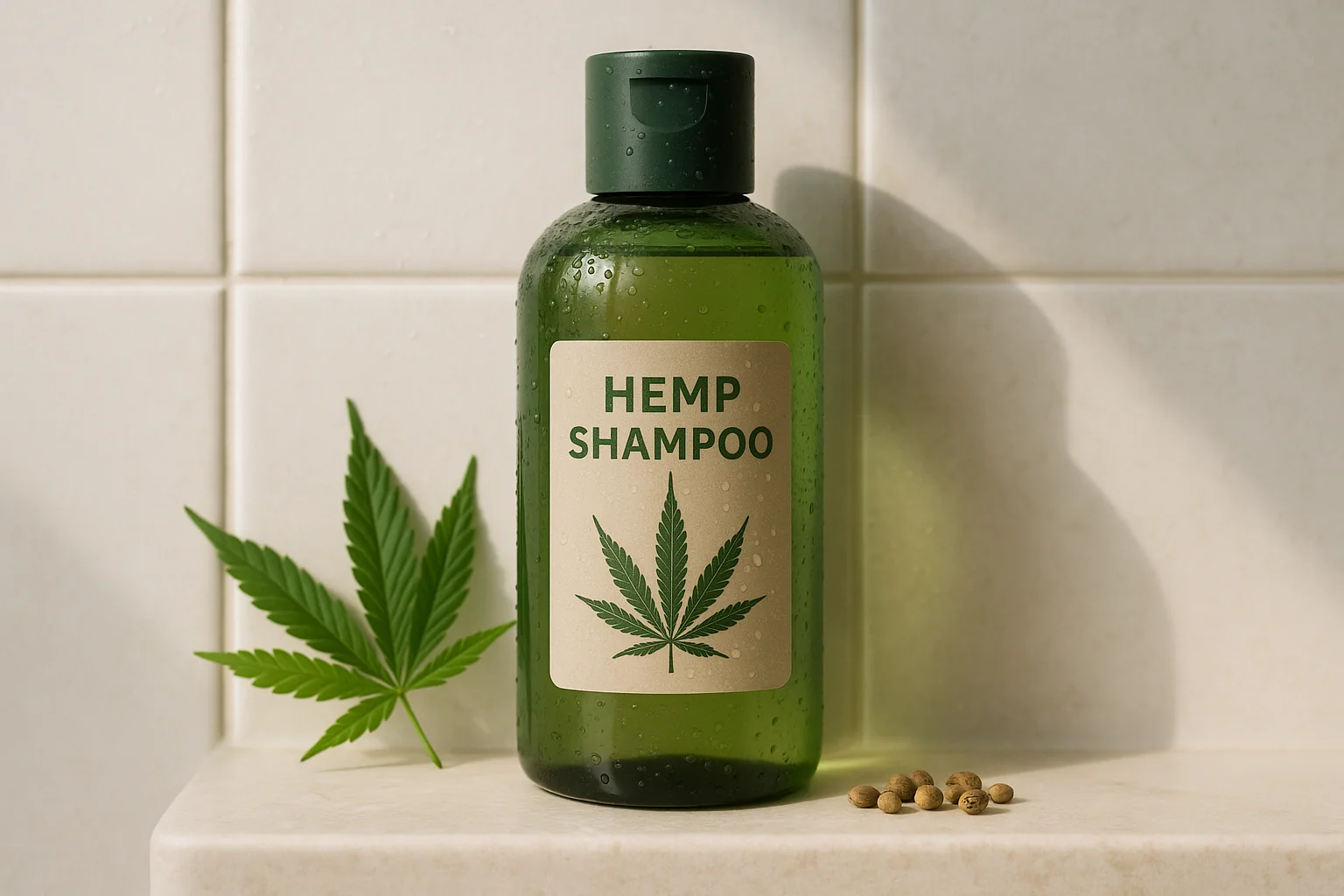

Hemp Shampoo: Properties for Hair Loss and Does Hemp Really Help
Hemp shampoo and hair loss, dandruff, and dry scalp. What research shows about hemp seed oil and cannabinoids, and what it does not show.
Hemp shampoos have taken the shelves of drugstores along with promises: strengthens, prevents hair loss, rebuilds the scalp. We checked what is backed by research. The result is less marketing than the label, and in one place, it is even the opposite. Studies that actually measured the impact of cannabinoids on human hair follicles showed inhibition of hair growth, not stimulation. Hemp seed oil, on the other hand, has solid backing where the problem lies in the scalp itself: with dryness and irritation. Below, we separate these two layers, show which type of hair loss hemp shampoo changes anything, and suggest what to check on the label before you pay for a trendy ingredient.
KEY INFORMATION
• Hemp seed oil consists of over 80% polyunsaturated fatty acids, and the omega-6 to omega-3 ratio is usually from 2:1 to 3:1 (Callaway, Euphytica, 2004).
• In cultured human hair follicles, cannabinoids inhibited hair elongation and shortened the growth phase (Telek et al., FASEB Journal, 2007).
• Hemp shampoo does not act on the cause of androgenetic alopecia.
• You rinse the shampoo after a few minutes, so the contact of the ingredients with the scalp is short.
What does hemp shampoo contain and how does it work on the scalp?
Hemp shampoo is based on one of two ingredients: hemp seed oil (listed in the INCI as Cannabis sativa seed oil) or hemp extract with cannabidiol. They are not the same. Hemp seed oil does not contain cannabinoids and acts as an emollient, providing lipids to the scalp. The CBD extract targets the receptors of the endocannabinoid system.
The composition of the oil itself is well described. Callaway in the review of the nutritional value of hemp seeds states that the oil consists of over 80% polyunsaturated fatty acids, and the omega-6 to omega-3 ratio usually falls within the range of 2:1 to 3:1 (Callaway, Euphytica, 2004). Among them is gamma-linolenic acid, rare in plant oils. The exact percentage values for individual acids circulating on labels change with the variety and method of pressing, so treat them as orientation, not specification.
That the skin has its own endocannabinoid system was described in a review by Bíró’s team. Cannabinoid receptors and enzymes of this pathway have been found in skin cells and its appendages, including hair follicles and sebaceous glands, and disruption of this balance is associated with acne, seborrhea, and hair growth disorders (Bíró et al., Trends in Pharmacological Sciences, 2009). This is a review, not a clinical study, and speaks of the existence of a mechanism, not the effectiveness of a cosmetic.
There is also a limitation of the carrier that manufacturers remain silent about. The shampoo stays on the scalp for one to three minutes, after which it is rinsed off. Products that remain on the hair, such as conditioners or scalp oils, have dozens of times more time for penetration. The difference between the oil itself and the extract is separately discussed in the entry hemp oil for hair and scalp.
Does hemp shampoo help with hair loss?
It depends on why the hair is falling out, as under one term there are several different conditions. For dry and irritated scalp, hemp shampoo improves the environment in which hair grows. For androgenetic alopecia, it does nothing about the cause, as it is hormonal. The table below organizes the most common cases.
| Type of Hair Loss | What is the Cause | What to Expect from Hemp Shampoo |
|---|---|---|
| Androgenetic Alopecia | Sensitivity of follicles to dihydrotestosterone | No effect on the cause; only scalp care |
| Telogen Effluvium | Stress, illness, deficiencies, hormonal changes | Supporting role; the problem is systemic and returns to the cause |
| Hair Loss with Dry and Irritated Scalp | Damaged lipid barrier, inflammatory state | Here it makes sense: hydration and less irritation |
| Alopecia Areata | Autoimmune background | No data; a matter for a dermatologist |
What the descriptions of shampoos do not mention: what has been measured on human hair follicles goes the other way. The Telk team cultured human follicles from the scalp and administered anandamide and THC to them. Both, depending on the dose, inhibited hair shaft elongation, limited keratinocyte divisions in the matrix, and prematurely introduced the follicle into the regression phase, and the effect was reversed by a CB1 receptor antagonist (Telek et al., FASEB Journal, 2007). The authors state directly that it is rather CB1 antagonists that could counteract hair loss. This is not a study of CBD or shampoo, but it shows that the slogan “cannabinoids stimulate hair growth” has no measurement behind it.
What does hemp shampoo really do for hair and scalp?
Aside from the hair loss issue, there is care, and here it is honest. Hemp seed oil brings lipids to the stratum corneum of the scalp and to the hair cuticle, and its gamma-linolenic acid has one study behind it in people with dry skin. Effects are evaluated over weeks, not after one wash.
| Effect | What it Involves | When to Evaluate |
|---|---|---|
| Less Dryness | Supplementing lipids of the epidermal barrier | After 2-4 weeks |
| Calmer Oiliness | Gentler cleansing base instead of strong detergents | After 3-4 washes |
| Smoothness and Shine | Lipids smooth the cuticle scales | Immediately after washing |
| Less Flaking | Rebuilding the barrier reduces micro-irritations | After 4-6 weeks |
Evidence for gamma-linolenic acid comes from a nutritional study, not a cosmetic one. Kawamura and colleagues provided adults with dry skin and mild atopic dermatitis with food enriched with this acid and noted an improvement in the transepidermal water loss rate, more pronounced in individuals with inflammatory features (Kawamura et al., Journal of Oleo Science, 2011). Transferring this result to a rinsed shampoo is an assumption, not a conclusion from the work.
Another matter is dandruff. Both dandruff and seborrheic dermatitis are associated with Malassezia yeasts, and hemp oil has no documented antifungal action. If flaking is due to dryness and irritation, hemp shampoo may limit it. If accompanied by redness and recurrences, a product with an antifungal agent, such as ketoconazole or zinc pyrithione, is needed.
How to choose a good hemp shampoo?
The composition decides, not the graphics on the bottle. Three things can be checked in the store in a minute: where on the INCI list the hemp oil stands, what detergent opens the composition, and whether the manufacturer even declares the content of the extract. The rest of the promises on the label are unverifiable.
Ingredients in INCI are listed in descending order according to content. If Cannabis sativa seed oil appears in the first half of the list, there is a real amount of it. If it is at the very end, behind preservatives and colorants, its share is trace and serves a marketing function. The same principle applies to any trendy ingredient, not just hemp.
The cleansing base determines whether the oil has anything to do. An aggressive detergent removes so much sebum from the scalp that the addition of oil does not compensate for it. For sensitive skin, look for gentler surfactants like sodium lauroyl sarcosinate or coco-glucoside and avoid formulas opened with a strong sulfate. Healthy scalp has a slightly acidic pH, so a shampoo with a pH around 5 is a safer choice than an alkaline one, although this value is rarely provided on the packaging.
For products with hemp extract, the question is simply: how much is there. The label “hemp extract” or “Cannabis sativa flower extract” without the stated cannabidiol content does not allow for any comparison between products. The absence of this number is information in itself.
We noticed while browsing descriptions that the most frequently repeated slogan is the hypoallergenicity of hemp oil. The oil itself indeed rarely causes allergies, but the shampoo contains several ingredients, and reactions are most often triggered by fragrance compositions and preservatives. If you have reactive skin, a patch test on a small area of forearm is cheaper than a discarded bottle.
Does hemp shampoo make sense alongside treatment for androgenetic alopecia?
It does, but only as care, and this is not a decision that should be made by an article. Androgenetic alopecia is a medical diagnosis, and the medications used to treat it can be irritating to the scalp. The selection of the product, its concentration, and the order of application should be left to a doctor or trichologist, not to a cosmetic description.
What hemp shampoo can contribute to such care is narrow and predictable: gentler washing and supplementation of lipids in dry scalp. It does not replace treatment, does not accelerate it, and does not change its outcome. Treating it as the only intervention in the progressive retreat of the hairline usually ends in disappointment after a few months.
From our experience, the most costly scenario is precisely this one. A person who counts on a cosmetic for a quarter instead of going to a dermatologist loses not money, but time, and in androgenetic alopecia, time works against the follicles. The signal at which it is worth scheduling a visit is simple: hair is thinning in a repetitive pattern, not evenly across the entire head. What supplementation deals with in this context and where its limits lie is discussed in the entry supplements for hair loss.
Frequently Asked Questions
Does hemp shampoo help with hair loss?
It depends on the cause. For dry and irritated scalp, it improves the environment for hair growth. For androgenetic alopecia, it does not address the cause, as it is hormonal. It is worth knowing that cannabinoids applied to cultured human hair follicles inhibited hair growth (Telek et al., FASEB Journal, 2007), so the promise of hair growth is unfounded.
What does hemp shampoo contain?
Either hemp seed oil or hemp extract with cannabidiol, sometimes both. Hemp seed oil does not contain cannabinoids and consists of over 80% polyunsaturated fatty acids, with an omega-6 to omega-3 ratio usually from 2:1 to 3:1 (Callaway, Euphytica, 2004). Hemp extract works differently, through receptors in the skin.
Is hemp shampoo good for dandruff?
Only if the flaking is due to dryness and irritation. Dandruff and seborrheic dermatitis are associated with Malassezia yeast, and hemp oil has no documented antifungal action. In cases of recurrence and redness, a product with an antifungal agent and a dermatological consultation is needed.
How often should you use hemp shampoo?
As often as you wash your hair with regular shampoo. For dry skin, less frequently and with longer massaging before rinsing; for oily skin, more often, provided the formula is gentle. Evaluate the care effects after 4-6 weeks, as the scalp needs time to adapt to the new cleansing base.
Is hemp shampoo safe for sensitive scalps?
Hemp seed oil rarely causes allergies, but the shampoo contains several other ingredients, and reactions are most often triggered by fragrance compositions and preservatives. For reactive skin, test the product on a small patch of forearm. For severe skin changes on the scalp, make care decisions with a dermatologist.
What is the difference between hemp oil shampoo and CBD shampoo?
Hemp seed oil is a plant fat without cannabinoids and acts as an emollient. The extract with cannabidiol targets the endocannabinoid system of the skin, which was described in the review by Bíró et al. (Trends in Pharmacological Sciences, 2009). However, no one has measured the effectiveness of such a shampoo in a clinical study.
Hemp cosmetic products in the store at Bucha today include creams, serums, and body balms, collected in the cosmetics category; there is no hemp shampoo in this offer (as of August 15, 2026). The entire line is discussed in the entry Palacio hemp cosmetics.
This article is for informational and educational purposes. It contains internal links to product categories available in the store at Bucha. Prices and specifications may change: check the current data on the product page before purchasing.
Author: Michał Waluk · Published: 2026-06-22 · Updated: 2026-08-15